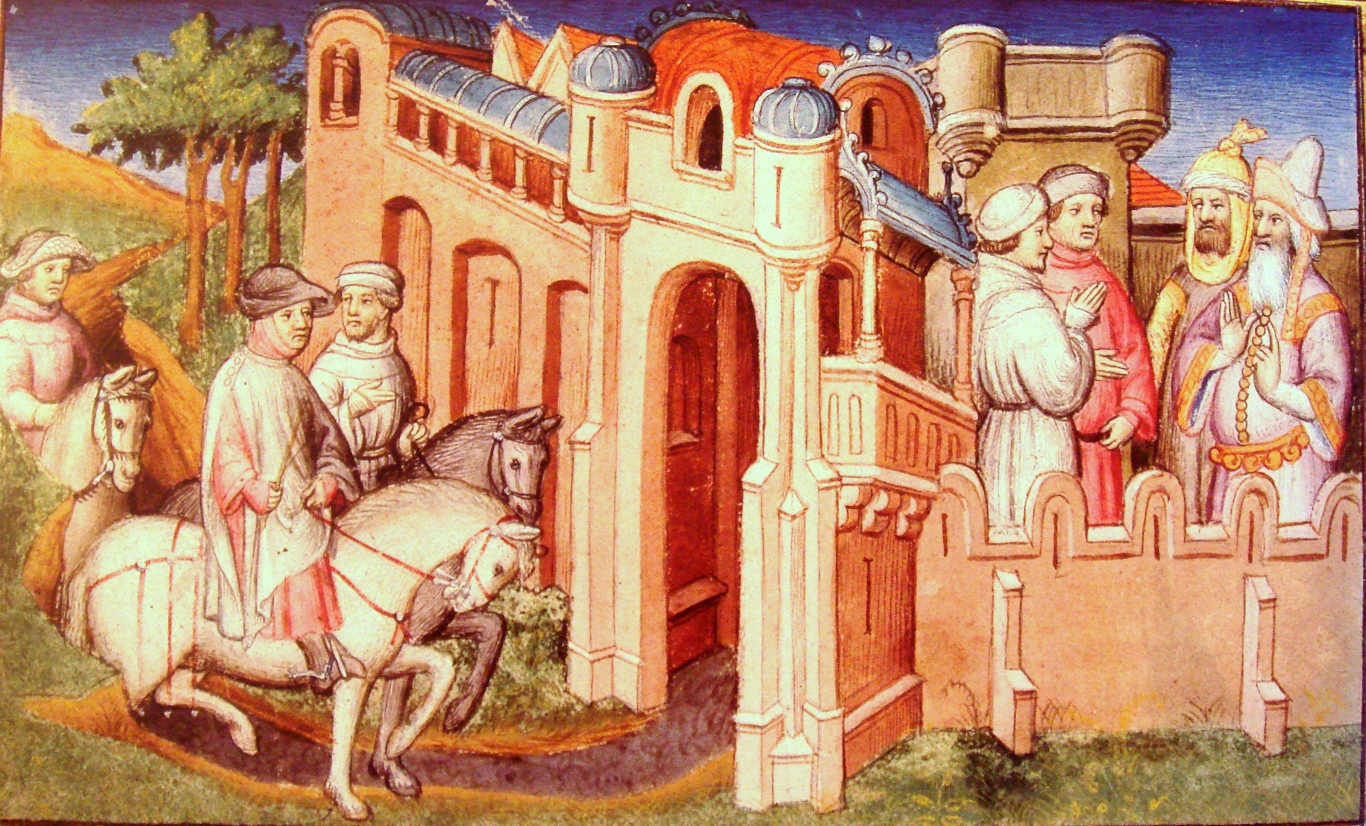
Niccolò and Maffeo in Bukhara, where they stayed for three years. They were invited by an envoy of Hulagu (right) to travel east to visit Kublai Khan. (Source: Wikipedia)
“Opium was the avenging daemon or alastor of Coleridge’s life, his dark or fallen angel, his experiential acquaintance with Milton’s Satan. Opium was for him what wandering and moral tale-telling became for the Mariner – the personal shape of repetition compulsion. The lust for paradise in ‘Kubla Khan,’ Geraldine’s lust for Christabel – these are manifestations of Coleridge’s revisionary daemonization of Milton, these are Coleridge’s countersublime. Poetic genius, the genial spirit itself, Coleridge must see as daemonic when it is his own rather than when it is Milton’s.” – Harold Bloom
This volume may be the epitome of indulgence, and the tone of Marc Scott Zicree, Guillermo del Toro’s interviewer – and effective co-writer in this endeavour – can come across as a bit sycophantic at times.
But really, a ‘cabinet of curiosities’ can’t help but be a gloriously indulgent exercise, and you don’t come here to read a sober dissection of del Toro’s life and filmography.
No, you come here to luxuriate in what is probably the ultimate ‘behind the scenes’ look into Del Toro’s oeuvre, as presented in a gorgeous coffee table edition crammed with photographs and studded with mini-essays by Del Toro’s friends and collaborators (the book is framed by tributes from James Cameron and Tom Cruise, respectively).
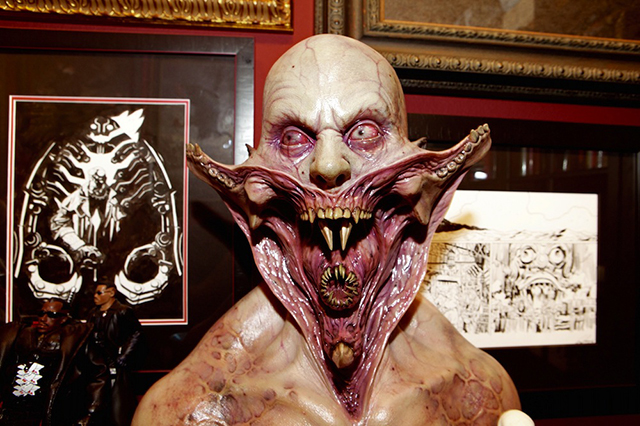
The book introduces us to Del Toro’s eclectic imaginative landscape with a bit of a tour of Bleak House – his second home and studio, which gives the book its organising principle, as the house itself is something of a cabinet of curiosities writ large – more than just a working space, it is arguably also the geeky man cave to end all geeky man caves.
Stuffed with original art and sculptures (some of them taking an extravagant bent, like the statue of Boris Karloff getting the final touches of his Frankenstein make-up done), each room in the house is themed around a particular genre or artistic milieu – like the ‘Steampunk Room’, the ‘Manga Room’…
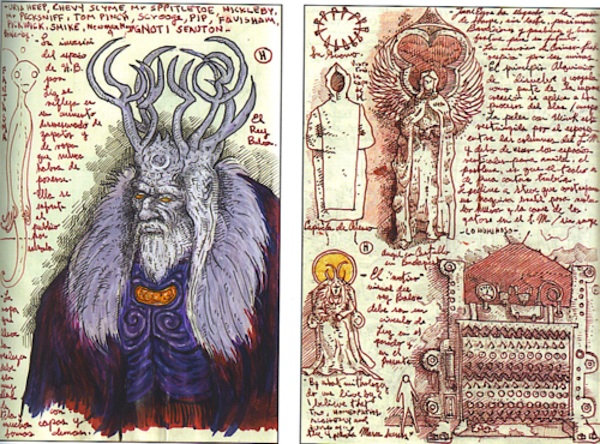
But above all, the ‘cabinet’ is really about del Toro’s colourful and frenzied notebooks, which the director has been keeping from the beginning of his career and which reveal the inner workings of his genre-melding chiaroscuro parables, from Cronos through the Hellboys and Pacific Rim.
The pages of the notebooks reproduced in the book often have a drawing at the centre – usually a portrait shot of a character in one of del Toro’s films, or a close-up of some grotesque prop or monster – which would be surrounded by (multi-lingua) marginalia. These notes will probably be the most pleasant discovery for a del Toro fan as they leaf through the book, revealing, as they do, the inner workings of the writer-director’s mind, often as he’s tackling and trying to figure out several projects at the same time: practical concerns (about props, costumes and loose story threads) jostle alongside philosophical musings and personal anecdotes.
As an extra, readers also get a glimpse into projects of del Toro’s that never came to fruition – an easy pitfall for a filmmaker with a tendency to multitask various media and juggle a number of projects at any given time.
The most prominent – or at least, the most recent and infamous – of these is of course del Toro’s – ultimately thwarted – adaptation of HP Lovecraft’s At the Mountains of Madness.
That project might just see the light of day, however, as del Toro recently announced that he’s cool with going for a PG-13 rated version of his film, under the wing of his recent collaborators Legendary Pictures (insisting on an R-rating proved to be the deal-breaker with the film’s previous studio-home-to-be, Universal).
But even before this announcement – which arrived some months after The Cabinet of Curiosities hit the shelves – hope already burned for a renewal of the project. “While this project we were so passionate about didn’t work out the first time round, I know that it’s going to happen one day,” Tom Cruise, who was set to star in At the Mountains of Madness (alongside Del Toro regular Ron Pearlman) writes in the Afterword to the ‘Cabinet’.
“Why? Because Guillermo will never stop creating, no matter what. He will keep at it against all odds. And when it finally happens, it will be infused with all the things that make a Guillermo del Toro movie so distinct and unforgettable: images, emotions, vistas, and characters that no one else creates.”
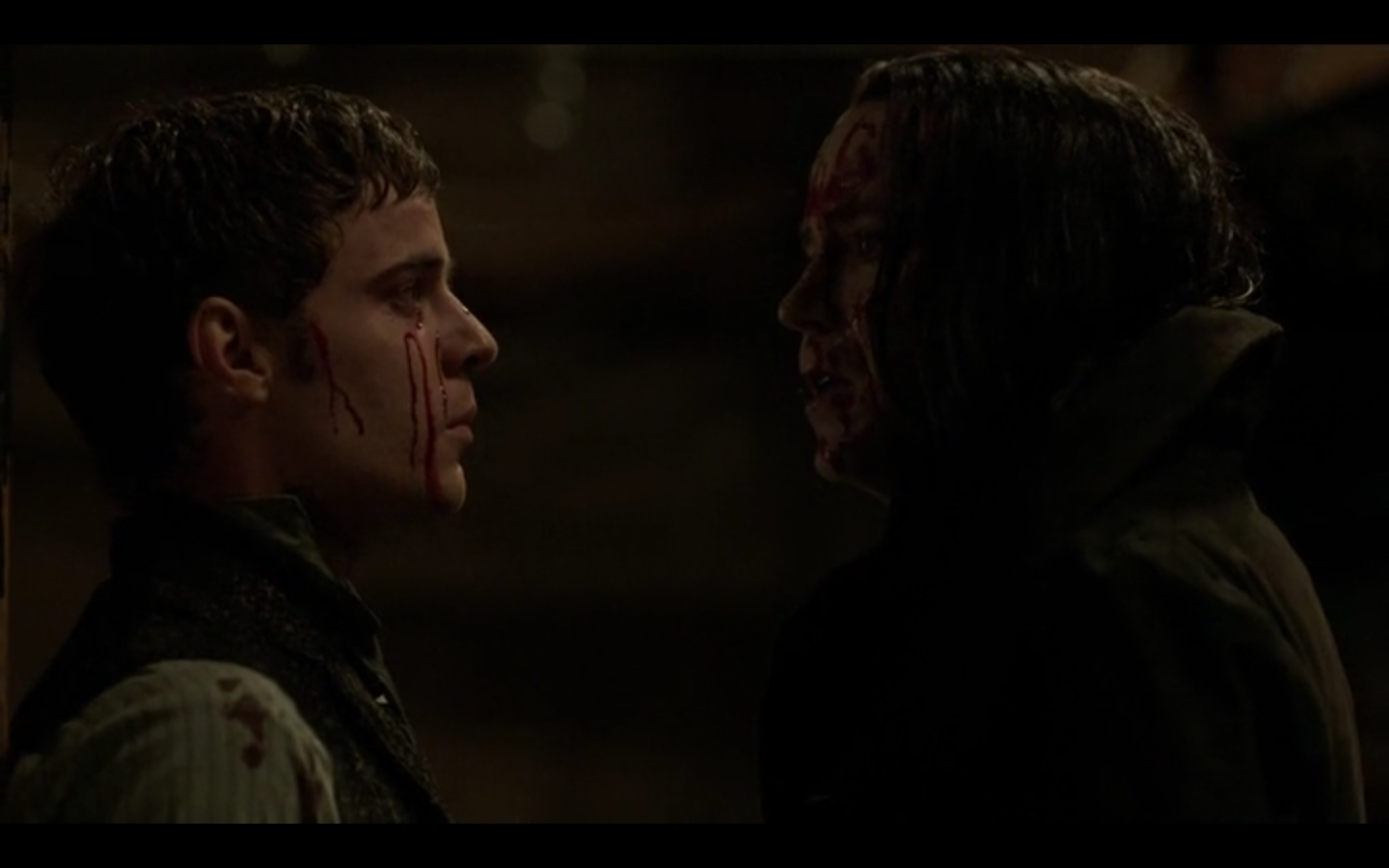
Victor Frankenstein (Harry Treadaway) and his Creature (Rory Kinnear) in Showtime’s Penny Dreadful (2014)
“By revealing that difference is arbitrary and potentially free-floating, mutable rather than essential, the monster threatens to destroy not just individual members of a society, but the very cultural apparatus through which individuality is constituted and allowed. Because it is a body across which difference has been repeatedly written, the monster (like Frankenstein’s creature, that combination of odd somatic pieces stitched together from a community of cadavers) seeks out its author to demand its raison d’être – and to bear witness to the fact that it could have been constructed Otherwise” – Jeffrey Jerome Cohen
Call it glorified procrastination (then again, what isn’t?) or a genuine pursuit of inspiration, but there are few things I love more than watching documentaries about creators I admire.
The release of Jodorowsky’s Dune (which my friend Marco incidentally nattered about on recently over at Schlock Magazine), coupled with the sad passing of HR Giger, made me think of this again, so I thought I’d compile a list of some of my favourites – all of which are thankfully available online.
I know I’ll be returning to this list every now and then for an inspiration top-up. Feel free to suggest any others I may have missed.
In Search of Moebius
The Mindscape of Alan Moore
Lovecraft: Fear of the Unknown
H.R. Giger Revealed
*
Incidentally, did some more nattering of my own, this time into the ears of the protean Maltese lifestyle web-hub, Malta Inside Out.
Standing with perfect symmetry at the centre of the frame, pop starlet Taylor Swift here embodies divine indifference.
Framed by two other ‘stages of man’ she stands as an aspirational vortex; a totemic reminder of what most of us want but cannot have.
The man to the left, jeans tattered, with the beaten-down expression familiar to so many ‘supporting characters’ in paintings by any number of the old masters, is on his way out: he has tried to scale heights but never managed to reach them, and it is clear that this dawns on him with fresh immediacy every waking day now – now, that he’s realised just how few of those days he has left.
To the right is his younger counterpart, his clothes clean-pressed and chosen with sensitivity to colour-coordination, the shades completing a look of sharp impersonality.
And in the middle stands the figure of Taylor Swift: even when disembodied away from the stage, from red carpet events and curated photo shoots, immaculately – because casually – beautiful, her pose strikingly Christ-like but free of any suffering.
Her weary gaze at the paparazzo; she’s so young and already so jaded by the mechanisms of the world – her world, not ours.
*
It’s easy to wrench deities and archetypes out of pop culture representatives, partly because they pitch themselves that way. In some sense they can’t help but do this: see how Taylor Swift, simply by standing in front of a gardening shop, lends an aura of something other than what meets the eye.
The thrill of recognition is of course at the heart of what makes celebrity culture tick: bumping into celebrities, even spotting them on the street, becomes a story worth retelling to friends and family; a memory to be cherished, even in this day and age, where the ubiquitous torrent of images of the same celebrities should be enough to make us entirely jaded.
But the thrill of recognising someone who is supposedly ‘important’ – or at least, special enough for us to separate them above ourselves, and even our peers – remains a key instinct, and it’s not just limited to ‘real’ people (though the layers of simulacra through which celebrities are often transmitted to us do complicate this substantially, I’ll admit).
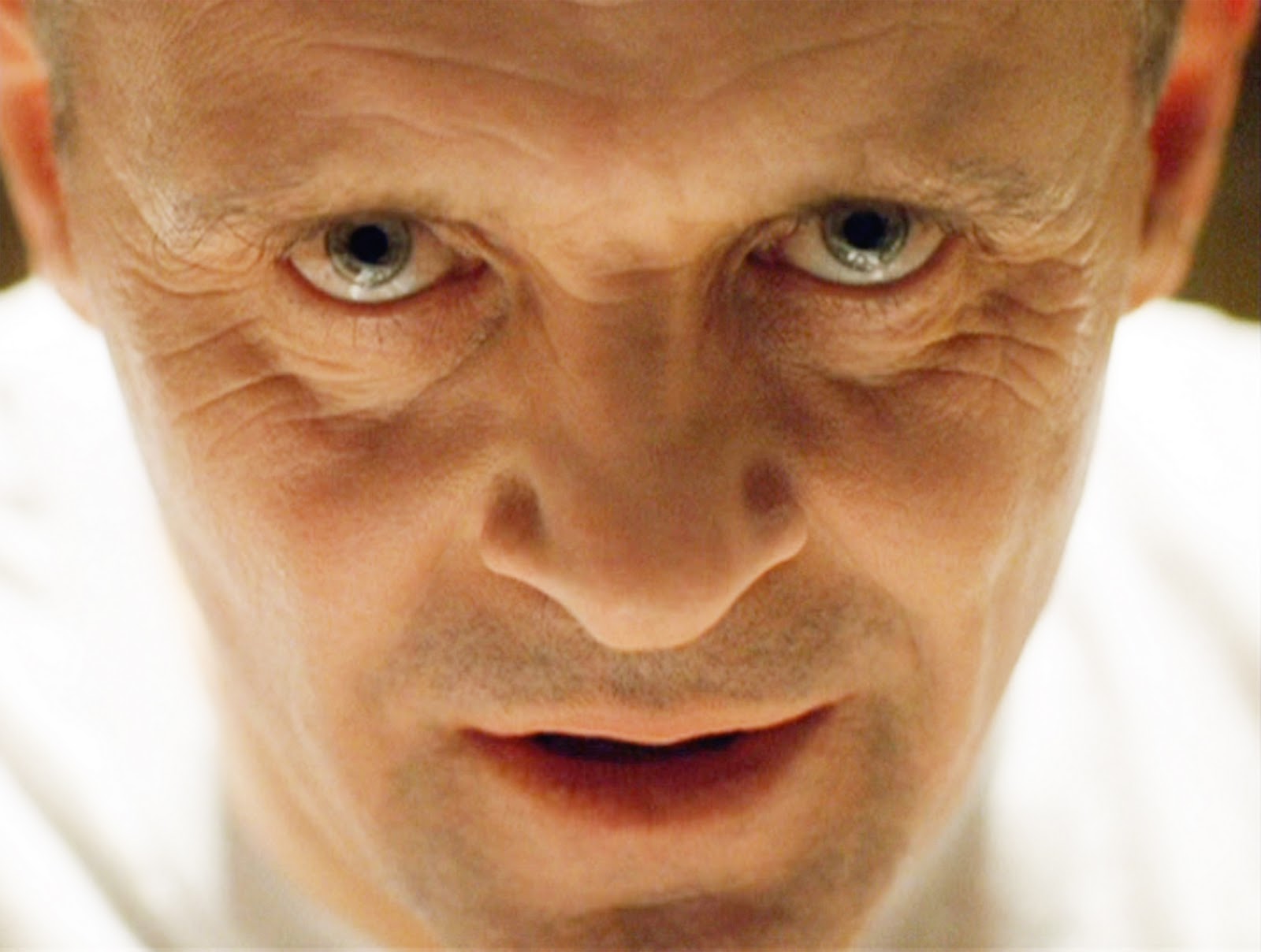
One such example – of a modern talismanic presence in fiction, I mean – is the figure of Hannibal Lecter. Originally a character in the bestselling Thomas Harris crime-horror trilogy of novels (Red Dragon, Silence of the Lambs and Hannibal), he has of course been elevated to the status of pop culture royalty thanks to his cinematic outing via Anthony Hopkins.
Anthony Hopkins as Hannibal Lecter in Silence of the Lambs (1991)
This was of course a career-defining performance, but it’s worth noting that the constituent elements making up Hannibal Lecter aren’t to be sniffed at. I wish I had a keener, more intuitive grasp of which literary factors, exactly, contributed directly to his creation. Perhaps it’ll serve as a research strand for another day, when I’m in a more industrious mood. Suffice to say that, whoever or whatever may have inspired Harris to breathe life into his archly horrific – and horrifyingly charming – figure, the fact remains that he has comfortably eclipsed them for quite some time, emerging as a trademark fictional character in his own right.
Hannibal Lecter is often citied as one of the great villains in the history of recent narrative. It’s not too hard to see why. He is an intriguing juxtaposition of opposites. Like most outré characters in fiction – the kind of characters whose composition in and of itself is exciting, beyond how they serve the story: think of Dickens – he is fascinating even in isolation. A respected psychiatrist who is also a cannibal. A highly cultivated – ‘cultured’, if you will – self-made man (there is something of an American projection of ‘European’ culture here) who is also in touch – and indulgent of – the most barbaric human impulses.
And now that he has made the jump into television – a medium undergoing its own steady renaissance – his domination has continued apace.
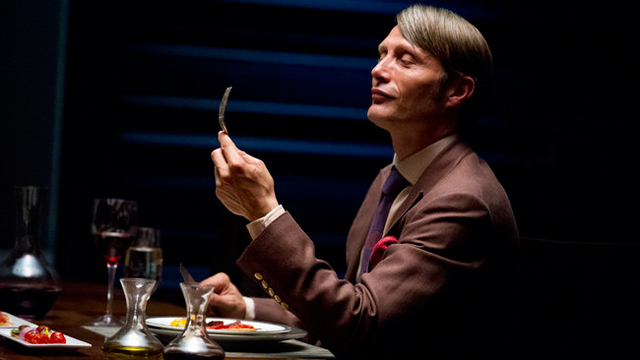
Man of wealth and taste: Mads Mikkelsen as Hannibal Lecter
I am a proud evangelist for Bryan Fuller’s Hannibal, produced and aired by NBC, in which the eminently watchable, razor-sharp-cheekboned Danish actor Mads Mikkelsen takes on the titular role.
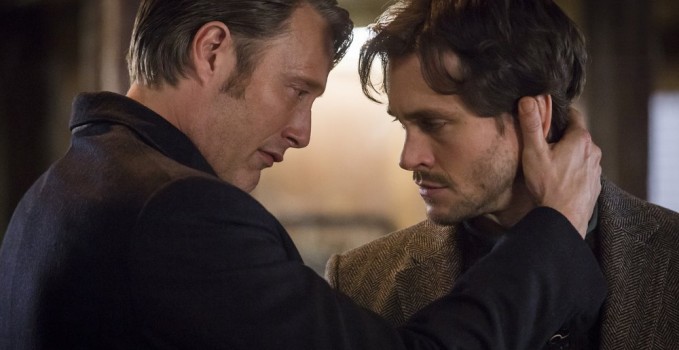
Though its first season was a workable enough affair – relying on the basic thrill of recognition of seeing Hannibal Lecter again to spruce up what was essentially an FBI murder-mystery procedural of the Criminal Minds/CSI ilk – come the second season the series reaches full bloom, allowing the ominous relationship between Hannibal and his ‘charge’ – in this case, a younger version of Red Dragon’s Will Graham – to be exploited for its “fucked-up” potential to the fullest.
Becoming: Mads Mikkelsen as Hannibal and Hugh Dancy as Will Graham
“Fucked-up” isn’t a cue for cheap titillation here. Being a prequel series to the trilogy we’re used to, the show by necessity has to ‘stretch’ Harris’ central conceit to fill up more story-time. Ordinarily, this would not augur well: stretching anything beyond its organic narrative confines usually results in stories that remain – to broadly apply the term – ‘unnecessary’; a limp extension of its mother-narrative, a decorative but hollow appendage.
No, “fucked-up” here extends the central taboo at the core of Harris’ stories – receiving useful investigative advice from a cannibalistic murderer, “fighting evil with evil” – to a mythic state.
Wrenched free from the three-act structure of novels and films, NBC’s Hannibal exploits the thrill of recognition to drive these characters to their logical narrative conclusion: away from mere innovative kinks, curios of the crime fiction genre, away from the exigencies of the ‘thriller’ plot structure, and further into the realm of the archetype… the realm of myth.
I’ve stopped giving much credence to birthdays over the past couple of years (I’m writing this on the eve of my 29th). Once the rites of passage in life become murkier – i.e., after you’re done with school and have no set ‘stages’ to go through any more – birthdays start to feel truly arbitrary.
But something strange, and just about wonderful is happening this year: right now I truly feel like there’s some kind of culmination of the recent experiences I’ve been through.
Part of all this is, of course, down to finally finishing and publishing the book, and I’m wary of how this feeling of relief mixed with euphoric uplift can be temporary and elusive.
But there’s other factors which have contributed to me feeling an increased sense of peace, and a receding of the persistent self-doubt which comes with – in a big way – from the very same arbitrariness that characterizes most of adult life.
It’s a hard-won sort of peace, though, and one which needs constant vigilance to be maintained.
I suppose the cost of growing up is, ultimately, the realization that bliss can no longer, at any point, come automatically.
*
Increased self-awareness also means an increased sensitivity to what is authentic about yourself – what you should keep and cultivate, and what you should discard because it’s no longer relevant to you: a dead-end road.
Authenticity was always a bit of a thorny subject for me; one the one hand yes, I work for a newspaper – which, at least ostensibly, trades in remaining authentic – while on the other, my primary obsessions are concerned with both the production and consumption of fiction.
A recent ‘catch up’ marathon for three films I’ve been wanting to watch – the ‘Before‘ films by Richard Linklater, starring Julie Delpy and Ethan Hawke (I know, I know) – put this in focus for me once again.
The trio’s breezy style clearly emerges as a result of consummate, carefully cultivated filmmaking, of course, but the way the films worry at concerns so delicate, intimate and – ultimately – relatable puts a number of cinematic attempts at the same themes to shame.
There is both a sensitivity and a kindness – as well as a dramatic dynamism, taking the shape of the best stage play’s effortless back-and-forth banter – to Linklater which made me think, first and foremost (and for whatever reason): Woody Allen is a fraud.
The comparison came to me just as automatically as that: finishing off either the second or the third ‘Before’ film, Woody Allen’s attempts at extrapolating home truths about sexual politics came to mind, and just didn’t ring true.
Where Linklater zooms in on an unfolding relationship between just two people – a thespian duo he clearly trusts – first by charming us with their idyllic romance but then boldly returning to his subject/s years later to shade that relationship, Allen props up his ping-ponging dialogue in the midst of cardboard cut-outs and facile plot developments.
*
My own reaction came as something of a surprise, because in recent years I’ve developed an increased fondness for artifice – a resistance to the ‘organic’ creation of art so vaunted by the Romantics, in favour of what we could, I suppose, at a stretch venture to call a more Decadent approach which places increased value on form and ornamentation.
In retrospect though, I think this may have something to do with the fact that over the past few years, I’ve made a conscious effort to write my own fiction, TO MAKE MORE STUFF, and so the – broadly defined – Romantic idea of ‘waiting for inspiration’ or of dedicating your attention solely to the perfect subject that is closest to your heart was not really helpful.
Focusing on just putting the thing together, on the other hand, helped me to move forward, and so the opposing milieu became more attractive.
*
Now that the novel is done, though, I have to confess that ultimately, its autobiographical elements are what kept me going – or, at least, that engine that whirred in the background, quietly fuelling me ahead as I scrambled to put the whole thing together.
Having a personal stake in something – anything – by its very nature adds urgency to a project, and one of the best things I’ve heard said about Two is that it made some readers – two of them, actually, as far as I know – “give me a hug”, because they recognized the emotional authenticity of the book.
Truth is a slippery thing; I will never understand it, not fully. People are constantly called out on begin ‘phony’ and ‘fake’; even a kind of manufactured authenticity seems to have pervaded our culture (see: Emma Stone, Jennifer Lawrence, and countless other celebrities presented as ‘just one of us’).
But I’ll be happy if I hit upon it, however fleetingly, when “it matters”.
*
Some more coverage for Two:
The Times of Malta – A measured, well-written review I’m quite happy about.
The Malta Independent – An interview by Colin Fitz, also delving into my work as a journalist. Some of the quotes come across as a bit pompous, and I’m fairly certain I was more self-deprecating during the conversation itself. But whatever.
If you – my fine, illustrious readers – insist on doing something for my birthday, might I suggest you pick up a copy of Two, either from “any good” brick-and-mortar store if you’re in Malta and Gozo, or through Merlin’s website if you’re seeing this from abroad? Shipping rates have been reduced to normal prices, thankfully, so you can order away without too much of a burden on your pockets. Ta!
It felt significant because my head was in a hectic, accelerated mess that day – peace seemed like a hardly achievable goal and then, I sat down in my favourite nook to read – for just under an hour – and the whirling clutter in my head decided to take a break.
I was glad to come across a particularly memorable passage, too.
*
“I knew him well enough to know that if you asked him the right way, at the right moment, he would do almost anything; and in the very act of turning away I knew he would have run after me and hopped in the car laughing if I’d asked one last time. But I didn’t. And, in truth, it was maybe better that I didn’t – I say that now, though it was something I regretted bitterly for a while. More than anything I was relieved that in my unfamiliar babbling-and-wanting-to-talk state I’d stopped myself from blurting the thing on the edge of my tongue, the thing I’d never said, even though it was something we both knew well enough without me saying it out loud to him in the street – which was, of course, ‘I love you’.” – Donna Tartt, The Goldfinch
*
It’s still early days, but I’m happy with the local reception of the novel so far. This being Malta it’s inevitable that your first (and possibly last?) readers be your friends and acquaintances, which complicates things somewhat as you’re never sure how honest they’re all being while dishing out praise. But luckily, some have qualified their praise quite convincingly, and I’m glad that others haven’t felt the need to sugar-coat what they didn’t like about it either.
But what makes me especially glad is that the reaction to the things I prioritised the most in the novel – atmosphere, ambiguity – is positive. I would hazard to say that this is the best a writer can ask for.
I’ll be keeping busy with collaborative projects in the meantime – the inherent loneliness of writing a novel doesn’t inspire me to dive into the process again so readily – but there is something about the process of long-haul writing that I do miss, at least at this relieved-that-it’s-over distance.
It becomes an organising principle; something to either dread or look forward to each passing day, week, month: regardless of whether you’re in a good place with it or not, it’s there, waiting. At its best, it keeps the relentless clutter at bay – it’s the space in your head that’s yours, and nobody else’s, and there is something thrilling about bringing a chunk of that shapeless aether out into the world.
So perhaps, despite my initial protestations, a second novel may be in the offing. Even if I write them in ten-year lapses like the aforequoted Donna Tartt…
My debut novel, Two, will be out from Merlin Publishers in just over a week’s time. The promo-machine for the book, such as it is, has been continuing apace, and it’s been great fun so far.
My good friend – the actor, theatre director and stand-up comedian – Philip Leone-Ganado wrote up a great interview on The Sunday Circle, which he also edits (yes, a Renaissance Man if there was one).
Photo by Jacob Sammut for The Sunday Circle.
Bolstered by great photos by Jacob Sammut (who seems intent on becoming my unofficial portraitist these days), it delves into the book’s themes, textures and origins, with a coda about the philosophy and day-to-day operations of Schlock. Click here to check it out.
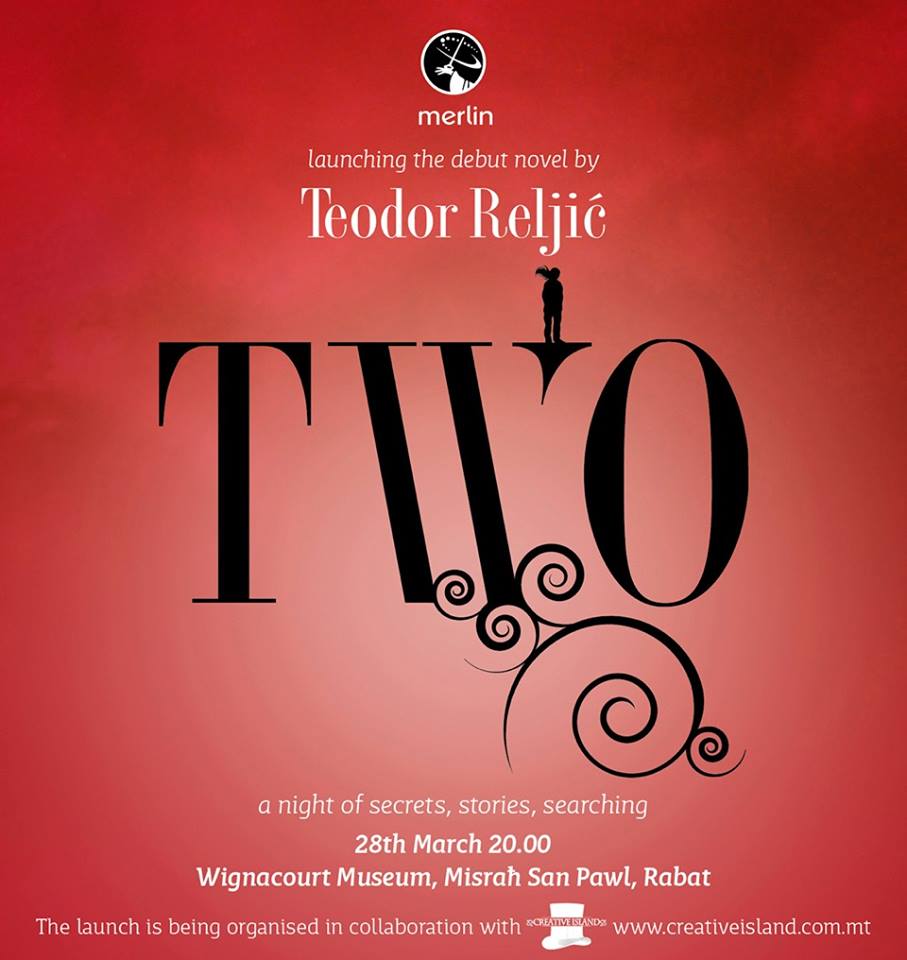
Following the release of the interview, the guys behind Merlin Publishers and myself activated one of our first ideas for Two’s actual book launch, taking place at the Wignacourt Museum in Rabat, with the aid of Nicole Cuschieri from Creative Island. Seeing as the narrative of Two hinges on a big secret, we’ve decided to make secrets the focal point of the launch.
To this end, we’re inviting everyone to anonymously submit their own secrets online, so that we may use them to ‘decorate’ the launch party’s venue. We’ve already amassed 60 secrets at the time of writing, and you’re still in time to submit your own by clicking here.
(Usage note: if you’re a first-time user of the simplyconfess.com site, you might need to click on the link and ‘enter’ the site — confirming you’re over 18 — then leave the site and re-enter via the same link.)
Finally – for now, anyway, because there’s still a couple of things I’ll be attacking you with in the coming week or so – we’ve also set up a Spotify playlist themed around the novel. I’d like to think that selection accurately reflects the mood of the book, at least to some degree. Click here to listen to it.
After the first couple of drafts of the book were finished, what I found most rewarding was doing my best to ensure that the texture and feel of it was flowing and consistent – a particular challenge in this case, given that the novel is structured on a parallel narrative.
Putting together a playlist that capitalises on that just feels like a (dare I say it?) well-deserved cherry on the cake.
Hope to see you on March 28. Overseas readers: we’ll keep you posted on ebook options for Two as soon as we have them.
China Mieville’s argument that Halloween is not an enemy to contemporary socialists – if ‘done well’ – bears the kernel of what I was complaining about. Allowing your kids to dress up as cowboys for Halloween means just succumbing to the capitalist machine; making them dress as ZOMBIE cowboys – thereby allowing the still-existent chthonic underbelly that Halloween hints at – is good, because it acknowledges the topsy-turvy disorder that Halloween (like Carnival) encourages – a temporary subversion of the status quo.
And films that are nominated or Oscars tend to be guilty of promoting this ‘vanilla’ view of culture. 12 Years a Slave appears to be searing, but it comes draped in the trappings of stereotypical period dramas – the worst of both worlds. American Hustle appears to be an edgy look at how the capitalist machine in America functions, but it’s too keen to please it viewers to allow for anything genuine to seep through.
This isn’t just limited to Oscar fare, either. The Robocop remake has been released to some negative press in the US and UK, and it appears to have fallen into a similar trap. It’s not a freakish creation like its original – a wonderful aberration by Paul Verhoven that doubles up as a satire of the Regan administration. As a wonderful article on The Guardian illustrates, Verhoven was successful – and this counts for his subsequent films Total Recall and Starship Troopers too – because he had a keen grasp of how the grotesque works.
His films walk like dumb action flicks, but talk like something far more playful.
It’s this commitment to your vision that I tend to admire, and that I want to champion here. Just like wearing non-supernatural, non-horror costumes in favour of something generic for Halloween is a disservice to the imagination and the subversive implications of the festival, so does making concessions to the audience and the established cultural order make for maimed storytelling.
*
I admire China Mieville for saying what basically amounts to “Sometimes a monster is just a monster.” By making monsters obvious ‘symbols’ for something, you divest them of their real power. Monsters will always mean something, of course, but they can stand for a rich variety of things – as opposed to some single, often hackneyed idea – if you just let them be.
Utopian vision: Let the work do its work. And don’t give awards to work that is more interested in glory and appeasing the status quo than in delivering good work.
Don’t know if it’s down to coincidence or something deeper (never visited the region + not an anthropologist) but I’m really happy to have discovered two great works of weird and wonderful fiction from Australia that I’m enjoying more or less concurrently.
*
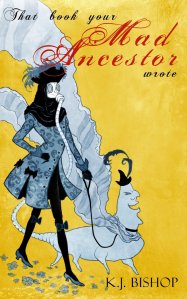
One was less accidental than the other though. I had enjoyed KJ Bishop’s debut novel The Etched City immensely, so upon discovering that she had self-published a collection of short stories and poems, I was sold from the word go. So far it definitely doesn’t disappoint.
The collection is what I’d like to call ‘unaggressively strange’ – Bishop’s ease with language and her appreciation of the Decadent idiom gives the tone of the work an unapologetically ‘decorative’ quality that couches her zany imagination into something consistently enjoyable.
The overall feel of ‘That Book Your Mad Ancestor Wrote‘ is that of a cabinet of strange delights… due in no small part to it being a self-published work and so free from any overbearing commercial strictures.
Testament to its freewheeling, ramshackle variety are the poems accompanying the stories – surreal feasts of language, placed like addenda at the end of the book but in truth – and in spirit – reflecting the joyfully insane feel of the rest of the book.
*
Though commenting on a book before you’re even done may seem silly or even crass, I can’t help but enthuse about Anna Tambour’s Crandolin.
Speaking about the art of criticism, Oscar Wilde said that, just like you don’t need to consume an entire bottle of wine to determine whether it’s any good or not, so a critic should be allowed to pass judgment on a work of art without having to have experienced it in its entirety.
Of course the statement is just a witticism to be taken with a heavy pinch of salt, but Tambour writes with such frenzied confidence (yes, a paradox worthy of Wilde) that her narrative voice alone is enough to convince me that she’ll carry her vision through to its end.
Using the titular magical device as a MacGuffin to pull a strange array of characters together (think Aladdin’s lamp, but if its gifts were less materialistic and more sensorial) Tambour lets her tale cumulatively paint a vivid picture. There’s no laborious world-building here: the reader is shoved straight into the detail, and save for a final destination involving the Crandolin serving as the figurative dangling carrot, we’re never sure where this is all headed.
Which is where Tambour’s grasp of language can really come out to play. Rhythmic, jokey and always at the ready with a wry (and not cringeworthy) pun, it works in perfect tandem with the craziness of the story so far.
*
I’ve been trained to nitpick – both academically and professionally. Which is why it feels good to gush sometimes.








 Soft Disturbances