Call it glorified procrastination (then again, what isn’t?) or a genuine pursuit of inspiration, but there are few things I love more than watching documentaries about creators I admire.
The release of Jodorowsky’s Dune (which my friend Marco incidentally nattered about on recently over at Schlock Magazine), coupled with the sad passing of HR Giger, made me think of this again, so I thought I’d compile a list of some of my favourites – all of which are thankfully available online.
I know I’ll be returning to this list every now and then for an inspiration top-up. Feel free to suggest any others I may have missed.
In Search of Moebius
The Mindscape of Alan Moore
Lovecraft: Fear of the Unknown
H.R. Giger Revealed
*
Incidentally, did some more nattering of my own, this time into the ears of the protean Maltese lifestyle web-hub, Malta Inside Out.
It felt significant because my head was in a hectic, accelerated mess that day – peace seemed like a hardly achievable goal and then, I sat down in my favourite nook to read – for just under an hour – and the whirling clutter in my head decided to take a break.
I was glad to come across a particularly memorable passage, too.
*
“I knew him well enough to know that if you asked him the right way, at the right moment, he would do almost anything; and in the very act of turning away I knew he would have run after me and hopped in the car laughing if I’d asked one last time. But I didn’t. And, in truth, it was maybe better that I didn’t – I say that now, though it was something I regretted bitterly for a while. More than anything I was relieved that in my unfamiliar babbling-and-wanting-to-talk state I’d stopped myself from blurting the thing on the edge of my tongue, the thing I’d never said, even though it was something we both knew well enough without me saying it out loud to him in the street – which was, of course, ‘I love you’.” – Donna Tartt, The Goldfinch
*
It’s still early days, but I’m happy with the local reception of the novel so far. This being Malta it’s inevitable that your first (and possibly last?) readers be your friends and acquaintances, which complicates things somewhat as you’re never sure how honest they’re all being while dishing out praise. But luckily, some have qualified their praise quite convincingly, and I’m glad that others haven’t felt the need to sugar-coat what they didn’t like about it either.
But what makes me especially glad is that the reaction to the things I prioritised the most in the novel – atmosphere, ambiguity – is positive. I would hazard to say that this is the best a writer can ask for.
I’ll be keeping busy with collaborative projects in the meantime – the inherent loneliness of writing a novel doesn’t inspire me to dive into the process again so readily – but there is something about the process of long-haul writing that I do miss, at least at this relieved-that-it’s-over distance.
It becomes an organising principle; something to either dread or look forward to each passing day, week, month: regardless of whether you’re in a good place with it or not, it’s there, waiting. At its best, it keeps the relentless clutter at bay – it’s the space in your head that’s yours, and nobody else’s, and there is something thrilling about bringing a chunk of that shapeless aether out into the world.
So perhaps, despite my initial protestations, a second novel may be in the offing. Even if I write them in ten-year lapses like the aforequoted Donna Tartt…
Don’t know if it’s down to coincidence or something deeper (never visited the region + not an anthropologist) but I’m really happy to have discovered two great works of weird and wonderful fiction from Australia that I’m enjoying more or less concurrently.
*
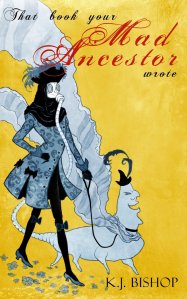
One was less accidental than the other though. I had enjoyed KJ Bishop’s debut novel The Etched City immensely, so upon discovering that she had self-published a collection of short stories and poems, I was sold from the word go. So far it definitely doesn’t disappoint.
The collection is what I’d like to call ‘unaggressively strange’ – Bishop’s ease with language and her appreciation of the Decadent idiom gives the tone of the work an unapologetically ‘decorative’ quality that couches her zany imagination into something consistently enjoyable.
The overall feel of ‘That Book Your Mad Ancestor Wrote‘ is that of a cabinet of strange delights… due in no small part to it being a self-published work and so free from any overbearing commercial strictures.
Testament to its freewheeling, ramshackle variety are the poems accompanying the stories – surreal feasts of language, placed like addenda at the end of the book but in truth – and in spirit – reflecting the joyfully insane feel of the rest of the book.
*
Though commenting on a book before you’re even done may seem silly or even crass, I can’t help but enthuse about Anna Tambour’s Crandolin.
Speaking about the art of criticism, Oscar Wilde said that, just like you don’t need to consume an entire bottle of wine to determine whether it’s any good or not, so a critic should be allowed to pass judgment on a work of art without having to have experienced it in its entirety.
Of course the statement is just a witticism to be taken with a heavy pinch of salt, but Tambour writes with such frenzied confidence (yes, a paradox worthy of Wilde) that her narrative voice alone is enough to convince me that she’ll carry her vision through to its end.
Using the titular magical device as a MacGuffin to pull a strange array of characters together (think Aladdin’s lamp, but if its gifts were less materialistic and more sensorial) Tambour lets her tale cumulatively paint a vivid picture. There’s no laborious world-building here: the reader is shoved straight into the detail, and save for a final destination involving the Crandolin serving as the figurative dangling carrot, we’re never sure where this is all headed.
Which is where Tambour’s grasp of language can really come out to play. Rhythmic, jokey and always at the ready with a wry (and not cringeworthy) pun, it works in perfect tandem with the craziness of the story so far.
*
I’ve been trained to nitpick – both academically and professionally. Which is why it feels good to gush sometimes.
One of my favourite things about the internet is the easy availability of material that has been released into the public domain.
Literature fans are especially fortunate in this regard, with sites like Project Gutenberg providing a rich variety of writings ‘only a click away’, as the cliche would have it.
One thing I like to do is to commemorate dead authors, and the internet certainly helps to a) remind me about birthdays/death days of the authors in question and b) provide me with enough material to commemorate them properly, for free.
Said commemoration usually involves just reading out something of theirs to mark the occasion. I try not to miss out on any of my favourites, dorky or obliquely cult-like as it may sound, mostly because I never really grew up with any real sense of ritual.
Books and stories are my ritual. Having grown up in a family that wasn’t in any way religious and that had to find its place in a foreign country while still getting on with day-to-day affairs, stories were always a welcome mental buttress through which I tried to make sense of the world.
I took this behaviour to its conclusion after I resolved to study English literature at university, though I may not have known it at the time.
I channel my academic years somewhat too, I suppose, when I look back at authors I want to remember and commemorate. This sense of history is important to me, but being outside of the academic sphere now also makes it possible for me to come at it more casually, playfully.
Writers commemorated this month
Edith Wharton – January 26 (birthday)
Can’t say I’m terribly familiar with Wharton’s work. Save for a BBC Radio adaptation of Ethan Frome and Martin Scorcese’s Age of Innocence, I have had no direct contact with her novels and stories. So I looked her up last Sunday and came across this, a Christian allegory that reads like a folk tale and/or, at a stretch, a fantasy story.
Again, this is probably a superficial assumption, but the story popped up as a bit of a surprise to me given that the Wharton I know is the buttoned-up early 20th century chronicler of high society – much like her compatriot Henry James.
One of my favourite authors of all time. Woolf’s work made me realise that prose fiction can explore the psychology of character in a way that is natural and beautiful, though often crushing.
I never had the chance to delve into the works of Scotland’s national poet properly. But that’s one great thing about being alerted about these celebrations – they remind you of the authors whose works you’ve missed and might want to catch up with.
*
With this in mind, I should really be getting back to my own fiction writing. Later!
What I remember: Reading The Stranger at Sixth Form. Hating the sterile Everyman edition I found at the school library. Loving the equally austere but slightly more stylish silver-grey Penguin edition, with the footsteps in the sand.
He was a softer version of Nietzsche, to me. Nietzsche pummeled me. Camus let me in. I could see his philosophy working, somehow: absurdism felt both sexier and more managable than nihilism – or raging anti-nihlism… guess it depends who you ask.
It’s his short stories that remain etched in my memory. I’ll never re-read The Myth of Sisyphus. I doubt I’ll ever re-read The Stranger or The Plague either. But The Exile and the Kingdom felt friendlier… more humane than anything I’d ever encountered from his oeuvre. The sweeping intellectual make-up of ‘Sisyphus’ and The Plague; the blunt, macho minimalism of The Stranger… there’s none of that in The Exile and the Kingdom.
The fact that someone so intellectually flinty and sharp could allow themselves sentimentality to seep through; the fact that he showed himself to be artistic, to be open to occasional, experimental bouts of emotion in prose…
It was to be the last time I engaged with Camus, but it felt like a good way to round off the relationship. (Of course I could still get into his writing again, of course I could dip into the books every now and then and still derive pleasure for them. But what I mean is that the ‘phase’, the fevered season of devouring them wholesale, was gone.)
Feeling the pull away from the core of his work, I moved on to Camus but took some of the absurd with me. I’d like to think it’s still with me, anyway. The scepticism of any definite moral or philosophical impositions. The framing of human endeavour against something ultimately unpredictable, but not necessarily malevolent or cold. Acknowledging our passion as something fiery and real and justified in every way, even if we’re not sure where it all comes from, and where it’s all going…
This could all just be projecting. My memory of Camus’ work and its implications could be faulty (and, of course, it could be that I never quite grasped if fully in the first place). But that’s what I remember when I think back on it.
A solitary figure – alone but not lonely. The world spinning on regardless, and you jumping on the carousel.
While my teenage sister was out on the town rocking a Wednesday Addams get-up (her ‘bff’ went as Morticia so they stalked the small island nightlife scene with old-school-goth panache), I had no Halloween party to go to.
That’s a lie, actually: I could have very easily – and very lazily – donned my stock Dracula cape and multi-purpose 18th century broach, waxed my moustache and tagged along with my younger sibling, to revisit the local rock club for some Halloween fun, as well as a healthy dollop of nostalgia.
But in what is probably another sign that I’m getting old before my time, I opted to stay in to read instead. Fridays are hard work for me anyway – so that there’s a distinctly non-Halloweeny sense of dread looming over every Thursday evening.
The reading was as ritualistic as I could make it though, so some sense of commemoration was kept. I indulged in Edgar Allan Poe’s ‘The Masque of the Red Death‘ for umpteenth time; it’s a story that I keep returning to for its visceral and visual impact, but would you believe that I have yet to fully conjure up an image of Prospero’s castle in my head? Maybe that’s why I keep returning to it.
The fact that Gabriel Byrne did a brilliant reading of it some years back helps too, of course:
After I was done, I got the urge to revisit what is probably one of my favourite literary tributes of all time: Laird Barron‘s ‘Strappado’, published in the Ellen Datlow anthology Poe, released in commemoration of the macabre master’s 200th anniversary. It’s a glorious mash-up of both ‘Masque’ and ‘The Cask of Amontillado‘ – probably my second-favourite of Poe’s stories, and updates their most horrifying elements in a way that makes my skin crawl.
Though Lovecraft – my second choice for the evening’s reading – is perhaps more vulnerable to this than Poe due to his stylistic excesses, the visual furniture and 19th century narration that fuels Poe’s tales can sometimes soften their impact (if not all that substantially). Barron’s story doesn’t have this problem. I don’t want to write a detailed crit of it – I like it too much anyway – but do check out the anthology if you can, it’s got a few other gems in store.
My reading of HP Lovecraft’s ‘He‘ was cut short by my drooping eyelids. However, I returned to it after a ranging storm woke me from my slumber… which I appreciated for providing some holiday-appropriate mood, if nothing else. But the story is truly one of Lovecraft’s lesser works, any terror undermined by its ridiculous antagonist and the logorrithic miasma that works much better in the Cthulhu stories than it does here.
Re-reading can be far more pleasurable and rewarding than reading something for the first time. It has the ability to etch stories in you like incantations, like prayers that remind you of who you are. If the stories and the storm congeal into something meaningful for my writing, that would be truly great.




 Soft Disturbances