This volume may be the epitome of indulgence, and the tone of Marc Scott Zicree, Guillermo del Toro’s interviewer – and effective co-writer in this endeavour – can come across as a bit sycophantic at times.
But really, a ‘cabinet of curiosities’ can’t help but be a gloriously indulgent exercise, and you don’t come here to read a sober dissection of del Toro’s life and filmography.
No, you come here to luxuriate in what is probably the ultimate ‘behind the scenes’ look into Del Toro’s oeuvre, as presented in a gorgeous coffee table edition crammed with photographs and studded with mini-essays by Del Toro’s friends and collaborators (the book is framed by tributes from James Cameron and Tom Cruise, respectively).
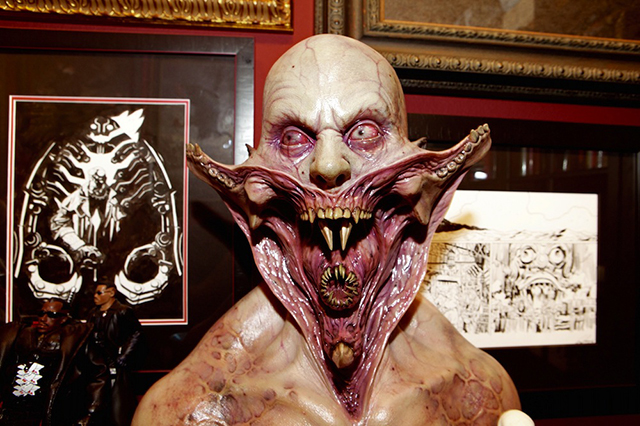
The book introduces us to Del Toro’s eclectic imaginative landscape with a bit of a tour of Bleak House – his second home and studio, which gives the book its organising principle, as the house itself is something of a cabinet of curiosities writ large – more than just a working space, it is arguably also the geeky man cave to end all geeky man caves.
Stuffed with original art and sculptures (some of them taking an extravagant bent, like the statue of Boris Karloff getting the final touches of his Frankenstein make-up done), each room in the house is themed around a particular genre or artistic milieu – like the ‘Steampunk Room’, the ‘Manga Room’…
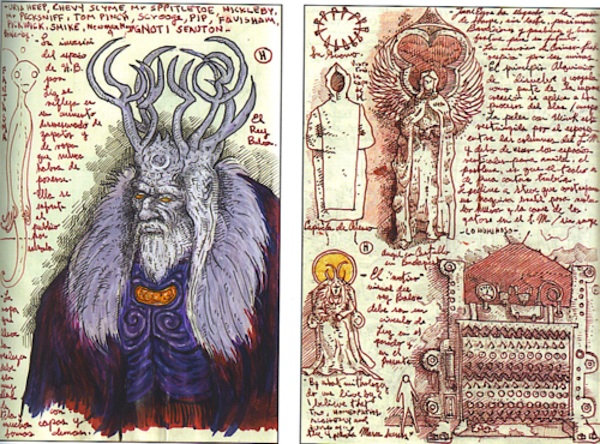
But above all, the ‘cabinet’ is really about del Toro’s colourful and frenzied notebooks, which the director has been keeping from the beginning of his career and which reveal the inner workings of his genre-melding chiaroscuro parables, from Cronos through the Hellboys and Pacific Rim.
The pages of the notebooks reproduced in the book often have a drawing at the centre – usually a portrait shot of a character in one of del Toro’s films, or a close-up of some grotesque prop or monster – which would be surrounded by (multi-lingua) marginalia. These notes will probably be the most pleasant discovery for a del Toro fan as they leaf through the book, revealing, as they do, the inner workings of the writer-director’s mind, often as he’s tackling and trying to figure out several projects at the same time: practical concerns (about props, costumes and loose story threads) jostle alongside philosophical musings and personal anecdotes.
As an extra, readers also get a glimpse into projects of del Toro’s that never came to fruition – an easy pitfall for a filmmaker with a tendency to multitask various media and juggle a number of projects at any given time.
The most prominent – or at least, the most recent and infamous – of these is of course del Toro’s – ultimately thwarted – adaptation of HP Lovecraft’s At the Mountains of Madness.
That project might just see the light of day, however, as del Toro recently announced that he’s cool with going for a PG-13 rated version of his film, under the wing of his recent collaborators Legendary Pictures (insisting on an R-rating proved to be the deal-breaker with the film’s previous studio-home-to-be, Universal).
But even before this announcement – which arrived some months after The Cabinet of Curiosities hit the shelves – hope already burned for a renewal of the project. “While this project we were so passionate about didn’t work out the first time round, I know that it’s going to happen one day,” Tom Cruise, who was set to star in At the Mountains of Madness (alongside Del Toro regular Ron Pearlman) writes in the Afterword to the ‘Cabinet’.
“Why? Because Guillermo will never stop creating, no matter what. He will keep at it against all odds. And when it finally happens, it will be infused with all the things that make a Guillermo del Toro movie so distinct and unforgettable: images, emotions, vistas, and characters that no one else creates.”
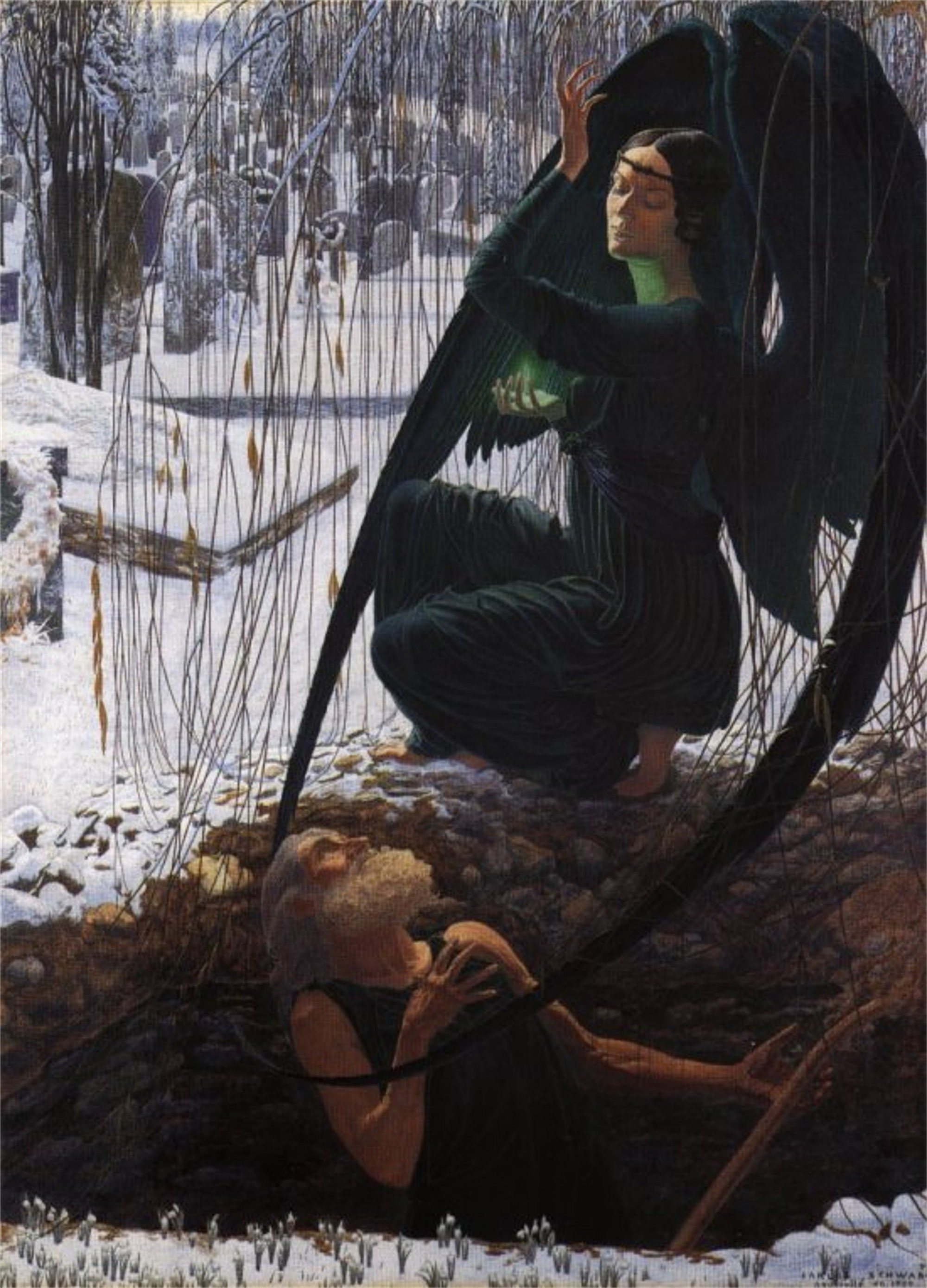
“In this day and age, we confuse hip smartness that does not fully endorse any idea with intelligence, and consider callousness the product of an experienced point of view of the world. Naturally, this attitude leads us to value artists who seem to know it all. But Schwabe and the rest of the symbolists were the exact opposite: They celebrated not knowing, the twilight of our knowledge. To them, the supernatural was absolutely real, and mystery was the supreme goal of art.” – Guillermo del Toro
Peter Stromare in Fargo (1996). The foot belongs to Steve Buscemi’s character
“The only jarring note [in Fargo] is the unnecessary pandering to the horror crowd – a remnant of the Evil Dead days – when Buscemi is being fed into the mechanical wood chipper, although we only see some of his leg sticking out of it. To illustrate how props in films can take on talismanic properties, the wood-chipper, owned by Milo Durben, a Delano farmer who acted as dolly grip on the film, had its own float in the 1996 Delano Fourth of July parade and was in the window of Dayton’s store in downtown Minneapolis as part of a movie display. Milo and his wife have continued to use the machine to chip wood on their farm, presumably now cleansed of bits of Buscemi.” – Ronald Bergan
Vanessa Ives (Eva Green) is asked a tough question in the final moments of the first season of Showtime’s Penny Dreadful
Spoilers for the first season of Penny Dreadful ahead
“Do you really want to be normal?”
That question, delivered by a seemingly benign Welsh priest (though given the particular show’s propensity for sneaky evil presences, one shouldn’t be too sure) concludes the final episode of the first season of Showtime’s Penny Dreadful, fading to black before the show’s erstwhile protagonist, Vanessa Ives (Eva Green) can respond.
It’s an apt question to ask – even an apt question to end a season on – considering we’re dealing with a show about characters who are either grotesque, extraordinary or a mix of both. But it’s also pertinent to the show’s structure itself. Like the critically lauded but structurally uneven True Detective before it (also a moody slow-burner entrenched in the history of horror fiction, albeit the two shows picking two separate – Transatlantic, even – branches of the tradition), Penny Dreadful had eight episodes in its first season.
Apart from being somewhat atypical in the current trend of ongoing ‘prestige’ television dramas, whose seasons generally take in at least 10 and up to 13 or 14 episodes, Penny Dreadful – perhaps contrary to its title and the associated cultural pedigree that that implies – opted to unspool its story in slow drops, instead of at a frenetic pace, with a twist and/or “shocking” character revelation at every corner.
In addition to this, the show also kept its cards to its chest – and still has quite a few, it must be said, even after the season one finale – so that while it was hoped that the viewers would remain intrigued by the mystery, it was never quite certain which parts of the story had the most urgent implications for our characters. And to make things even harder for itself, the show dedicated two whole episodes – precious time, for such a considerably brief season – to flashbacks.
This begs the question: is Penny Dreadful just slow, or have we been ‘spoiled’ by a certain degree of acceleration in the way TV series tend to be delivered?
*
Indeed, Penny Dreadful has nothing like the immediate (and sustained) hook of Breaking Bad, which works because it’s striking, simple and also workable over the long term: Walter White’s cancer is a looming portent of doom, while his gradual transformation into a drug baron can be enjoyed episode-to-episode (or perhaps more accurately, it can be charted from season to season) because it’s precisely that: a transformation, a journey, an element of the story that yields new developments by its very nature; and in this case, it’s a particularly seductive element as it promises to transform our protagonist from hero to villain. Neither can Penny Dreadful boast of the huge cast of characters and intersecting story-lines one finds in Game of Thrones which, unlike Penny Dreadful, can satisfy a large and varied swathe of viewers with each episode, as George RR Martin’s vast, medieval-fantasy world can flicker from one sub-plot to another in the blink of an eye, with each sub-plot practically catering to its own mini-genre (political thriller, domestic drama, picaresque journey, fantasy actioner… even horror of the ‘torture porn’ variety).
Penny Dreadful – perhaps by dint of its title alone – can’t even claim to be ‘above’ genre television, necessarily. It can’t afford to luxuriate in the longueurs of a Mad Men without consequence, because its premise, and the cultural milieu it pastiches, demands a certain amount of genre-familiar action: an expectation corroborated by the memory of the literary characters it has adopted (who are, at the very least, a century old, which increases the expectation we have of them substantially).
*
Vanessa Ives (Eva Green) and Dorian Grey (Reeve Carney)
Am I suggesting that Penny Dreadful is faultless, or that any faults it may have should be forgiven because we appear to have been ‘spoilt’ by accelerated storytelling (even in long-haul drama) in this day and age? No.
Come the conclusion of season one, a couple of things about the show still rankle me slightly, namely:
1) The season’s primary plot engine: Sir Malcolm Murray (Timothy Dalton) and Vanessa’s quest to retrieve Mina Murray (Olivia Llewellyn). It just feels a little thin. Though there’s enough simmering interpersonal drama between Malcolm and Vanessa to spare (as we learn about half-way through the season), and though of course the supporting characters also do their part in filling up the episodes leading to the climax, the sweep of it just doesn’t feel epic enough to justify an entire season. (I wonder if a plot reshuffle would have worked better… if, say, Mina is actually retrieved earlier on – even as early as the third or fourth episode – but it turned out that she is still gripped by whatever evil she appears to be possessed by. The rest of the season would then progress much in the same way, but it would also be free of what is essentially a threadbare ‘final destination’. As it stands, it feels as though the story will only get going come season; and
2) The fact that Dorian Grey (Reeve Carney) appears to have been thrown into the fray to elicit sexual tension and titillation and little else. His character arc will doubtlessly pick up come season two (we weren’t offered a glimpse of his infamous portrait after all), but it was sloppy of the writers not to leave any breadcrumbs for us at all. Come the final episode, he’s a cipher – and not a tantalizing one, at that.
*
But you’ll be hard-pressed to deny that Penny Dreadful is a sumptuous, atmospheric and impeccably photographed show, despite all its faults. This isn’t just cosmetic praise: its production value works towards creating its atmosphere of gloomy dread and, ultimately, menace. And I think this is far more worthwhile a dramatic pursuit than endeavoring to create a ‘monster-of-the-week’ type show, which this easily could have become, and which even I suspected it may have been (and I probably wouldn’t have minded one bit if that were the case, I must admit).
Like Hannibal – a show I love and admire even more than Penny Dreadful – it shoots everything in a gloomy chiaroscuro, reinforcing the sense that, if there’s a light at the end of the tunnel for these characters, they’re going to have to work through plenty of gloom to get to it. But more than just being a trick of cinematography and production design, this prolonged sense of foreboding helps the story.
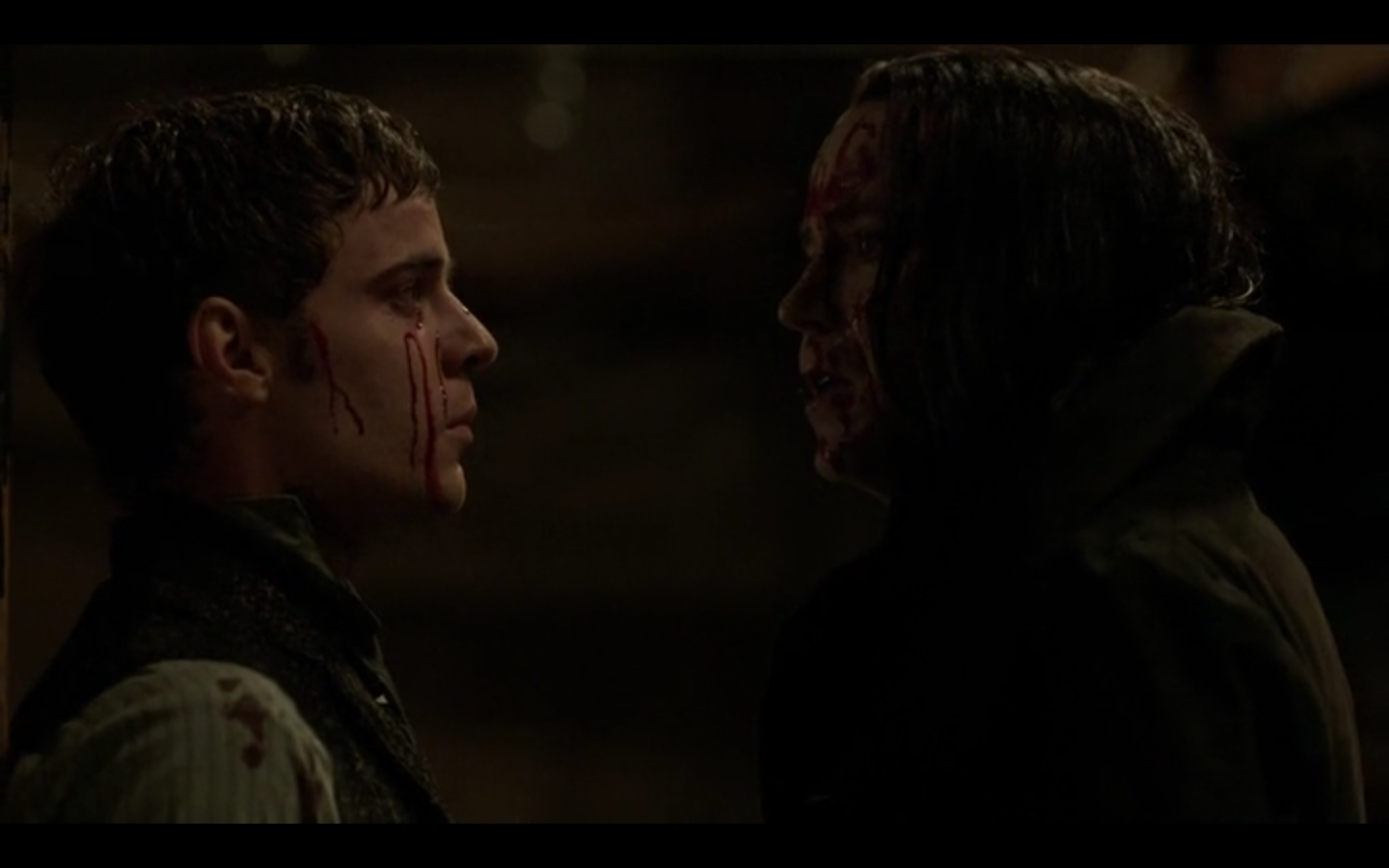
Ethan Chandler (Josh Hartnett) and Malcolm Murray (Timothy Dalton)
Because it’s a story about how evil is incredibly hard to beat. Though we were promised Dracula, and though some kind of vampire mythos is most certainly at play here, the suggestion is that the old Count (or some version of him), is being helped, or is subservient to, an ancient Egyptian deity who appears to be channeling powers we’d normally associate with Satan (at least in pop culture lore).
Eva Green’s Vanessa is of course the fulcrum of all this: because this demonic presence appears to have taken a liking to her, she’s also made to serve as bait for Mina – or, at least, as a tracking device. In a show as restrained as this – restrained, at least, within its genre – Vanessa’s moments of demonic possession were the key set pieces… and it’s commendable that the ‘wow’ factor of the show depended not on shocking key character deaths (Red Viper, anyone?) but rather, on an actress’ talents, necessarily OTT as those particular moments were. The adage ‘force of nature’ is one of those hateful phrases that are tossed around too easily, but Green certainly gives the show her all: she can switch from beautiful to horrific, from formidable to crushed, in the blink of an eye.
Her effective martyrdom, powerfully rendered by Green, points to one thing above all: there is no talisman or magic charm, no arcane incantation that will drive this malevolent presence out for good (though our boy Ethan (Josh Hartnett) surprised everyone with his spot of impromptu exorcism, which saved Vanessa’s life in the season’s penultimate episode).
*
The chosen tone of John Logan’s show – which has thankfully been confirmed for a second season – makes perfect sense for the kind of property (the word is crucial here) that it is.
Victor Frankenstein (Harry Treadaway)
Save for Vanessa, we know a lot of these characters from their source material (that includes Malcolm Murray, who is H. Rider Haggard’s Allan Quartermain in all but name), and the show can’t play too closely to that. Instead of exploiting its Gothic and supernatural pedigree for effects-laden gimmicks and sensationalist shocks, it’s playing the long game, and keeping us guessing.
Or would you rather it were a “normal” show, after all?
*
Questions:
1) Do you think that the eight-episode arc is proving to be a real challenge for TV writers?
2) Genre historians! Would you say that Penny Dreadful follows an old-school model of storytelling? Did the original penny dreadfuls have a similar structure? Haven’t had a chance to research this myself, so I’m really curious about this.
Dizzee Rascal performs at the Isle of MTV 2014 concert at the Granaries, Floriana, Malta. Photo by Ray Attard/Mediatoday
“I’m attracted to the idea that trickster narratives appear where mythic thought seeks to mediate oppositions. Just as Raven eating carrion stands between herbivore and carnivore (or, in my own earlier version, just as Raven stealing bait stands between predator and prey), so there is a category of mythic narrative, a category of art, that occupies the field between polarities and by that articulates them, simultaneously marking and bridging their differences. It is the tale in which Coyote tries to retrieve his wife from the land of the dead but creates death as we know it, Coyote does go to the underworld and so overcomes the barrier between life and death, but at the same time his impulses overcome him and the barrier remains.” – Lewis Hyde
But East London rapper Dizzee Rascal was something of a refreshing presence in this year’s otherwise stale and repetitive churn of pre-prepared, mealy-mouthed sound-bites.
Asked (by the chipper, elfin-faced and Irish-inflected MTV VJ Laura Whitmore) about what he thinks of the Isle of MTV image as a production, he replied: “Well MTV’s got the money, innit?”
Asked (just like his Isle of MTV colleagues were) about how he’ll handle the oppressive heat on stage, he replied: “I mean it’s only a 20-minute set, really, we’ll be okay.”
Asked (by an equally chipper local radio journalist) whether performing at Glastonbury was the highlight of his career so far, he replied: “I don’t know… I actually think the proudest moment of my career so far is being able to buy my mum a house.”
Joseph Marcell as King Lear and Rawiri Paratene as Gloucester. Photo by Ellie Kurrtz
So I got to interview Joseph Marcell, aka Geoffrey from The Fresh Prince of Bel Air, for the paper a couple of week’s ago.
The phone interview was arranged in light of his forthcoming visit to Malta, where he will be playing the title role in The Globe Theatre’s touring production of King Lear.
I will admit to feeling star-struck by the opportunity. I will also admit to succumbing to a slight bout of panic when the phone number I was instructed to call appeared to be non-existent. But once that logistical hiccup was ironed out, Mr Marcell instantly put my nerves at ease, doing good to the memory of Geoffrey with his effortlessly cordial demeanour.
*
“From where I’m standing… I think what people responded to [in Geoffrey] was the fact that he’s an employee who doesn’t hesitate to criticise his employers. He’s not a bore: he pushes the boundaries and risks things all the time.”
“Upon my return to the UK, I didn’t have white lilies in my dressing room, a personal assistant and Voss water from Norway – I had to deal with that kind of stuff (laughs)! But seriously, it was difficult in some ways because the Hollywood thing is that you have people who do things for you – in the theatre, on the other hand, you do things for yourself.”
“To be honest, that is the sort of thing you think when you’re in your 20s – that King Lear is the role you ought to be playing later on in your career. But then when you get there you realise there’s so much more to it than that.”
Victor Frankenstein (Harry Treadaway) and his Creature (Rory Kinnear) in Showtime’s Penny Dreadful (2014)
“By revealing that difference is arbitrary and potentially free-floating, mutable rather than essential, the monster threatens to destroy not just individual members of a society, but the very cultural apparatus through which individuality is constituted and allowed. Because it is a body across which difference has been repeatedly written, the monster (like Frankenstein’s creature, that combination of odd somatic pieces stitched together from a community of cadavers) seeks out its author to demand its raison d’être – and to bear witness to the fact that it could have been constructed Otherwise” – Jeffrey Jerome Cohen
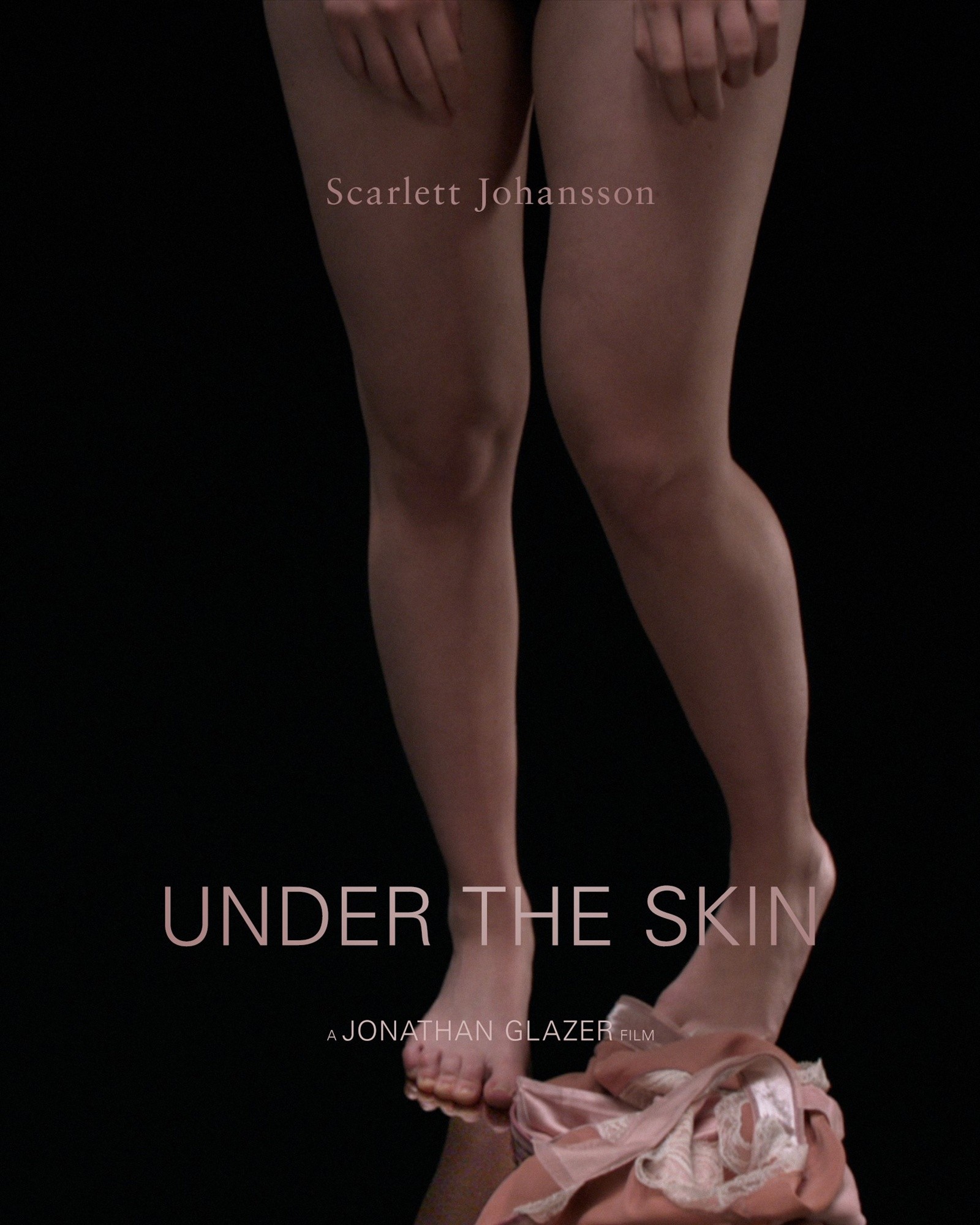
If Lars von Trier’s Nymphomaniac implores us to “forget about love“, then Jonathan Glazer’s acid-sharp body-snatcher thriller Under the Skin seems to be asking us to forget about sex too, at least “as we know it”, both in real life and movie convention.
Adapting Michael Faber’s novel of the same name, Glazer casts Scarlett Johansson as a woman on a mission to seduce and kill as many male Glaswegians as she can manage, working on the orders of what appears to be an unsavory research team of some kind (whether they’re aliens or just morally bereft scientists is never really spelled out in the film itself).
Beyond that, however, the audience is as much in the dark as Scarlett’s victims (the protagonist is never named), and this is the key to the film’s appeal: a journey through complete emotional disconnect which seems to suggest that something may just be developing around its edges.
Species it certainly ain’t, but is it just an art house variant of the cheap slasher film?
Throughout the film’s first half – which I would perhaps somewhat paradoxically argue is its strongest – one is tempted to answer “yes” to that question. Though devoid of cheap thrills and ultimately meandering – and therefore non-sensational – in how it presents the predator-prey encounters, Glazer knows how to calibrate our response to imminent menace, and his finely-tuned aesthetic sense is exploited for terror wonderfully here.
Playing into – rather than playing up – Johansson’s status as a Hollywood sex icon, Glazer derives both suspense and humour from the central conceit (ScarJo cruising for men).
A key scene, which takes place on a beach, will probably be among the most-discussed segments of the film. Actually not spurned by an ostensibly sexual encounter, it’s a depiction of complete callousness that cuts to the bone, with our (alien or otherwise) protagonists looking on impassively as tragedy unfolds right in front of them.
The scene is also another example of Glazer’s calculated vision. It’s a mathematical arrangement of unpleasant details: crashing waves over a dangerously rocky beach, a thwarted rescue, a screaming child left behind. Genuinely gripping, or just well-curated contrivance? It really is up to you to decide, and I think that a film which exists on such finely-tuned polarities is worth exploring.
That said, its second half is substantially weaker. A plot development is allowed, which – perhaps necessarily, perhaps not – deflates some of the tension and attempts to wrestle with themes that deserve a full film in their own right, not the tail-end of one.
But that an aura of mystery is maintained throughout can certainly be appreciated, and in developing the idiosyncratic atmosphere of the film, Glazer owes much to composer Mica Levi, whose score is by turns minimal and overwhelming (the signature tune bursts in almost as if it’s been snuck out of an Italian ‘giallo’).
But it’s Johansson, of course, who turns out to be his bravest and most consistently compelling collaborator. The Guardian’s Leo Robson used “prick her and she doesn’t bleed” to describe her performance, and I won’t bother trying for a more economical or apt descriptor. This isn’t a wooden performance masquerading as ‘laconic’ or ‘depressed’; this really is a consistent, stark display of non-being.
Though Faber’s (and now Glazer’s) story is at its core an old one – think Frankenstein, better still, think Pinocchio – Glazer is to be commended for going full-bore against that most comfortable of narrative short-hands: making characters and situations ‘relatable’.
Chilly and immersive in a way that can only be fully experienced on the big screen, Under the Skin is a sinister blank canvas. What you see most definitely not what you get. Or is it?
Scarlett Johansson is dropped into Glasgow dressed as any other woman and ready to be picked up by the nearest gentlemen. Jonathan Glazer, the director, follows her with a string of hidden cameras, and turns the street into a theatre. A fiction about desire, the object of wonder, and that pale extraordinary woman with red lips who just happens to take a fancy to the passer by.
*
Good news: my adoptive country will be getting to see the Scarlett Johansson-starring, Jonathan Glazer-directed Under the Skin from this Friday onwards, by which time it would hopefully have not hit the pirate networks and will entice a generous-enough audience to St James Cavalier in Valletta, where it will be showing for a total of six screenings from mid-June to early July.
*
Glazer’s film – based on the book of the same name by Michael Faber, whose prose has previously been adapted into BBC’s rather good ‘R-rated Dickens’ mini-series The Crimson Petal and the White (2011) – has intrigued me for quite some time, not least because of its seemingly arch approach to genre: it seems to have elements of both sci-fi and horror, but the overall arc of it appears to suggest something ultimately undefinable and definitely eerie.
It also appears as though the team behind the film – and this includes the star herself – appear to be keen to strip the glamour off Scarlett Johansson’s persona.
This interests me because a) it appears to play against the way stars are constructed these days, which is only a metonym for how we consume and internalize them; and b) it’s a reminder that Johansson wasn’t always a sex goddess (remember Ghost World?) and that her on-screen transformation into one was, I think, signaled quite clearly with that opening shot of Lost in Translation. Does it mean it can be unmade just as easily now?
By making her play an alien who preys on men, will Jonathan Glazer succeed in letting her career and aesthetic direction develop into something more substantial?
*
Either way, Glazer will always have the benefit of being a curio, of being someone who operates from at least one remove from the standard Hollywood system; even, perhaps, beyond the indie film festival carousel.
His music video CV is thicker than his feature-filmography, which suggests that he can’t be bothered with the grind of narrative cinema and its corresponding industry, only approaching a project if it really interests him through and through.
There’s always risk involved here (music video directors-turned-feature film directors run the gamut from dazzling to dire), but this makes them an interesting phenomenon either way.
Personally I found his debut Sexy Beast (2004) to be a style-over-substance kind of experience. Save Ben Kingsley’s blistering turn as a deranged gangster who pays (an ultimately unwelcome) visit to his former colleagues’ idyllic island getaway, the film could easily have been directed by Guy Ritchie – the Brit-gangster tropes are very much in place (with iconic tough guy Ray Winstone leading the show, they can’t help but be) and the narrative is thin.
Birth (2004), on the other hand, is a different kettle of fish entirely. The premise grabs you: Nicole Kidman’s husband comes back to life in the body of a 10-year-old boy just as she’s about to get remarried.
But instead of being blunt or exploitative, it’s a delicate experience; the music and the affluent and snow-capped New York surroundings making the whole thing feel like a fairy tale. And here fairy tale does not mean Disney cartoon with a happy ending tacked on; it means the simple but ominous build-up of otherworldly doom that suffuses the story as each element of it clicks inevitably into place.
Different as they are, what both Sexy Beast and Birth share is the theme of an intruder disrupting our protagonists’ comfort. You could say that Glazer enjoys existing – or, at least, of telling stories – in this zone of discomfort.
In terms of Glazer’s archetypes, so far we’ve had Nemesis (Sexy Beast), a Ghost (Birth) and now we have an Alien (Under the Skin).
The latter promises to be the most foreign, the most unsettling. Let’s hope it lives up to its title. Because we’re all masochists at heart, aren’t we?
I especially like my music dark and immersive – I find it perfect to write to, for one thing, and my social network has been very generous on that front this particular month of May (hey, it is my birthday month after all), as two friends of mine – one from this here isle, the other from one further up north in Scotland – both unveiled their dark, twisted projects to the world, and I found them both a joy to listen to.
First out of the gate is Fastidju, the brainchild of Nigel Baldacchino who, together with a veritable ‘super-band’ of local talent, has released a double-CD album of haunting, burrowing (and bi-lingual) sounds. It all comes gorgeously packaged too. Check out a track below, and click here to go to the band’s Facebook page, where you’ll find info about how to acquire a copy of the album.
Next is MONGALIECH – a two-man-band release brought to my attention by horror writer Alistair Rennie, one half of this heady initiative. It’s a dramatic soundscape that clearly evokes the duo’s Scottish environs, and will be of particular interest to those who like a bit of horror, in whichever form. Their entire album is available to listen to and download for free from bandcamp. I hope you enjoy it as much as I did.