Gotham Nights | Top Three Batman Adaptations

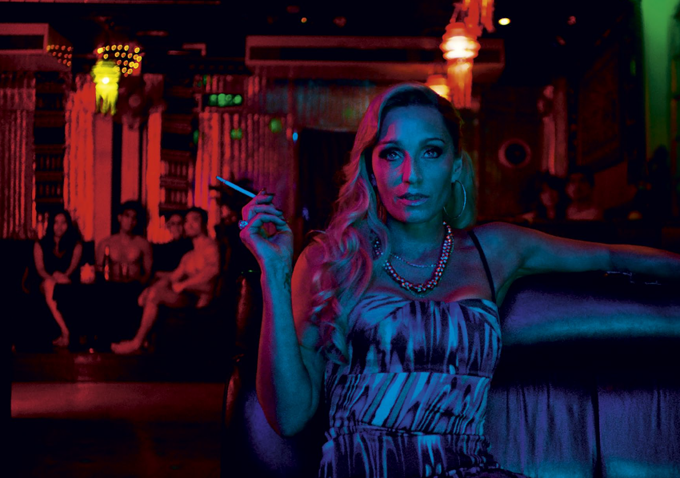
Carmen Bicondova as soon-to-be Catwoman Selina Kyle in Fox's Batman prequel series Gotham

Carmen Bicondova as soon-to-be Catwoman Selina Kyle in Fox’s Batman prequel series Gotham

The Fox network’s Batman prequel series Gotham looks to be a solid but unremarkable bit of hokum, if this week’s pilot is anything to go by. An otherwise competent-enough police procedural, it relies far too heavily on Caped Crusader brand recognition, hoping that none-too-subtle “a-ha!” moments revealing an early version of Batman’s rouges gallery will be enough to make us sit up and pay attention for longer than a couple of episodes.

Still, its inaugural episode made me look back at some of my favourite Batman stories in non-comic book media. I’ve narrowed it down to a top three – a top three of features I don’t mind re-visiting on occasion.*

3) The Dark Knight (2008)

The late Heath Ledger as The Joker

The late Heath Ledger as The Joker

There are only a handful of films I’ve watched in my life time that were bona-fide ‘events’ at the cinema. Not even a handful… off the top of my head I can think of two, maybe three films, tops, that weren’t just successful genre blockbusters but long-awaited, almost social events by dint of their pre-screening buzz and subsequent pop culture impact.

Star Wars: Episode I – The Phantom Menace (1999) was the first. Despite the fact that it disappointed me even though I was an easy-to-please kid at the time, George Lucas’ return to the sci-fi/fantasy world that made him a Hollywood pioneer felt like some kind of watershed moment: never mind its intrinsic worth as a film – it was a monumental gesture on Lucas’ part that bridged two generations of fandom, right at the cusp of the internet revolution, which lent fuel to the fire of its many detractors.

Following closely on its trail was a far less controversial film – though its sequels proved to be a fast-tracked mirror image to the disappointment caused by the Star Wars prequels ­– which I won’t hesitate to call a modern masterpiece: The Matrix; a cyberpunk collage which wore its homages proudly on its sleeve but which was also animated by a pioneering energy.

The Dark Knight was the third and final one that comes to mind – the only example I can think of from past adolescence.

There are several reasons why Christopher Nolan’s sequel to Batman Begins (2006) struck a chord with me (along with many, many others worldwide). Its escalating tempo perfectly mirrors the chaotic, all-pervasive nature of a terrorist attack (relentlessly topical for all of us post-9/11), with Nolan perfectly balancing blockbuster friendly action with what is now referred to a ‘grimdark’ approach to superheroics. But instead of coming across as too sombre for its own good, Nolan’s seriousness is both gripping and infectious. He commits to the material in a way that doesn’t feel preposterous or disproportionate, in a way that’s been justifiably compared to Michael Mann’s Heat (1995).

But it’s unsurprisingly Heath Ledger’s performance as the film’s key antagonist, The Joker, that keeps me returning to the film. Over and above the tragic romance of Heath Ledger being reported dead soon after the shoot wrapped, there’s something magnetic about his performance that makes it a joyous thing to experience.

Yes, it’s disturbing and dark – like his director, Ledger grabs the role by the collar and doesn’t let go, diving head-first into the nihilistic psychosis of his character. But despite being the orchestrator of the film’s panic and chaos, he’s above all fun to watch, a spirited grotesque in the spirit of Johnny Depp’s Jack Sparrow who is enjoyable to experience even in isolation, as his introduction to the parliament of Gotham mobsters amply displays (and rewards in repeat viewings).

2) Batman: The Mask of the Phantasm (1993)

Batman: Mask of the Phantasm

The Paul Dini/Bruce Timm Batman Animated Series – as transmitted (and dubbed) on Italian TV – was one of the defining cartoons of my childhood. Apart from bolstering my love of Batman lore, it also imbued in me a love of film noir and Art Deco.

It gives us a Batman origin story beyond the my-parents-were-murdered sequence, as well as an uncharacteristic and finely fleshed out romance. There’s no bimbotic Vicki Vales here; in Andrea Beaumont Bruce Wayne gets a mirror image of his traumatic obsession. Also packing in a great Joker story, the feature-length ‘Phantasm’ exquisitely built on the foundations set by the animated series.

Playing into Batman’s noir appeal while remaining kid-friendly, it also maintains a certain decorum absent from subsequent – and concurrent – movie adaptations. It certainly has none of the camp excesses of the much-maligned Joel Schumacher films, and neither is it particularly close in tone to the comparatively toned down Tim Burton opening salvos.

That’s not to say it doesn’t have a flair for the theatrical ­– just wrap your ears around Shirley Walker’s theme tune for a rousing introduction to this inspiring labour of love.

1) Batman Returns (1992)

Feline fling: Michelle Pfeiffer and Michael Keaton in Batman Returns

Feline fling: Michelle Pfeiffer and Michael Keaton in Batman Returns

Nolan gets all the accolades and Schumacher gets all the hate, but it’s Tim Burton’s second (and final) sequel to his soujourn in Gotham that stays with me to this day – to the point that I re-watch it every Christmas (the period in which the film is set, all the better to amplify its Gothic excess).

It is the only Batman film in the franchise that takes on the core absurdity of the DC Comics character and runs with it.

But it doesn’t run with it in the same way that Burton’s successor Joel Schumacher ran with it; turning it into a camp carnival of steel bat-nipples and shiny gadgets and architecture. In pitting Bruce Wayne/Batman against the double-menace of feral jewel thief Selina Kyle/Catwoman (the never-sexier Michelle Pfeiffer) and the orphaned freak-cum-underground mobster Oswald Cobblepot/The Penguin (the never-uglier Danny De Vito), Burton showed that he understood the inner workings of Batman and his rogues’ gallery.

It’s about watching mad people in costumes tearing each other apart (which is as far as you can get from the moralistic, dead-serious drama-thrillers of the latter-day Christopher Nolan trilogy).

The snowy pall of Christmas time over Gotham city only reinforces the stylistically-heightened panorama: a truly Gothic sight if there ever was one, and a more than apt rehearsal for that other Burton-sponsored classic, The Nightmare Before Christmas (1993).

*This, incidentally, remains the ultimate litmus test for me when it comes to deciding what is a ‘favourite’ – particularly in this day and age when daisy-chain social media gimmicks keep requesting us to make a favourite list of this or that. If you truly love something, you’ll keep coming back.

LISTEN: Podcasts of the Year

Over the past couple of weeks, I was reminded of just how important it is to remain humble and nice no matter what.

At Malta Comic Con 2013, I met some truly great and highly accomplished international comic book creators, and as luck (and the efforts of the great Kenneth Scicluna) would have it, I also scored the opportunity to interview Joshua Oppenheimer, the award-winning documentary director of The Act of Killing – arguably the most important film of our generation (with Mr Oppenheimer’s kind permission, I will be reproducing our conversation in full on this blog very soon).

Both of these encounters flew in the face of certain notions we tend to hold about successful and/or famous people: that they’ll look down on anyone not in their position, or that they’re brusque and difficult.

These artists were both on top of their game and very, very polite and accommodating people to boot: which made me chuckle privately to myself as I thought of the pompous figures I’ve met in my time who hadn’t accomplished half as much but still felt the need to peacock about (and having grown up in Malta, the ‘big fish in a small pond’ syndrome is very pervasive).

One of the people I met at the Comic Con was Chris Thompson, the man behind the Pop Culture Hound podcast – a mainstay of discussion on all things comic book related. And because he’s such a nice guy, I’ll open this haphazard list of great podcasts I’ve listened to over the past year (so far) with one of his offerings.

1. Pop Culture Hound Ep. 66: Alan Moore and Lance Parkin

Magic Words

With the help of the Prince Charles Cinema in London, Chris Thompson’s Pop Culture Hound podcast delivers this conversation between comic book luminary and literary magus Alan Moore and his biographer Lance Parkin for all those who couldn’t be present for it on the night.

It’s worth a listen for anyone interested in Alan Moore’s work (obviously) but also for those who care about art and the future of humanity beyond our immediate physical and financial concerns. If that sounds a bit lofty well, it’s because it is. Moore was never one to pull his punches and neither was he ever cagey about embracing ideas that may veer away from the norm (and, perhaps, dangerously into ‘loony’ territory).

This recent conversation is a heartening reminder that the Moore we know and love is very much alive and kicking and that, despite his general grumpiness about the contemporary cultural climate of the world, he always has something magical – the word is not incidental – to offer up to his listeners that will refresh their outlook and inspire them.

2. The History of Byzantium Ep. 15: Justinian

Justinian I

I came to this one a little late and frankly, I’m a bit miffed – I had been hunting around for a podcast on this very subject for quite a while. It’s a period I’m interested in particularly because it concerns the development of my country of origin – Serbia – while following on from another podcast I used to listen to with relish – Mike Duncan’s excellent The History of Rome.

Host Robin Pierson openly acknowledges that this podcast follows on the heels of The History of Rome both in form and in content – delivering a comprehensive sweep of the period in 20-30 minute chunks.

I haven’t reached all that far into this podcast just yet, but I’m enjoying it very much so far. I’ve chosen the episode dedicated to Emperor Justinian because, as Pierson says, his is a life packed with incident, and is I think in many ways representative of the kind of conflicts that characterised the Byzantine age.

3. Lightspeed Magazine Podcast: A Fine Show on the Abyssal Plain by Karin Tidbeck

Jagannath

One of the reasons I really got into podcasts was because they offered the possibility to enjoy short fiction while ‘on the go’, and in a way that preserves some of that time honoured by sadly fading format of oral storytelling.

Lightspeed Magazine – offering a selection of science fiction and fantasy fiction compiled by master editor John Joseph Adams – is a great venue for varied, colourful work, and Tidbeck’s story is a fine example of how genre fiction can be made to do some great things if the writer in question is a brave, playful and emotionally honest one. I keep coming back to this poignant story about a theatre troupe performing to seemingly nobody, especially because it’s so sensitively narrated by Kelley Catey in its podcast version.

4. VICE Podcast: Interview with Nicolas Winding Refn

Only God Forgives

The Danish filmmaker Nicolas Winding Refn (Drive, Only God Forgives) is one of my favourite directors.

His most recent film, Only God Forgives, suffered something of a drubbing at the hands of the critics (and, from what I can tell, a bemused shrug on the part of the general moviegoing audience), but to me it only reaffirmed his alchemical mix of lush visuals, unflinching brutality and his masterful employment of archetypal figures.

So it’s hardly surprising that I enjoyed listening to this expansive interview, which apart from picking apart the engine behind Only God Forgives, draws parallels to some of his previous films – particularly Valhalla Rising, a Viking-era thriller starring Mads Mikkelsen which is reminiscent of both Werner Herzog’s work and Apocalypse now – a cocktail I can’t resist.

And how about you? Any good podcasts you’ve heard recently?

Never mind the rain: Malta Comic Con 2013

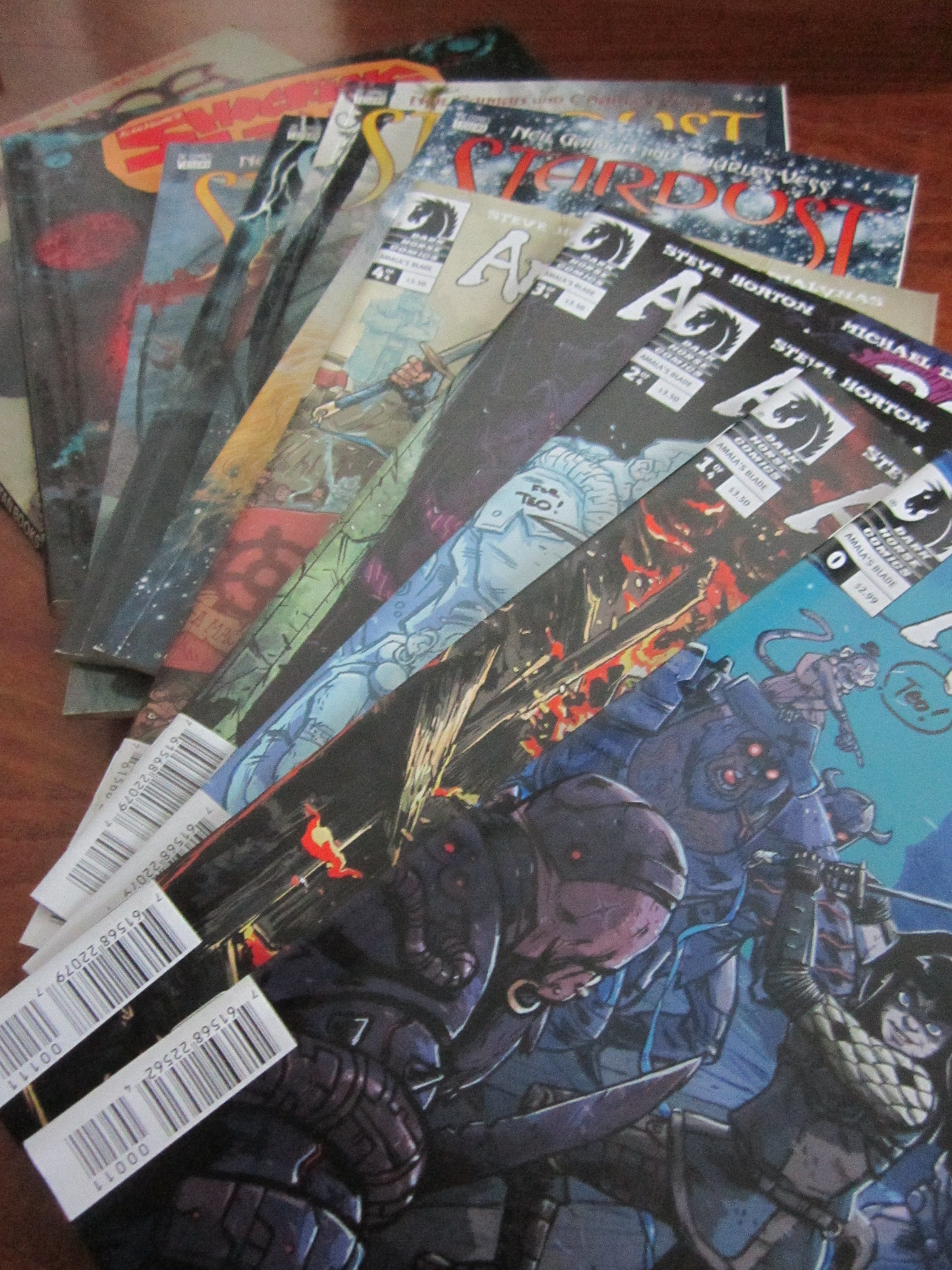
Comic Con haul (and that’s just Day One)

An inspiring weekend can make all the difference to your creative biorhythms, and I’m pleased to report that last weekend was one of them.

Maybe it’s the psychological glut caused by competitions like Nanowrimo (to say nothing of Movember) and its awkward position as the penultimate month of the year, but this November in particular felt a bit strange to me.

I was less and less keen to go out – preferring to stay indoors and – supposedly – tinker away at various creative projects (being human beings yourselves, I’m pretty sure you can tell how this ended up most of the time).

So I began to hope that the end of November would prove to be something of a release, and that December would make for a nice fresh start.

With the Malta Comic Con in town over November 30 and December 1, it seemed like a fair enough assumption to make, and I’m glad I was proven right.

The ‘Con, having been around since 2009, has been growing in reputation and quality with each passing year, and I certainly felt this year’s edition was an ‘upgrade’. Not just because big-name creators were once again in attendance – The Walking Dead’s Charlie Adlard, Game of Thrones storyboard artist William Simpson and ‘Lucifer’ writer Mike Carey being just a small fraction of them – but also because the attendees appeared to be as enthusiastic about the experience as the organisers.

Image

It’s a motley gathering, as any ‘Con should be, I think: there’s those who come to tastefully sample the wares on display and those who make a beeline to the venue, foaming at the mouth because they’ll get to share breathing space with some of their favourite creators.

(All despite the rain: an important caveat considering the Maltese’s often hysterial attitude to the falling-water-from-the-skies phenomenon.)

Also, rain in Malta often means… rainbow!

Cosplay, previously something of a halting sight at this particular ‘Con, was very well represented this year: I was often intimidated by stampeding groups of anime-inspired characters, while other costumes were so well-crafted that they came close to resembling the ‘real thing’ (be that Batman antagonist Bane or Jack Sparrow… and yes, I realise that ‘real thing’ may be a poor choice of words here).

There was a healthy mixture of ages and social groups among the attendees too – a polar opposite to the cliqueish exhibition culture that often asserts itself at other art events – often at the very same venue where the ‘Con itself was held (Valletta’s St James Cavalier). But the difference is not just down to the attendees.

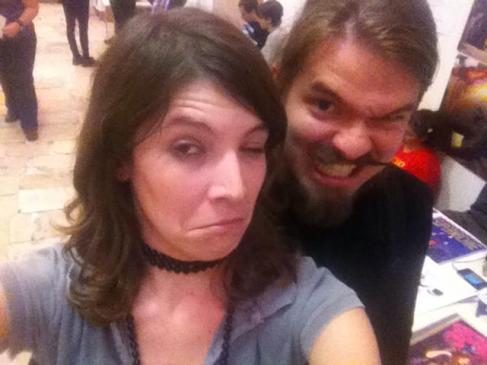
Crazy artists (Widdershins, left) and their editors (myself, right) were also present.

Comic book fandom, by its very nature, foments a completely unpretentious appreciation of art. Instead of self-conscious fawning, you get entirely unselfconscious gushing.

(Though a visit by Prime Minister Joseph Muscat was a heartening reminder that the ‘Con’s reputation as a quality, audience-grabbing event is growing, I’m afraid he fails to win the Coolest Official On Show Award. That honour would have to go to US Ambassador Gina Abercrombie-Winstanely, who enthusiastically did the rounds while wearing a Star Trek shirt.)

But there were quiet moments amidst the madness too, and I was lucky enough to sit in for one of them. Giving a reading of his upcoming novel The Girl With All The Gifts, Mike Carey also took time to answer questions from the intimate group that had gathered at St James’ Music Room for the occasion.

Preach, Mr Carey.

The genre-hopping British writer spoke, among other things, about the differences between prose fiction and writing for serialised comic books, and something he said resonated with me due to a kinda-secret project I’m working on at the moment.

Read: not that secret at all. (Credit: Widdershins/Nel Pace)

Speaking about the way comics are structured as stories, Carey said that “you can’t do it scene by scene”.

That mulling over period is essential when it comes to planning a sustained piece of fiction – more so when it’s a more dramatically ‘tactile’ thing – when it’s a story delivered in conjunction with a visual element, like a comic book, a film or a play.

It’s something I’ve rather enjoyed doing over the past day, aided by a purchase from yet another inspiring event held in tandem with the ‘Con – Patches Market. The notebook shown below – courtesy of the ever-brilliant, ever-meticulous Sarah of The Secret Rose – has been serving as a repository of notes, ideas and in-character psychological rationalisation towards a project that will only be coming into full fruition next year.

Cockbook. Hihi.

It’s a thoroughly unromantic thing – Wordworth: “we murder to dissect” – but I find it necessary. It’s one of the many things that writing ‘Two’ has taught me… and it was a long process, one which started during a particular November, some four years ago…