Words will wait

Writing hasn’t been easy lately.

That’s not to say I haven’t been able to jot things down. And neither am I “out of ideas” or bereft of the required energy or confidence to keep on ploughing through the sentences and drafts.

It’s just that my current project is at a point where the drafts, the ideas and the characters need some time to get to know each other better. They’re talking at cross-purposes and on a vague, sun-bleached plan, which was mapped out by a remote authority seated in a comfy office and simply left out to the elements and the drafts, the ideas and the characters are forced to squint to make out the shapes which were once words or diagrams meant to take them to the next stage of their journey.

This probably just means that I need to take a break.

Which is funny to consider, when my writing schedule is essentially “whatever you manage in the one hour before you have to head out to go to work”. But a mental break from a specific strand from writing doesn’t necessarily mean stopping to write altogether. Even switching projects works, though arguably swapping over an ingrained, long-term writing practice for some experimental noodling could have an even greater restive (or restorative) effect.

***

Freedom in writing is always a relative term, for me… I’m deeply sceptical of the idea that an artistic practice implies a sense of spontaneous, intuitive and even anarchic liberation away from the strictures of mainstream society. If anything, I find that it actually requires a deeper and more neurotic commitment to some of these tenets, with the anarchism only made evident in the obsessive streak with which you double-down on them.

You can zone out at work, and go for the umpteenth cigarette or coffee. Household chores have definitive parameters, and even the most byzantine of bureaucratic tasks have some kind of ceiling. Clients will have deadlines, and even lovers have their ultimatums. Lovers, partners and friends also have physical bodies that tick away to sometimes endless-seeming, but ultimately finite desires and frustrations. They may be erratic but they’re never truly, entirely unpredictable for those of us who know a thing or two about how humans operate in general. And while they may expect a certain degree of telepathy on your end — and as annoying as such an expectation may be — they will never ask you to create and recreate them anew.

But your characters will. And this is why I think that Mary Shelley’s Frankenstein will always remain a reference point. I’m sure there’s a flurry of doctoral theses and obscure articles out there to prove the following statement wrong, but I’m always surprised that so much of our processing of that pioneering piece of sci-fi gothic literature is focused on the ‘scientific hubris’ reading, and so little on how it’s also a commentary on the act of creation. Yes, I’m sure the theological implications have often been made as well, but I’m referring specifically to how Victor Frankenstein could also be seen as the neurotic and nervous artist trying to come to terms with the horror of a first draft. (And also, how that first draft threatens to morph into something unexpected, and demands that more of these mutations be facilitated by dint of a fertile co-partner).

(I’m not trying to claim this interpretation as original. Those of you have links and PDFs, please pass them on. They are more than welcome).

So yeah, for me, writing is never about freedom but about finding the right straitjacket for the right moment. Or rather, the correct protective suit for whichever uncharted territory you happen to be traversing at the time. Because the territory will always BE uncharted, and populated by monsters to whom you’d not only have to teach language, but whose independence you’d have to facilitate and reassure. Let Victor Frankenstein’s fate be a cautionary tale.

***

Apart from being literally one of two or three annual events I legitimately look forward to each year, the Malta Mediterranean Literature Festival, organised by Inizjamed, often offers me a chance to experience writing in a looser and more immediate way to my default mode. More poetry, less novels. More of experimental prose, and less of the three-act structure.

It often results in me buzzing with a renewed fervour for the written word, experiencing precisely the kind of ‘break-that-is-not-a-break’ that I’d mentioned earlier. You encounter new writers without the aid of an algorithm: better still, right in the flesh. This adds wrinkles to your programme; unexpected experiences that open new doorways.

But there was a dash of welcome familiarity in this year’s edition of the festival. As an honorary member of the extender Inizjamed family, I’d assumed that I had some dibs on suggesting future festival guests. So a couple of years ago I started lobbying for the inclusion of Karin Tidbeck to the roster. Of course, as a subculture-rat since my early teens, my allegiance to specific groups will always trump pretty much all else: in this case, it’s the genre/speculative fiction community. I will always aim to advocate and represent of that literary class in my local stomping grounds, much in the same way I managed to do for Kali Wallace and Jon Courtenay Grimwood.

But I also felt Karin to be germane to Inizjamed’s festival in particular for more specific reasons related to their artistic practice and MO. A festival that comes with its own translation workshop attached, a multi-lingual, self-translating author is practically catnip. And a writer who so keenly identifies with liminal spaces can’t help but feel at home in any festival that deigns to include ‘Mediterranean’ in its title, and this particular one does so with a degree of conviction: operating with both intellectual rigour and humane generosity to create authentic spaces of encounter.

***

All of this largely a preamble to celebrate this year’s edition of the festival (as I did when I was lucky enough to participate back in 2018); to remind you that I got a chance to chat with Karin in print about their uncategorisable nature in the run up to the event; to brag about being allowed to ventriloquise for Karin in her absence from the grand finale due to a ridiculously early wake-up call the following morning; and to hopefully open this space back up for more regular, and looser, writings of this kind.

Especially now that I’m starting a new job in a field that’s relevant to my experience once again. Which is the perfect push and pull of the familiar and the new.

***

I mentioned the prolific (and gentlemanly) Jon Courtenay Grimwood above. During one of our in-person conversations (either during his Malta visit or a follow-up meeting in London, I can’t recall), I spoke admiringly of his substantial output, a lot of it filtered through different noms de plume.

He responded by stating simply, “Well, if I don’t write, I can’t think.”

Increasingly, I find this to be true in my case. It doesn’t necessarily mean that whatever I write will have any value at all; at least not in that early stage. And neither does it have to be some sort of revelatory, epiphanic distillation of the self at that given moment.

The mechanics of writing are their own reward. This is why every single shift away from the programme has value. Words remain words. They will serve you in different ways at different times, but they remain at your disposal.

Featured image: Authors performing at the final night of the 18th edition of the Malta Mediterranean Literature Festival, on 26 August 2023. From left: Tanja Bakic, Claudia Gauci, Karin Tidbeck, Simone Inguanez and Virginia Monteforte (photographer)

Chatting is the thing | Worldcon 75

20643541_1401840483244764_939056664614733252_o

Being overwhelmed is part and parcel of going to any convention. I would argue that it’s actually baked into the experience from the word go — the idea that you shove yourself into a large space — usually one with inordinately high ceilings — to experience specialised events and ‘network’ incessantly is not a recipe for being chill, exactly.

Worldcon 75, having taken place at the Messukeskus in Helsinki from August 9 to 13, was certainly one such experience for me, and judging by the exhaustion of many other science fiction, fantasy (etc.) writers and fans who I came into contact with over this intensive batch of days, I wasn’t the only one.

But neither would I say that it was all draining, or particularly difficult to grasp.

Part of this is down to just how much better a time I had at the Worldcon this year than I did back in 2014 — the so-called ‘Loncon’ in the — you guessed it — still-not-blighted by Brexit UK capital. Perhaps the event itself is not entirely to blame for my awkwardness (and I had my good friend Alistair Rennie guiding me through the worst of it anyway) but learning the ropes and pacing yourself is what the convention should be all about.

20690196_10159488179380019_9075826178441768889_o

Day One!

There’s also the fact that Helsinki seems to have attracted a batch of people whom I knew online but hadn’t yet had the pleasure to meet ‘IRL’ — largely thanks to the fact that I had lured them to participate in Schlock Magazine in some capacity, which now being more than ably run by my little sister. There was an especially nice symmetry to the fact that the lovely trio of Gregory Norman BossertKali Wallace and John Chu served as both a welcoming and a farewell committee for myself and my new bride (who was bemused by the whole affair but, I’m sure, enjoyed the company and is bound to have taken some lovely (film) photos of our various gatherings).

In what was to become another through-line for the trip, that trio are alumni of the celebrated Clarion workshops — just like two other friends I was lucky enough to chat with on more than one occasion during the Con; Haralambi Markov and Karin Tidbeck. The latter, whose novel Amatka you should definitely check out and who was among the many people kind enough to write me a recommendation letter as I applied for — and won! — the Malta Arts Council grant that allowed me to come to the Con in the first place, openly recommended that Clarion should be the next step forward for me.

20645308_10159490019485019_127105677795070052_o

We shall see what the future holds in this regard… actually, let me rephrase that: I will have to see just how I can manage to rustle up the necessary funds to attend the Clarion Science Fiction and Fantasy Writers Workshop, since its benefits were made empirically evident for me throughout the Con.

20746259_10159494213690019_3793921440173154767_o

On a panel about European Myths and History (ambitious, much?)

Standing — or as was more often the case, sitting — shoulder to shoulder with the Clarionites for the best part of a week could easily have made me feel out of place, were it not for the fact that they were, for the most part, really nice and accommodating every step of the way. Perhaps the knee-jerk clubiness of Maltese culture is what leads me to assume that everyone ends up that way. When in fact, it’s certainly not the case; and going to events like this Con is a clear reminder that pretentiousness and ‘attitude’ of any kind is never helpful if you want to get ahead in any creative industry — be it based on writing or otherwise.

Indeed, I will remain forever humbled by some of the writers I’ve met and who, despite their success guaranteeing them a certain degree of autonomy, still found enough time to speak to me one-on-one and offer their professional advice in a candid and expansive manner. Part of that, I think, is borne out of a desire to ‘pay it forward’ after your own creative trajectory has been so tough (even if the rewards came, in the end).

20746206_10159497757330019_8924531153394361132_o

Sith Happens

It could be a dispiriting fact to remember, but I also find it inspiring. It’s a reminder this word-wrangling business isn’t just a ghostly pursuit, but a field whose steps you can climb.

***

There’s a lot more that could be said about the Con; or at least, a lot more that I could say from my perspective of it, which — owing to the overwhelming-by-proxy nature of the thing I detailed above — would necessarily be subjective to a fault. Starting with my own discomfort with certain performances of ‘fandom’ — hence my unsurprising focus on the dynamics between writers — and ending with my own perceptions of Helsinki itself — a beautiful, calming place that will hopefully get its own separate blog post — but I’d much rather leave things as they are: an airy but fresh perception typed out during a balmy Mediterranean night (so different to the cutting freshness of its bright, Finnish counterparts).

Because the fruit of the many conversations that happened at Worldcon 75 — and, should it not be obvious enough by now, the conversations are what I valued the most out of the entire experience — will be made evident later. When I actually have the time and energy to write out the ideas sparked off by these chats, and to follow up on the networking possibilities that they suggest.

Let this be a promise, to myself above all.

20746102_10159509694275019_520479762851342923_o

***

Thanks to Gregory Norman Bossert, Karin Tidbeck, Jeff VanderMeer, T.E. Grau, Jon Courtney Grimwood, KJ Bishop, Chris Gruppetta and the organising team behind Worldcon 75 for helping me get to the con. My visit to and participation in Worldcon 75 was supported by Arts Council Malta – Cultural Export Fund. 

READ: Schlock Magazine’s 5th year anniversary issue

Image

Schlocktopus selfie – Schlock Magazine’s December 2013 cover by Nel Pace/Widdershins

It started with a casual discussion at a now-defunct reggae bar: what if we created an online version of, say, Weird Tales?, I asked my friend Peter.

He said sure why not – a lot of our friends like to write and draw and stuff.

And so five years on, Schlock Magazine has continued to pollute the internet superhighway with an eclectic mix of prose, poetry and illustration – originating from us in Malta but, gradually, extending all over the globe.

We have since featured interviews and even fiction by authors like Jeffrey Ford and Angela Slatter, and we have names like Ken Liu, Nathan Ballingrud, Laird Barron and Karin Tidbeck lined up for the coming year.

Needless to say, I’m quite proud of what we’ve accomplished so far, and grateful for all the readers and contributors we’ve received over the years.

I hope you continue reading. For now though, I hope you find it in yourself to check out our December 2013 issue, which also doubles up as our 5th year anniversary issue.

Thanks!

LISTEN: Podcasts of the Year

Over the past couple of weeks, I was reminded of just how important it is to remain humble and nice no matter what.

At Malta Comic Con 2013, I met some truly great and highly accomplished international comic book creators, and as luck (and the efforts of the great Kenneth Scicluna) would have it, I also scored the opportunity to interview Joshua Oppenheimer, the award-winning documentary director of The Act of Killing – arguably the most important film of our generation (with Mr Oppenheimer’s kind permission, I will be reproducing our conversation in full on this blog very soon).

Both of these encounters flew in the face of certain notions we tend to hold about successful and/or famous people: that they’ll look down on anyone not in their position, or that they’re brusque and difficult.

These artists were both on top of their game and very, very polite and accommodating people to boot: which made me chuckle privately to myself as I thought of the pompous figures I’ve met in my time who hadn’t accomplished half as much but still felt the need to peacock about (and having grown up in Malta, the ‘big fish in a small pond’ syndrome is very pervasive).

One of the people I met at the Comic Con was Chris Thompson, the man behind the Pop Culture Hound podcast – a mainstay of discussion on all things comic book related. And because he’s such a nice guy, I’ll open this haphazard list of great podcasts I’ve listened to over the past year (so far) with one of his offerings.

1. Pop Culture Hound Ep. 66: Alan Moore and Lance Parkin

Magic Words

With the help of the Prince Charles Cinema in London, Chris Thompson’s Pop Culture Hound podcast delivers this conversation between comic book luminary and literary magus Alan Moore and his biographer Lance Parkin for all those who couldn’t be present for it on the night.

It’s worth a listen for anyone interested in Alan Moore’s work (obviously) but also for those who care about art and the future of humanity beyond our immediate physical and financial concerns. If that sounds a bit lofty well, it’s because it is. Moore was never one to pull his punches and neither was he ever cagey about embracing ideas that may veer away from the norm (and, perhaps, dangerously into ‘loony’ territory).

This recent conversation is a heartening reminder that the Moore we know and love is very much alive and kicking and that, despite his general grumpiness about the contemporary cultural climate of the world, he always has something magical – the word is not incidental – to offer up to his listeners that will refresh their outlook and inspire them.

2. The History of Byzantium Ep. 15: Justinian

Justinian I

I came to this one a little late and frankly, I’m a bit miffed – I had been hunting around for a podcast on this very subject for quite a while. It’s a period I’m interested in particularly because it concerns the development of my country of origin – Serbia – while following on from another podcast I used to listen to with relish – Mike Duncan’s excellent The History of Rome.

Host Robin Pierson openly acknowledges that this podcast follows on the heels of The History of Rome both in form and in content – delivering a comprehensive sweep of the period in 20-30 minute chunks.

I haven’t reached all that far into this podcast just yet, but I’m enjoying it very much so far. I’ve chosen the episode dedicated to Emperor Justinian because, as Pierson says, his is a life packed with incident, and is I think in many ways representative of the kind of conflicts that characterised the Byzantine age.

3. Lightspeed Magazine Podcast: A Fine Show on the Abyssal Plain by Karin Tidbeck

Jagannath

One of the reasons I really got into podcasts was because they offered the possibility to enjoy short fiction while ‘on the go’, and in a way that preserves some of that time honoured by sadly fading format of oral storytelling.

Lightspeed Magazine – offering a selection of science fiction and fantasy fiction compiled by master editor John Joseph Adams – is a great venue for varied, colourful work, and Tidbeck’s story is a fine example of how genre fiction can be made to do some great things if the writer in question is a brave, playful and emotionally honest one. I keep coming back to this poignant story about a theatre troupe performing to seemingly nobody, especially because it’s so sensitively narrated by Kelley Catey in its podcast version.

4. VICE Podcast: Interview with Nicolas Winding Refn

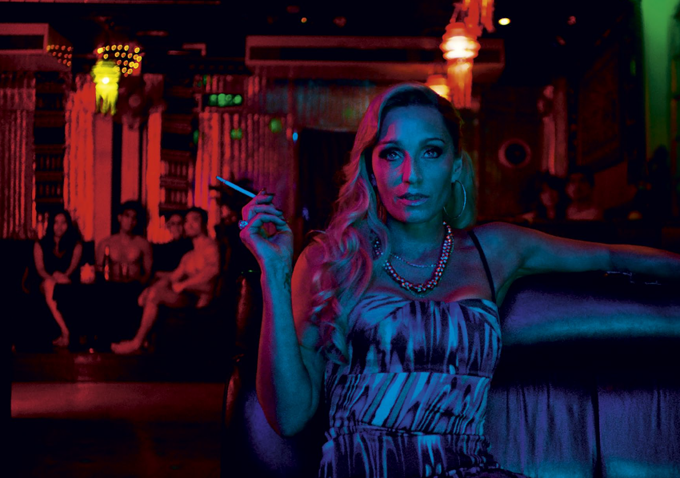
Only God Forgives

The Danish filmmaker Nicolas Winding Refn (Drive, Only God Forgives) is one of my favourite directors.

His most recent film, Only God Forgives, suffered something of a drubbing at the hands of the critics (and, from what I can tell, a bemused shrug on the part of the general moviegoing audience), but to me it only reaffirmed his alchemical mix of lush visuals, unflinching brutality and his masterful employment of archetypal figures.

So it’s hardly surprising that I enjoyed listening to this expansive interview, which apart from picking apart the engine behind Only God Forgives, draws parallels to some of his previous films – particularly Valhalla Rising, a Viking-era thriller starring Mads Mikkelsen which is reminiscent of both Werner Herzog’s work and Apocalypse now – a cocktail I can’t resist.

And how about you? Any good podcasts you’ve heard recently?