We Are the Hollow Men | The Bear – Season 4 (Christopher Storer et al, 2025)

“I don’t know what I’m like”.

Carmy’s confession in the final episode of the fourth season of ‘The Bear’ is an existential wrecking ball, all the more so because by now, loyal viewers can easily – nay, with the glistening, wretched smoothness of tragic inevitability – chart the origin of that realisation.

A clenched man who has willed himself into a new persona that is all about end result, all about proving yourself at every turn… the embodiment of the truism that ‘you’re only as good as your last [project]’. 

Of course you don’t know what you’re like, you dumb fuck – you never even considered that you could be you. That you could be *a* you to begin with. 

In Carmy’s case, the the surface story-metaphor and plot engine is of course tied into him being a superstar chef – a career-rung he only managed to climb after accumulating a fresh barrage of abuse to complement the legacy-pain he suffered under the auspices of his volatile alcoholic mother. 

But like any good metaphor, it is not there to exclude and close off but to include anyone willing and keen enough to pay good attention to what’s going on. 

Showrunner Christopher Storer must have made Robert McKee proud, whether he knows it or not or whether he likes it or not. I’m referring to one of my favourite takeaways from McKee’s ‘Story’, in which McKee is actually channelling someone else – I forget who it is, and I actually think it’s one of those bona fide lines whose original utterer has long since been lost to memory, and it’s now become community property – and it’s this: 

“If the scene’s about what it’s about, you’re in deep shit.” 

Of course The Bear isn’t ‘just’ about cooking. Of course it’s not ‘just’ about the travails of running a catering establishment (or two) in downtown Chicago. 

But Carmy’s mistake is assuming that life can in fact be just that. That if life becomes limited to ‘just’ that one thing, everything will be okay. After all, this is a form of self-annihilation that he can easily justify and perpetuate because it has the potential to create joy for others. Who doesn’t love good food? And the community feeling of a restaurant – HIS restaurant – clearly justifies him erasing everything else by that. He’s performing a service. Nay, he’s a martyr. 

Until the cracks start to show. Until we realise about how his ego is running things to the ground. An addiction to excellence is just another addiction after all, and you chase the high in ever more elaborate ways. In Carmy’s case, this becomes manifested in him changing the menu every night to accommodate a twisted idea of greatness and abundance, draining both his staff and the restaurant’s already-on-thin ice resources. 

That is the hypnotic fallacy that looms large over many a quest for ‘greatness’ in any given field, when it’s employed as a tool of evasion by damaged men (and let’s face it, it’s mostly men who are afflicted by this because it’s mostly men who get access to this arena – see Sydney’s journey in The Bear itself as a useful bit of contrast).

“If I break through an undeniable barrier of greatness all of my previous problems and traumas will become irrelevant because I will have ascended a higher plane, where I will be impermeable and indestructible, and the thought of my mother driving her car through the living room won’t ever bother me again, ever. It’s like that. Trust me, it’s like that. It will be like that. Believe, just believe.” 

But Carmy doesn’t want to become a god. What he really wants – what he really needs – is to become a real boy. He’s a Pinocchio with no Gepetto and no fairy and no Jiminy Cricket. (The Whale is the Bear is the bear is the bear…). 

And so much of Hollywood is ostensibly about this. So much of our mainstream storytelling pays lip service to an idea of what “just be yourself” means. ‘The Bear’ even risked having its version of the manic pixie dream girl in Molly Gordon’s Claire (she even had a cutesy nickname: Claire-Bear!) but luckily that trope was swerved into an opposite pathway and in so many ways, it could only ever be that way: who could possibly be more manic than the Berzatto’s anyway? 

But Carmy is so divorced from an idea of a foundational self that even the mere idea feels ungraspable. Jeremy Allen White’s glassy, thousand-yard stare isn’t a placid, contemplative mode – he’s reaching deeper and deeper into a vast nothingness. 

All of his motions are the repetitive striving of a crazed phantom. He has no access to generative movement, growth and interaction and so settles into what he knows and just runs in place. 

If only his food production were a ritual. It is a ritual, or it could be. If only the running in place were the ecstatic dancing of an indigenous tribe calling forth rain, a good crop… anything that would serve the wider community. 

But instead, it’s a stomping down to silence another tattoo. A beat whose sole aim is to stomp on the mere notion that you are a person at all. 

Here we go round the prickly pear  

Prickly pear prickly pear  

Here we go round the prickly pear  

At five o’clock in the morning.

Streaming through a strike | Beef, Dead Ringers, The Bear

The things you take for granted.

Like the vast slew of hard-hitting, boundary-pushing streaming TV shows that manage to both hook you along for an escapist journey that also makes you think of the world you’re living in, RIGHT NOW, for all that you live on a tiny speck of island in the middle of the Mediterranean and said shows would be conceived and shot oceans away.

(Though the latter may not always be true — some would be filmed closer to home, in jurisdictions with comparatively weaker film unions, but that’s a story for another day. Or is it?)

Shows like Beef, Dead Ringers and The Bear: a powerful but eclectic bunch (I know I’m late on the last one) and an example of the kind of stuff we’ve learned to yes, take as a god(s)-given gift without questioning its provenance.

But the currently-ongoing writers’ strike puts what we take for granted into real perspective.

Funny Feud: Steven Yeun and Ali Wong in Beef (Netflix)

When I posted to my socials about how much I was enjoying BOTH Beef and Dead Ringers, the enthusiasm came thick and fast for the former: a zippy-snappy comedy-drama forged by the joint behemoths of Netflix and A24; a charged melange of commercially friendly adrenaline-hit episodes and an arthouse-boosted satirical, observational backbone (that one of its two main leads is a professional stand-up comedian by day surely helped channel some that energy).

But few seemed to be aware of Dead Ringers, despite its starring the quasi-generation hopping, quasi-household name of Rachel Weisz (multiplied by two, no less). Here’s a show that seems to be playing all its cards right: like FX’s Fargo, it is a legacy reboot of a cult classic film — in this case, David Cronenberg’s 1988 surgical fever dream opera, conducted by Jeremy Irons times-two — and, again, it stars an actress we’ve had a chance to fall in love with over and over again in projects which range from award-baiting costume dramas to prestige espionage thrillers and endlessly rewatchable action-adventure capers. And this is hardly about Weisz taking a swing to give a newbie a chance: the show is penned by Alice Birch, a regular scribe for a little show by the name of Succession.

Double Trouble: Rachel Weisz in Dead Ringers (Amazon Prime)

But just like Variety‘s article on the matter states, the gold rush for shows has led to a saturation point that’s created an absurd scenario, where even projects with the marquee-est of marquee actors struggle to find elbow room in this crowded space: “Do you remember the Julia Roberts series on Starz last year? What was it called? How about Samuel L. Jackson’s series on Apple TV+? And they were good shows.”

Dead Ringers is also a good show. Not as easy to watch as Beef, certainly — for all the moral wincing Beef pinches at, DR squeezes the corkscrew in far deeper while cackling at your pain — but to me, at least, it brought back memories of another favourite yet hard-done-by programme: NBC’s (or should we say most emphatically above all, Bryan Fuller’s) Hannibal, once again starring a couple of Hollywood primed behemoth thespians in roles of a lifetime.

Both DR and Hannibal are pointedly indulgent programmes, more in terms of tasteful production design than anything requiring a surfeit of digital effects (though I’m sure its painterly bouts of bodily violence did require some tinkering in that regard). It’s the kind of stuff that gets made when both literal and figurative stars are aligned.

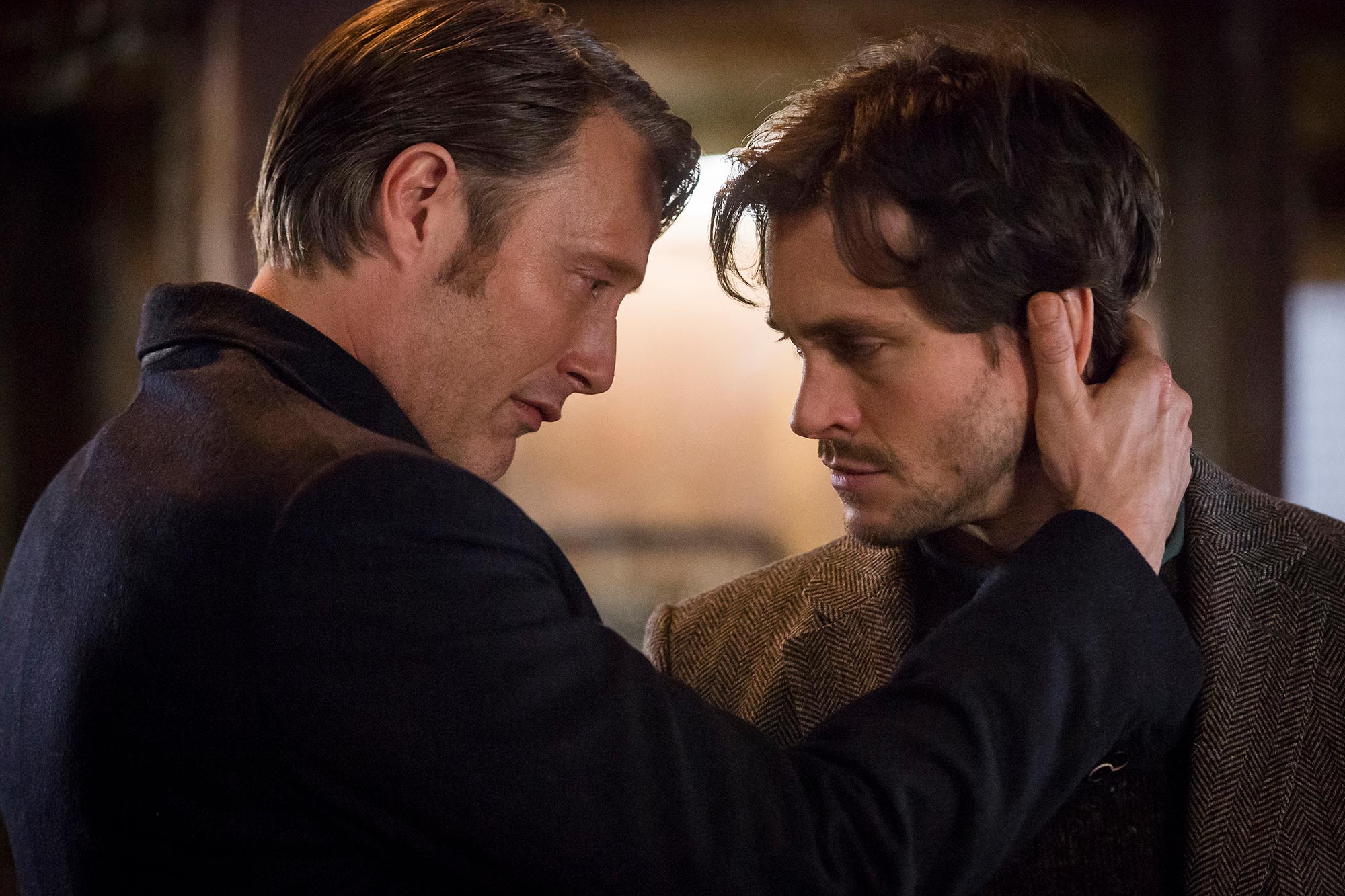
Love Crimes: Mads Mikkelsen and Hugh Dancy in Hannibal (NBC)

But they’re also the shows that risk getting buried under the avalanche of material that the streamers have insisted on churning out to appease the gods of growth. A malaise that has infiltrated many areas of our life, for sure, but that’s how it’s manifesting itself here, among the very shows that we settle down to watch after our own daily reckoning with what’s asked of us by late capitalism.

It may not be as baroquely pretty as DR or Hannibal, and neither does it attempt to chase the zeitgeist like Beef, but The Bear — whose characters traffic in literal beef! — may serve as the best compounded allegory for this mess.

Just like we tend to forget about the writers who toil away to conceive of the avalanche of shows we not only take for granted, but that we are actually spoilt for choice over, so would a (largely off-screen) clientele fail to consider the full extent of the sacrifices made by the chefs delivering up signature beef sandwiches in The Bear.

Pressure Cooker: Jeremy Allen White in The Bear (FX)

It’s not so much about stoking a dormant guilt in us. That would defeat the purpose, and even be counter-productive. It’s also not about some passive idea of ‘awareness’; of simply paying tribute and showing appreciation and then flipping back into default mode a second or two later.

But it may be about remembering that we watch these shows primarily because they explore the things that make us people… as stylistically exaggerated and/or excessively zoomed-in as they may be. And if the people making them are sidelined — either through dismal pay conditions or by defaulting to AI solutions — well, that deflates the whole point of watching these shows in the first place, don’t you think?