No agency: The patchwork creations of Frankenstein’s Army are a perverted steampunk fever dream
While Schlock Magazine gets its ‘Monster March’ on the road, I troop away with my own, starting with a shit-and-mud caked gem.
That there is something both liberating and enslaving about the monster is a well-worn trope in both popular culture and popular discussion. ‘You take something away, you get something back’ is part of it: monstrosity can signify exclusion and enslavement, but by that same token it can also mean that the monster is freed from the rat race of day-to-day existence. By destiny or design, the monster is plunged into a skewed world, which can yield to plenty of advantages if they play their cards right… that is, given that the monsters in question have any cards to play at all, or if they do, whether they have the cerebral capability to process the rules of the game in question.
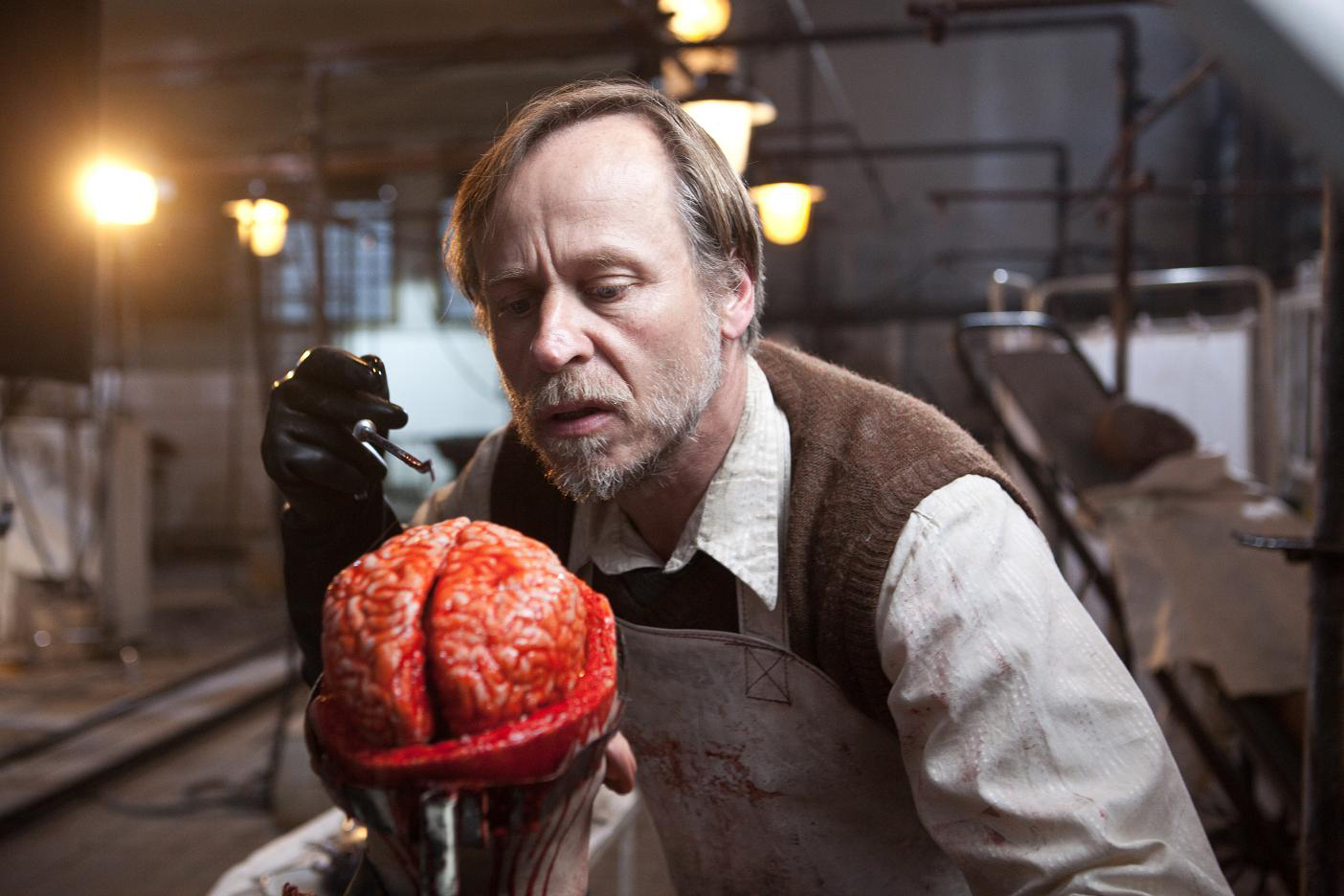
The monsters of Frankenstein’s Army (2013) certainly have zero agency. Nazi cyborg grunts for the titular Josef-Mengele like throwback to Mary Shelley’s famous doctor, they shuffle along, showing off their freshly grafted bodily modifications with automated – but still menacing – glee. What’s more interesting though is Dr Frankenstein’s (Karel Roden) justification for his experiments… at least, the justification we’re given at the end, which feels like a hurried, tacked-on thematic appendage suited both to his in-film creations and the meta-film’s messy raison d’etre.
Frankenstein, you’re barmy: Karel Roden as the titular mad scientist
The fascists he – ostensibly – works for and under are “insane”, Frankenstein admits. But so are communists and capitalists. he declares. His creations, on the other hand, made entirely of the human contradictions that lead to war, can in fact be used to smooth the same contradictions out. The scene in which the doctor attempts to collage a fascist brain with a communist one is an explicit illustration of this, of course, but it’s also a reminder of how vulgar pulp can remind us of what monsters are ‘for’ in the first place.
A version by Pete Yorn was heard in the original Hellboy (2004), also directed by Del Toro. Something of a logical choice given the subject matter, even if the connection is a shallow one (i.e., limited to the song’s title). Yorn’s jauntier version certainly strips the song of its atmospheric sense of foreboding. Which is just as well in this case, because even though Hellboy – and Del Toro’s films in general – may have its creepy gothic touches, it remains a quirky superhero romp at the end of the day.
PJ Harvey’s version, originally commissioned for another audio visual project – this time the British gangster TV series Peaky Blinders – feels right for gothic melodrama Crimson Peak, at least insofar as the trailer suggests. Harvey’s pained vocals offer a nice contrast to Cave’s hard, stark imagery.
It’s a dynamic that matches my expectations of Crimson Peak itself. It appears to be a ghost story of the Victorian variety and as such, one that would by definition rely on subtle scares, rather than the outre, primary-coloured flourishes Del Toro is known for, and which he doesn’t appear to be shying away from here. I anxiously await to see how the twain will meet – if it does at all – come October.
The Oscar race is underway, with its depressing churn of predictable bland shoo-ins like The Imitation Game and The Theory of Everything, coupled with the politically vile (not that the Academy cares) American Sniper and the scattershot and smug mess that is Birdman. I don’t hate all of the top contenders, exactly: Boyhood and The Grand Budapest Hotel are works of singular artistic vision – if they are nothing else, they’re that – and Whiplash is a fun monster thriller masquerading as a musical künstlerroman.
But out of all the films I’ve watched during the holiday season and just about beyond, it’s not decorated ‘art dramas’ – to use Noam Chomsky’s charming descriptor for middlebrow awards-bait – that made me stand to attention. That honour goes to the workmanlike talents of Adam Wingard, whose You’re Next (2011) and The Guest (2014) captured my imagination and made me feel like a kid again.
My good friend Krista Bonello Rutter Giappone described the former film as an adult version of Home Alone in a lot of ways, and taken on those terms, Wingard’s high-concept but low-budget home invasion thriller works a treat. Extra geek points for casting fellow indie directors Joe Swanberg and Ti West, along with a matronly role from the formerly oft-naked Barbara Crampton, who furnished many a young boy’s burgeoning sexual fantasies in the cult splatter fests envisioned by Stuart Gordon (and often based on the works of HPLovecraft). But the film thankfully doesn’t waste too much screen time on geeky winking and nudging, instead getting on with the violent and inventive-prop-heavy job at hand with brutal gusto and a healthy dose of black humour. There’s no excuses made for the moral implausibility of its central premise (and twist), nor for the explained-away survival skills of its Australian protagonist, Erin (Sharni Vinson), and that’s fine. You’re Next belongs to neither of the flogged-horses of contemporary horror – torture porn and found footage – and it gets extra points for me on that basis alone.
The Guest is similarly un-trendy in its evocation of meaty genre thrills of yore: this time the action thrillers of the 70s and 80s, albeit with a Drive-like sonic wash courtesy of an evocative ear-worm of an electro soundtrack. Its narrative anatomy appears to suggest a military thriller brimming beneath the (suburban) surface. But as the John Carpenter-esque opening credits font suggests: we’re entering into Halloween territory, and if this weren’t clear enough already, the film is set during Halloween too. But again, the references don’t call attention to themselves, and Wingard commits to his material and his influences to craft something that’s a direct descendant of a lineage – pulpy as it may be – and not a threadbare imitation with references stapled on. What this means is that we look forward to every lurid twist and payoff, and that Wingard delivers it. Dan Stevens, formerly of Downton Abbey, also ‘gets’ what the project is all about: it’s a loving tribute, not a cynically knowing one.
Although it garnered a generous clutch of positive reviews, The Guest fared abysmally at the American box office. But that’s to be expected, really. Wingard’s films have been hatched into a cinematic atmosphere that favours either young-adult reboots and/or superhero epics on the one hand, and hyped-to-death awards bait on the other – the latter of which ends up being more about the viability of their stars than the story they occupy.
But I think Wingard’s films remain important aberrations in the scene. Freed from the insipid and facile ‘irony’ of most latter-day B-movies, but possessing a canny intelligence that helps them rise above morass, they are primordial and fully pleasurable experiences. Like the splatter-heavy but vivacious early short stories of Clive Barker, they eschew subtlety and good taste to tap into the childish – not childlike – anarchic side. Sure, Bunuel this ain’t – but at least it’s something akin to Gremlins.
And Hollywood needs a similar injection of crazy, stat. It needs wilder dreams. Sleep of reason produces monsters, and all that…
“I rejoice at accepting [the award] for, and sharing it with, all the writers who were excluded from literature for so long, my fellow authors of fantasy and science fiction—writers of the imagination, who for the last 50 years watched the beautiful rewards go to the so-called realists.
“I think hard times are coming when we will be wanting the voices of writers who can see alternatives to how we live now and can see through our fear-stricken society and its obsessive technologies to other ways of being, and even imagine some real grounds for hope. We will need writers who can remember freedom. Poets, visionaries—the realists of a larger reality.”
“It’s tempting to think that we might do without these kinds of distinctions altogether. Why not just let books be books? The thing is that genre doesn’t have to be vexing. It can be illuminating. It can be useful for writers and readers to think in terms of groups and traditions. And a good genre system—a system that really fits reality—can help us see the traditions in which we’re already, unconsciously, immersed. As it happens, there is such a system: it was invented by the Canadian literary critic Northrop Frye, and laid out in his 1957 masterwork, Anatomy of Criticism.”
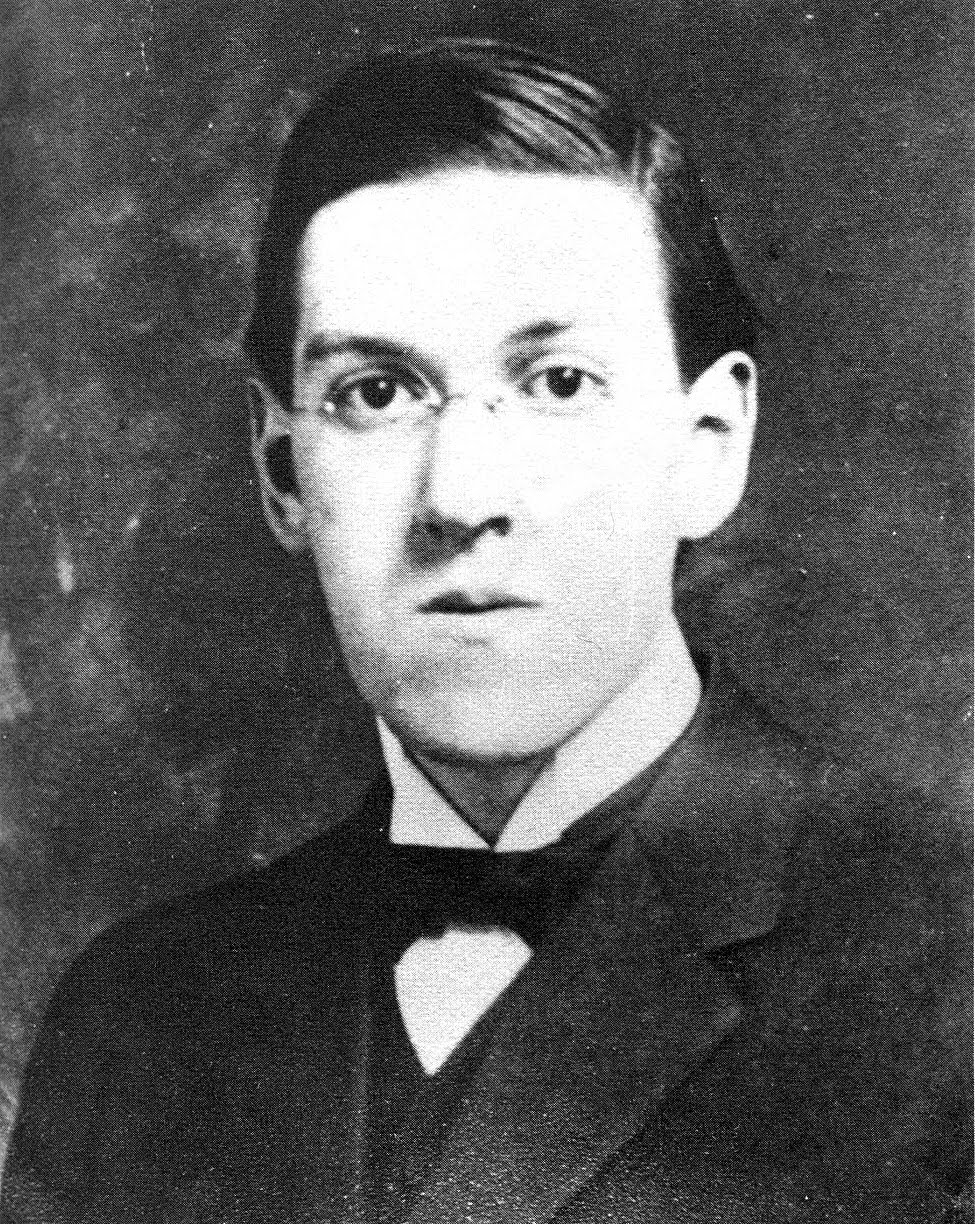
“Lovecraft’s quality is obscured by his difficulty, and his difficulty is obscured by his popularity. If Lovecraft isn’t seen as a difficult writer, it is because of the pulp idiom in which he worked. [Jonathan] Franzen points to college as the place where people are made to read difficult books, but Lovecraft is an adolescent fascination. Lovecraft demands the careful attention that only a teen boy with little else to do – no high school romances, no sports practice – can muster. Lovecraft’s pulp provenance, and early spike by Edmund Wilson, kept Lovecraft’s work from being taken seriously. Only over the past twenty years, with reprint volumes via Penguin Classics and Library of America, with champions such as Michel Houellebecq and Reza Negarestani has Lovecraft earned a place in what we used to call the canon (while making quotation marks in the air with our fingers, notch).”
*
These are all problems that have been burning at my brain in some form of another for as long as I can remember (slight exaggeration, but it certainly feels that way). Because I take this very seriously for whatever reason – friends and family who know me intimately can feel free to psychoanalyze away – I’m driven to find an evolutionary root to our need to divide up literature into genres, and then argue about it endlessly.
Cards on the table: if I’m a follower of any critical school on this front at all, I’m a follower of Frye’s. His organic view of genre both suits my needs as a writer and provides me with an inclusive argument about genre that, ostensibly, short-circuits going-nowhere binary arguments on the issue. Also, there’s a pervasive paradox in the way I process this whole thing: I hate the idea of genre as segregation, but I don’t want us to do away with recognizing genres, because there’s an aesthetic pleasure in picking out what belongs to which tradition.
That Edgar Allan Poe influenced Lovecraft who in turn influenced Ridley Scott and Stuart Gordon and Caitlin R. Kiernan and Nick Mamatas and Cradle of Filth and countless others, and that the details stolen from Lovecraft by each of these artists are traceable to Lovecraft but still distinct, and that this intertextual richness evokes a kind of hopeful reminder of the prodigious human imagination, as it stretches across generations.
But on a more universal note, I will suggest that genre stems from a combined need for both INDIVIDUALITY and COMMUNITY. In this pantomime debate between the ‘literary mainstream’ and the ‘genre community’, the literary side is ‘clubby’ in the original sense of the word: the domain of an elite that gatekeeps itself into a privileged minority, with all the attendant ‘real world’ social implications of that.
While the ‘genre’ community, on the other hand, is seen as a regressive ‘cult’ circle that turns its back on the ‘real world’ in favour of a vacuum-sealed aesthetic that often favours the tried and tested over any attempts at current social commentary or formal innovation (perhaps the Pre-Raphaelite Brotherhood is an iconic example).
But this perception – the pantomime is very much a perception – is made doubly complicated by the fact that we’re discussing works of art here. Leaving aside value judgements of the individual works of art in question, the reason why the genre debate will never settle into a peaceful resolution is because we’re asking the works of individuals to answer to the needs of a community, however large and nebulous this community may be.
There will always be mavericks, trailblazers, and ‘exceptions to the rule’. But even declaring that the mavericks are all that you like places you in a double bind: each maverick will have their influences, and in each influence – much like Lovecraft’s fish-god mongrels from Innsmouth – lies a genetic code that can’t be denied, and which ties back to a tradition.
Traditions are what genre is built on, and tradition will be something not even the most opaque of ‘literary’ fiction would be able to deny… strain as it might for originality and freedom from market constraints and critical labels.
We all want to be ourselves, but none of us want to be lonely.
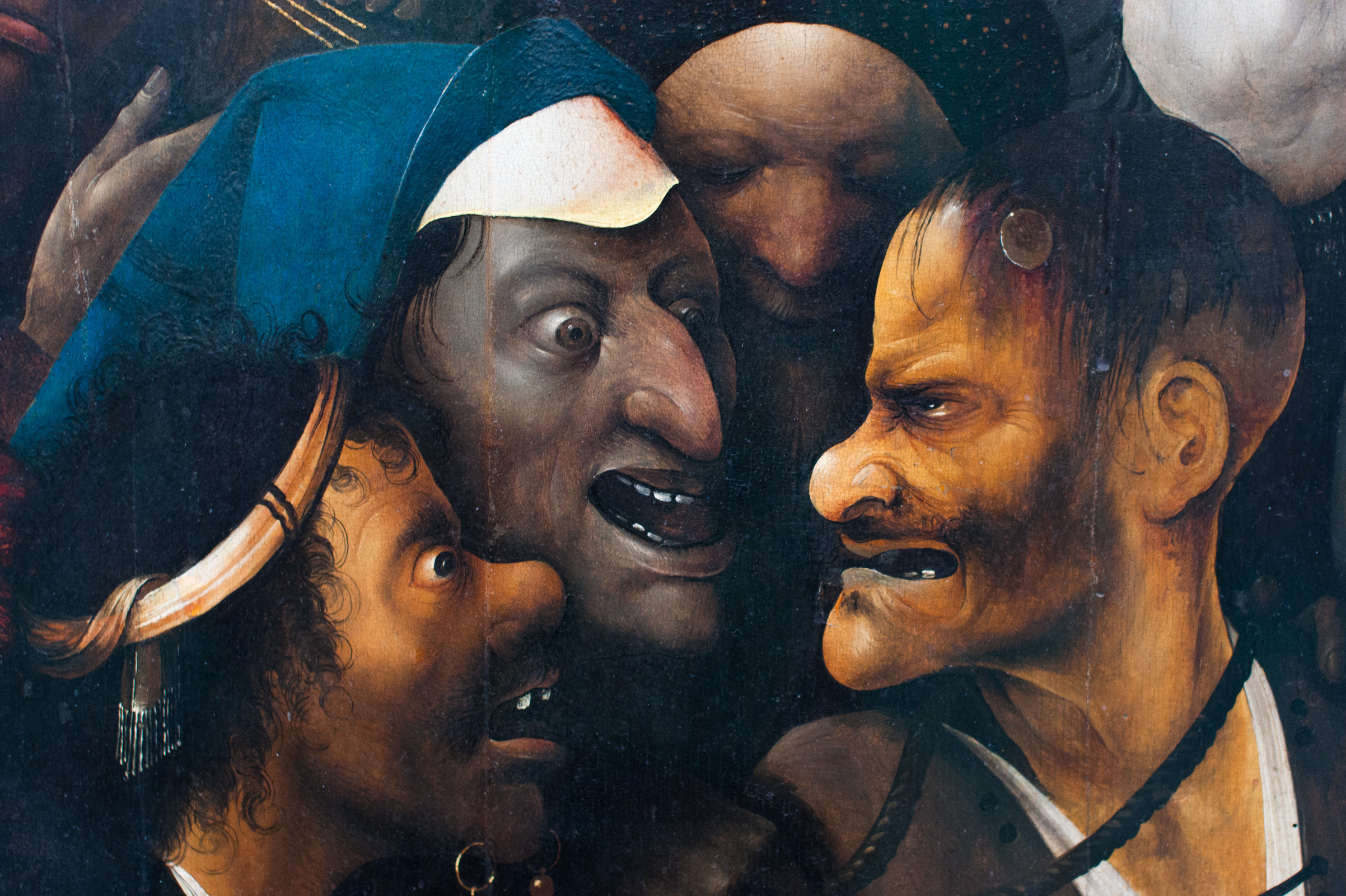
Christ Carrying the Cross by Hieronymous Bosch (Detail; c. 1515-1516)
“…recent studies suggest that people behave with more charity if they’ve just gone upstairs and less if they’ve just gone down – if studies like that weren’t just an enormous pile of crap. There’s science and there’s science, is all I’m saying. When humans are the subjects, it’s mostly not science.” – Karen Joy Fowler
Carmen Bicondova as soon-to-be Catwoman Selina Kyle in Fox’s Batman prequel series Gotham
The Fox network’s Batman prequel series Gotham looks to be a solid but unremarkable bit of hokum, if this week’s pilot is anything to go by. An otherwise competent-enough police procedural, it relies far too heavily on Caped Crusader brand recognition, hoping that none-too-subtle “a-ha!” moments revealing an early version of Batman’s rouges gallery will be enough to make us sit up and pay attention for longer than a couple of episodes.
Still, its inaugural episode made me look back at some of my favourite Batman stories in non-comic book media. I’ve narrowed it down to a top three – a top three of features I don’t mind re-visiting on occasion.*
3) The Dark Knight (2008)
The late Heath Ledger as The Joker
There are only a handful of films I’ve watched in my life time that were bona-fide ‘events’ at the cinema. Not even a handful… off the top of my head I can think of two, maybe three films, tops, that weren’t just successful genre blockbusters but long-awaited, almost social events by dint of their pre-screening buzz and subsequent pop culture impact.
Star Wars: Episode I – The Phantom Menace (1999) was the first. Despite the fact that it disappointed me even though I was an easy-to-please kid at the time, George Lucas’ return to the sci-fi/fantasy world that made him a Hollywood pioneer felt like some kind of watershed moment: never mind its intrinsic worth as a film – it was a monumental gesture on Lucas’ part that bridged two generations of fandom, right at the cusp of the internet revolution, which lent fuel to the fire of its many detractors.
Following closely on its trail was a far less controversial film – though its sequels proved to be a fast-tracked mirror image to the disappointment caused by the Star Wars prequels – which I won’t hesitate to call a modern masterpiece: The Matrix; a cyberpunk collage which wore its homages proudly on its sleeve but which was also animated by a pioneering energy.
The Dark Knight was the third and final one that comes to mind – the only example I can think of from past adolescence.
There are several reasons why Christopher Nolan’s sequel to Batman Begins (2006) struck a chord with me (along with many, many others worldwide). Its escalating tempo perfectly mirrors the chaotic, all-pervasive nature of a terrorist attack (relentlessly topical for all of us post-9/11), with Nolan perfectly balancing blockbuster friendly action with what is now referred to a ‘grimdark’ approach to superheroics. But instead of coming across as too sombre for its own good, Nolan’s seriousness is both gripping and infectious. He commits to the material in a way that doesn’t feel preposterous or disproportionate, in a way that’s been justifiably compared to Michael Mann’s Heat (1995).
But it’s unsurprisingly Heath Ledger’s performance as the film’s key antagonist, The Joker, that keeps me returning to the film. Over and above the tragic romance of Heath Ledger being reported dead soon after the shoot wrapped, there’s something magnetic about his performance that makes it a joyous thing to experience.
Yes, it’s disturbing and dark – like his director, Ledger grabs the role by the collar and doesn’t let go, diving head-first into the nihilistic psychosis of his character. But despite being the orchestrator of the film’s panic and chaos, he’s above all fun to watch, a spirited grotesque in the spirit of Johnny Depp’s Jack Sparrow who is enjoyable to experience even in isolation, as his introduction to the parliament of Gotham mobsters amply displays (and rewards in repeat viewings).
2) Batman: The Mask of the Phantasm (1993)
The Paul Dini/Bruce Timm Batman Animated Series – as transmitted (and dubbed) on Italian TV – was one of the defining cartoons of my childhood. Apart from bolstering my love of Batman lore, it also imbued in me a love of film noir and Art Deco.
It gives us a Batman origin story beyond the my-parents-were-murdered sequence, as well as an uncharacteristic and finely fleshed out romance. There’s no bimbotic Vicki Vales here; in Andrea Beaumont Bruce Wayne gets a mirror image of his traumatic obsession. Also packing in a great Joker story, the feature-length ‘Phantasm’ exquisitely built on the foundations set by the animated series.
Playing into Batman’s noir appeal while remaining kid-friendly, it also maintains a certain decorum absent from subsequent – and concurrent – movie adaptations. It certainly has none of the camp excesses of the much-maligned Joel Schumacher films, and neither is it particularly close in tone to the comparatively toned down Tim Burton opening salvos.
That’s not to say it doesn’t have a flair for the theatrical – just wrap your ears around Shirley Walker’s theme tune for a rousing introduction to this inspiring labour of love.
1) Batman Returns (1992)
Feline fling: Michelle Pfeiffer and Michael Keaton in Batman Returns
Nolan gets all the accolades and Schumacher gets all the hate, but it’s Tim Burton’s second (and final) sequel to his soujourn in Gotham that stays with me to this day – to the point that I re-watch it every Christmas (the period in which the film is set, all the better to amplify its Gothic excess).
It is the only Batman film in the franchise that takes on the core absurdity of the DC Comics character and runs with it.
But it doesn’t run with it in the same way that Burton’s successor Joel Schumacher ran with it; turning it into a camp carnival of steel bat-nipples and shiny gadgets and architecture. In pitting Bruce Wayne/Batman against the double-menace of feral jewel thief Selina Kyle/Catwoman (the never-sexier Michelle Pfeiffer) and the orphaned freak-cum-underground mobster Oswald Cobblepot/The Penguin (the never-uglier Danny De Vito), Burton showed that he understood the inner workings of Batman and his rogues’ gallery.
It’s about watching mad people in costumes tearing each other apart (which is as far as you can get from the moralistic, dead-serious drama-thrillers of the latter-day Christopher Nolan trilogy).
The snowy pall of Christmas time over Gotham city only reinforces the stylistically-heightened panorama: a truly Gothic sight if there ever was one, and a more than apt rehearsal for that other Burton-sponsored classic, The Nightmare Before Christmas (1993).
*This, incidentally, remains the ultimate litmus test for me when it comes to deciding what is a ‘favourite’ – particularly in this day and age when daisy-chain social media gimmicks keep requesting usto make a favourite list of this or that. If you truly love something, you’ll keep coming back.
Samwise Gamgee returns to the Shire, in the final scene of Return of the King (2003)
“There is no safe place from the injuries of history; home as a place or a time of innocence can only be an illusion. But the poet doesn’t recover the bitter past to serve present grudges – his acts of remembering, his quest for identity are grounded in generosity.
“And from this sense of loss and recovery, this mix and merging, this reckoning with the complexities of the past, present national identity and patterns of belonging can be fruitfully formed. The way Walcott has worked the material of his complicated memories and inheritance in the Caribbean represents an exemplary openness to making a new model of the homeland, which doesn’t exclude, but rather includes, which doesn’t justify, but seeks to understand. No home is an island; no homegrown culture can thrive in permanent quarantine. We’re all wayfarers and we make our destinations as we go.” – Marina Warner
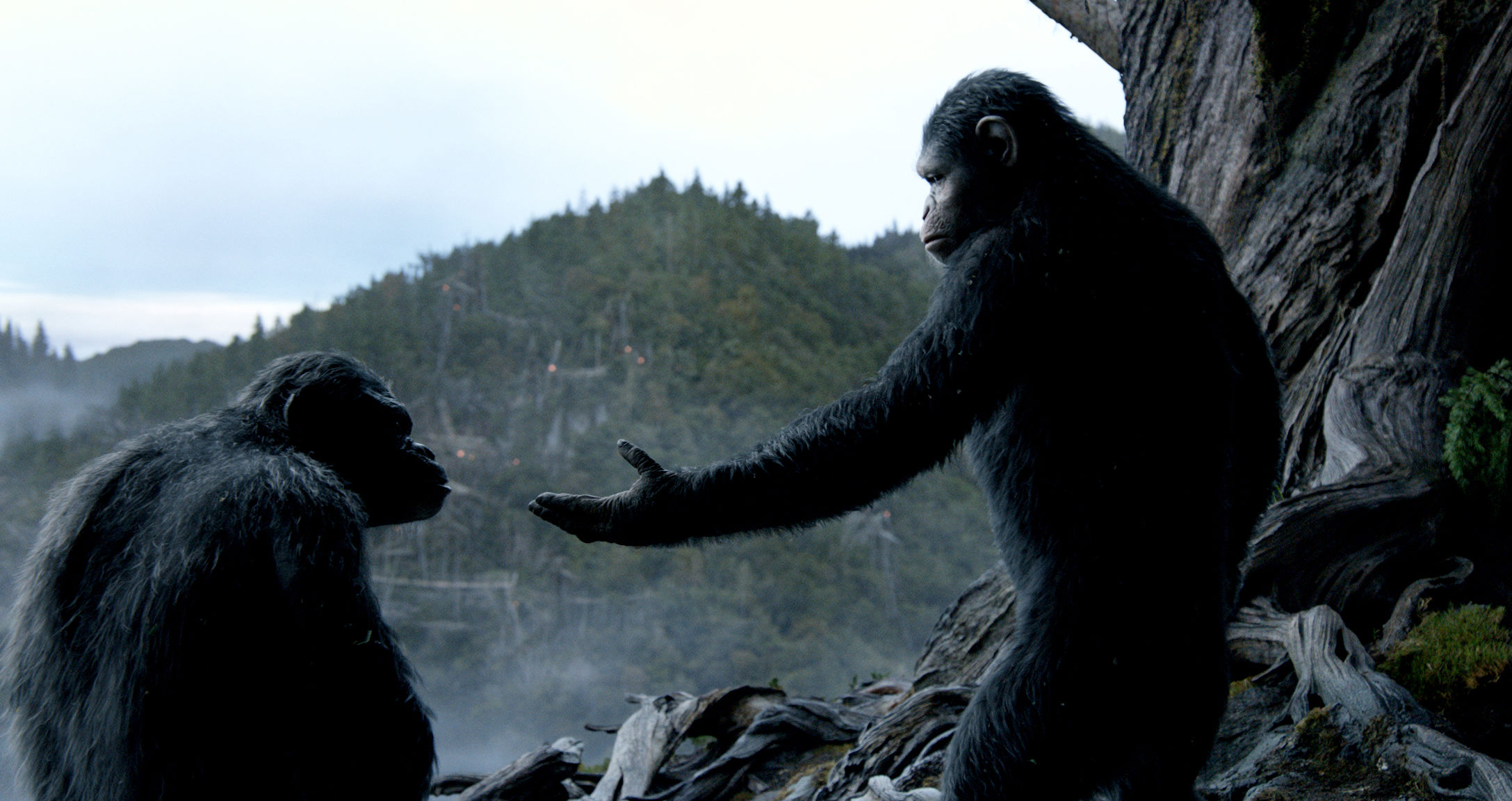
Toby Kebbell (left) as Koba and Andy Serkis as Caesar in Dawn of the Planet of the Apes
Watching Dawn of the Planet of the Apes – an entertaining and effectively realized action-blockbuster, by all accounts – reminded me of just how much the idea of home is related to complete, all-out aggression. It is one of the key justifications for war, and if it isn’t Hollywood blockbusters that remind us of it, real-life world events will, unfortunately, persist in doing their darndest to ensure that we do not forget.
From my sheltered and privileged standpoint, obsessing over national borders instinctively feels doubly surreal, as I – like many people of my generation, and many of those living in some kind of diaspora – have made the internet their second home. Cultivating and negotiating a virtual identity has become a direct part of who we are, and the more that shapes itself into the fabric of our day-to-day life, the more it will assume the likeness of an undeniable, self-evident and near-physical ‘space’ which we may feel justified in fighting over.
Even my workspace has apes in it
Beyond the fever dreams of cyberpunk – from William Gibson to The Matrix – the web has become so ‘normal’ that it’s not far-fetched to assume that it will soon adopt other, less pleasant features of human ‘normality’ – our insistence on waging border wars being just another one of them. The ongoing debate over net neutrality is one explicit portent of the above, but I’m sure there will be many related polemics to come.
*
Another thing that Dawn of the Planet of the Apes – or DOTPOTA, an acronym I love – brought to mind is the panicked and often messy way in which pop culture responds to contemporary anxieties, and processes ‘universal’ themes.
To my mind, the film is great because its ‘message’ doesn’t feel like a tacked-on imposition, but part and parcel of its conceit. Of course, Matt Reeves’ continuation of the Planet of the Apes mythology reboot doesn’t really say anything new about the enduring phenomenon of border conflicts, or our stewardship of the earth. But I’d still like to think that it contributes to the discussion in its own way.
Though even the word ‘discussion’ feels wrong here – it assumes a lilting, rational conversation about carefully ironed-out topics. Because what we in fact get is far more chaotic: the necessities of crafting a crowd-pleasing blockbuster in which talking apes do battle with economically compromised humans only allows lucid allegory to slip through up to a point.
Like DOTPOTA, Zero Dark Thirty is an action-intensive mainstream film shot with a gloomy palette that has become par for the course among blockbusters which aspire to court the critical consensus as well as the box office success that it is often assumed they would secure anyway.
(Largely blaming Christopher Nolan’s stratospherically successful Batman film The Dark Knight, critics of this pervasive aesthetic trend have taken to name-calling it ‘grimdark’.)
Jessica Chastain in Zero Dark Thirty
But unlike DOTPOTA, Zero Dark Thirty is about a very specific and very real event – a persistently controversial one, to boot. Katheryn Bigelow’s treatment of the steps taken to ensure the assassination of Osama Bin Laden is a fascinating watch even if you – like me – were unconvinced by its narrative thrust and troubled by its murky ethics.
Whichever way you slice it, ZDT was a brave attempt at tackling a very recent and morally, politically fraught scenario. In the end its internal contradictions forced it to devour itself, but only because Bigelow aspired to tackle her subject head-on, with as little aesthetic filters as possible.
This is where genre allegories like DOTPOTA have the upper hand. The way the message is processed is of course open to cynical interpretation: “It’s not really saying anything, they’re just re-treading secure narrative and thematic ground to ensure they make money at the box office”.
But the mere fact that it’s out there, doing its thing for a large audience who will enjoy it – or not – on the surface level to begin with feels like some kind of potential triumph.
*
Final question: as more of the world goes online, as more of the world does ideological battle online and as more of our personal identity is shaped and justified by our online presence, will the web be treated by poets much in the same way as the natural world has been treated in earlier times?
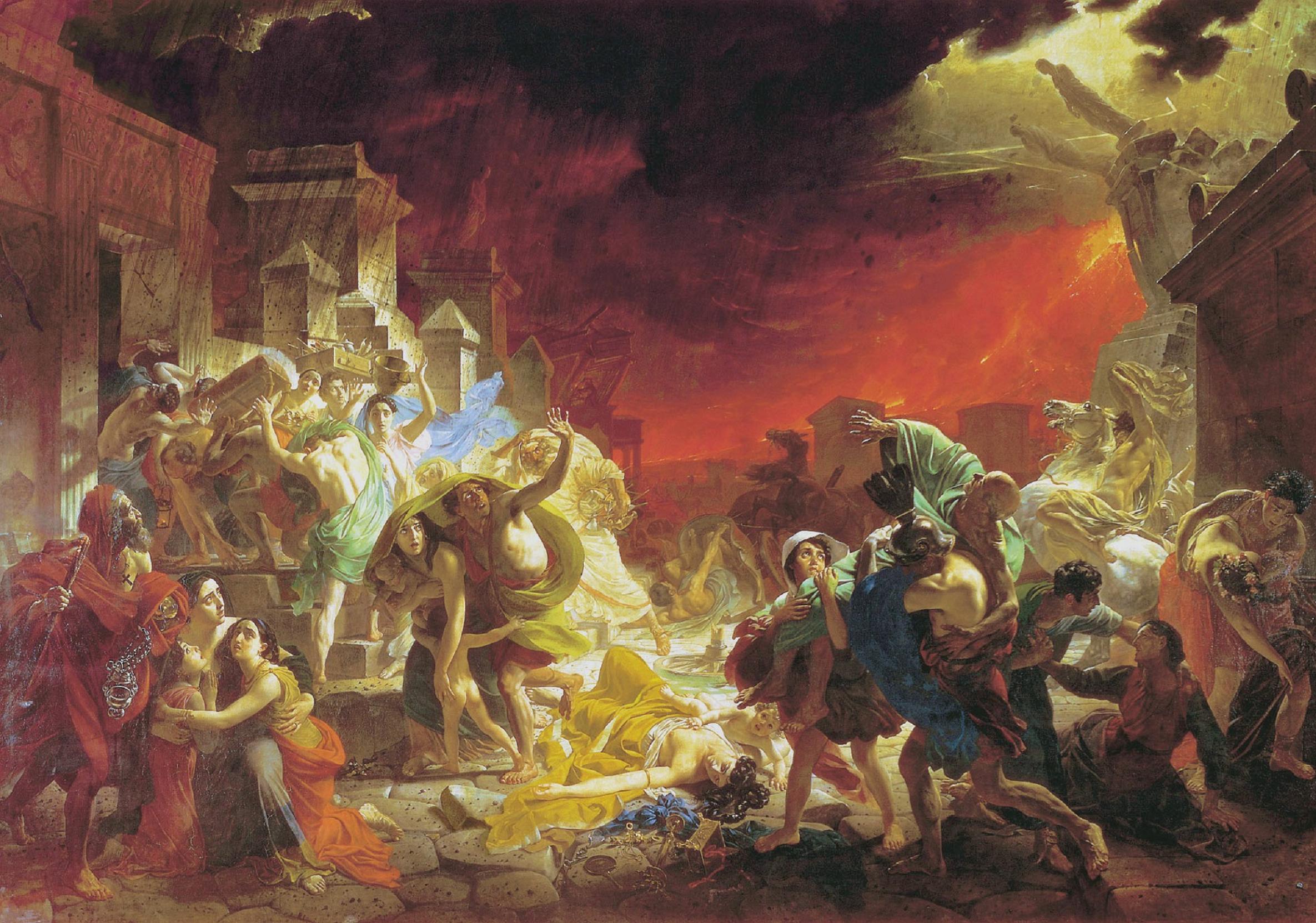
The Last Day of Pompeii by Karl Briullov (1830-33)
“When there’s a big explosion, it doesn’t really have a visceral impact on the audience if it’s just flinging people through the air. They know that’s just stunts. But if you fly people through the air and they then they hit something, it’s a lot better. And then if they hit something really hard — like, you know, a brick wall — it’s even better. And if they hit a kind of rough edge on that brick wall, then you’re getting to the good stuff. And then if what they hit breaks, then that’s the best.” – Paul W.S. Anderson
Niccolò and Maffeo in Bukhara, where they stayed for three years. They were invited by an envoy of Hulagu (right) to travel east to visit Kublai Khan. (Source: Wikipedia)
“Opium was the avenging daemon or alastor of Coleridge’s life, his dark or fallen angel, his experiential acquaintance with Milton’s Satan. Opium was for him what wandering and moral tale-telling became for the Mariner – the personal shape of repetition compulsion. The lust for paradise in ‘Kubla Khan,’ Geraldine’s lust for Christabel – these are manifestations of Coleridge’s revisionary daemonization of Milton, these are Coleridge’s countersublime. Poetic genius, the genial spirit itself, Coleridge must see as daemonic when it is his own rather than when it is Milton’s.” – Harold Bloom








 Soft Disturbances