The moon was made to mush and I poured it into the bowl and added water and stirred with my grandmother’s wooden spoon and I worried it would break, crack against the thick glop that refused to budge until I stirred and stirred harder, working against my fear of breaking until it rewarded me with an uninterrupted swirl.
The moon gave in to its new liquid shape and I was glad to have finally done something, anything.
The room in the tower with the wooden table the wooden cups tucked into carved holes made snug to fit. I hear that the other villages have tables of marble but, no matter.
The three baby giraffes had the cups to their chins. The table was high, at least on this it was enough – made just right to allow them to sit and drink without straining and distending.
It would have been something to witness them drinking the mixture in. I poured the moon from the bowl and into the three wooden cups with my backs to the baby giraffes. I imagined their eager, liquid eyes. Blackness, but not of night. The blackness of early innocence. Enveloping, pure.
Another source of pride, and I stung to resist it. The pride: pouring the moon so neatly into the cups that an equal gap was left up top. The rare, brief elegances. But this was not mine. This is where I was drawn, and I merely followed.
I set the cups down onto the gaps and now, at least, I could look. They did not look at me – they were too eager for their meal. But in this eagerness I found gratitude, and I held it warm to my chest. The warmth turned into the remembered words of the Edict: “You are to pour, the rest is theirs. You are to then turn and walk away. They will only flower in your absence.”
It was not in me to break edicts, least of all this one. So I allowed myself this one small thing, this one last thing: to look upon the giraffes as they drank the moon with a total abandon. The abandon of rest. The marker and promise at the end of my mission. All that makes edicts and towers necessary.
I took the spiral staircase and when I opened the wooden door that released me from the tower, I looked up to the moonless black sky and thought about the consuming gardens to come.
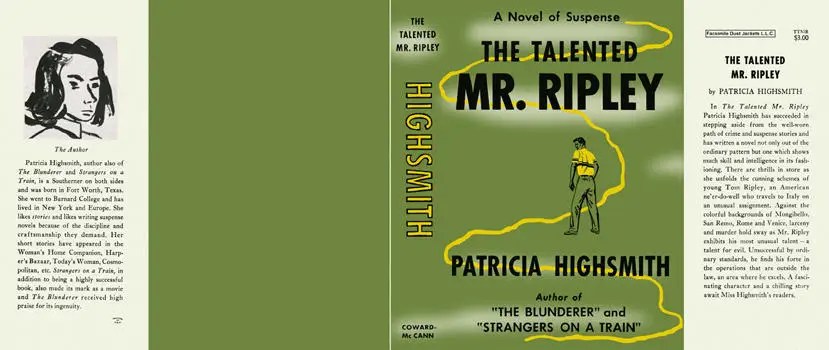
I’ve just finished reading The Talented Mr Ripley for the first time and I can’t help but think of the story as being essentially about what it takes to carry a narrative to full term.
I remain convinced that Patricia Highsmith was essentially transferring the challenges of writing a novel onto a character who has no qualms about committing murder to further his hedonistic aims, but who is then also burdened with having to cover his tracks after the deeds have been done.
Like an author of fiction, he responds to creative prompts emerging from aspirational ideas of aesthetic fulfilment: here, compare the novelist’s desire to craft a masterpiece that recalls and respects their aloof influences and predecessors, with Ripley’s murderously driving urge to be in a position to soak in the fruits of high culture at his own leisurely pace, no matter the cost.
But what follows after you’ve responded to the initial call is the far more careful and laborious work of follow-through, where impulse must be supplemented with a quick-thinking application of intelligence, sensitivity and rigour.
I’ve never watched any of the Ripley film/TV adaptations — I was waiting to finish the book — but of course I was familiar with the overall premise by osmosis. What surprised me about Highsmith’s novel when I finally got down to it was how prone to emotional hissy fits Tom Ripley is, against the calculating, Hannibal Lecter-style sociopath that I had previously pictured. It’s like he does actually have the full range of human emotions at his disposal. He just parcels that energy out in a way that’s generally at odds with how you and I would manage it.
This aspect of the story speaks to how artists — we’ll consider writers as the main focus here — will tend to isolate themselves by proxy, at least while they’re cultivating and executed any given work. I’m not pushing the misunderstood, outsider artist cliché here — I have good reason to be deeply sceptical of that cultural trope — but it’s true that a certain degree of observational distance is necessary for an artist to really focus and get stuck into the work.
And for writers, in particular, this can take on the tenor of detached people-watching. You’re putting characters in your story, and characters are proxy humans who need to feel more human than human for the reader: the reader will, in fact, be compelled to become one and the same with them for the book to really live up to the full potential of the phenomenon of fictional narrative… in exactly the same way that Ripley assumes and then subsumes Dickie Greenleaf’s entire persona (an act of cannibalism so insidious it may even make the aforementioned Mr Lecter blush).
Which means that while the people you’re watching go about their routines, your own will be thrown off-piste for a bit, and you’ll be venting either through the characters you’re puppeteering, or in oblique ways and habits that will register as strange to the outsider.
But much like Tom Ripley’s own ‘bliss of evil’, there is something to be said about the plan finally coming together. Putting Tom’s shocking callousness to one side — which you will as you’re reading anyway, because Highsmith is a master at all of the above — the pleasure of the novel comes with watching with morbid fascination at how our man not only covers up the bodies, but spins a story that convinces everyone: from an international array of law enforcement officials down to the victims’ nearest and dearest.
Like any writer worth their salt, Ripley knows what makes his cast of characters tick, and he knows when to tug at their strings and when to release. The most naked display of this allegory comes to the fore not through Ripley the murderer but Ripley the letter-writer. That’s when his cunning and skill at manipulation reveals the author’s brain at work.
The pen is mightier than the sword, indeed: or rather, it can serve as the civilised supplement to the sword’s blunt-force damage; providing an escape hatch from the animal realm of the murderous impulse and back to the showered, shaven and fragrant world of the cocktail-sipping chattering classes.
Of course, no novel is perfect, and neither is Ripley’s plan. Rerouting and improvisation is often necessary, and the utter unravelling of this delicate tapestry is never not on the table.
Consequently, another constant is the intermittent reappearance of blind panic: that demonic pulse at the core of us all — writers included — which beats out a tattoo that says ‘why did you even attempt this? It’s built to fall apart, and you know it’.
The fact that Ripley gets away with it means that Highsmith has given us a perennial cheerleader for our projects. If you’ve looking for a pep talk to motivate you while you plough through your drafts but (rightly) have no truck with superficial slogans and toxic positivity, the talented (and hardworking) Tom Ripley might just be your man.
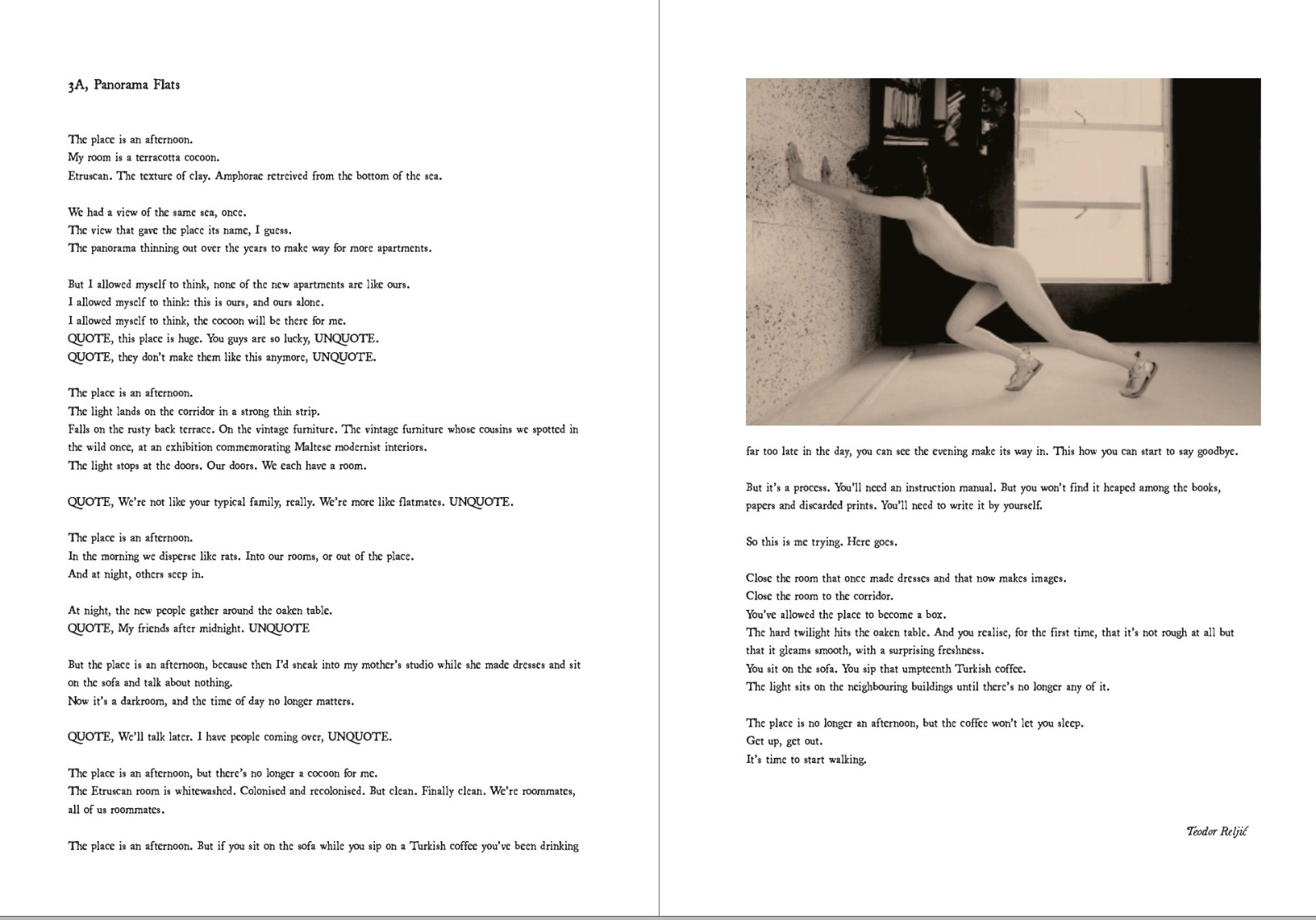
Poem read on the occasion of the ‘finissage’ event for JA! JA! JA! — an exhibition of print works, photography and installations by Zvezdan Reljic at R Gallery, Sliema.
Zvezdan Reljic is my father, and 3A, Panorama Flats is where our family was based for a number of years, and whose sofa featured as a prop in the exhibition.
***
3A, Panorama Flats
The place is an afternoon.
My room is a terracotta cocoon.
Etruscan. The texture of clay. Amphorae retreived from the bottom of the sea.
We had a view of the same sea, once.
The view that gave the place its name, I guess.
The panorama thinning out over the years to make way for more apartments.
But I allowed myself to think, none of the new apartments are like ours.
I allowed myself to think: this is ours, and ours alone.
I allowed myself to think, the cocoon will be there for me.
QUOTE, this place is huge. You guys are so lucky UNQUOTE.
QUOTE, they don’t make them like this anymore, UNQUOTE.
The place is an afternoon.
The light lands on the corridor in a strong thin strip.
Falls on the rusty back terrace. On the vintage furniture. The vintage furniture whose cousins we spotted in the wild once, at an exhibition commemorating Maltese modernist interiors.
The light stops at the doors. Our doors. We each have a room.
QUOTE, We’re not like your typical family, really. We’re more like flatmates. UNQUOTE.
The place is an afternoon.
In the morning we disperse like rats. Into our rooms, or out of the place.
And at night, others seep in.
At night, the new people gather around the oaken table.
QUOTE, My friends after midnight. UNQUOTE
But the place is an afternoon, because then I’d sneak into my mother’s studio while she made dresses and sit on the sofa and talk about nothing.
Now it’s a darkroom, and the time of day no longer matters.
QUOTE, We’ll talk later. I have people coming over, UNQUOTE.
The place is an afternoon, but there’s no longer a cocoon for me.
The Etruscan room is whitewashed. Colonised and recolonised. But clean. Finally clean. We’re roommates, all of us roommates.
The place is an afternoon. But if you sit on the sofa while you sip on a Turkish coffee you’ve been drinking far too late in the day, you can see the evening make its way in. This how you can start to say goodbye.
But it’s a process. You’ll need an instruction manual. But you won’t find it heaped among the books, papers and discarded prints. You’ll need to write it by yourself.
So this is me trying. Here goes.
Close the room that once made dresses and that now makes images.
Close the room to the corridor.
You’ve allowed the place to become a box.
The hard twilight hits the oaken table. And you realise, for the first time, that it’s not rough at all but that it gleams smooth, with a surprising freshness.
You sit on the sofa. You sip that umpteenth Turkish coffee.
The light sits on the neighbouring buildings until there’s no longer any of it.
The place is no longer an afternoon, but the coffee won’t let you sleep.
That’s not to say I haven’t been able to jot things down. And neither am I “out of ideas” or bereft of the required energy or confidence to keep on ploughing through the sentences and drafts.
It’s just that my current project is at a point where the drafts, the ideas and the characters need some time to get to know each other better. They’re talking at cross-purposes and on a vague, sun-bleached plan, which was mapped out by a remote authority seated in a comfy office and simply left out to the elements and the drafts, the ideas and the characters are forced to squint to make out the shapes which were once words or diagrams meant to take them to the next stage of their journey.
This probably just means that I need to take a break.
Which is funny to consider, when my writing schedule is essentially “whatever you manage in the one hour before you have to head out to go to work”. But a mental break from a specific strand from writing doesn’t necessarily mean stopping to write altogether. Even switching projects works, though arguably swapping over an ingrained, long-term writing practice for some experimental noodling could have an even greater restive (or restorative) effect.
***
Freedom in writing is always a relative term, for me… I’m deeply sceptical of the idea that an artistic practice implies a sense of spontaneous, intuitive and even anarchic liberation away from the strictures of mainstream society. If anything, I find that it actually requires a deeper and more neurotic commitment to some of these tenets, with the anarchism only made evident in the obsessive streak with which you double-down on them.
You can zone out at work, and go for the umpteenth cigarette or coffee. Household chores have definitive parameters, and even the most byzantine of bureaucratic tasks have some kind of ceiling. Clients will have deadlines, and even lovers have their ultimatums. Lovers, partners and friends also have physical bodies that tick away to sometimes endless-seeming, but ultimately finite desires and frustrations. They may be erratic but they’re never truly, entirely unpredictable for those of us who know a thing or two about how humans operate in general. And while they may expect a certain degree of telepathy on your end — and as annoying as such an expectation may be — they will never ask you to create and recreate them anew.
But your characters will. And this is why I think that Mary Shelley’s Frankenstein will always remain a reference point. I’m sure there’s a flurry of doctoral theses and obscure articles out there to prove the following statement wrong, but I’m always surprised that so much of our processing of that pioneering piece of sci-fi gothic literature is focused on the ‘scientific hubris’ reading, and so little on how it’s also a commentary on the act of creation. Yes, I’m sure the theological implications have often been made as well, but I’m referring specifically to how Victor Frankenstein could also be seen as the neurotic and nervous artist trying to come to terms with the horror of a first draft. (And also, how that first draft threatens to morph into something unexpected, and demands that more of these mutations be facilitated by dint of a fertile co-partner).
(I’m not trying to claim this interpretation as original. Those of you have links and PDFs, please pass them on. They are more than welcome).
So yeah, for me, writing is never about freedom but about finding the right straitjacket for the right moment. Or rather, the correct protective suit for whichever uncharted territory you happen to be traversing at the time. Because the territory will always BE uncharted, and populated by monsters to whom you’d not only have to teach language, but whose independence you’d have to facilitate and reassure. Let Victor Frankenstein’s fate be a cautionary tale.
***
Apart from being literally one of two or three annual events I legitimately look forward to each year, the Malta Mediterranean Literature Festival, organised by Inizjamed, often offers me a chance to experience writing in a looser and more immediate way to my default mode. More poetry, less novels. More of experimental prose, and less of the three-act structure.
It often results in me buzzing with a renewed fervour for the written word, experiencing precisely the kind of ‘break-that-is-not-a-break’ that I’d mentioned earlier. You encounter new writers without the aid of an algorithm: better still, right in the flesh. This adds wrinkles to your programme; unexpected experiences that open new doorways.
But there was a dash of welcome familiarity in this year’s edition of the festival. As an honorary member of the extender Inizjamed family, I’d assumed that I had some dibs on suggesting future festival guests. So a couple of years ago I started lobbying for the inclusion of Karin Tidbeck to the roster. Of course, as a subculture-rat since my early teens, my allegiance to specific groups will always trump pretty much all else: in this case, it’s the genre/speculative fiction community. I will always aim to advocate and represent of that literary class in my local stomping grounds, much in the same way I managed to do for Kali Wallace and Jon Courtenay Grimwood.
But I also felt Karin to be germane to Inizjamed’s festival in particular for more specific reasons related to their artistic practice and MO. A festival that comes with its own translation workshop attached, a multi-lingual, self-translating author is practically catnip. And a writer who so keenly identifies with liminal spaces can’t help but feel at home in any festival that deigns to include ‘Mediterranean’ in its title, and this particular one does so with a degree of conviction: operating with both intellectual rigour and humane generosity to create authentic spaces of encounter.
***
All of this largely a preamble to celebrate this year’s edition of the festival (as I did when I was lucky enough to participate back in 2018); to remind you that I got a chance to chat with Karin in print about their uncategorisable nature in the run up to the event; to brag about being allowed to ventriloquise for Karin in her absence from the grand finale due to a ridiculously early wake-up call the following morning; and to hopefully open this space back up for more regular, and looser, writings of this kind.
Especially now that I’m starting a new job in a field that’s relevant to my experience once again. Which is the perfect push and pull of the familiar and the new.
***
I mentioned the prolific (and gentlemanly) Jon Courtenay Grimwood above. During one of our in-person conversations (either during his Malta visit or a follow-up meeting in London, I can’t recall), I spoke admiringly of his substantial output, a lot of it filtered through different noms de plume.
He responded by stating simply, “Well, if I don’t write, I can’t think.”
Increasingly, I find this to be true in my case. It doesn’t necessarily mean that whatever I write will have any value at all; at least not in that early stage. And neither does it have to be some sort of revelatory, epiphanic distillation of the self at that given moment.
The mechanics of writing are their own reward. This is why every single shift away from the programme has value. Words remain words. They will serve you in different ways at different times, but they remain at your disposal.
Featured image: Authors performing at the final night of the 18th edition of the Malta Mediterranean Literature Festival, on 26 August 2023. From left: Tanja Bakic, Claudia Gauci, Karin Tidbeck, Simone Inguanez and Virginia Monteforte (photographer)
A young girl whose mother has committed suicide discovers she’s able to commune with ancient monsters, who have emerged from their slumber to wreak havoc on the over-developed, tiny planet of Mibdul.
‘Mibdul’ is a six-issue comic book mini-series written by myself, illustrated by Inez Kristina and published by Merlin Publishers. The first issue will be launched at Kixott on 14 April, and the party starts at 19:30. Said party will feature a signature cocktail, and early-comers will be rewarded by an open bar tab courtesy of our long-suffering but beloved publisher.
Now that the logistical stuff’s out of the way…
I’d like to point out that, much like the last few posts to appear on this sporadically updated page, Mibdul is a tribute to Marsascala. The place served as a hometown for both Inez and myself while we worked on the book, and the very idea for the comic came about after it was announced that the unspoilt patch of seaside land at Zonqor Point was given away to a Jordanian construction company.
The ‘American University’ project thankfully never panned out as per its worst threats, but at that point I needed a vent for the helpless rage that came over me and many others.
It is, sadly, a rage that continues to crop up every now and again, whenever the construction lobby which de facto rules the country proposes a fresh monstrosity.
We all protest in the ways we know best. At least, we should be allowed to. From each according to their ability. And my own tend towards a love of genre fiction. As such, Mibdul taps into the ‘space fantasy‘ popularised by Star Wars, with a dollop of cosmic horror and the freewheeling surrealism of Euro-comics.
Mibdul will be published as a monthly six-issue series, starting from April and running through to September. We hope to see you at the launch for Issue 1. But in the meantime, do avail yourselves of the pre-publication offer, to have each issue delivered to your door upon release, at a discounted price.
With A Vipers’ Pit (Is-Sriep Regghu Saru Velenuzi) enjoying a healthy run at Eden Cinemas, I thought I’d compile a little guide for prospective viewers before they take a chance on our political thriller-family drama-literary adaptation.
Response has been better than anything I had every hoped for: reviews ranges from ecstatic to ecstatically disappointed, but indifference was never the least bit part of the equation. For a low-budget debut based on a beloved book which attempts to treat national wounds, it’s just the kind of response you want.
So here’s a handily collated list of some previews, interviews and even reviews that the film has already amassed so far.
Starting from this Friday (6 August), those of you based in Malta can watch a film I wrote at Eden Cinemasin St Julian’s.
This is the first feature film script of mine to be produced, and suffice it to say that I’m excited about how audiences are going to react to our adaptation of Is-Sriep Regghu Saru Velenuzi (literal translation: ‘The Snakes Are Venomous Again’; our translation, ‘A Vipers’ Pit’) by Alex Vella Gera, a novel whose trajectory I’ve followed from a very early stage back in 2012.
Director-producer Martin Bonnici called me up to ask if I’d be on board with adapting the novel back in late 2015, by which point the book had been established as a landmark of contemporary Maltese literature. This had partly to do with its thrilling core conceit – a group of ultra-Catholic nationalist insurgents plan the assassinaton of firebrand socialist prime minister of Malta, Dom Mintoff, in the 1980s – but also for more formal reasons.
Vella Gera’s novel is written in the bilingual register which reflects how a large part of the Maltese population speak; a linguistic schizophrenia that stands in for the binaries of social class on the island. The middle classes speak English, the working classes speak Maltese. At least, that’s the boilerplate belief, which has of course always been more nuanced on the ground than on paper. Middle-class born Noel Sammut Petri decides to break with that tradition after a move to Brussels, insisting on speaking Maltese in Maltese company.
It may seem like a small detail, but it speaks volumes. Where the English-speaking Maltese are either coded as elites or subject to gentle (and not-so-gentle) ridicule for the most part, Vella Gera chooses to depict this reality honestly, filtering some of this understandable distaste through the now liminal figure of Noel.
It’s one of the many ways in which the book resists an earnest, try-hard attempt to flaunt an idea of Malteseness that can be packaged and sold, and it’s probably the reason why it felt so refreshing to so many. Despite the attention-grabbing Mintoff plot, at its core the story is about the emotional landscape of the people trying to navigate the uncertain morass that is Malta: an infant Republic in its early segment set in the 1980s – following Noel’s father Richard as he’s pushed to serve as triggerman for the Mintoff assassination – and an EU member state at the cusp of regime change in 2012.
Vella Gera himself told me as much while we were conducting an email interview about the book prior to its publication in 20 October, 2012. Here’s a quote that didn’t make the final cut:
“I wanted to steer away from narratives dictated by the political parties. In a way, this book is a direct challenge to that bipolarism. Not that I’m propagating a “third way”, which is really conservatism by another name. However, like Noel, I too am aloof from the tug of war of local politics, so if my book were to be “unofficially boycotted” I think in a way it would be a success because it would underline that aloofness and continued lack of understanding of where I really come from
[…]
“Obviously, I have my political opinions, which to a certain extent continue to validate that aloofness, because I find very little in Maltese politics to rejoice over. I wonder who Noel would vote for. Probably [Green Party] AD, or perhaps he wouldn’t vote at all, or then again, he’d vote Labour just to spite [his property magnate friend] Roger. But I never get into these intricacies, because I find them very dull to deal with […] Personally I tried to steer away from getting too specific about anything except the gut feelings of people, which is what I’ve always felt is missing in most Maltese political fiction. That gut feeling that cannot be brushed aside or censored, or made more palatable with a joke or a witty aside, or some satirical tone.”
Despite its many changes to the source novel, I also sincerely hope that our film adaptation manages to convey a similar commitment to the complex emotional spaces the characters occupy, in favour of safely packaged assumptions, and jingoism by any other name.
Is-Sriep Regghu Saru Velenuzi (A Vipers’ Pit) will be screening at Eden Cinemas, St Julian’s, from 6 August. True to its bilingual source novel, the film will be in both Maltese and English, andcome with English subtitles. Book your tickets here.
When you spend a large chunk of your adult life going to the cinema during weird lonely hours as part of your job routine, something alters about the way in which you view that space. Working as a film critic for a national newspaper since I was 18 years old – albeit the nation being the micro-island state of Malta – while being blacklisted from the local distributor critics’ screenings for… reasons, meant that I got to watch films for review with a general audience, though rarely a full house.
A Friday deadline meant that I would need to get my films in by Thursday latest – leaving me little wiggle room as new films tended to make their way into cinemas on Wednesdays.
So aside from those rare occassions in which I could convince partners and/or friends to accompany me to watch a film that’s not entirely baker-fresh but which still remains reviewable after a weekend viewing, I got to spend a lot of lonely, torpid midweek afternoons in a darkened room with only a creepy trickle of strangers for company.
Looking back, it’s kind of jarring to think just how uninterrupted an activity film reviewing was for me.
There *was* a brief respite at the peak of my university years – during which I still maintained a nominal relationship with the newspaper, slotting in bits and pieces for the cultural supplement while one of Malta’s more veteran film critics took over – but I was soon back at it, penning a review for the then much-hyped Kate Winslet-starring middlebrow Oscar-courter, The Reader while starting my MA.
(How I would have loved to delve into Winslet’s richly devastating and utterly enthralling turn as the titular Mare of Easttown in HBO’s deservedly beloved recent mini-series. Or maybe that’s not true. Maybe I’m finding a new appreciation for just leaving things be).
The only thing that could stop me, it turns out, was a murderous global pandemic. Between mandated cinema closures, the paper shortening its culture pages, and me opting for a return to full-time employment to stem the resultant economic haemorrage, reviewing films made for one unfeasible activity too many.
It would be romantic to say that I miss the darkened rooms, the creak and pull of the seats, the crunch of popcorn (crushed by both tooth and boot) and the promise of the possibility of total, immersive storytelling, with the auditorium as a dark womb keeping the world at bay while beautiful lies are spun across a screen as large as six or so people and accompanied by deafening sound.
The reality is of course far more prosaic – even if you’re after that level of immersion, your fellow punters are unlikely to be as committed, and the advent of the smartphone, coupled with the tendency to view the cinema as an extension of one’s living room, are just additional punctures. I don’t think I miss anything about being a regular film reviewer.
If anything, I honestly appreciate the unwitting benefits of this covid-induced break. A treadmill implies thoughtless forward motion. Now, I can finally think about what I was doing all these years. Or rather, what the process has done to me and for me.
***
When all is said and done (though it never, of course, truly is) what film criticism gave to me was an opportunity to work on my craft as a writer. This was hardly a pre-planned process borne out of specific ambitions and career goals (I was not too young to dream, but I was certainly too young to do so in anything resembling a structured fashion).
Yes, I did love movies as far back as I could remember. Yes, I did make a habit of leafing through Empire Magazine whenever I saw it on the shelves, sometimes even buying my own copies with pocket money. Yes, I can sheepishly confess to Marilyn Manson’s autobiography being a trigger for me here, a particularly embarrassing confession given the has-been shock-rocker has now joined the ranks of the justifiably ‘cancelled’.
But at the time, he was a gateway drug into a more flamboyant universe which openly flouted the shit-steamed sauna of the boys-only secondary school I attended. I saw something in his early forays into zine culture and freelance journalism which clicked with me. That possibly taking his path could serve as a stepping stone to more fully-fledged creative work.
Reviewing films on a weekly basis also gave me a glimpse at the inner workings behind a key truism that’s often bandied about in the general direction of so-called ’emerging’ writers: That it ‘never gets easier’, and that every subsequent project will be just as tough to think through and execute as its predecessor. But I found this truism to be both true, and not.
Certainly, it’s shocking – and hilarious – to me to think back on those early all-nighters as I desperately battled with my inner demons to churn out 800 words before deadline day. Social media as we now know it did not exist back then, so I would take to the then still-extant IMDB forums to temper my own critical insecurities by parsing through the smogasbord of public opinion: deluding myself into thinking that this is how I will get a feel for the consensus opinion so that my own review will be more far-reaching in scope… but really, I was just shit-scared to committing to my own ideas and opinions because I felt they were lackluster and inadequate.
So while the amount of required concentration and effort to execute an effective review did not diminish with time – much as I fantasised about it as some sort of romantic possibility, I never got to a stage where I could thoughtlessly churn out a review and submit it in under an hour – I did learn to quieten at least some of those demons to a whisper.
Coupled with the fact that my career path subsequently forced me to learn to juggle far more than just that one 800-word review a week – between writing other articles, curating a culture section, copy-editing commerical press releases and proofreading the entire paper, I was left with little room to be precious about *anything* – submitting one review a week over a long stretch of time meant that I learned to predict how my thoughts pan out across the process while also picking up on new tricks that would help me save time and effort.
The first of these was learning to relax into the viewing experience and doing all that I can to take it in as an audience member, not through some sort of strained ‘critical’ eye that favours a rarefied perspective.
One step at a time: first comes the viewing, then the retrospective critique. This was a crucial lesson in respecting the stages of the writing process and giving them their due. When writing a script, it’s wiser to consider the outline and treatment before jumping into the scene… in the same way, I picked up on how it’s best to just let the film unspool over you before the critical demons start puncturing through to cloud the experience. This also had to do with knowing your audience and understanding the parameters of the job.
After all, I was writing for a national newspaper, not an academic journal or a magazine that specialises in cinema, so the core purpose of my review was to give readers a full picture of what the given film is about – not just in terms of plot (and I always endeavoured to keep spoilers at a minimum) but the overall feel and tone of what they’d be experiencing if they choose to watch it.
Once I twigged to this function of my reviews, it became easier to focus on the task at hand at sentence-level, instead of worrying about how my piece will fare in some imaginary hall of fame of cuttingly perceptive analytical studies of contemporary mainstream cinema. The advent of Rotten Tomatoes and aggregator-culture in general would have plunged the knife even deeper anyway: who the hell is going to actively seek out my review when a three-second Google search will likely resolve the question of whether or not they should waste their time with any given new release? Had I let this get to me, I would be toast.
Instead, I learned to appreciate the more immediate pleasures at hand: the possibility to reverse-engineer my experience of watching a film and to assess its entrails for what’s worth cooking, what should be discarded… and what could be used to map out my own future as a writer.
***
I’m sure there’s tons more of my kindred spirits scattered around which I could find if I deigned to look hard enough, but so far the only prose works to make me feel a frisson of recognition when it comes to all this are Caitlin R. Kiernan’s short story ‘The Prayer of Ninety Cats‘, and Gemma Files’ haunting novel Experimental Film. Though Kiernan and Files can broadly be said to form part of the upper tiers of the international genre fiction community – with those works in particular mining a vein of elegantly disturbing horror – their approaches differ even in the works in question.
But there is something in both ‘Cats’ and Experimental Film that speaks to me: the idea of criticism as a starting point for keener existential immersion that goes beyond meta-ficitonal games. The idea that regularly putting films under the microscope means abandoning yourself to a labyrinth that could, by definition, go either way.
Looking back on it now that I am no longer in the grind and can finally afford to take a broader perspective on things… the greatest value of criticism for me lay in having to fully visualise and reverse-engineer an entire film while writing about it. It sounds like the kind of phenomenological minutae that can dovetail all-too-easily into banality. But it’s something that I think, in the end, gave me the tools I needed to help picture plot outlines and arcs for myself in a more solid and grounded manner when it came to writing my own stuff.
In many ways – and to risk banality once again – the clue is in the name: review. You are forced to run through the film once again in your head – because no, I could never spare the time or expense for an *actual* rewatch – and that does train your visualisation muscles. You begin to create a mind palace of story – reflecting somebody else’s, sure, but also adaptable to your own, eventually. It’s a retracing and remapping process, where you skim back over your memory of the film to rediscover what was notable, or to confirm or disprove and assumptions that you hold. In this way, the process is also useful to assess your own knee-jerk reactions and inbuilt prejudices.
Was that bit of dialogue really that bad? Could it have simply been functional to the story, or a reflection of the character’s state of mind at the time? Was that bravura mix of swelling soundtrack and magic-hour cinematography really great filmmaking, or does it fall apart upon reflection? But is the reflection a moot point anyway? Could it be that the reviewing process is not always the right approach to these things – that the ephemeral should be valorised as such, that its immediate experiential result is what should be placed under the microscope, and nothing else?
These are things I learned only gradually, and in small steps. ‘Learned’ is also too definitive – it implies a completed process: signed, sealed, delivered. It would be more accurate to say that I learned to internalise certain lessons by glancing at them and making a note of them for next time. But when the next time rolled around, I may or may not have forgotten what I was supposed to have learned. And the process starts again without the luxury of reflection, because the tickets have been bought, the voluminous Thursday afternoon seats are beckoning, and the Friday deadline is looming.
***
Film reviewing taught me to write. It could have been film reviewing, it could have been something else, but that’s what I was handed and it was a privilege in its own way. I entered in medias res – I did not start reviewing after a stint in film school (there was no such thing at the time in Malta, and there still barely is), and I only learned to pick up on film history further along the line, and in my own time. So there was no chronological development here for me – my training trenches were the early noughties releases from mainstream Hollywood, for the most part.
Truth be told, I don’t miss it terribly. Being a semi-professional opinion-haver is a thoroughly unsexy thing to be in this day and age, when social media has democratised such chatter to oblivion. (Actually, oblivion is too kind as it once again implies finality – a feverish vortex would probably make for a better fit).
But I am glad to the Hollywood behemoth for giving me a training mat on which I could jump, fall, and make a fool of myself before getting up again to fight another day. Its steely chassis will barely have registered the clinking and plinking punches from tiny Malta, so my necessary mistakes were allowed wide berth and shame was ever a stranger.
“Take no enterprise in hand at haphazard, or without regard to the principles governing its proper execution”
– Marcus Aurelius (Meditations, Book Four)
Yes, I’ve been cracking open ye olde Meditations back up because some advice from the grandfather and grandmaster of Stoic philosophy would certainly not go amiss right now, when uncertainty is the order of the day and the mainstream world media — especially its malignant ‘social’ offshoot — is doing absolutely zero to counter the mood with some sense of sobriety or perspective.
But the above quote popped out for me, during my now once again regular re-read of the embattled Ancient Roman emperor’s diary to self, for reasons that have very little to do with the essential self-care we need all the more urgently at this moment in time.
No, the reminder to do nothing at ‘haphazard’ reached me on a more professional — or rather, vocational — level, as I felt it very much got to the heart of an important lesson I have learned about writing narrative stories — be they in prose or script format — over the past couple of years.
Marcus Aurelius via Batman, or vice versa: Daily meditation with the Meditations, with journal entries jotted into the Bat-book
It’s not a glamorous fact of the writing life, and neither is it bound up to the ‘tortured artist’ archetype in any way. In fact, in a lot of ways what I’m about to talk about swerves directly into the opposite camp, and perhaps the times we are living in call for precisely the kind of habits that evoke a degree of control and agency over the traditionally — notoriously — chaotic process of making up stories from scratch.
I’m talking about finding the rationale that lies behind either your plot mechanism, or the choices your characters make, in the interest of improving them for the benefit of subsequent drafts.
Now ‘character’ and ‘plot’ are almost always inextricably bound together, or at least they should be. What should we call this? I’m struggling to think of a more bite-sized term for it right now. Is it as broad as ‘rewriting’ or ‘editing’? Is it just ‘tweaking’, or does that teensy word not quite do it? Maybe I’ll arrive to the correct term or neulogism, maybe not. The point is that the process I’m describing often takes on a similar trajectory: that of working away at issues, problems and unwanted lacunae through the process of writing itself.
For me, it’s important that this does not happen before a complete draft is well and truly finished. An imperfect draft, sure. But a complete one. That allows me to see the big picture — such as it is — and make a clear and rational assessment of what needs to be fixed.
That’s why the Marcus Aurelius quote resonated with me. Sending off that draft without having polished it up, or even stopping half-way through to tweak at something that I nervously, pre-emptively assume is gonna be a problem later on, would indeed by a haphazard way of going about it. A script, novel or short story often has a lot of stuff going on inside it. Even the most minimalist of stories and narrative situations need to be informed by subtext, by nested considerations that move things forward, that plant seeds in the reader/viewer’s mind before hopefully being taken to full term in the most felicitous way possible.
But beyond the disciplinarian ‘good sense’ of not rushing things and giving them their due before assuming they’re ready so that you can focus and/or indulge in something else, the Meditations quote also got at something I legitimately find pleasurable about this stage of the writing process.
Just like certain filmmakers live by the dictum that ‘directing is the price you pay for going into the editing room later’, I find the greatest pleasure in cutting underneath the draft I’ve just written (over and above the more obvious, superficial ‘cuts’ that are also inevitably made) and figuring out why something doesn’t work, and how it could work better.
I think the ‘fun’ of this process has a lot to do with a sense of regaining control over the work. Now that the draft’s done, there’s far less of that Dark Night of the Soul feeling descending, and the associated ‘staring at the blank page’ jitters that either accompany it or are triggered by it. I can finally bring the full extent of my rational and analytical mind to bear: the same mind that I’ve chiseled into a decent-enough shape through my academic training and working as a film reviewer for over 15 years.
So finally, a touch of the familiar, the graspable and the tangible appears through the haze of uncertainty that otherwise characterises the writing process. It’s an uncertainty that is conducive to both chaos and play, to be sure, so that it can be fun in its own way. But regaining a sense of control is also affirming and energising.
This brings me to the latter part of the Aurelius aphorism, the bit about ‘the principles governing its proper execution’. Because the process of making something better through this kind of reworking would be hollowed out if it didn’t consider the in-depth internal logic of whatever problem you’re facing.
My most immediate experience of this process had to do with responding to a script note that called for a pivotal event in the story to occur much, much earlier than it does in the script as-is. My producer and I both agreed that we should think of a way to take this criticism on board and implement it productively, without compromising the integrity of the script as a whole.
So I got to thinking about how this action would alter some of the characters’ actions throughout the script as-is. I went back to the quasi-literal drawing board, writing out the logical trajectory of these change in long-hand. The end goal of this was to have a clear, bullet-pointed battle plan for what needs to be done. The changes that need to be implemented so as to make this note work. And it did happen, eventually.
But before I could get there, I spent a few pages writing out the characters’ motivations for taking this particular action, in this particular order, to accommodate the changes in line with a new chronology. This also led me to reconsider some taken-for-granted aspects of the characters in question. I thought I knew them. Turns out I didn’t get a chance to know them all that well, before.
In working out a logic that would justify the alterations suggested by the note, new things clicked into place. No, that one character doesn’t have to be as passive as they appear. They do have a desire, it’s just submerged so deeply it’s barley visible. And we need to think of ways to make that pop out. And so on.
In short, the process got me thinking about the ‘principles governing the proper execution’ of this character, and a couple of others who orbit around them and are influenced by their actions. It felt both rational, and organic. Like a clear understanding of something that lives and breathes, and which may yet surprise you in positive ways if you lay down a good environment in which it can thrive.
Chaos is often the order of the day because we aren’t born with a map at birth and cannot see into the future, which is why good stories are built in a way that respects certain internal harmonies that promote coherence. Focusing on the elements of the craft in this way has helped me find a ballast in these times. There’s a baseline for who we are no matter what happens around us, and that internal coherence is crucial to maintain because of what’s coming at us all the time, pandemic or not.
PS: Keeping me sane and out of the maddening rigmarole of the frenzied news cycle are great reads such as this, and this, as well as the ‘Coronavirus Newsroom’ set up in the Members’ Area of the Rune Soup portal.
Just like many other freelancers the world over, the economic fallout of the covid-19 epidemic has left me scrambling for work that would ensure my livelihood in the coming months. Scrambling is something out tribe is accustomed to, of course, and I’ve often been in this situation before and have emerged (relatively) unscathed.
But of course, these are extraordinary times, during which some old clients will scram any prospective ones suddenly find themselves denuded of any lust for adventurous new collaborations.
Freelancing in marginally less trying times, with thought bubble lamp for added effect
To this end, I would like to invite anyone who does retain a sense of adventure during these trying times to consider taking on my services as a freelance writer with experience in various fields — journalism, content writing and scriptwriting being the main three, though I’d be more than happy to work on anything you’ve got going as long as it’s in English and the deadlines are humane.
Neither is there any need to simply take my own word for it, however: do take a look at what some kindly but exacting professionals had to say about my work in various fields by popping over to the ‘Services‘ section of this very site.
***
Offerings
Though it’s hardly the Netflix back (and front) catalogue, some of my own work could very easily keep you company while you’re social distancing away at home.
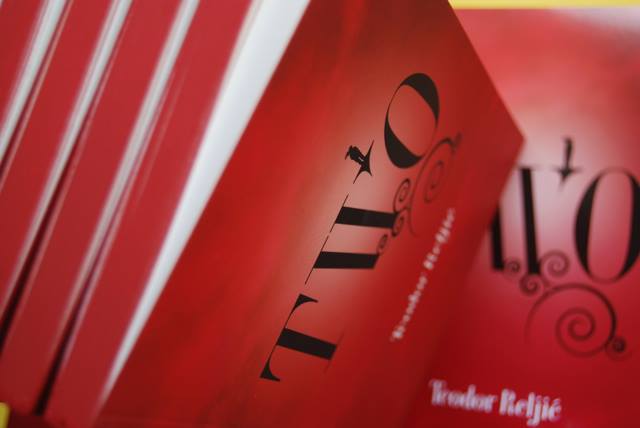
Novel: Two
My debut novel started life as a piece of flash fiction, tumbled into larger and more mottled being thanks to the steady encouragement of Merlin Publishers’ Chris Gruppetta and was released into the little slice of world that would have it at the beautiful Cafe Wignacourt in Rabat, my Maltese town-crush.
Very much a debut novel in spirit, tone and theme, it is a labour of equal parts love and pain: deeply autobiographical and largely told from the POV of a young child, for gods’ sake. Does it get any more debut novel-y than that?!
You can find out more about it here. Those of you in Malta and Gozo can currently avail themselves of a 25% discount from Merlin Publishers — a covid-solidarity move that applies to all of their books. Do also check out Awguri, Giovanni Bonello, featuring a vampire-tinged historical fiction tale that was a blast to write, and which dovetails nicely into our next item…
Short Film: Camilla
Literary film adaptation and vampires are just about two of my favourite things, so it was an honour and a pleasure to be able to adapt Clare Azzopardi’s ‘Camilla’ into a short film, together with Stephanie Sant (who co-wrote and directed) and under the ever-intrepid auspices of producer Martin Bonnici (Shadeena Entertainment). The film was made possible thanks to a competitive fund awarded to us by the National Book Council, whose sterling work can, I hope, continue unabated after all this mess is over.
Meanwhile, please feel free to enjoy our 21-minute slice of Mediterranean Gothic, cross-generational romantic intrigue and sexual discovery, all wrapped up in a coming-of-age story featuring a wide-eyed but hardly bushy-tailed protagonist, brought to entrancing life by Steffi Thake, working under the austere shadow cast by the inimitable Irene Christ.






 Soft Disturbances