Perfunctory Epic: The Rings of Power, Season 2 (Amazon Prime)

DISCLAIMER: Here be spoilers.

Like most nerds of my generation – lapsed or otherwise and to varying degrees of commitment and intensity – I cling hard to the pure memories of my earliest viewings of Peter Jackson’s The Lord of the Rings trilogy.

While the books weren’t childhood favourites – I was knee-deep in Marvel comics up until my early teens – I did bone up on them while the films were still in the early stages of pre-production, goaded on by another close friend who would move back to Canada with his family before we would get a chance to see them in the Maltese cinemas together.

But there were other friends who would’ve filled the gap in the meantime, some of whom I was, by this point, playing Dungeons and Dragons with.

So in my mind, this period now forms a mash-up of time where a store of fantasy imagery was taking root in my ‘mind palace’, which would serve as a source of comfort and self-identification for years to come… in many ways it still serves that function to this very day, albeit in somewhat altered form.

I’m thinking about all of this after finally having caught up with the second season of The Rings of Power – Amazon Prime’s bid to secure their own Game of Thrones franchise by pre-committing to five seasons of the thing and even launching a reserve long-form adaptation in the form of The Wheel of Time should this one go bust.

Charlie Vickers as Sauron and Charles Edwards as Celebrimbor

This cynicism seeps through the operation and, unfortunately, I feel it’s particularly evident in this second season, which toggles in a perfunctory fashion from one of the many sub-plots to another, the only real connective tissue being the long-game machinations of Sauron (Charlie Vickers): here a svelte Machiavellian figure whose Season One disguise as sea-faring lone wolf ‘Halbrand’ pulled the wool under the eyes of none other than Galadriel (Morfydd Clark) herself.

(In Halbrand-mode, he could’ve easily fronted one of those neo-Britpop acts… there’s something disarming in the image of Galadriel bopping to Kasabian.)

The thing is, I was quite chill about The Rings of Power when it first appeared. Unlike many others, apparently, I was willing to give Season One a chance, with its slow burn and trickle of ‘new’ characters and fill-in-the-blanks exercises riffing on the sketches of lore the showrunners and their writers had to work with.

It felt, at the very least, the start of something that could grow into an organic story with its own heartbeat… and Galadriel-as-fundamentalist struck me as a bold-enough narrative choice which, I suspected, would yield some interesting detours further down the pike.

But, hand on heart, I can’t quite say that the second season is exactly rewarding my investment on this front. Where we previously had a gorgeously photographed and put together spark of potential, now we have that, only with the potential snuffed out in favour of a flattening and overstretched story that is really just a set of fan-fictiony vignettes ticking off boxes, all scattered across disparate geographical locations on Tolkien’s famously vast and detailed map of Middle Earth.

It’s yet another reminder of how the magic we associate with fantasy literature in particular – that thrill of immersion all too often written off as simply ‘escapist’ – has very little to do with by-the-numbers tropes and settings and everything to with an innate poetry that speaks to a wider yearning.

The yearning for a world which is more mysterious and more alive, where traveling means discovery, danger and difference and where transcendence can be mapped out and understood but never replicated in rote human terms.

But replication is so ingrained in pop culture now. In a sense, it is its only real faith. The belief that for something to work – for something to even be conceived – it needs to have worked before, and on a massive scale.

Rory Kinnear as Tom Bombadil

You can of course imagine that such an approach doesn’t do too well when attempting the kind of fay whimsy that is very much part of Tolkien’s fictional universe, no matter what the more macho strands of the fandom would have you believe.

It’s why the sequences with not-(yet)Gandalf and his duo of not-Hobbit buddies are the dullest in the show, and why Rory Kinnear’s Tom Bombadil, while certainly a welcome presence on screen after being infamously excised from the Jackson trilogy, feels just like another placeholder mentor figure – a wizard whose only USP is a higher quotient of chill than his counterparts – instead of a baffling and refreshingly unexplained spirit of sylvan inevitability.

Perhaps this is why The Rings of Power is at its best when zooming in on still-human-shaped Sauron and his horrifically ingenious acts of arts-and-crafts based gaslighting. Let’s face it, it’s the all-too-human cruelties on lurid display that helped Game of Thrones nab a healthy swathe of the non-nerd audience, because this is stuff that soap operas are made of and as long as we want power, sex and exist among people who desire the same, the electric charge of it will never cease to appeal.

So it’s clear that the showrunners are confident in their abilities to tighten the noose around poor Celebrimbor(Charles Edwards)’s neck, as Sauron – disguised as the outwardly benign jewellery savant Annatar – makes good on his moniker as the Great Deceiver, and how.

For all that the show is littered with instances of orcs, giant spiders and other gory creatures whose mere presence is meant to trigger our gag reflex, none of them can hold a candle to the gross yet precise – precisely so gross because it’s so precise – way in which Sauron ingratiates himself into Celebrimbor’s workshop (really, the seat of this craftsman-monarch’s very kingdom). I don’t remember feeling this disgusted by a TV character since the John Paul (aka ‘The Prick’) from the first season of Bad Sisters.

Leon Wadham as Kemen

This is just about the only instance of genuine emotional frisson we’re allowed to feel during the season, where we’re allowed to wince and hiss at displays of moral callousness because how else are we gonna react? Same goes Kemen (Leon Wadham), the PG-13 Joffrey of the show: nepo-baby son to the scheming aspirant to the Númenórean throne and the custodian of the most smoothly slappable faces this side of Westernesse. (Thankfully, it’s a face that *does* get slapped once or twice already, though we’re meant to understand that his true comeuppance is yet to come and given how padded out the show is, this’ll be a case of delayed gratification for the Ages).

But there’s an elevated flip-side to all this. Namely, that Celebrimbor’s rise and fall constitutes a decent stab at a Greek-style tragedy. But this is the kind of stuff we’ve internalised a long time ago and now keep regurgitating with ease… and arguably, the real lasting value of Tolkien’s work lies in how he decided to side-step the otherwise ubiquitous Hellenic legacy in favour of the knottier and gnarlier brambles of Beowulf and the Norse Sagas.

Of course, you can never go home. (This is true of the denizens of Eregion in more ways than one, after Sauron’s done with them). Nobody’s asking a new show to try and rekindle the same magic we felt when we first read The Lord of the Rings or watched the Peter Jackson adaptations. (And if they are, they really should reconsider what they expect from their pop culture artifacts.)

My suggestion? Pick up The King of Elfland’s Daughter by Lord Dunsany. It’s a good deal shorter than both The Lord of the Rings – slimmer than any of its three books, actually – and you’ll likely work through it even quicker than you would sitting through this latest season of That Second Age Show.

It’s the kind of book that Tom Bombadil would’ve written, because Bombadil understands the world and its denizens better than they understand themselves, and can sing a story that still remains a song.

In Defense of Escapism

Following the annual horror binge of October, I tend to slip back into fantasy favourites during the subsequent months in an attempt to close off the year with something of a cosily immersive lilt; to both weather and take advantage for what passes for autumn and winter in this warm part of the world, and to plug into its wellspring of restorative nostalgia.

This often gets me thinking about the vilification of the fantasy genre — broadly speaking — as ‘escapist’, which tag tends to be loaded and, as is often the case, flung around in a dismissive and rather unreconstructed way.

The implication being that, the further we are from a cleanly mimetic representation of reality in fiction, the more ‘irresponsible’ we become in its consumption. That such a mode encourages us to forget the world as it is now, in favour of an ethereal indulgence that numbs us to our day-to-day realities and leaves us in a torpid stupor, the kind that Tennyson detailed in The Lotos-eaters.

There’s of course been endless shadings and nuancing of this argument over the years, but I believe that the core of it has remained with us — throbbing like a planetary core that has lodged itself and become essential to historical ecosytem of the discourse, much like any other ossified truism.

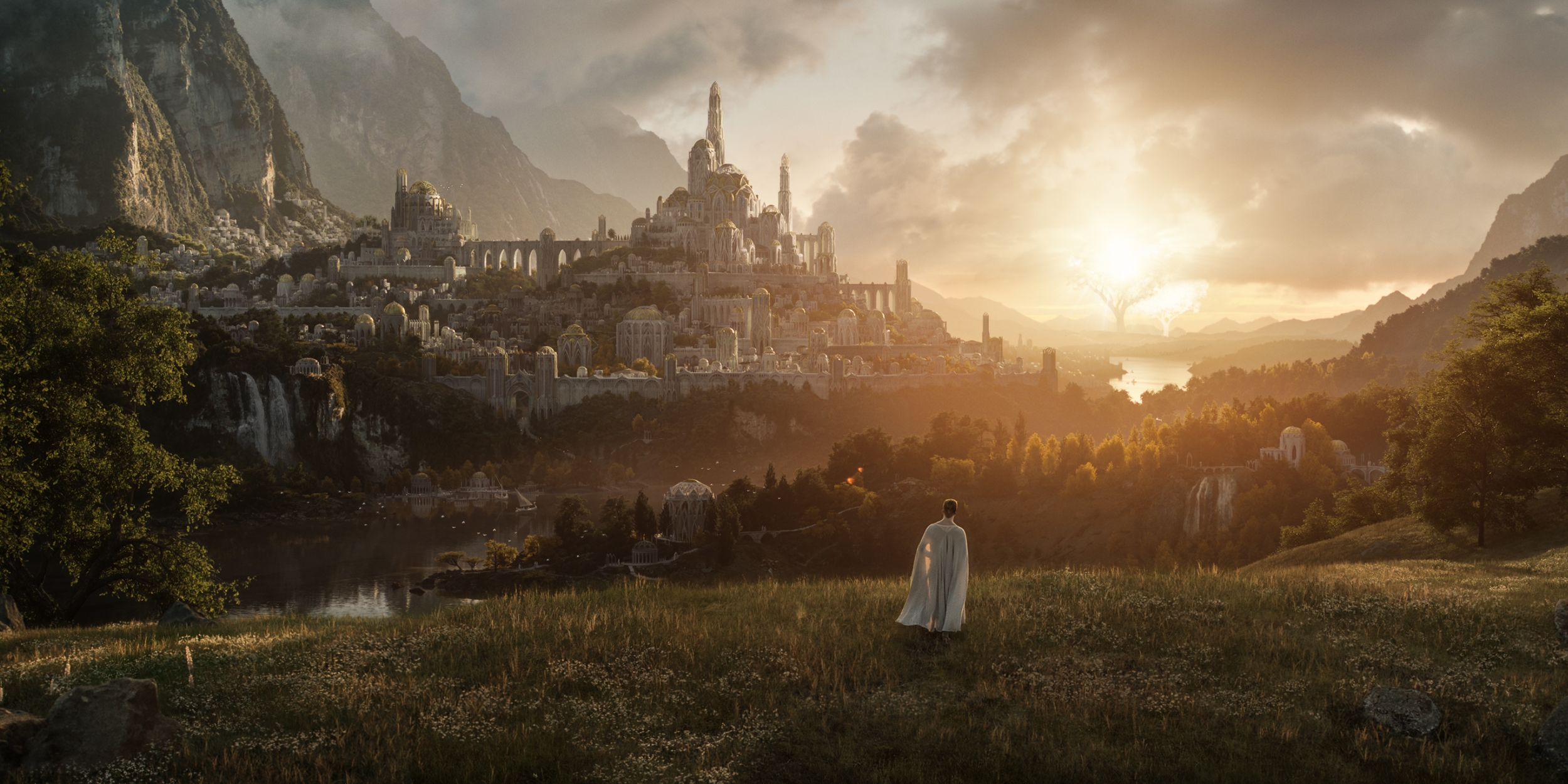
The Rings of Power (Amazon)

I find it to be endlessly faulty, and not just because I’m a fan of fantasy literature (and therefore don’t appreciate being characterised as some sort of head-in-the-sand naive idiot by proxy).

My issue here is far more fundamental. To put it as plainly as I can manage: it assumes that reality is a flat, clearly definable surface, and that we can posit a clean reality : fantasy binary.

The popularity of such an assumption is hardly surprising, given that it’s taken root primarily within the confines of a materialist, capitalist western society. This is a mode of living which at best compartmentalises all that is not tangibly measurable, rendering it peripheral to the day-to-day workings which make the machinery tick.

So that religious practice is tolerated, as long as it can be woven into the fabric of the day-to-day without causing too much offence (and crucially, it is called upon to occasionally prop up the agendas of certain politicians and ratify certain acts of exclusion and social inequality).

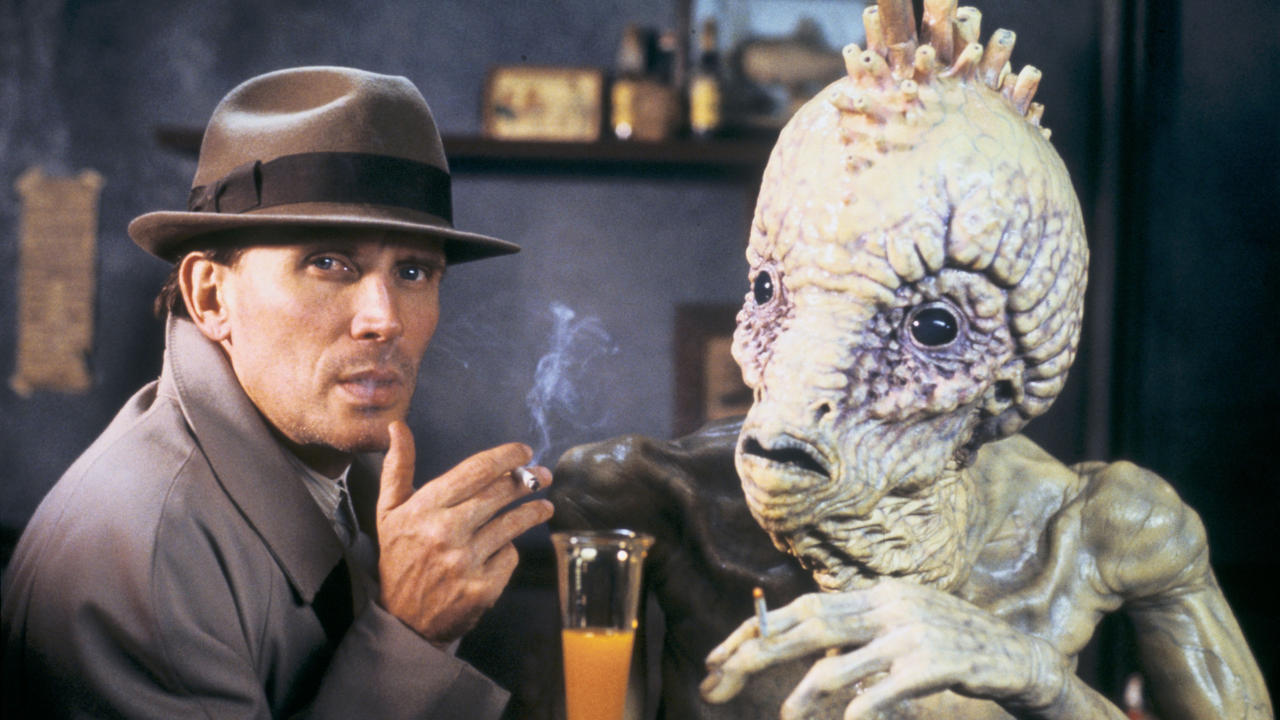
Acceptable escapism? Naked Lunch (1991) by David Cronenberg, adapted from the William S. Burroughs novel

Perhaps we accept the intangible when it relates to issues of mental health. There is, at the very least, an understanding that — medication-based psychiatric help aside — the mental realm needs tending to in ways that are suspiciously apposite to the kind of treatments and rituals we would associate with religious and/or magical practice.

But even then — the overarching practise is to simply ‘treat’ any mental health anguish in a way that’ll make it go away so that you can resume being a healthy cog that can help keep the system chugging along. We are hardly encouraged to take its wider implications — that there’s more to life than what’s in front of us — and run with it.

In the same way, fantasy is also compartmentalised, only to be richly consumed by all of us. Literature aside, its popular adaptations litter our screens and the streaming services that have latched onto them like eager barnacles. Adaptations of the works of JRR Tolkien, George RR Martin and Neil Gaiman were some of the most-watched (or at least most talked about) shows of the past year or so.

Chloë Grace Moretz in The Peripheral (Amazon)

Even something like Amazon’s take on William Gibson’s The Peripheral — ostensibly a work of ‘hard’ neo-cyberpunk from the grandfather of that subgenre — ultimately partakes of fantasy tropes at its root: it’s a portal fantasy with virtual reality and cyborg stand-ins only superficially replacing the mechanics of magic and its adepts.

Ultimately, branding fantasy more escapist than its supposedly ‘realistic’ counterparts is bound to devolve into a fool’s errand animated into being solely by the assumptions of a category error.

Still from The Company of Wolves (1984), directed by Neil Jordan and adapted from the Angela Carter short story

If you’re reading, watching or hearing something — anything — for an extended period of time, you’re lost in that experience, and at least somewhat disconnected from the real world, by proxy. Whether this is an epic adventure quest populated by dragons, elves and goblins, or a kitchen-sink drama of an immigrant family trying to make ends meet in present-day Munich, is really beside the point.

That’s not to say that there are no distinctions to be made within the minutae of experience to be had in each, of course. But the moralistic tone that is often taken against the allegedly more ‘escapist’ of the two still betrays at least a hint of lazy thinking.

For all that the more grimily realist fiction can illuminate and raise awareness — political awareness which, it must be said, is thinner on the ground(s) of that genre’s more navel-gazing counterparts — the fantastic acts as an extension of that experience.

Let’s give voice to what’s easier to defend here, for starters. Boundary-pushing works of the fantastical — the kind you’ll find among the likes of Kafka, Angela Carter or David Cronenberg — will exaggerate and amplify with the aim of exploring loftier points. The flinty realists are largely on the side of these non-escapist works of the fantastical.

Tom Sturridge as Morpheus/Dream in the Netflix adaptation of Neil Gaiman’s The Sandman

But I would submit that even the most reactionary or nostalgic of fantasy works can have a purpose which isn’t simply redolent of intellectual vacuity or laziness, of a kind of distracted quietism that numbs the intellect and reduces its consumers to little more than sludge.

At the end of the day, even the knockiest of Tolkien knock-offs will be better for your mental hygiene than hours spent doomscrolling through the social media platform/s of your choice… and the degree of actual, conscious choice involved in that experience is questionable to begin with.

Because if distraction from reality is what makes fantasy such an ‘irresponsible’ intellectual pursuit, what is the doomscrolling impulse of the 24/7 news cycle, which has now emigrated beyond the relatively confined space of the television screen to also latch themselves onto our mobile phones? (Yes, Gibson and Cronenberg have been warning us of this with grotesque gusto for decades).

Haunted by this reality, I submit that anything which promotes immersion of any kind is a better and more meditative alternative.

***

Re-read of the season: The King of Elfland’s Daughter by Lord Dunsany
Currently reading: The Broken Sword by Poul Anderson

On The Tee-Vee | Two & Some Favourite Books | Wicc imb Wicc

It’s been a bit of a strange month; something I’ll be delving into with cautionary coyness in a subsequent blog post. So much so that I’ve missed out on both writing some proper entries over here, and even simply putting up updates on cool stuff I’ve been involved in and invited to.

And one of these actually happened on exactly the day of the premiere of our last burlesque show — the latest thing I spoke about here in some detail before the hiatus. This was an interview for the television programme Wicc Imb Wicc (‘Face to Face’), put together by the National Book Council of Malta, recorded on the very morning of the premiere of Apocalesque. (In fact, beady-eyed viewers might just spot the remnants of hastily-removed cropse-paint eyeliner post-dress rehearsal the night before).

wicc imb wiccThe interview is now up online for all of you to check out, should you be up for hearing an extract from my novel Two — read out by the show’s host, the actress Antonella Axisa — and/or hearing me be interviewed by the same Antonella about some of the key themes and plot dynamics of the book itself. That’s all before my favourite segment of the show kicks in, however: talking about some of my favourite and most energising books.

Among them are Mary Shelley’s Frankenstein, Judith Halberstam’s Skin Shows, Lord Dunsany’s The King of Elfland’s Daughter, Angela Carter’s The Infernal Desire Machines of Doctor Hoffmann, Mervyn Peake’s Titus Groan, and Moebius’ hallucinatory classic of a graphic novel, Arzach.

Find out more about Wiċċ imb Wiċċ here, and log on to the National Book Counci’s YouTube channel to watch previous episodes.


Swords v Cthulhu read-a-thon #6 | Jeremiah Tolbert

As outlined in an earlier post, in the coming weeks I will be dedicating an entry to each story in the upcoming anthology Swords v Cthulhu, edited by Molly Tanzer and Jesse Bullington and published by Stone Skin Press. My reviewing method will be peppered with the cultural associations that each of these stories inspire. These will be presented with no excuse, apology or editorial justification.

Swords_v_Cthulhu_DRAFT_COVER_350

The Dreamers of Alamoi by Jeremiah Tolbert

“Dante was the first to conceive of Hell as a planned space,” Dr Bedelia Du Maurier tells an assembled audience in the 10th episode of the third season of Hannibal, “an urban environment.” Before Dante, Bedelia continues, we spoke not of the gates of Hell but simply the mouth of Hell — a shapeless, devouring pit with no real modus operandi.

I feel that Lovecraft’s structuring of his own ‘Dreamlands’ plays to a similar dynamic and that certainly, the author is also to be lauded for — quite literally — mapping out what may otherwise have been vague repository of images and half-formed notions of geographical space. But I also find it a blessing that Lovecraft never quite went the Tolkien route with his world-building either, and that the Dreamlands were allowed to accumulate in the author and reader’s mind in gradual drops throughout various loosely connected stories.

The Dreamlands of HP Lovecraft by Jason Thompson (2011). Find out more about it

‘The Dreamlands of HP Lovecraft’ by Jason Thompson (2011). Find out more about it

In this way, I think Lovecraft remains true to the psychology behind why we keep chasing after these spaces. It’s a comforting notion, to be able to travel to a place where the laws and conventions that dominate our daily life have been suspended in favour of some kind of sublime bliss; even if — to go with the original, Kantian notion of the sublime — this does not mean that what we would see and experience in these places is necessarily pleasant, or even safe.

With Lovecraft the concept gets a keener edge of poignancy, I think, because for all the implied eldritch horror of the Dreamlands, it feels as if he’d rather go there than face the realities of the modern world — a tic in his character that also speaks to the oft-discussed and deeply problematic ideological underpinnings of a lot of his work (to say nothing of how his public proclamations to this effect continue to be something of a blot on his reputation). It’s form of ‘negative escapism’, I think — not the idyll of Tolkien’s Shire, but an alienating and alluring space populated by strange, mushrooming presences, and whose geographical confines expand and contract to the whims of an ‘idiot god’.

Jeremiah Tolbert’s story develops on this motif in Lovecraft’s work — a motif that Lovecraft himself likely cribbed from his perennial source of inspiration, Lord Dunsany (who was, in turn, also an influence on Tolkien).

Tolbert gets the notes of desire and fascination right and, indeed, establishes an urban environment that despite its otherworldly nature still insists on carving out a concrete space, with the very architecture serving as an ominous, jarring construct — an element certainly in line with Lovecraft’s own stories in this vein.

“At first, he thought it only another hallucination that the two towers seemed to bend toward one another at their peak, but the vision did not waver. Realization arrived late: these were not two towers, but instead the opposing sides of an arch. Closer now, he could make out the ropes and pulleys lifting an enormous keystone into the heavens. It inched upwards as he watched.

“The dreaming construct would soon be complete. What would happen then was a great mystery, but not one Garen was eager to solve.”

Garen, our erstwhile protagonist, explores the contours of the Dreamlands with the hungry and often thwarted desire of a junkie. Strait-laced as Lovecraft may have been, he wouldn’t have been inclined to confront this aspect of his stories head-on. But it’s an evident element of the desire (with a capital D?) we have for these spaces… just as its erotic counterpoint is never too far behind, either.

‘Fantasy’ is a broad term — something we often forget, conditioned as we are to view literary genres in strict categories — and ‘dreams’ are even more vast in their potential.

But though Lovecraft and Tolkien may have stopped short of exploring the more R-rated elements of this universal trait, Tolbert — like Catherynne Valente and Clive Barker before him — isn’t shy of teasing the limits between reverie and obsession.

Read previous: John Langan

Ecstasy of influence: Bowie via Manson

Marilyn Manson - Mechanical Animals (1998)

I first got to know about Elmore Leonard through Quentin Tarantino – on that note, Tarantino introduced me to a whole raft of pop culture curios – and I started digging into Norse mythology after Marvel Comics planted a seed in my brain thanks to their version of Thor.

Lovecraft swam into my purview during my teenage years – though I would delve into his stories much later, again – motivated by this initial, delayed spur – through the likes of Metallica and Cradle of Filth, and Lord Dunsany I read after finding out that actually, both Lovecraft and my former literary hero JRR Tolkien were influenced by him.

One of the joys of delving into the DNA of your favourite creative people is finding out, once you crack that shell, what lies beneath. Everyone is influenced by someone else, and this hall of mirrors is what arguably characterises our relentlessly postmodern age. (Should that be post-post-postmodern? I’m not an English undergrad anymore, which frankly means I’m past caring.)

In the case of the late David Bowie, it was Marilyn Manson who did it for me – specifically, the Marilyn Manson of the androgynous Mechanical Animals era.

Now of course, I had known who Bowie was long before my friend Herman loaned me a bootleg tape of the said Manson album (come to that, I of course knew who Manson was before that talismanic tape too). Family lore has it that my aunt and father went out to buy the latest Bowie LP to reach Serbia during a respite from the hospital as my mother was getting ready to give birth to me, even – and I’m sure that same record was spun in my presence after I eventually popped out into the world on that fateful May day in 1985.

But I think I first started to gain an understanding of what Bowie was “about” thanks to Manson’s very deliberate and openly acknowledged cribbing from Bowie during that comparatively brief chapter in “the God of Fuck’s” career.

I wouldn’t really be able to talk about the technical make-up of the songs in Mechanical Animals, so I doubt that I’d be able to construct much of a formal argument in favour of why these songs ‘worked’ on me the way they did.

But neither was it a case of being transfixed by the superficial aspects of Manson’s project, dazzling and sort-of* subversive as they may have been in the pop-culture mainstream at the time. And I say this at the risk of discounting just how mind-blowing it was to me to watch Manson’s performance of The Beautiful People – taken from Antichrist Superstar, the album previous to Mechanical Animals – at the MTV Video Music Awards back in 1997 (I was twelve). It still gives me a thrill of sadistic pleasure to remember the cut-aways to the likes of Sean Combs apparently scandalized by Manson’s bare-bottomed, fascist-attired attack on MTV glamour culture. The hypocrisy of someone like Combs taking apparent offense at Manson still strikes me as telling, in a “gotcha” kind of way.

But Mechanical Animals was certainly a ‘softer’ beast, and its immersive qualities are what seduced me. Beyond the obvious, catchy charms of The Dope Show and I Don’t Like the Drugs (But the Drugs Like Me), songs like The Last Day on Earth and my personal favourite, Coma White, transported me somewhere alien but strangely calming.

The electronic wash that characterises the album still gives me a sense of something cold but meditative, and it’s all helped along by the androgynous surrogate – ‘Omega’ – that Manson created for the purpose of the album. As I would later learn, creating an artistic persona, particularly an androgynous one of this kind, was cribbed from Bowie, who admittedly trumps Manson on this front – not only because he ‘got their first’ but also because he had a far clearer vision about when to adopt these personalities and when to drop them**.

But at the time, it introduced me to the concept of, well, the concept album. Not only that, but the concept album as propped up by an invented personality the performer deliberately took on. In short, the idea of music as storytelling, which has resonated with me ever since.

It’s this echo of Bowie that I’ve carried with me ever since. Of course I’ve listened to Bowie since that time too, though not, I must admit, with the kind of visceral fan-like fervour the teenage me bestowed upon Marilyn Manson.

That’s another thing about influences. You can be introduced to artists askance. Simply put, it wouldn’t have made much sense to me to force myself to listen to Bowie at the time. I was into hard rock and heavy metal, and Manson was a more palatable jumping point into the Bowie milieu for me at that point. This is, of course, the problem with recommending essential works to people with the kind of evangelical zeal we reserve for the very best. We tend to forget that everyone’s on their own journey, and telling them that you HAVE to read/watch/listen to this at that point in their life makes little sense.

If you’re meant to reach it, you’ll reach it. In the meantime you can follow the breadcrumbs you recognise.

*I think I opted for ‘sort-of’ partly because I know Bowie did all this before

**Manson’s dithering post-Holywood career is a testament to this… compare it to how Bowie, despite some flailing years of his own, remained so much in control that he even recorded a final album as a farewell