The moon was made to mush and I poured it into the bowl and added water and stirred with my grandmother’s wooden spoon and I worried it would break, crack against the thick glop that refused to budge until I stirred and stirred harder, working against my fear of breaking until it rewarded me with an uninterrupted swirl.
The moon gave in to its new liquid shape and I was glad to have finally done something, anything.
The room in the tower with the wooden table the wooden cups tucked into carved holes made snug to fit. I hear that the other villages have tables of marble but, no matter.
The three baby giraffes had the cups to their chins. The table was high, at least on this it was enough – made just right to allow them to sit and drink without straining and distending.
It would have been something to witness them drinking the mixture in. I poured the moon from the bowl and into the three wooden cups with my backs to the baby giraffes. I imagined their eager, liquid eyes. Blackness, but not of night. The blackness of early innocence. Enveloping, pure.
Another source of pride, and I stung to resist it. The pride: pouring the moon so neatly into the cups that an equal gap was left up top. The rare, brief elegances. But this was not mine. This is where I was drawn, and I merely followed.
I set the cups down onto the gaps and now, at least, I could look. They did not look at me – they were too eager for their meal. But in this eagerness I found gratitude, and I held it warm to my chest. The warmth turned into the remembered words of the Edict: “You are to pour, the rest is theirs. You are to then turn and walk away. They will only flower in your absence.”
It was not in me to break edicts, least of all this one. So I allowed myself this one small thing, this one last thing: to look upon the giraffes as they drank the moon with a total abandon. The abandon of rest. The marker and promise at the end of my mission. All that makes edicts and towers necessary.
I took the spiral staircase and when I opened the wooden door that released me from the tower, I looked up to the moonless black sky and thought about the consuming gardens to come.
We all begin from a place of idiocy when tackling family trauma.
This is largely because very few of us can hit the ‘pause’ button on life and explore our damage at our leisure, taking our time with our healing journey and tending to each scar with the requisite care and tenderness.
Like death, trauma is one of the few instances of the ungraspable numinous we still encounter at an alarmingly regular rate in our otherwise secularised existence; it’s slippery and hard to categorise, and you cannot pin it down and name it like Adam was instructed to do when first placed on earth.
And even though we’re popularly guided to apply a cause-and-effect template to trauma (‘I am like this because X happened to me when I was young’), the ghostly after-effects will still linger, and will not be sucked into ectoplasm boxes any time soon. So we can’t analyse. We can’t sit down to calmly pore over things. Still babes in the woods. Still dumb to what came before and what will come next.
Which is why I appreciated Deborah Levy’s Hot Milk: a wry, caustic treatment of trauma and how it seeps down into a mother-daughter relationship, zooming in particularly at a volatile time in both Rose (mother) and Sofia’s (daughter) lives, during which they arguably attempt to undertake what I’ve described above: hitting pause on life so that Rose – but only Rose – may finally heal her ailment (inability to walk) for good.
***
The mixed reception to both the novel – I get a feeling that most people viewed its Booker Prize shortlisting as a perfunctory gesture, riding on Levy’s reputation – and now Rebecca Lenkienwicz’s film adaptation is likely down to a number of factors.
Characters rendered in oblique psychological brush strokes – at times incomplete at best, insufferable at worst. A loaded narrative proposition which never tips into melodrama but offers us little by way of conventional catharsis either. The dangling promise of a queer sub-plot which in the end makes no attempt to say anything politically significant about such an arrangement…
And so on.
I do agree that the novel is somewhat slight, and that other writers would have perhaps filled out the story with a more generous well-spring of empathy towards our characters, particularly the leading female triumvirate that leads the show: Sofia, Rose and Ingrid – the enigmatic, bandana-sporting seamstress who, in the film, appears to Sofia like valkyric vision: astride a horse on the hot Spanish beach: unlikely, unpredictable and ultimately, affected to a fault and hardly the safety raft Sofia needs. But we should all learn to take work on its own terms, and the gaps that both Levy and Lenkienwicz leave out are spaces where discomfort and tension is allowed to grow.
It’s the same tension that grows mushroom-like out of the idiocy of our own thwarted attempts at understanding just what’s wrong with us.
***
Rose has been paraplegic for as long as her aspiring anthropologist daughter can remember, and when we meet them they have temporarily relocated to Almería from London to pursue a last-ditch attempt at treating this ailment for good: enlisting the costly and unconventional services of Dr Gomez, whose methods have more in common with a version of talk therapy than anything resembling a hard medical approach.
Sofia is her mother’s keeper, and has been for a long time. (Her Greek father Christos is out the picture – having flown the coop back to Athens years ago; he now has a baby daughter by his “child bride”). She is prematurely bitter as a result, and her training as an anthropologist only serves to widen the scope of her pain. Crucially, however, this default mode – the paralysing cycle of familial duty and a stalled approach to her academic development – leads to no breakthroughs.
It’s a recipe for an endlessly deferred existence; a purgatory made even more deeply manifest by their stay at the scorching Spanish seaside. Because Rose isn’t keen on solutions either – Lenkienwicz adds a ghost of trauma to keep the clock ticking there too – and finds comfort in endless deferral.
Which is where the matter of tackling trauma by employing agency gets particularly tricky.
***
The most significant coup of the film adaptation is arguably its casting. For all that Emma Mackey supposedly came in late in the day – our screening in Malta was happily accompanied by a surprise Q&A from the film’s co-producer, Christine Langan, who revealed as much – there is something inevitable to the Sex Education star flexing her dramatic muscles here: effectively, she builds on the easy charm of that show by depicting another sensitive and intellectually curious young woman in, however, a far more sombre and mercurial key.
Fiona Shaw makes for an equally obvious fit for Rose: the veteran actress knows her way around that toxic mix of haughty entitlement and whiny dependence and understands that it’s part and parcel of how she wields her power over her daughter.
And I’d be hard-pressed to imagine anyone other than the prolific and dependably luminous Vicky Krieps in the role of Ingrid. Sofia is swept along, and so are we. At least we are at first, until her accumulated deceptions – and the underbelly which animates them – chip away at the implication that she is here to create a welcome oasis of bliss for Sofia.
On this subject, I also have a bone to pick with some of the ripples emerging from the critical consensus on the film, both in mainstream publications and online commentary, namely that Ingrid is yet another example of a ‘manic pixie dream girl’ trope.
In many ways, she is. And that is precisely the point. Ingrid is clearly someone who has internalised, and weaponised, her status as something that could be construed as a real-life manic pixie. But as the story progresses, we see that crumble right before our eyes, and we follow Sofia closely on that journey of realisation.
Like Rose, Ingrid shapes her entire identity around her inability to cope with the defining traumatic incident of her life. She knows it happened and what it implies, but she’s either unable or unwilling to process it, so she gilds and embellishes a persona out of the elisions and deviations she takes to avoid confronting things head on (her being a seamstress feels apt, here).
In the middle of it all is Sofia – whose coping mechanism is neither aggressive self-pity (Rose) or promiscuous hedonism (Ingrid) but repression. In this way, she becomes the perfect bedrock on which both Rose and Ingrid can vent their fears, desires and complaints, assuming that Sofia will stick around to absorb it all.
In fact, Sofia’s troubled and troubling pursuit of agency is the true ticking clock of the narrative, and it’s a strand that resonates deeply, particularly with those among us who have been forced to become parents to their own from a young age.
***
You could say that my parents were a mix of both Rose and Ingrid. Charmingly bohemian and easy to love among the social circle they frequented, they were also inept at managing their own emotional landscapes and taking the temperature of their kids’ true needs. Ridiculously young immigrant parents going at it alone with only nominal support (and at a long distance) from the extended family, and relying on badly-managed improv and reheated cliches to ensure we somehow stayed alive.
It’s no wonder that they took any complaint as an affront. That keeping the peace was top priority. We all took pride in not shouting, even if a good row would’ve released energy that would remain suppressed, set to do poisonous damage many years down the line.
Following a stroke, my mother was left in a coma for ten years; the stroke occurred just a few months before my own father suffered his first, which he survived, only to suffer a fatal one a decade and a bit later… largely the result of unheeded medical advice and the same, Rose-adjacent refusal to comprehend that eternal passivity and dependence on others cannot be a permanent life goal.
As such, I very much identify with Sofia’s default setting: keeping the peace by keeping mum. I felt the ripples of damage her repression causes, and I sympathised with her falling for Ingrid: this is an image of who you want to be – a free spirit; ironically, in my case, the same projection of bohemian freedom modelled by my parents in life.
Watching Hot Milk in 2025, after the fallout of losing both my parents, I’m beginning to understand why I’ve always been drawn to coming-of-age stories, of which this is a finely wrought and arthouse ready reminder (none of the tropey, self-help-booky Hollywood takes on that sub-genre here). I found kindred spirits in these retreating protagonists, but also the hope of some kind of release when they finally gain the confidence to break out of the vicious cycle which defines them.
In a weird way, this is aspirational fiction for me. And Sofia’s small wins – working up the courage to steal a fish from the market; liberating a noisy neighbours’ dog from its cruel confinement atop a sun-baked rooftop – feel as they are presented: welcome irruptions of healthy transgression, the promise that you can change things around.
The central couple of Vincenzo Latronico’s fourth novel Perfection –– translated into English by Sophie Hughes and published by Fitzcarraldo Editions — are living the digital nomad dream c. 2015 when we first meet them: crafting brand identities, catalogues and interfaces for trendy businesses, having successfully uprooted themselves from an unspecified Southern European country of origin to build a new life in Berlin.
That much of the novel centres on their outward success — which only appears to require minor upkeep — is the key to its own triumph as an insidious but blistering satire of the white, middle class and now variously mobile zeitgeist.
Novels like Perfection are judgemental rather than satirical in the broader and more creatively energetic interpretation of that genre, but it’s Latronico’s unsentimental sharpness that makes it into something more than just a pained litany of complaints against a generalised — and generational — mass of people, one so keen for individualised gratification that they come out on the other end of that equation.
Anna and Tom are so thoroughly homogenised in their curated desires that Latronico almost always refers to them as a collective unit. The rare moments where this device is broken are also rare moments of rupture for the couple, but which scan as a relief for us. Could this be the point where some genuine self-awareness can creep in? Or at the very least, a shifting of gears, a recalibration?
The recalibration does come, as it happens, but in the end, only results in repetition. A relocation from Berlin — never fully a committed separation, more of a sabbatical — for more of the same in Lisbon, or Sicily. There is a parasitic dimension to these movements… which has of course become something of a truism in discussions around the phenomenon of 21st century gentrification. This is probably among the more caustic of Latronico’s landmines, cousins and variants of which are dotted all throughout the short, sharp sliver of a novel: the idea that Anna and Tom’s actual job is to serve as worker-ants in an ongoing gentrification project, all the while believing they are in fact agents of an unprecedented form of self-actualisation.
Their labour alienation reaches an apex that previous generations were at least spared from dreading: they are alienated from work they’re not even aware they’re engaged in executing. (Latronico shrewdly articulates the couple’s own arm’s length awareness of gentrification: they respond to it much in the same way that an unrepentant smoker shrugs off the threat of cancer, and anyway — they reassure themselves that they are never bona fide gentrifiers).
Latronico’s minimalism doesn’t allow for interiority, but this is what lends the novel its merciless hammer-drop. The whole novel essentially one long arc of a braining hammer, so it’s a mercy that it’s so short, lest byways of specificity and complexity upend its ‘perfect’ journey. We may wish for Anna and Tom to be rendered with more psychological complexity. Indeed, experiencing them as separate human beings would be a decent enough start.
But psychological realism would run the risk of scuppering the social and cultural realism that Latronico is going for here. There are numerous ways in which either Anna or Tom would be able to justify their lifestyle and its attendant ambitions through psychological byways, through reappropriated therapy-speak… because the neoliberal status quo has made a bedfellow out of all this, the closest equivalent we have to a spiritual resting point.
So in choosing to merely observe their motions through spare, unsentimental prose, we see just how oblivious their drive is; how the constant push towards the comforts of good taste for its own sake merely leads to hollow replication — an addiction whose cure can be indefinitely deferred because its damage is not so readily apparent.
This is how we are haunted out of life.
*
Reading Perfection brought to mind the Gen X variant of the ‘state of our time’ novels that I’d devour in my late teens and early twenties: choice cuts from Douglas Coupland, Bret Easton Ellis, Chuck Palahniuk, Irvine Welsh and the like. These writers were either hailed or reviled as often-gratuitous purveyors of their generation’s excesses: rubbing our faces in its nihilism and emptiness for the sheer sadistic — if not subversive — thrill of doing so.
But there was an undercurrent to my reading that I felt but never quite confronted, but I’m ready to confront it now because Perfection brought it bubbling back up and, I guess, I find myself in a less insecure space than that jittering post-teen used to occupy while thumbing through these books in between breaks and on buses while attending Sixth Form.
This is a deeply moral work. If not a spiritual one.
The hollowness it depicts is also a call to action. Of course, articulating it as such would break the spell of the shimmering, sharp minimalism of the work — would introduce that crucial element of earnest humanity into what is otherwise a mini-opus of ‘perfect’ cynicism.
But that is precisely how Latronico — and the previous writers I’ve mentioned, at their best — operates.
The status quo wants us to believe that Anna and Tom are the ultimate aspirational figures. Latronico spends upwards of 100 pages convincingly arguing otherwise.
Like most nerds of my generation – lapsed or otherwise and to varying degrees of commitment and intensity – I cling hard to the pure memories of my earliest viewings of Peter Jackson’s The Lord of the Rings trilogy.
While the books weren’t childhood favourites – I was knee-deep in Marvel comics up until my early teens – I did bone up on them while the films were still in the early stages of pre-production, goaded on by another close friend who would move back to Canada with his family before we would get a chance to see them in the Maltese cinemas together.
But there were other friends who would’ve filled the gap in the meantime, some of whom I was, by this point, playing Dungeons and Dragons with.
So in my mind, this period now forms a mash-up of time where a store of fantasy imagery was taking root in my ‘mind palace’, which would serve as a source of comfort and self-identification for years to come… in many ways it still serves that function to this very day, albeit in somewhat altered form.
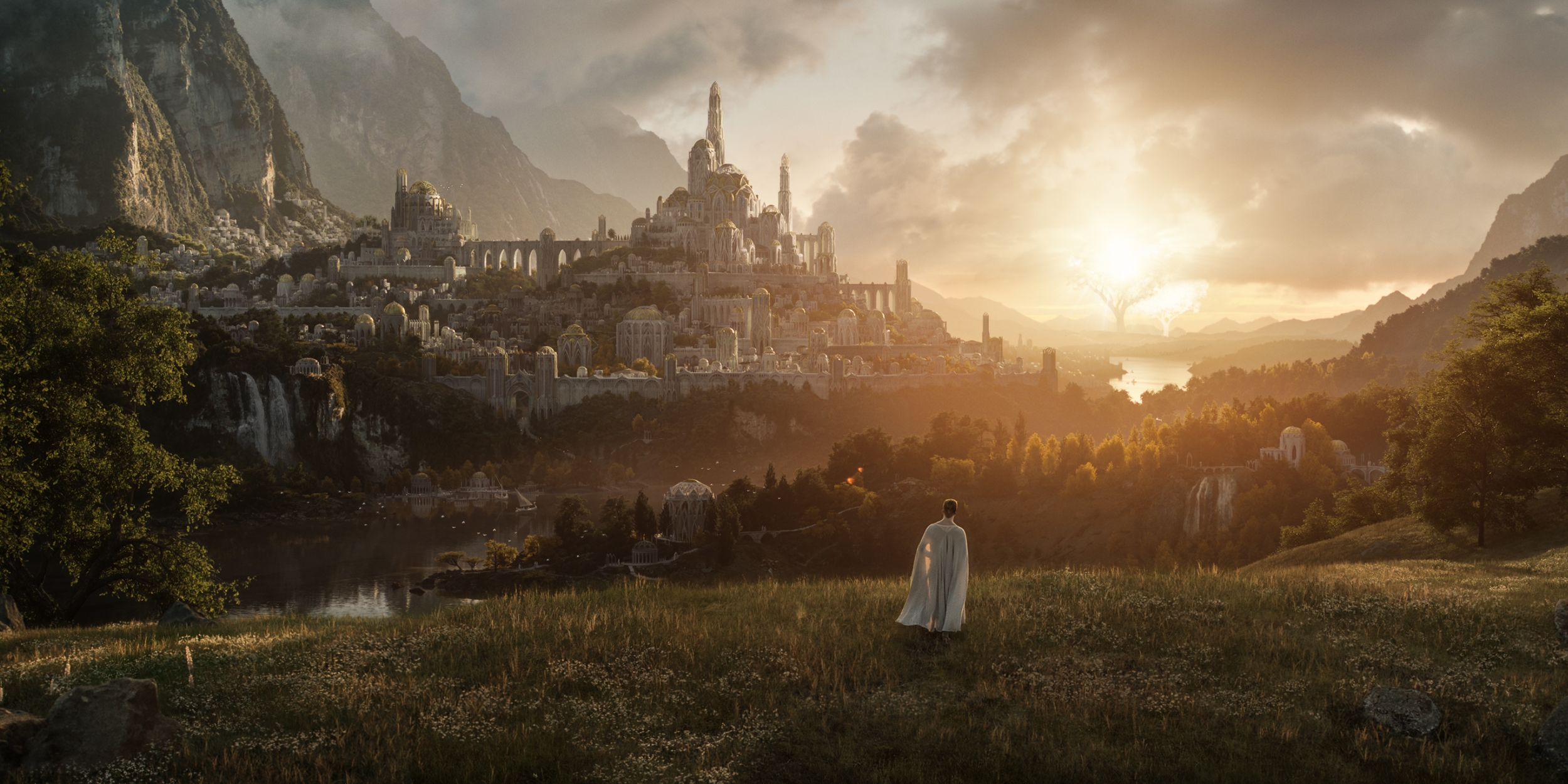
I’m thinking about all of this after finally having caught up with the second season of The Rings of Power – Amazon Prime’s bid to secure their own Game of Thrones franchise by pre-committing to five seasons of the thing and even launching a reserve long-form adaptation in the form of The Wheel of Time should this one go bust.
Charlie Vickers as Sauron and Charles Edwards as Celebrimbor
This cynicism seeps through the operation and, unfortunately, I feel it’s particularly evident in this second season, which toggles in a perfunctory fashion from one of the many sub-plots to another, the only real connective tissue being the long-game machinations of Sauron (Charlie Vickers): here a svelte Machiavellian figure whose Season One disguise as sea-faring lone wolf ‘Halbrand’ pulled the wool under the eyes of none other than Galadriel (Morfydd Clark) herself.
(In Halbrand-mode, he could’ve easily fronted one of those neo-Britpop acts… there’s something disarming in the image of Galadriel bopping to Kasabian.)
The thing is, I was quite chill about The Rings of Power when it first appeared. Unlike many others, apparently, I was willing to give Season One a chance, with its slow burn and trickle of ‘new’ characters and fill-in-the-blanks exercises riffing on the sketches of lore the showrunners and their writers had to work with.
It felt, at the very least, the start of something that could grow into an organic story with its own heartbeat… and Galadriel-as-fundamentalist struck me as a bold-enough narrative choice which, I suspected, would yield some interesting detours further down the pike.
But, hand on heart, I can’t quite say that the second season is exactly rewarding my investment on this front. Where we previously had a gorgeously photographed and put together spark of potential, now we have that, only with the potential snuffed out in favour of a flattening and overstretched story that is really just a set of fan-fictiony vignettes ticking off boxes, all scattered across disparate geographical locations on Tolkien’s famously vast and detailed map of Middle Earth.
It’s yet another reminder of how the magic we associate with fantasy literature in particular – that thrill of immersion all too often written off as simply ‘escapist’ – has very little to do with by-the-numbers tropes and settings and everything to with an innate poetry that speaks to a wider yearning.
The yearning for a world which is more mysterious and more alive, where traveling means discovery, danger and difference and where transcendence can be mapped out and understood but never replicated in rote human terms.
But replication is so ingrained in pop culture now. In a sense, it is its only real faith. The belief that for something to work – for something to even be conceived – it needs to have worked before, and on a massive scale.
Rory Kinnear as Tom Bombadil
You can of course imagine that such an approach doesn’t do too well when attempting the kind of fay whimsy that is very much part of Tolkien’s fictional universe, no matter what the more macho strands of the fandom would have you believe.
It’s why the sequences with not-(yet)Gandalf and his duo of not-Hobbit buddies are the dullest in the show, and why Rory Kinnear’s Tom Bombadil, while certainly a welcome presence on screen after being infamously excised from the Jackson trilogy, feels just like another placeholder mentor figure – a wizard whose only USP is a higher quotient of chill than his counterparts – instead of a baffling and refreshingly unexplained spirit of sylvan inevitability.
Perhaps this is why The Rings of Power is at its best when zooming in on still-human-shaped Sauron and his horrifically ingenious acts of arts-and-crafts based gaslighting. Let’s face it, it’s the all-too-human cruelties on lurid display that helped Game of Thrones nab a healthy swathe of the non-nerd audience, because this is stuff that soap operas are made of and as long as we want power, sex and exist among people who desire the same, the electric charge of it will never cease to appeal.
So it’s clear that the showrunners are confident in their abilities to tighten the noose around poor Celebrimbor(Charles Edwards)’s neck, as Sauron – disguised as the outwardly benign jewellery savant Annatar – makes good on his moniker as the Great Deceiver, and how.
For all that the show is littered with instances of orcs, giant spiders and other gory creatures whose mere presence is meant to trigger our gag reflex, none of them can hold a candle to the gross yet precise – precisely so gross because it’s so precise – way in which Sauron ingratiates himself into Celebrimbor’s workshop (really, the seat of this craftsman-monarch’s very kingdom). I don’t remember feeling this disgusted by a TV character since the John Paul (aka ‘The Prick’) from the first season of Bad Sisters.
Leon Wadham as Kemen
This is just about the only instance of genuine emotional frisson we’re allowed to feel during the season, where we’re allowed to wince and hiss at displays of moral callousness because how else are we gonna react? Same goes Kemen (Leon Wadham), the PG-13 Joffrey of the show: nepo-baby son to the scheming aspirant to the Númenórean throne and the custodian of the most smoothly slappable faces this side of Westernesse. (Thankfully, it’s a face that *does* get slapped once or twice already, though we’re meant to understand that his true comeuppance is yet to come and given how padded out the show is, this’ll be a case of delayed gratification for the Ages).
But there’s an elevated flip-side to all this. Namely, that Celebrimbor’s rise and fall constitutes a decent stab at a Greek-style tragedy. But this is the kind of stuff we’ve internalised a long time ago and now keep regurgitating with ease… and arguably, the real lasting value of Tolkien’s work lies in how he decided to side-step the otherwise ubiquitous Hellenic legacy in favour of the knottier and gnarlier brambles of Beowulf and the Norse Sagas.
Of course, you can never go home. (This is true of the denizens of Eregion in more ways than one, after Sauron’s done with them). Nobody’s asking a new show to try and rekindle the same magic we felt when we first read The Lord of the Rings or watched the Peter Jackson adaptations. (And if they are, they really should reconsider what they expect from their pop culture artifacts.)
My suggestion? Pick up The King of Elfland’s Daughterby Lord Dunsany. It’s a good deal shorter than both The Lord of the Rings – slimmer than any of its three books, actually – and you’ll likely work through it even quicker than you would sitting through this latest season of That Second Age Show.
It’s the kind of book that Tom Bombadil would’ve written, because Bombadil understands the world and its denizens better than they understand themselves, and can sing a story that still remains a song.
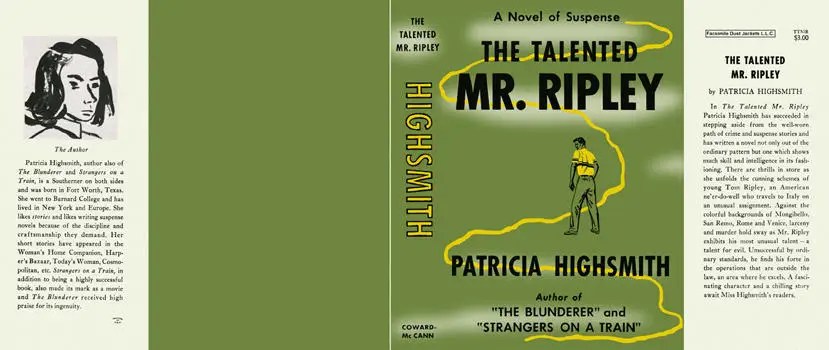
I’ve just finished reading The Talented Mr Ripley for the first time and I can’t help but think of the story as being essentially about what it takes to carry a narrative to full term.
I remain convinced that Patricia Highsmith was essentially transferring the challenges of writing a novel onto a character who has no qualms about committing murder to further his hedonistic aims, but who is then also burdened with having to cover his tracks after the deeds have been done.
Like an author of fiction, he responds to creative prompts emerging from aspirational ideas of aesthetic fulfilment: here, compare the novelist’s desire to craft a masterpiece that recalls and respects their aloof influences and predecessors, with Ripley’s murderously driving urge to be in a position to soak in the fruits of high culture at his own leisurely pace, no matter the cost.
But what follows after you’ve responded to the initial call is the far more careful and laborious work of follow-through, where impulse must be supplemented with a quick-thinking application of intelligence, sensitivity and rigour.
I’ve never watched any of the Ripley film/TV adaptations — I was waiting to finish the book — but of course I was familiar with the overall premise by osmosis. What surprised me about Highsmith’s novel when I finally got down to it was how prone to emotional hissy fits Tom Ripley is, against the calculating, Hannibal Lecter-style sociopath that I had previously pictured. It’s like he does actually have the full range of human emotions at his disposal. He just parcels that energy out in a way that’s generally at odds with how you and I would manage it.
This aspect of the story speaks to how artists — we’ll consider writers as the main focus here — will tend to isolate themselves by proxy, at least while they’re cultivating and executed any given work. I’m not pushing the misunderstood, outsider artist cliché here — I have good reason to be deeply sceptical of that cultural trope — but it’s true that a certain degree of observational distance is necessary for an artist to really focus and get stuck into the work.
And for writers, in particular, this can take on the tenor of detached people-watching. You’re putting characters in your story, and characters are proxy humans who need to feel more human than human for the reader: the reader will, in fact, be compelled to become one and the same with them for the book to really live up to the full potential of the phenomenon of fictional narrative… in exactly the same way that Ripley assumes and then subsumes Dickie Greenleaf’s entire persona (an act of cannibalism so insidious it may even make the aforementioned Mr Lecter blush).
Which means that while the people you’re watching go about their routines, your own will be thrown off-piste for a bit, and you’ll be venting either through the characters you’re puppeteering, or in oblique ways and habits that will register as strange to the outsider.
But much like Tom Ripley’s own ‘bliss of evil’, there is something to be said about the plan finally coming together. Putting Tom’s shocking callousness to one side — which you will as you’re reading anyway, because Highsmith is a master at all of the above — the pleasure of the novel comes with watching with morbid fascination at how our man not only covers up the bodies, but spins a story that convinces everyone: from an international array of law enforcement officials down to the victims’ nearest and dearest.
Like any writer worth their salt, Ripley knows what makes his cast of characters tick, and he knows when to tug at their strings and when to release. The most naked display of this allegory comes to the fore not through Ripley the murderer but Ripley the letter-writer. That’s when his cunning and skill at manipulation reveals the author’s brain at work.
The pen is mightier than the sword, indeed: or rather, it can serve as the civilised supplement to the sword’s blunt-force damage; providing an escape hatch from the animal realm of the murderous impulse and back to the showered, shaven and fragrant world of the cocktail-sipping chattering classes.
Of course, no novel is perfect, and neither is Ripley’s plan. Rerouting and improvisation is often necessary, and the utter unravelling of this delicate tapestry is never not on the table.
Consequently, another constant is the intermittent reappearance of blind panic: that demonic pulse at the core of us all — writers included — which beats out a tattoo that says ‘why did you even attempt this? It’s built to fall apart, and you know it’.
The fact that Ripley gets away with it means that Highsmith has given us a perennial cheerleader for our projects. If you’ve looking for a pep talk to motivate you while you plough through your drafts but (rightly) have no truck with superficial slogans and toxic positivity, the talented (and hardworking) Tom Ripley might just be your man.
There’s something surreal about still being able to glut on a banquet of streaming material as the Hollywood strikes rage on in the background.
Add to that the ‘feast or famine’ vibe of my own personal summer vs autumn streaming experience: there was very little new stuff I wanted to watch over the summer, and then October came along and I’m once again spoilt for choice.
Not that this is a new mood for me. For all the economic chaos we’ve been labouring under in the Western world since 2007 or so, that doesn’t really seem to apply to cultural consumption. Audio-visual “content” is piped in at a regular pace through our obedient army* of trusted apps.
The “TBR” pile only grows and grows, and in my case, twists and morphs into Cronenbergian variants as I give up on one pile to forge another, confident in my prediction that this time, this will be the one that gets devoured.
Ready for them re-reads
This all stands in marked contrast to how I remember experiencing culture in the ’90s. As a geeky son of emigres who lived in Malta and spent summers back in native Serbia, but who was trained to desire the globalised products of the Anglophone sphere, I was often left blue-balled by my inability to grasp at all the stuff I wanted — nay needed — and required to consume. Consume, of course, on the basis of an imagined diet whose prescription was as vague as it was specific.
Getting comics in Malta was nigh impossible at the time, though there was a grassroots ‘comics club’ established by a pair of passionate — though often frustrated — friends who often treated its members as foundlings… which, in many ways, we were: orphaned in our need to latch onto story-products which would not otherwise have reached us were it not for their benediction.
The lack of a foundational cultural identity — or rather, a fragmented one that I wasn’t particularly keen to embrace or even poke at, given that Serbians were officially the aggressors in the nineties’ most significant conflict, rudely blotting the End of History with its own traumatic fallout — is perhaps what led me to latch onto various subcultures: comics were one, metal music was another.
Funnily enough, our trips to Serbia were particularly useful when it came to the latter. The mess of the post-Milosevic era meant that bootlegs could proliferate with impunity — public television channels even aired brand new cinema releases on their evening schedule — so we’d end up taking a bunch of CDs home and gain some degree of bragging rights with out metal head buddies.
Because for all that it was still struggling under the weight of a post-war depression, Belgrade in particular remained a European cities, and subcultures still functioned with an historic sense of purpose, and kindred spirits could be found if you knew where to look. Malta, for all its aspirations of being an up-and-coming place, still operated on a provincial logic.
This was also why the rapid rise and fall of Napster — whose fall was made largely redundant by the floodgates opening up to handily-available variants — was a balm to us in Malta. Suddenly, we could all be on the same page as our international counterparts. Metal Hammer and Kerrang were no longer dispatches from the future.
And yet, fast-forward to the present day, and what I look forward to most re-read season. This is how I’ve unofficially dubbed autumn, over and above its many reliefs and delights (ostensibly cooler weather at some point — climate change permitting — the excuse to binge on horror faves ‘cos Halloween, etc etc.).
It’s about acknowledging a split. On the one hand, there’s so much desirable stuff to consume. On the other, all of that noise is just so piercingly alienating. And caring for the self is all about remembering what makes you, you. The foundations built by all those things that left an impact, for some reason.
This runs counter to the prevailing cultural narrative, of course, which is probably why I always feel an internal pushback whenever I try to implement it. But the relief of re-reading a favourite book is immediate, and immense. It’s a relief akin to the best of drug-free hedonistic pursuits: sex, swimming and a volcanic eruption of laughter during a friends catch-up.
Consumption is what sold us the end of history. But we were nowhere near the end, of course. And regardless, there’s always been a ton of history to feast on in the meantime.
*though a master-slave dialectic may be the more appropriate metaphor here.
That’s not to say I haven’t been able to jot things down. And neither am I “out of ideas” or bereft of the required energy or confidence to keep on ploughing through the sentences and drafts.
It’s just that my current project is at a point where the drafts, the ideas and the characters need some time to get to know each other better. They’re talking at cross-purposes and on a vague, sun-bleached plan, which was mapped out by a remote authority seated in a comfy office and simply left out to the elements and the drafts, the ideas and the characters are forced to squint to make out the shapes which were once words or diagrams meant to take them to the next stage of their journey.
This probably just means that I need to take a break.
Which is funny to consider, when my writing schedule is essentially “whatever you manage in the one hour before you have to head out to go to work”. But a mental break from a specific strand from writing doesn’t necessarily mean stopping to write altogether. Even switching projects works, though arguably swapping over an ingrained, long-term writing practice for some experimental noodling could have an even greater restive (or restorative) effect.
***
Freedom in writing is always a relative term, for me… I’m deeply sceptical of the idea that an artistic practice implies a sense of spontaneous, intuitive and even anarchic liberation away from the strictures of mainstream society. If anything, I find that it actually requires a deeper and more neurotic commitment to some of these tenets, with the anarchism only made evident in the obsessive streak with which you double-down on them.
You can zone out at work, and go for the umpteenth cigarette or coffee. Household chores have definitive parameters, and even the most byzantine of bureaucratic tasks have some kind of ceiling. Clients will have deadlines, and even lovers have their ultimatums. Lovers, partners and friends also have physical bodies that tick away to sometimes endless-seeming, but ultimately finite desires and frustrations. They may be erratic but they’re never truly, entirely unpredictable for those of us who know a thing or two about how humans operate in general. And while they may expect a certain degree of telepathy on your end — and as annoying as such an expectation may be — they will never ask you to create and recreate them anew.
But your characters will. And this is why I think that Mary Shelley’s Frankenstein will always remain a reference point. I’m sure there’s a flurry of doctoral theses and obscure articles out there to prove the following statement wrong, but I’m always surprised that so much of our processing of that pioneering piece of sci-fi gothic literature is focused on the ‘scientific hubris’ reading, and so little on how it’s also a commentary on the act of creation. Yes, I’m sure the theological implications have often been made as well, but I’m referring specifically to how Victor Frankenstein could also be seen as the neurotic and nervous artist trying to come to terms with the horror of a first draft. (And also, how that first draft threatens to morph into something unexpected, and demands that more of these mutations be facilitated by dint of a fertile co-partner).
(I’m not trying to claim this interpretation as original. Those of you have links and PDFs, please pass them on. They are more than welcome).
So yeah, for me, writing is never about freedom but about finding the right straitjacket for the right moment. Or rather, the correct protective suit for whichever uncharted territory you happen to be traversing at the time. Because the territory will always BE uncharted, and populated by monsters to whom you’d not only have to teach language, but whose independence you’d have to facilitate and reassure. Let Victor Frankenstein’s fate be a cautionary tale.
***
Apart from being literally one of two or three annual events I legitimately look forward to each year, the Malta Mediterranean Literature Festival, organised by Inizjamed, often offers me a chance to experience writing in a looser and more immediate way to my default mode. More poetry, less novels. More of experimental prose, and less of the three-act structure.
It often results in me buzzing with a renewed fervour for the written word, experiencing precisely the kind of ‘break-that-is-not-a-break’ that I’d mentioned earlier. You encounter new writers without the aid of an algorithm: better still, right in the flesh. This adds wrinkles to your programme; unexpected experiences that open new doorways.
But there was a dash of welcome familiarity in this year’s edition of the festival. As an honorary member of the extender Inizjamed family, I’d assumed that I had some dibs on suggesting future festival guests. So a couple of years ago I started lobbying for the inclusion of Karin Tidbeck to the roster. Of course, as a subculture-rat since my early teens, my allegiance to specific groups will always trump pretty much all else: in this case, it’s the genre/speculative fiction community. I will always aim to advocate and represent of that literary class in my local stomping grounds, much in the same way I managed to do for Kali Wallace and Jon Courtenay Grimwood.
But I also felt Karin to be germane to Inizjamed’s festival in particular for more specific reasons related to their artistic practice and MO. A festival that comes with its own translation workshop attached, a multi-lingual, self-translating author is practically catnip. And a writer who so keenly identifies with liminal spaces can’t help but feel at home in any festival that deigns to include ‘Mediterranean’ in its title, and this particular one does so with a degree of conviction: operating with both intellectual rigour and humane generosity to create authentic spaces of encounter.
***
All of this largely a preamble to celebrate this year’s edition of the festival (as I did when I was lucky enough to participate back in 2018); to remind you that I got a chance to chat with Karin in print about their uncategorisable nature in the run up to the event; to brag about being allowed to ventriloquise for Karin in her absence from the grand finale due to a ridiculously early wake-up call the following morning; and to hopefully open this space back up for more regular, and looser, writings of this kind.
Especially now that I’m starting a new job in a field that’s relevant to my experience once again. Which is the perfect push and pull of the familiar and the new.
***
I mentioned the prolific (and gentlemanly) Jon Courtenay Grimwood above. During one of our in-person conversations (either during his Malta visit or a follow-up meeting in London, I can’t recall), I spoke admiringly of his substantial output, a lot of it filtered through different noms de plume.
He responded by stating simply, “Well, if I don’t write, I can’t think.”
Increasingly, I find this to be true in my case. It doesn’t necessarily mean that whatever I write will have any value at all; at least not in that early stage. And neither does it have to be some sort of revelatory, epiphanic distillation of the self at that given moment.
The mechanics of writing are their own reward. This is why every single shift away from the programme has value. Words remain words. They will serve you in different ways at different times, but they remain at your disposal.
Featured image: Authors performing at the final night of the 18th edition of the Malta Mediterranean Literature Festival, on 26 August 2023. From left: Tanja Bakic, Claudia Gauci, Karin Tidbeck, Simone Inguanez and Virginia Monteforte (photographer)
Following the annual horror binge of October, I tend to slip back into fantasy favourites during the subsequent months in an attempt to close off the year with something of a cosily immersive lilt; to both weather and take advantage for what passes for autumn and winter in this warm part of the world, and to plug into its wellspring of restorative nostalgia.
This often gets me thinking about the vilification of the fantasy genre — broadly speaking — as ‘escapist’, which tag tends to be loaded and, as is often the case, flung around in a dismissive and rather unreconstructed way.
The implication being that, the further we are from a cleanly mimetic representation of reality in fiction, the more ‘irresponsible’ we become in its consumption. That such a mode encourages us to forget the world as it is now, in favour of an ethereal indulgence that numbs us to our day-to-day realities and leaves us in a torpid stupor, the kind that Tennyson detailed in The Lotos-eaters.
There’s of course been endless shadings and nuancing of this argument over the years, but I believe that the core of it has remained with us — throbbing like a planetary core that has lodged itself and become essential to historical ecosytem of the discourse, much like any other ossified truism.
The Rings of Power (Amazon)
I find it to be endlessly faulty, and not just because I’m a fan of fantasy literature (and therefore don’t appreciate being characterised as some sort of head-in-the-sand naive idiot by proxy).
My issue here is far more fundamental. To put it as plainly as I can manage: it assumes that reality is a flat, clearly definable surface, and that we can posit a clean reality : fantasy binary.
The popularity of such an assumption is hardly surprising, given that it’s taken root primarily within the confines of a materialist, capitalist western society. This is a mode of living which at best compartmentalises all that is not tangibly measurable, rendering it peripheral to the day-to-day workings which make the machinery tick.
So that religious practice is tolerated, as long as it can be woven into the fabric of the day-to-day without causing too much offence (and crucially, it is called upon to occasionally prop up the agendas of certain politicians and ratify certain acts of exclusion and social inequality).
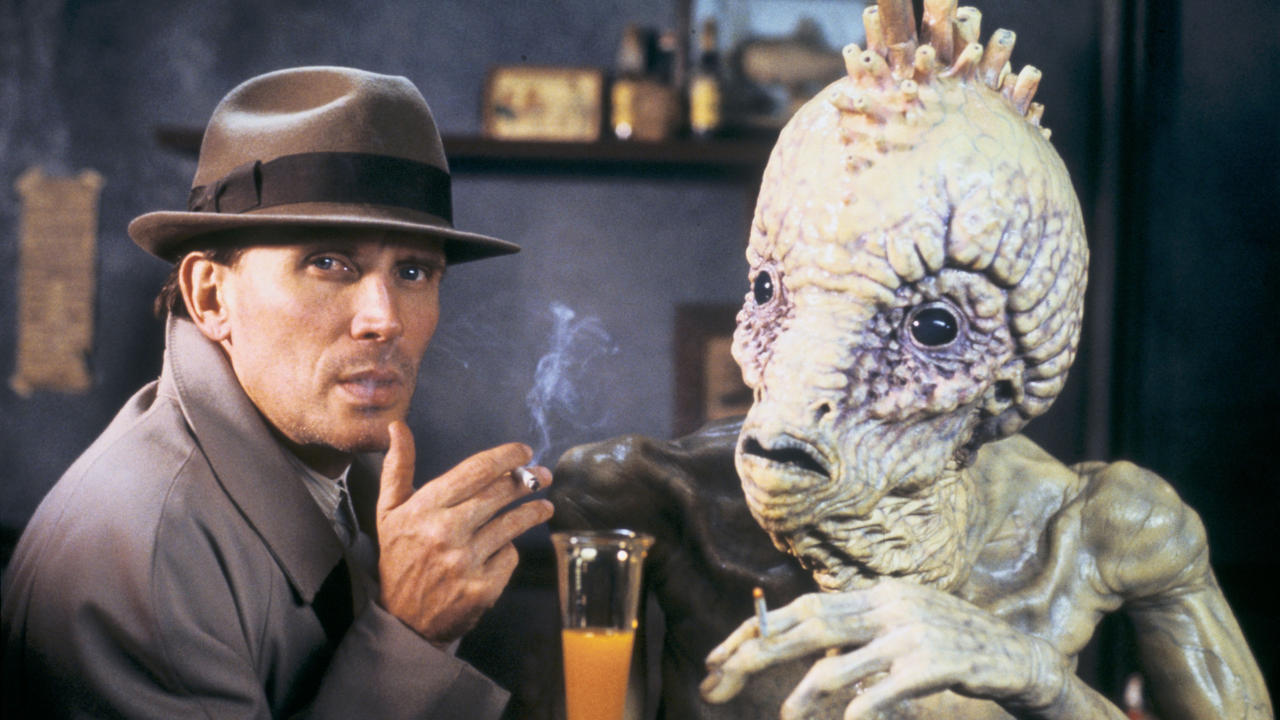
Acceptable escapism? Naked Lunch (1991) by David Cronenberg, adapted from the William S. Burroughs novel
Perhaps we accept the intangible when it relates to issues of mental health. There is, at the very least, an understanding that — medication-based psychiatric help aside — the mental realm needs tending to in ways that are suspiciously apposite to the kind of treatments and rituals we would associate with religious and/or magical practice.
But even then — the overarching practise is to simply ‘treat’ any mental health anguish in a way that’ll make it go away so that you can resume being a healthy cog that can help keep the system chugging along. We are hardly encouraged to take its wider implications — that there’s more to life than what’s in front of us — and run with it.
In the same way, fantasy is also compartmentalised, only to be richly consumed by all of us. Literature aside, its popular adaptations litter our screens and the streaming services that have latched onto them like eager barnacles. Adaptations of the works of JRR Tolkien, George RR Martin and Neil Gaiman were some of the most-watched (or at least most talked about) shows of the past year or so.
Chloë Grace Moretz in The Peripheral (Amazon)
Even something like Amazon’s take on William Gibson’s The Peripheral — ostensibly a work of ‘hard’ neo-cyberpunk from the grandfather of that subgenre — ultimately partakes of fantasy tropes at its root: it’s a portal fantasy with virtual reality and cyborg stand-ins only superficially replacing the mechanics of magic and its adepts.
Ultimately, branding fantasy more escapist than its supposedly ‘realistic’ counterparts is bound to devolve into a fool’s errand animated into being solely by the assumptions of a category error.
Still from The Company of Wolves (1984), directed by Neil Jordan and adapted from the Angela Carter short story
If you’re reading, watching or hearing something — anything — for an extended period of time, you’re lost in that experience, and at least somewhat disconnected from the real world, by proxy. Whether this is an epic adventure quest populated by dragons, elves and goblins, or a kitchen-sink drama of an immigrant family trying to make ends meet in present-day Munich, is really beside the point.
That’s not to say that there are no distinctions to be made within the minutae of experience to be had in each, of course. But the moralistic tone that is often taken against the allegedly more ‘escapist’ of the two still betrays at least a hint of lazy thinking.
For all that the more grimily realist fiction can illuminate and raise awareness — political awareness which, it must be said, is thinner on the ground(s) of that genre’s more navel-gazing counterparts — the fantastic acts as an extension of that experience.
Let’s give voice to what’s easier to defend here, for starters. Boundary-pushing works of the fantastical — the kind you’ll find among the likes of Kafka, Angela Carter or David Cronenberg — will exaggerate and amplify with the aim of exploring loftier points. The flinty realists are largely on the side of these non-escapist works of the fantastical.
Tom Sturridge as Morpheus/Dream in the Netflix adaptation of Neil Gaiman’s The Sandman
But I would submit that even the most reactionary or nostalgic of fantasy works can have a purpose which isn’t simply redolent of intellectual vacuity or laziness, of a kind of distracted quietism that numbs the intellect and reduces its consumers to little more than sludge.
At the end of the day, even the knockiest of Tolkien knock-offs will be better for your mental hygiene than hours spent doomscrolling through the social media platform/s of your choice… and the degree of actual, conscious choice involved in that experience is questionable to begin with.
Because if distraction from reality is what makes fantasy such an ‘irresponsible’ intellectual pursuit, what is the doomscrolling impulse of the 24/7 news cycle, which has now emigrated beyond the relatively confined space of the television screen to also latch themselves onto our mobile phones? (Yes, Gibson and Cronenberg have been warning us of this with grotesque gusto for decades).
Haunted by this reality, I submit that anything which promotes immersion of any kind is a better and more meditative alternative.
Starting from this Friday (6 August), those of you based in Malta can watch a film I wrote at Eden Cinemasin St Julian’s.
This is the first feature film script of mine to be produced, and suffice it to say that I’m excited about how audiences are going to react to our adaptation of Is-Sriep Regghu Saru Velenuzi (literal translation: ‘The Snakes Are Venomous Again’; our translation, ‘A Vipers’ Pit’) by Alex Vella Gera, a novel whose trajectory I’ve followed from a very early stage back in 2012.
Director-producer Martin Bonnici called me up to ask if I’d be on board with adapting the novel back in late 2015, by which point the book had been established as a landmark of contemporary Maltese literature. This had partly to do with its thrilling core conceit – a group of ultra-Catholic nationalist insurgents plan the assassinaton of firebrand socialist prime minister of Malta, Dom Mintoff, in the 1980s – but also for more formal reasons.
Vella Gera’s novel is written in the bilingual register which reflects how a large part of the Maltese population speak; a linguistic schizophrenia that stands in for the binaries of social class on the island. The middle classes speak English, the working classes speak Maltese. At least, that’s the boilerplate belief, which has of course always been more nuanced on the ground than on paper. Middle-class born Noel Sammut Petri decides to break with that tradition after a move to Brussels, insisting on speaking Maltese in Maltese company.
It may seem like a small detail, but it speaks volumes. Where the English-speaking Maltese are either coded as elites or subject to gentle (and not-so-gentle) ridicule for the most part, Vella Gera chooses to depict this reality honestly, filtering some of this understandable distaste through the now liminal figure of Noel.
It’s one of the many ways in which the book resists an earnest, try-hard attempt to flaunt an idea of Malteseness that can be packaged and sold, and it’s probably the reason why it felt so refreshing to so many. Despite the attention-grabbing Mintoff plot, at its core the story is about the emotional landscape of the people trying to navigate the uncertain morass that is Malta: an infant Republic in its early segment set in the 1980s – following Noel’s father Richard as he’s pushed to serve as triggerman for the Mintoff assassination – and an EU member state at the cusp of regime change in 2012.
Vella Gera himself told me as much while we were conducting an email interview about the book prior to its publication in 20 October, 2012. Here’s a quote that didn’t make the final cut:
“I wanted to steer away from narratives dictated by the political parties. In a way, this book is a direct challenge to that bipolarism. Not that I’m propagating a “third way”, which is really conservatism by another name. However, like Noel, I too am aloof from the tug of war of local politics, so if my book were to be “unofficially boycotted” I think in a way it would be a success because it would underline that aloofness and continued lack of understanding of where I really come from
[…]
“Obviously, I have my political opinions, which to a certain extent continue to validate that aloofness, because I find very little in Maltese politics to rejoice over. I wonder who Noel would vote for. Probably [Green Party] AD, or perhaps he wouldn’t vote at all, or then again, he’d vote Labour just to spite [his property magnate friend] Roger. But I never get into these intricacies, because I find them very dull to deal with […] Personally I tried to steer away from getting too specific about anything except the gut feelings of people, which is what I’ve always felt is missing in most Maltese political fiction. That gut feeling that cannot be brushed aside or censored, or made more palatable with a joke or a witty aside, or some satirical tone.”
Despite its many changes to the source novel, I also sincerely hope that our film adaptation manages to convey a similar commitment to the complex emotional spaces the characters occupy, in favour of safely packaged assumptions, and jingoism by any other name.
Is-Sriep Regghu Saru Velenuzi (A Vipers’ Pit) will be screening at Eden Cinemas, St Julian’s, from 6 August. True to its bilingual source novel, the film will be in both Maltese and English, andcome with English subtitles. Book your tickets here.
Just like many other freelancers the world over, the economic fallout of the covid-19 epidemic has left me scrambling for work that would ensure my livelihood in the coming months. Scrambling is something out tribe is accustomed to, of course, and I’ve often been in this situation before and have emerged (relatively) unscathed.
But of course, these are extraordinary times, during which some old clients will scram any prospective ones suddenly find themselves denuded of any lust for adventurous new collaborations.
Freelancing in marginally less trying times, with thought bubble lamp for added effect
To this end, I would like to invite anyone who does retain a sense of adventure during these trying times to consider taking on my services as a freelance writer with experience in various fields — journalism, content writing and scriptwriting being the main three, though I’d be more than happy to work on anything you’ve got going as long as it’s in English and the deadlines are humane.
Neither is there any need to simply take my own word for it, however: do take a look at what some kindly but exacting professionals had to say about my work in various fields by popping over to the ‘Services‘ section of this very site.
***
Offerings
Though it’s hardly the Netflix back (and front) catalogue, some of my own work could very easily keep you company while you’re social distancing away at home.
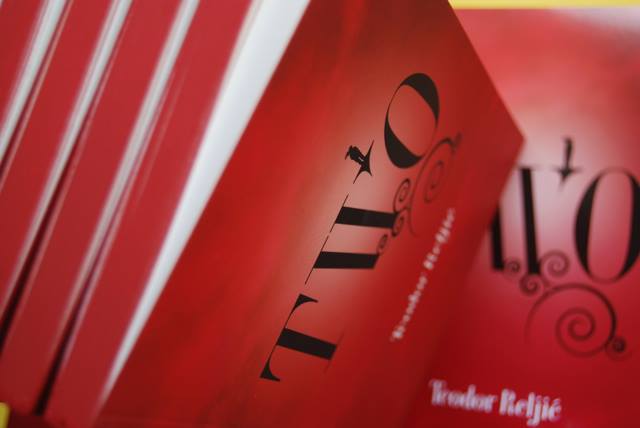
Novel: Two
My debut novel started life as a piece of flash fiction, tumbled into larger and more mottled being thanks to the steady encouragement of Merlin Publishers’ Chris Gruppetta and was released into the little slice of world that would have it at the beautiful Cafe Wignacourt in Rabat, my Maltese town-crush.
Very much a debut novel in spirit, tone and theme, it is a labour of equal parts love and pain: deeply autobiographical and largely told from the POV of a young child, for gods’ sake. Does it get any more debut novel-y than that?!
You can find out more about it here. Those of you in Malta and Gozo can currently avail themselves of a 25% discount from Merlin Publishers — a covid-solidarity move that applies to all of their books. Do also check out Awguri, Giovanni Bonello, featuring a vampire-tinged historical fiction tale that was a blast to write, and which dovetails nicely into our next item…
Short Film: Camilla
Literary film adaptation and vampires are just about two of my favourite things, so it was an honour and a pleasure to be able to adapt Clare Azzopardi’s ‘Camilla’ into a short film, together with Stephanie Sant (who co-wrote and directed) and under the ever-intrepid auspices of producer Martin Bonnici (Shadeena Entertainment). The film was made possible thanks to a competitive fund awarded to us by the National Book Council, whose sterling work can, I hope, continue unabated after all this mess is over.
Meanwhile, please feel free to enjoy our 21-minute slice of Mediterranean Gothic, cross-generational romantic intrigue and sexual discovery, all wrapped up in a coming-of-age story featuring a wide-eyed but hardly bushy-tailed protagonist, brought to entrancing life by Steffi Thake, working under the austere shadow cast by the inimitable Irene Christ.







 Soft Disturbances