February Updates #2 | iBOy, RIMA, You Are What You Buy & the latest in Mibdul (again)

Some updates from my ‘day job’ desk-adventures. Happy to report that February is turning out to be quite the productive and creatively satisfying month. Click here to read the previous update. 

Questioning consumption | You Are What You Buy

31-tw-front-main-pix-1

It was interesting to hear what Kristina Borg had to say about her project You Are What You Buy, which takes an interdisciplinary approach to assessing the implications of shopping at the supermarket.

“One of the principal themes of this project is consumption – what and how we consume. This does not solely refer to food consumption; one can also consume movies, literature and more. However, in order to reach and engage with a wider audience I felt it was necessary to work in, with and around a place of consumption that is more universal and common for all. Let’s face it, whether it’s done weekly or monthly, whether we like it or not, the supermarket remains one of the places we visit the most because […] it caters for our concerns about sustenance and comfort.”

31-tw-front-inset-kristina-borg

Kristina Borg

“An interdisciplinary approach definitely brings together different perspectives and different experiences and […] it could be a way forward for the local art scene to show and prove its relevance to one’s wellbeing. I think it is useless to complain that the arts and culture are not given their due importance if as artists we are not ready to open up to dialogue, exchange and distance ourselves from the luxury that one might associate with the arts. Talking about experience instead of a product might be what the local art scene needs. 

Click here to read the full interview

Fixing the moment | Mohamed Keita and Mario Badagliacca 

The migrants living at the Belgrade Waterfront are using the beams of abandoned tracks (or tires or rubbish) against the temperatures below zero degrees and to produce hot water. Photo by Mario Badagliacca

The migrants living at the Belgrade Waterfront are using the beams of abandoned tracks (or tires or rubbish) against the temperatures below zero degrees and to produce hot water. Photo by Mario Badagliacca

Ahead of their participation at the RIMA Photography Workshops, I got a chance to delve into the dynamics of migration — particularly the problematic way in which migratory flows are portrayed through mainstream political discourse and the media — with Sicilian photographer Mario Badagliacca, who tapped into his experience of documenting the realities of migration — most recently in my own native Belgrade — as well as Ivorian photographer Mohamed Keita, who took a self-taught route to photography after traversing Africa to reach Italy.

The power of photography is to fix the moment. Psychologically speaking, there’s a difference between perceiving a ‘fixed’ image and a ‘moving’ image (as in a video, for example). The ‘fixed’ image constrains us to reflect on it in a different way. In my case, I want the images to serve as a spur for further questions – to be curious about the stories I’m telling. I don’t want to give answers, but raise more questions. – Mario Badagliacca

Photography by Mohamed Keita

Photography by Mohamed Keita

Click here to read the full interview

Film Review | iBoy — Netflix takes the info wars to the gritty streets

Screams of the city: Tom (Bill Milner) finds himself plugged into London’s mobile network after being attacked by thugs in this formulaic but serviceable offering from Netflix

Screams of the city: Tom (Bill Milner) finds himself plugged into London’s mobile network after being attacked by thugs in this formulaic but serviceable offering from Netflix

I had fun watching the ‘Netflix Original’ iBoy — not a groundbreaking movie by any means, but certainly a fun way to spend an evening in the company of Young Adult urban sci-fi that slots into formula with a satisfying click.

film-review-inset-pix

Love interest: Maisie Williams

“iBoy is yet another example of British cinema being able to strip down genre stories to their essentials and deliver up a product that, while hardly brimming with originality, still manages to create a satisfying piece of escapist entertainment. From Get Carter (1971) down to Kingsman (2014), the Brits sometimes manage to upend their Stateside counterparts by just cutting to the chase of what works without the need to inflate their budgets with unnecessary star power and special effects, while also toning down on any sentimentality and drama at script stage.”

Click here to read the full review

Patreon essay | MIBDUL & ‘that uncomfortable swerve’

MIBDUL & that uncomfortable swerve

Not exactly a ‘day job’ entry — though I wish it were — this month’s Patreon essay for our MIBDUL crowdfunding platform was all about me panicking over not having enough space to write out the story as I was planning it, and needing to make some drastic changes to accommodate this new reality.

“The thing about the detailed outlining of issues – and the rough thumbnailing of the pages in particular – is that, unlike the planning stage [in my journal], I approach them largely by instinct. This is the time when you have to feel your story in your gut, because you need to put yourself in the position of the reader, who will be feeling out the story in direct beats instead of painstakingly – and digressively – planned out notebook excursions. (To say nothing, of course, of the fact that the story needs to look good on the page – that the artwork needs the necessary room to breathe).”

Please consider donating to our Patreon page to access this essay and more
Swords v Cthulhu read-a-thon #17 | Eneasz Brodski

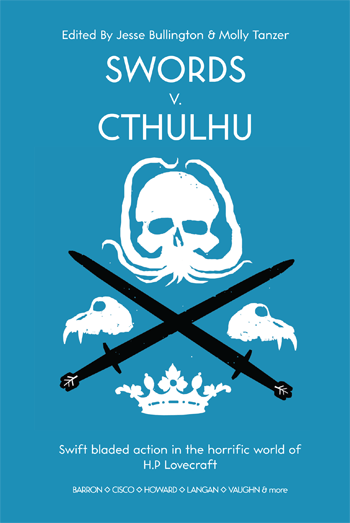
As outlined in an earlier post, in the coming weeks I will be dedicating an entry to each story in the new anthology Swords v Cthulhu, edited by Molly Tanzer and Jesse Bullington and published by Stone Skin Press. My reviewing method will be peppered with the cultural associations that each of these stories inspire. These will be presented with no excuse, apology or editorial justification.

Swords_v_Cthulhu_DRAFT_COVER_350

Of All Possible Worlds by Eneasz Brodski

We started this reviewing journey in Ancient Rome, and as we near its end we prove the adage that all roads do, indeed, lead back to the Eternal City.

However, Brodski’s take on the milieu is markedly different from that of Michael Cisco. Whereas the previous story slid in its weirdness among the Empire’s reputation for sterling military prowess and efficiency, here we are plunged into the city’s multicultural squalor — where violence and exploitation are the order of the day.

In other words, it’s less Neil Marshall’s Centurion and more Fellini’s Satyricon… with some mind-bending eldritch strangeness thrown in for good measure.

Still from Fellini Satyricon (1969)

Still from Fellini Satyricon (1969)

Our protagonist Marad deals with peddling animals for gladiatorial shows, and though he does betray hints of a conscience about his chosen profession, hints are all that remain. In fact, the phrase, “I am sorry. You must die so that I may live. I don’t ask your forgiveness; this is the way of life. But know I wish this world was different,” ends up being something of an anchoring chorus throughout this dizzying narrative.

How this plays out when placed side-by-side with classic Lovecraftian cosmic indifference makes for a good thematic twist, which I won’t spoil. But more importantly for the rest of the tale, that other Lovecraftian trope — the power of nightmares — is employed to give the story an animating force.

A bit confusing at first, this device ultimately creates a sense of thrilling discombobulation, one that perfectly matches the sordid and chaotic social underbelly in which the story is set.

A story with grit and teeth, told by a surrealist street performer who would just as soon slit your throat for all your cash rather than simply accepting your busking tips.

Read previous: E. Catherine Tobler

Swords v Cthulhu read-a-thon #15 | Carlos Orsi

As outlined in an earlier post, in the coming weeks I will be dedicating an entry to each story in the new anthology Swords v Cthulhu, edited by Molly Tanzer and Jesse Bullington and published by Stone Skin Press. My reviewing method will be peppered with the cultural associations that each of these stories inspire. These will be presented with no excuse, apology or editorial justification.

Swords_v_Cthulhu_DRAFT_COVER_350

The Argonaut by Carlos Orsi

In their introduction to the anthology, Tanzer and Bulllington described Brazilian author Carlos Orsi’s contribution as ‘Errol Flynn Goes To Hell’, and it’s a tantalizingly accurate description of what goes on in this ghoulish swashbuckler of a tale.

But the real hook of the story for me was the fact that this takes place on a Maltese vessel in what we can assume is roughly the Golden Age of piracy — and given that the Order of the Knight of St John had no qualms about sponsoring corsairs during their soujourn on the island, Orsi’s choice of setting and conceit is as apt as they come.

Nevertheless, the naval politics of the 17th century and their corresponding geo-historical context only matter up to a (sword) point in this fast-moving tale, whose key qualities lie in its cinematic scope and pace. Orsi conjures up some great images, but more importantly, he makes sure that things are constantly in motion. Stylistically, this is the polar opposite of Lovecraft, whose trembling paranoia inspires gloriously knotted prose that slowly but surely unravels a terrified but richly imaginative mind.

Bill Nighy as Davy Jones in the Pirates of the Caribbean film franchise

Bill Nighy as Davy Jones in the Pirates of the Caribbean film franchise

One would be tempted to throw Pirates of the Caribbean as an easy reference point for this tale on an unfortunate seaman charged with rescuing the husband of a Christian virgin aboard the aformentioned Maltese ship — which is assailed by shoggoths (subordinate figures in Lovecraft’s bestiary). Davey Jones would be the obvious figure that comes to mind once the bewitched sailors turn monstrous.

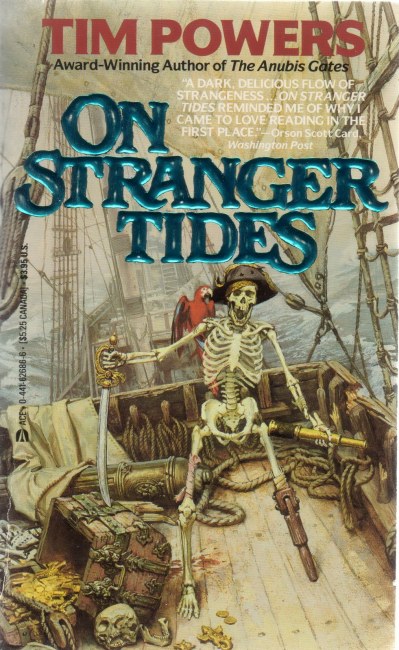
But Orsi’s prose — down to its rapid-fire style — actually recalls a more significant forebear: the work of Tim Powers. After all, On Stranger Tides was not just yet another (and ultimately disappointing) installment in the Pirates of the Caribbean saga. It was actually the book that started it all: inspiring not just the theme park ride that in turn gave way to PoC film franchise, but also that other piece of piratical pop culture lore — the Monkey Island video game series.

On-Stranger-Tides-by-Tim-Powers

And Orsi’s story, with its no-nonsense protagonist and equally no-nonsense approach to storytelling and style, channels Powers’s ability to grip the reader and keep them there. The supernatural is a by-the-by inconvenience here, but a real one nonetheless; much in the same way as Blackbeard’s meddling with the dark arts is a key obstacle for our protagonists in On Stranger Tides.

Whereas the other story in the anthology to channel pirates does so with added lyrical and surrealist gusto, Orsi’s tale provides some classic thrills.

Read previous: Natania Barron

Swords v Cthulhu read-a-thon #12 | Jonathan L. Howard

As outlined in an earlier post, in the coming weeks I will be dedicating an entry to each story in the new anthology Swords v Cthulhu, edited by Molly Tanzer and Jesse Bullington and published by Stone Skin Press. My reviewing method will be peppered with the cultural associations that each of these stories inspire. These will be presented with no excuse, apology or editorial justification.

Swords_v_Cthulhu_DRAFT_COVER_350

Without Within by Jonathan L. Howard

One of the great joys of the anthology under discussion is that Tanzer and Bullington appeared to have transferred their shameless enjoyment of literary pastiche to their contributors, so that most of the 22 tales crackle with the lively literary fetishes being fulfilled.

This has resulted in some funny, pulpy entries that will go down a treat with readers endowed with corresponding interests. Howard’s story, however, is remarkable and enjoyable for taking something of an opposite tack.

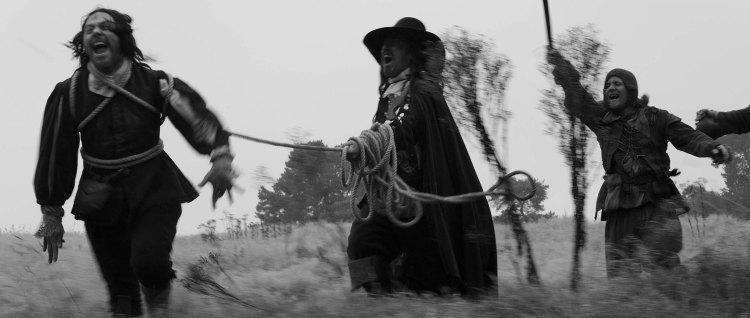
Being a story of Lovecraftian happenings in a suspicious tunnel inspected by a military regiment during the English Civil War, the itch that this would have scratched for me would be something like Ben Wheatley’s mad masterpiece A Field in England — set in the same era and featuring what appear to be drug-addled protagonists trapped in the titular field by some mysterious, cthonic force.

A Field in England (dir. Ben Wheatley, 2013)

A Field in England (dir. Ben Wheatley, 2013)

Instead, Howard’s tone is sober and disciplined, which ultimately results in a fine work of weird fiction whose strangeness is embedded, and eventually serves to undermine, the sober, stiff-upper-lip attitude embodied by our main character, Major Bell.

What starts off as little more than a logistical headache for Bell — who has to repair a broken wall while his men mutter about a mysterious ‘tunnel’ nearby — turns out to be a descent into a nightmare world occupied by ancient and seemingly unstoppable horrors.

So far, so Lovecraft — and the excavation aspect of the story reminded me of the Lovecraft original The Rats in the Walls in particular. The overall structure of the tale doesn’t venture too far off from the Lovecraft schema of Curious Discovery –> Madness, but Howard’s sensitive and haunting prose style lends its own weave to the cosmic horror tradition.

“It was manlike, but whether it had ever been a man he sorely doubted. It was more in the nature of a device in the form of a man, as though some ancient corpse had been the pencil sketch and the final shape the inking of an artist who had never seen a man and allowed new fancies into the design.”

See what I mean?

Read previous: Andrew S. Fuller, M.K. Sauer

Swords v Cthulhu read-a-thon #8 | John Hornor Jacobs

As outlined in an earlier post, in the coming weeks I will be dedicating an entry to each story in the upcoming anthology Swords v Cthulhu, edited by Molly Tanzer and Jesse Bullington and published by Stone Skin Press. My reviewing method will be peppered with the cultural associations that each of these stories inspire. These will be presented with no excuse, apology or editorial justification.

Swords_v_Cthulhu_DRAFT_COVER_350

The Children of Yig by John Hornor Jacobs

Jacobs’s story isn’t the only entry in the collection to channel Norse mythology and/or vikings, and this isn’t exactly surprising. As evidenced by the hit History channel TV show — entitled, simply, Vikings — that historical period continues to gain pop culture traction.

There is something irresistible about the power and freedom implied in the figure of vikings. Or, at least, our perception of them. And although history is a porous thing and we will never get our facts one hundred percent straight, venerating what was essentially a raping-and-pillaging band of marauders is suspect, at best.

But we do it anyway, because the engines of desire — with apologies to Lydia Llewellyn — operate on an amoral setting, and what we find appealing we’ll continue to find appealing despite any curveballs thrown our way by conventional ethics. The Vikings show is the clearest case in point imaginable: a show populated by impossibly beautiful people in impeccable costumes and which liberally mixes historical fact and myth so as to better tease at our magnetic attraction to all that’s related to the ‘viking’ brand.

And just like Game of Thrones appears to suggest a connection between Norse heritage and Lovecraft through the House Greyjoy cephalopod sigil, so John Hornor Jacobs taps into both of those things to deliver a merciless story of two forces of destruction colliding over the bodies of their myriad, hapless victims.

Tourism Ireland hops on the House Greyjoy wagon

Tourism Ireland hops on the House Greyjoy wagon

The most striking and admirable thing about Hornor’s story, however, is that it doesn’t in fact play into the all too common romanticization of Viking culture. Instead, he presents the marauders for what they are — merciless killers who will do anything in the name of loot and waste no time with sentimentality.

Clive Standen as Rollo and Travis Fimmel as Ragnar in The History Channel series Vikings

Clive Standen as Rollo and Travis Fimmel as Ragnar in The History Channel series Vikings

Something of a coming-of-age story for the young Grislae, ‘The Children of Yig’ does not, however, care too much about making you feel any sympathy towards the raiding protagonists. The plight of their victims — often impoverished villagers who are, in turn, often women and children — is rendered in harrowing detail, and the indifference of their aggressors is a stark slap in the face.

In this world, it’s only the Great Old Ones that can offer significant — and, once again, equally amoral — resistance.

A rich story that courses with blood and dread.

Read previous: A. Scott Glancy

Swords v Cthulhu read-a-thon #7 | A. Scott Glancy

As outlined in an earlier post, in the coming weeks I will be dedicating an entry to each story in the upcoming anthology Swords v Cthulhu, edited by Molly Tanzer and Jesse Bullington and published by Stone Skin Press. My reviewing method will be peppered with the cultural associations that each of these stories inspire. These will be presented with no excuse, apology or editorial justification.

Swords_v_Cthulhu_DRAFT_COVER_350

Trespassers by A. Scott Glancy

Even in these supposedly more enlightened times, the trappings of colonial adventure never fail to seduce and enthrall. While we may acknowledge that the bedrock of what makes all the stories of white people venturing into dark lands for booty and triumph as suspect, a primordial gland in our brain will always be attracted to these narratives.

The reasons, a lot of the time, are quite obvious: leaping into the exotic and the unknown feels easier and more legitimized when you have the churning hegemonic power of an imperial/colonial machine behind you, and so these ‘thrilling yarns’ — as they end up being called with alarming regularity — come with enough requisite hand-holding to make them as comfortable as they are exciting.

The ‘have your cake and eat it too’ version of these narratives is embodied quite explicitly in the recent Oscar-baiter movie The Revenant. Once you machete your way through the long-telegraphed hype about just how hard it was to make, you’ll find an adventure story whose moral ambiguity and caked-on grime is the only sop to it existing in the 21st century.

The same — aforementioned — gland is satisfied by the rollicking and blinkered tales of H. Rider Haggard and in fact, Glancy’s contribution to the anthology begins with the words, “Rider approaching!”

Adventure time? The Revenant (2015)

Adventure time? The Revenant (2015)

What follows is the journey of an unwittingly cosmopolitan group of explorers and their misadventures across the treacherous Kunlun Mountain chain in China. An expedition that includes Brits, Russians, Germans and Indians is enough to cause its own drama — add some Lovecraftian horror into that mix and you’ve got yourself a heady melange of historical drama and eldritch inventiveness.

The ‘pygmies’ that serve as the antagonists of the piece are yet another reminder of the ‘have your cake and eat it too’ dynamic that also powers The Revenant. Because in many ways, they slot in ‘nicely’ with the various grotesques of Lovecraft’s own canon — strange races which serve as uncomfortable reminders of their author’s intrinsic discomfort with anything genetically separate from his own biological and cultural constitution.

On the other hand, however, these pygmies are presented as decidedly ‘other’ in a way that neutralizes any ideological scapegoating — or at least, just about. It’s similar to how the not-Native American cannibals of Bone Tomahawk are presented: that film being yet another Western that’s ‘revisionist’, but only to a point.

Glancy’s story shies away from neither the thrill nor the wanton violence that characterizes these stories, both in terms of the dynamic of its setting as well as its relationship to its characters. More crucially, the reader’s relationship with the characters is telling: these are men on a suspect mission that is hardly respectful of local traditions, but goddamn it, they’re facing unprecedented horrors and goddamn it, you’re stuck in there with them and you’re loving it.

As in The Revenant, the grime is not only the point — it’s also the hook. There is no moral centre to this story, just the forward propulsion into a heart of darkness that is in fact getting darker as it progresses.

Read previous: Jeremiah Tolbert

Swords v Cthulhu read-a-thon #3 | L. Lark

As outlined in an earlier post, in the coming weeks I will be dedicating an entry to each story in the upcoming anthology Swords v Cthulhu, edited by Molly Tanzer and Jesse Bullington and published by Stone Skin Press. My reviewing method will be peppered with the cultural associations that each of these stories inspire. These will be presented with no excuse, apology or editorial justification.

Swords_v_Cthulhu_DRAFT_COVER_350

St Baboloki’s Hymn for Lost Girls by L. Lark

One of those words we’re not allowed to use for fear of sounding pretentious or whatever is, apparently, ‘fecund’. I can see the logic in effectively banning the word — it’s a fancy way of saying ‘growth’ and outside of the context of the discussion of population demographics, it can come across as a tad too highfalutin for most.

(Just check out how ‘James Joyce’ is framed saying ‘fecund in its nuttiness for laughs, in this clip.)

But fecund is the first word that came to mind as I was reading St Baboloki’s Hymn for Lost Girls by L. Lark.

“Young monkeys watch from low branches, cheeks stuffed with fruit” is an image from its first paragraph, and it could easily reflect the tone of the entire piece – exotic but not ornamental, and evocative of the growth and appetite of the natural world come spring time.

With this coming-of-age story embedded in a secondary world in which nature is a source of both truth and terror, Lark manages to paint a vivid picture of a world in constant — and sometimes dangerous — flux, building to a confrontation between Nalendi, who “grows too quickly for her skin”, and the titular St Baboloki: a deity in Lark’s ramshackle invented religion, and a figure that Nalendi is warned not to take too lightly.

Hieronymus Bosch was the first association to spark in my head: the teeming world constantly at the risk of altering itself in ways that may not be to your benefit or expectation isn’t only a decorous and inspired way to approach the coming-of-age trope. It’s also a reminder that we’re ultimately the mercy of the natural cycle and whatever it decides to churn out.

The Garden of Earthly Delights by Hieronymus Bosch (1503-1515) (Detail)

The Garden of Earthly Delights by Hieronymus Bosch (1503-1515) (Detail)

But, the appearance of Baboloki itself brought to mind more immediate pop culture precursors — namely, its shifting skin, made up of a hive-mind mosaic of flies. Sure, Constantine (2005) is not the most beloved example ever, but I’ve always had a soft spot for this particular scene — for the monster, if nothing else.

Beyond just flies though, the image is very satisfying for me because it presents the body as a liquid, pliable shape that can change at a moment’s notice. Coupled with a long-standing love and admiration for Ovid’s Metamorphoses and what I deem to be its most cogent modern response — the ‘body horror’ films of David Cronenberg — I was happy to find that in Lark’s story, this thread runs wide and deep.

But I think that my first encounter with such an entity was far less grandiose than all that. Mr Todd McFarlane, take a bow.

Eddie Brock/Venom by Todd McFarlane

Eddie Brock/Venom by Todd McFarlane

It’s a shame that the cinematic adaptations of Venom haven’t exactly been all that fecund after all.

Read previous: Carrie Vaughn

Swords v Cthulhu read-a-thon #1 | Michael Cisco

As outlined in an earlier post, in the coming weeks I will be dedicating an entry to each story in the upcoming anthology Swords v Cthulhu, edited by Molly Tanzer and Jesse Bullington and published by Stone Skin Press. My reviewing method will be peppered with the cultural associations that each of these stories inspire. These will be presented with no excuse, apology or editorial justification.

Swords_v_Cthulhu_DRAFT_COVER_350

‘Non Omnis Moriar (Not All Of Me Will Die): A Sequel to H.P. Lovecraft’s The Very Old Folk’ by Michael Cisco

What makes Michael Cisco an interesting writer is his insane imagination. I’ve yet to encounter a contemporary author who can construct stranger props and plots, and who commits to the weirdness of his worlds with such febrile intensity.

But what makes him a great writer is his ability to do this while maintaining a clinically precise literary style. The end result often ends up being deliciously jarring, as the strange events and characters that populate his stories and novels are delivered to us in the most sober language possible. Imagine if your best friend sidles up to you at a cafe one day, vomits a goblin baby into your glass, and when you look up to him with a shocked expression on your face, he or she darts back with, “So?”

Alas, it’s the latter that’s more in evidence with this particular story, which continues where H.P. Lovecraft’s ‘The Very Old Folk’ left off to present us with something in the vein of the ‘lost Roman legion’ sub-genre.

But given the expected and obvious connection to Lovecraft – a writer Cisco has plenty of time for, even as a literary critic – as well as Cisco’s own vaunted position in the field of weird fiction, the strangeness, comparatively minimal as it may be, is both strong and lingering.

Starting off with an evocative description of a missing body – without any gore, Cisco immediately creates unease through the corpse’s absence – the story proceeds by pitting our stolid and otherwise entirely rational protagonists into an increasingly strange landscape. With supreme confidence, Cisco ensures that it’s the final sentences of the story that deliver their Lovecraftian punch.

What it reminds me of

The ‘lost legion’ genre is of course the obvious signpost here, though I’m not sure how exactly Lovecraft and Cisco’s own boys tally historically with perennial legends such as the Spanish Ninth Legion.

Eagle of the Ninth

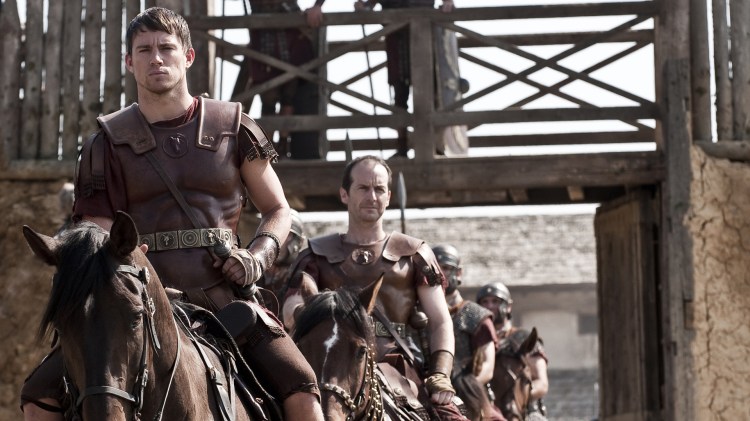
Channing Tatum and Denis O’Hare in The Eagle (2011)

It’s somewhat unfortunate that my most recent memory of these films is marred by the Channing Tatum-starring The Eagle: a yawn-inducing attempt at capturing the broad appeal of something like Gladiator that fell straight on its face.

But more felicitous associations aren’t too far behind, as the pulpy and unambitious Centurion – from the dependable Neil Marshall and starring the as-yet untested Michael Fassbender – plays on the same theme with far more violent aplomb.

Michael Fassbender and Olga Kurylenko in Centurion (2010)

Michael Fassbender and Olga Kurylenko in Centurion (2010)

And a particular scene – I won’t give more away – actually brought to mind one of my favourite films of all time, Nicolas Winding Refn’s Valhalla Rising: the sublime terror of surrendering to an ‘alien’ people in this final scene.

Wishing you a better, stranger future

Schlock Magazine, Utopia Issue (June 2016), Cover (detail) – Daniela Attard

Schlock Magazine, Utopia Issue (June 2016), Cover (detail) – Daniela Attard

Schlock Magazine has finally emerged out of – only slightly self-imposed – hibernation with a special issue on the theme of ‘Utopia’, guest-edited by my good friend, the anthropologist Elise Billiard.

In a lot of ways, and particularly in the way that its entire thrust is based on a healthier attempt to look at the future, the issue lays the groundwork for how I’d like to see the magazine develop too.

Check out Schlock Magazine’s Utopia Issue (June 2016)

It’s been through many permutations over the years, and I refuse to see this as anything but a good thing. More than anything else, our ability to change according to whim (though mainly circumstance) is the most honest way to leverage our ‘amateur’ status with all the possibilities offered by online publication methods for lo-fi operations such as us.

*

Speaking of imaginary structures given added life through creative impetus and irony, the Romanian film Hotel Dallas has proven to be my favourite from the selection at the second edition of the Valletta Film Festival so far.

A mockumentary built on a quirky historical factoid – Ceausescu allowed Dallas as the only American broadcast on Romanian TV for the express purpose of showing how decadent and corrupt American society was – its weaving together of musical, surrealist road trip and an overarching quest narrative never felt forced, pretentious or weird-for-weird’s-sake.

The reason for this is simple: the film’s inherent – sometimes cartoony – strangeness is implicit in the topsy-turvy political situation it seeks to dissect. But it’s the dissection of a trickster, not a surgeon.


Witch

‘Witch’ by Goblin, composed for Dario Argento’s giallo classic Suspiria (1977) appears to have a compelling series of tributes – deliberate, direct or otherwise – in more recent songs. But I am not a music critic is this is all based on intuition.

Valhalla Rising – Theme – Peter & Peter Kyed

The occult connection is something of a given in this, one of my favourite films of all time, but Peter & Peter Kyed’s main theme to Nicolas Winding Refn’s Valhalla Rising carries over the same ominous percussion as Goblin’s incantatory trip. Bonus link: Refn is a dedicated giallo fan who will be putting his money where his mouth is.

Burn the Witch – Queens of the Stone Age

Certainly a more upbeat experience than either of the above, but the breathy-screamy sample at the beginning marks a clear link to its goblinoid predecessor. Radiohead’s recent namesake track channels The Wicker Man instead – shoving us into northern climes far from Argento’s Italy but closer to Refn’s own sublime and brutal hills. Bonus link: Both Valhalla Rising and The Wicker Man were shot in Scotland.