What we talk about when we talk about home

I.


Is there a standard expectation of when our earliest memory is expected to be? The image I have in mind feels a bit late in the day – I was six or seven years old – but I can’t grasp for anything earlier with any conviction and anyway, the further down you go the risk of low-key hallucination – our own personal storehouse of fiction – increases exponentially.

We left Serbia for Malta when I was seven years old, and we spent some days in Bulgaria en route to the island, because wartime sanctions meant we couldn’t fly out directly and had to make a pitstop to Sofia, taking a train ride from Belgrade and sleeping over at the home of acquaintances I hadn’t heard about before or since.

I do remember parts of Sofia – a large, Communist-style statue of a male figure seeping through the urban sprawl, a vegetable market, the brutalist buildings that weren’t all that different from Belgrade – and I remember the train ride too: though the sequence and the images aren’t that clear, my maternal grandmother’s sorrow and confusion still lands like a fresh arrow.

But these weren’t the very first memories – hazy and ancient though they feel too, like watching a grainy film of somebody else’s life, lost in archival wreckage and only just about salvagable, albeit in fragmented form.

The first memory was a foreshortened view of my mother – stylishly dressed as she always was, but definitely dressed to go out, with a coat and a hat and everything, and a wide, warm smile that was to become an aching pull of charm to whoever would meet her.

“We’re going to go find dad.”

She was foreshortened because I was sleeping on the top bunk of our bed in Zemun, with my four-year-old brother on the lower one. The mood of her smile suddenly matched my own – it spread out to me like an infectious carrier of pure joy.

Finding dad was the one thing I wanted. The one thing I felt was missing. The wistfulness for him that had become my norm by then was finally going to find its culmination, was finally going to be allowed to die a natural death.

So that I could become me, in whatever was left.


Dad wasn’t around for a bit because before the Malta plan, there was the Libya plan. The creep of the Yugoslav Wars – that one blip in the otherwise end-of-history-ish vibe that permeated the West during the ’90s – had nudged our parents into considering other options.

And the one that made itself readily available was this one: my father would go to work for his uncle at the drydocks of Benghazi, and the first stage of that was an exploratory trip away from us for some months.

The surge of instant gladness I still remember feeling the moment my mother smiled up at me to say we’re going to find dad means that I had felt his absence like the undeniable cavity of a freshly pulled out tooth.

There’s something that invokes self-pity in the idea that a lack was a main characteristic of my psychic development at that time, but there’s also a positive flip-side to this early memory being tinged with relief and expectation. It’s also a confirmation of the kind of bond you develop with a parent so early on – they really are at the center of your world, so their absence feels, at the very least, like a key comfort denied.

Now my parents are both dead. What to do when that absence becomes not just deferred, but extended indefinitely?


The more time passes, the more I realise just how much of that initial childish separation from my father conditioned my emotional space.

It made me all the more keenly susceptible to nostalgia, to the point where people would make fun of me for wallowing in it at such a young age. (“You’re seventeen, what could you possibly be nostalgic about?”).

Because my parents were either incapable, or unwilling, to internalise the value of sitting still. Displaced from Serbia, we moved within Malta too, just about enough to fully rattle my young psyche into believing that I’ll never find a true sense of home. It’ll surprise precisely no-one that the upshot of this was a dovetailing into fantasy by default.

During break-time at at school, I was magnetically drawn towards the areas of the playground market ‘out of bounds’ – signs virtually unenforced by whatever passed for gatekeeping authorities – lax at the best of times – and which were certainly not going to clamp down on the gawky, floppy-haired nerd who did little except munch of a soggy sandwich and stare into space.


Nostalgia and fantasy walk hand in hand. This is why nostalgia is more than just dry record or a verifiable memory. This is why it comes with a charge of desire and wistfulness, and consequently also why it tends to be viewed with suspicion. Unhealthy, neurotic, escapist and regressive. Putting people inside hamster-cage loops of the past that are both ghostly and undeniable.

This is all well and good. It is the rational position to take. It is the sober and constructive approach that discourages needless and ultimately damaging wallowing. Being lost in the past means being placed in a state of arrested development. Nostalgia means being plunged back into the past, but time as we live it moves forward, and a lot of our psychic success hinges

on at least meeting it halfway.

But that implies that a ground of some kind exists. A home base – indeed, a home, period.

But what if your home never quite materialised? And what if this tenuous home is a rock in the middle of the sea that is constantly made to evolve according to the whims of its colonising forces – both imperial and capitalist?

II.

Both my parents are now dead, and of course I have plenty of regrets and unasked questions which will forever remain pending in a rotting pigeon-box; snuck in but unopened, and I’ll soon forget the actual articulation of these questions and everything will join the same ghostly realm of the nostalgic miasma that I’m straining to pin down and describe here.

As we’ve said – time moves forward, and this forward motion also implies the scalding away of the bodies of those who gave you life and who – inadvertently or otherwise – shaped your social and emotional expectations. But these expectations are never perfect, and often in fact emerge from a build-up of keen and unique damage: unprocessed and even barely addressed.

You know all this. We know all this. But the forward churn of time often leaves these scars lodged into our bodies while we’re forced to tend to other, fresh ones. To put out new fires while older ones are still raging, though some may be reduced to a slow, keen sputter that has morphed into a fireplace of sorts.

I’m overreaching with these metaphors, maybe. I’m just sculpting verbal play from immediate impressions, in the hopes that it would yield something useful. But in the end, isn’t that what all writing is? Isn’t that what the essay form is in particular – to assay, to try, to learn as you go along.

Besides, I like the old-flames-as-new-fireplace metaphor. I think it speaks to the tendency of ‘legacy-trauma’ becoming a default state. Something to return to. A toxic form of comfort. Stories we tell to root ourselves into a sense of coherence, if nothing else.


One of these fireside conversations could concern the details of my father’s time in Libya. He was there around 1991 and 1992 – it had to be around the first half of that time period because by July of 1992 we had already ‘settled’ into Malta with the same provisional air that would inform pretty much everything else we would do as a family.

He was meant to work at the drydocks there, but that plan obviously did not work out because we ended up starting a new life in Malta instead. (There would’ve been something divinely ironic though, wouldn’t there, in going from one country with an authoritarian wartime crisis that devolved into civil war, only to find ourselves in another further down the line).

The fireside story is that he was given a reprieve from whatever hands-on work he was expected to do and he was sent to ‘deliver documents’ to people in Malta. He never got too specific about either. And I never really felt the need to ask, for some strange reason. It’s not so much that I feared the answer would yield something suspicious or unsavory. It’s just that at the time, I took his word for it. I guess we all did. It’s just the kind of thing you allow dads, I suppose, because you want to submit to that imperative – to believe they are the ones providing you with that stable bedrock from which all other meaning emerges and grows.


The fireside story isn’t so much about what he did and didn’t do there, exactly. For that, I suppose there’s both the prosaic and the spurious – if not romantic – interpretations available to us to bandy about.

He could’ve just decided it wasn’t for him – any by extension, per the aforementioned patriarchal imperative, not for us – and that he made a judgement call and opted for the post-colonially wrecked but pretty Mediterranean island instead. Then we could of course run riot with the poundshop espionage narratives, the lurid conspiracy theories: ‘delivering documents’ from Libya to Malta at the peak of the Gaddafi regime? Juicy. Le Carre worthy. Even ‘sus’.

(Later, much later, as my brother and I would bond over his many faults and wounds after his death, he’d offer a plausible stitch to the story: our artsy father was ‘useless at actual construction work’ and so his uncle found some use for him as an messenger boy).

But funnily enough, the fireside story doesn’t amount to a culmination of any of the above. It concerns an even more finely-tuned and concise piece of storytelling. One that frames our tale of settling into Malta as both sanguine and inevitable.

“My dad went to work in Libya, he didn’t really like it, so he took a Captain Morgan boat to Malta to scope out the island and once there he said, this is good – we’ll settle here.”

An elevator pitch. Free of needless detail and complication. Emboldened with pure immigrant pluck, and animated by hope.


Just like we never questioned the details of my father’s time in Libya, so my family never picked all that much at the thorny matter of the Yugoslav Wars, at least not in any incantatory way that would cohere a united front – those micro-political stances some families do take on major issues like these. It’s not that the subject was taboo – my parents spoke about it among themselves in our presence, openly discussing it with fellow Yugo-expats while trying to condense it into bite-sized chunks for Maltese acquaintances – but there was a sense in which talking about it at length with the kids meant infecting the family with its oozing ugliness.

There were some tableside scraps of the narrative which were easy to internalise, though: such as the prevailing thought that the very premise of the war was absurd, that the internecine divisions which characterise it were arbitrary and that nationalistic impulses in whichever direction were enabled by a lumpen mass of the uneducated.

But on a day-to-day level, the war only registered in the undeniable fact of our displacement, and our ongoing distance from the home country as it all raged at its worst and sanctions still barred us from traveling.

So that we lived in that absurdist limbo state where Bryan Adams’s ‘Everything I Do (I Do it for You)’ – ubiquitous as the equally incorrigible camp-fest that was Robin Hood: Price of Thieves to which it was wended as the banner theme song – edged itself into our lives in a more significant way than the contemporaneous Battle of Vukovar never could. Similarly, when we finally got to return to Serbia in 1996, the main emotional undercurrent was that we got to introduce my sister – born a year prior – to our grandparents… us kids were oblivious to the fact that the Dayton Agreement is really what made the trip possible.

‘The war’ was just a perpetual hum in the background of our lives: an undeniable state whose particulars, however, were always remote for us in the immediate sense.

I suppose this is the privilege of those like us who made their way out. (Not to mention the position of Serbia in particular, when it came to its role in the conflict itself).

But there are so many remainders and loose ends. No real narratives, only impressions. And I suppose that, when it comes to war, this is all for the better: we know that concrete narratives in these scenarios often breed monstrous things.

But for a child, the space of silence is rarely a cocoon for meditation. More often than not, it becomes an incubator for loneliness.

III.

The space of loneliness is of course different from that of solitude – with the latter assuming the mantle of the heightened position, the zen-like placid calm and an easy self-communion – but when you’re a kid and experimenting with the things that make you feel good and ease the pain you don’t yet have the layers of experience, of trial-and-error to really make the distinction.

I’ve spoken a lot about the in-the-moment dynamics of displacement and migration here, and loneliness – crucially, not solitude – was a big part of it for me from the beginning since there was very little to latch onto or even land on.

This is what I’ve always found funny about Malta. That the rock is totally a rock. Its undeniable state as an island predominantly defined by rock and STONE – largely the flaky-soft limestone, but still. Famous for it Neolithic temples and famous for all the subsequent temples that followed – one church for each day of the year, St John’s Co-Cathedral and Ta’ Pinu Basilica and all the rest of it. The winding country roads defined by handmade cobbled walls – precarious as they are ubiquitous, a trademark to be protected and which will determine the island’s definition for what feels like forever.

And even down underground, from the paleo-christian catacombs that snake their way across the north, the old water cisterns now fit for dark-tourism-lite tours and boutique concerts, and of course the Hypogeum: now barely reachable by the masses keen to visit all year round because the tickets prices have shot up just like everyone else…

So many perfect enclaves. So many stone spaces to snuggle up against. For shelter, for reflection… to count each crack and each pock-mark, if you like. To be guided by flaming torchlight down subterranean a subterranean passageway and then, reach a clearing and drop it down to the humid floor, and what follows will either be a period of meditation or its longest culmination – death.

But it doesn’t happen that way, does it? Instead of the earthy, enveloping powder of the pure stones by day and its chiaroscuro promises as the sun goes down, the island actually fights against itself and becomes louder and louder – taking the advice to rage against the dying light just that little bit too literally to tip it all over and ruin any remaining chance of peace.


The rocky enclosures are just the kind of spaces I would dream about when I’d head down to lunch break at Ħamrun Liceo; a place where I eventually did find friends but whose long stretches were defined with simply wanting to be elsewhere and assuming this was normal.

Shaping yourself into someone who tolerates life means negotiating the space between the physical and the non-physical, and when you’re raised by parents too scattered and frayed on their own end to offer a ballast or groundwork beyond the most rudimentary, your grasp of the non-physical is equally all over the place.

This is also the same absurd space where Bryan Adams hit anthems co-exist with the news of the Battle of Vukovar, that hum which cannot shape itself into anything coherent, let alone stone.


So, home. Malta became home. We were ‘third-country nationals’ for the longest time and then, one day in 2012, we weren’t any more. A couple of years after my mother had a stroke that would land her in a coma for a decade, we were finally mailed that much-desired olive branch: citizenship.

My father, brother and I went to the office and read out a declaration and signed a paper. The burly policewoman behind the heaving-with-documents desk pointed to another small but significant feature: a crucifix. “Catholic?” she asked us, and when we nodded no she made no fuss about it and just made us read the secular take on all this – said declaration that we would loyal to the Maltese state and respect its institutions and blablabla – and that was that.

We went back home after that, what for both my parents remained a forever home owing to their premature deaths, and what in any case for us was the longest-running home we’d known by then.


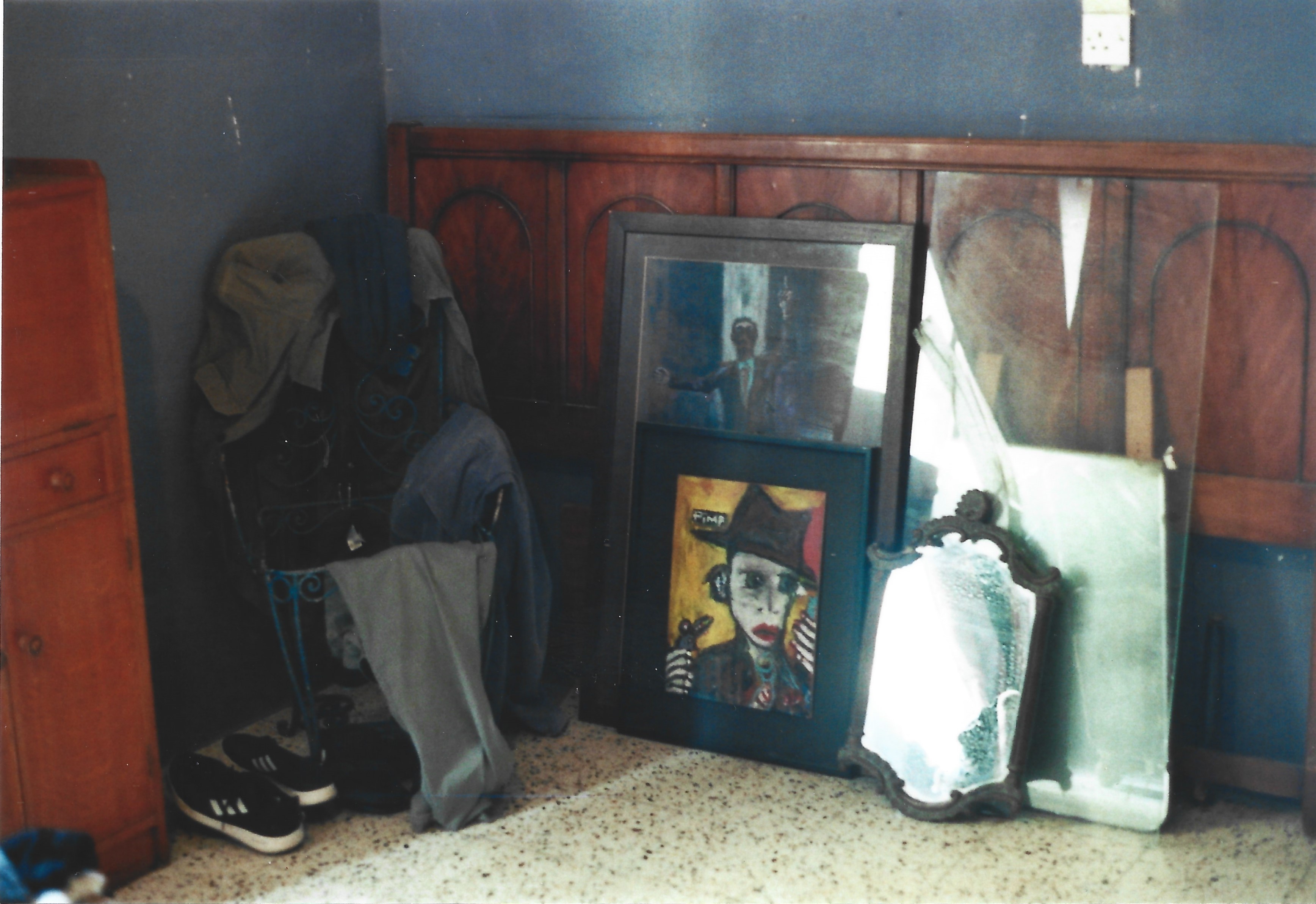
3A, Panorama Flats in Sliema. It was something of a purgatorial wreck by that point, owing my mum’s long sojourn in hospital, and then a care home from 2010 to 2020. As us kids trickled out bit by bit, my father would eventually rebrand it into a workshop space-cum-artist commune.

But in that crucial moment in 2012, it was still something of a gutted mess: we were living like roommates – as my father would take pride in saying, sloughing off any leftover parental responsibility he may have still felt beholden to – hypnotised by the puzzling absurdity of our present situation.

My mother was a beautiful, creative young woman who was holding a bunch of stuff together, and her presence in the home – this apartment, the likes of which they don’t make anymore – was a huge part of that: from its inspired decor, down to her expert hand at entertaining a varied panoply of guests, mostly culled from what would pass for something resembling a bohemian strain to Malta’s doggedly provincial social scene.

After she was gone, there was a period when the house simply took on a life of its own – where our respective rooms became cocoons and we would barely cross each other’s paths because making excuses to not confront the core realities of it all was what we’ve been taught. Our parents always gave us the impression that life was simply TOO MUCH – that there was always too much to do, that we were always too broke, that they were always too tired and too stressed for us to be adding to any of that with our own problems.

So I began to view the parties they would organise in the same way that they would – a reprieve from the inevitable, native stress that resided in all our hearts – and which subsequently exploded their own – and we could join in because, after all, we were all just roommates, right?


The permutation of Panorama into a new space for more roommates speaks to my father’s inability to move on from the ingrained idea that this apartment would be the only forever home he would allow himself, despite the residue of all the ghosts it still contained – the same ghosts he never had the gumption to confront with any real sense of finality and articulation. Speaking to one of the roommates who would subsequently populate the space – this one in particular residing for a while in what used to be my room – revealed the extent of this: “Cleaning that place to the end was impossible. There was always some rot, some mould that just wouldn’t go away.”

Apply all of the psychological cliches you can think of here: a man loses his wife and cannot muster the strength or courage to get up off his ass and leave the home they built together, and after his kids fly the coop he populates it with new kids so as to be able to exist in a version of the same patterns he was used to and thus, keep the inevitable at bay.

This is why I feel drawn to a darkened catacomb as a culmination of everything. This is the emotional legacy I’m labouring under, if we are to passively accept that we all become our parents and simply follow in their footsteps.


The fact is, however, that home is not a static object. My mother reaching out to me in the bunk bed and telling me “we’re gonna go find dad” meant that we were leaving a home to find a more permanent one – one in which the cavity of my father’s absence was no longer felt.

This emotional space is slippery and prone to unfortunate dependencies. You rely on your parents, for example, to continue carving out that space of security for you, but my own were never really able to do that, so what was left for me was my own headspace – the generous reading: ‘Mind Palace’ – where I had a degree of control and I could craft things my way, but whose particulars also inevitably pulled from existing surroundings.

The danger lies in getting tired. If you’re tired you’re more prone to lie down, and to lie down you need a solid surface that will accommodate you. So this is why you craft the idea of home as a solid space to return to and just lie down in. But without a sense of cultivation, when all that’s left is rot, home becomes a prison.


Working through this, I suppose the grandiose take is that it’s all about forward motion and sudden death. Moving from one place to a better one and then being drained my life so that you’re felled in the same spot in which you’ve tried to make a home.

When you’re felled, you’re alone. And you either die there or you achieve genuine rest.


Soon after we got our citizenship, I took advantage of my newfound privilege as a European citizen to cross a fraction of the continent on my own steam – taking a three-week trip across London, Edinburgh, Prague and Berlin.

When I came back to Malta, it was September and despite the heat, I decided to go on a solo hike up north. I failed to adequately follow a walking tour guide offered by the Malta Tourism Authority – my map-dyslexia is maddeningly legendary – and ended up prolonging my journey to a ridiculous degree.

But trekking along Dingli Cliffs while listening to Popol Vuh’s soundtrack to Werner Herzog’s ‘Nosferatu’ was transformative. The heat was of course doing my head in, quite literally in many ways, but I didn’t care.

The strumming sitar sound, the yellow stones and the occasional abandoned shrine to the Madonna. Increasingly irrational, but it was a communion with the space that I hadn’t really felt before or since.

What we talk about when we talk about home – Part 3

Read Part 1 here. Read Part 2 here.

The space of loneliness is of course different from that of solitude – with the latter assuming the mantle of the heightened position, the zen-like placid calm and an easy self-communion – but when you’re a kid and experimenting with the things that make you feel good and ease the pain you don’t yet have the layers of experience, of trial-and-error to really make the distinction.

I’ve spoken a lot about the in-the-moment dynamics of displacement and migration here, and loneliness – crucially, not solitude – was a big part of it for me from the beginning since there was very little to latch onto or even land on.

This is what I’ve always found funny about Malta. That the rock is totally a rock. Its undeniable state as an island predominantly defined by rock and STONE – largely the flaky-soft limestone, but still. Famous for it Neolithic temples and famous for all the subsequent temples that followed – one church for each day of the year, St John’s Co-Cathedral and Ta’ Pinu Basilica and all the rest of it. The winding country roads defined by handmade cobbled walls – precarious as they are ubiquitous, a trademark to be protected and which will determine the island’s definition for what feels like forever.

And even down underground, from the paleo-christian catacombs that snake their way across the north, the old water cisterns now fit for dark-tourism-lite tours and boutique concerts, and of course the Hypogeum: now barely reachable by the masses keen to visit all year round because the tickets prices have shot up just like everyone else…

So many perfect enclaves. So many stone spaces to snuggle up against. For shelter, for reflection… to count each crack and each pock-mark, if you like. To be guided by flaming torchlight down subterranean a subterranean passageway and then, reach a clearing and drop it down to the humid floor, and what follows will either be a period of meditation or its longest culmination – death.

But it doesn’t happen that way, does it? Instead of the earthy, enveloping powder of the pure stones by day and its chiaroscuro promises as the sun goes down, the island actually fights against itself and becomes louder and louder – taking the advice to rage against the dying light just that little bit too literally to tip it all over and ruin any remaining chance of peace.


The rocky enclosures are just the kind of spaces I would dream about when I’d head down to lunch break at Ħamrun Liceo; a place where I eventually did find friends but whose long stretches were defined with simply wanting to be elsewhere and assuming this was normal.

Shaping yourself into someone who tolerates life means negotiating the space between the physical and the non-physical, and when you’re raised by parents too scattered and frayed on their own end to offer a ballast or groundwork beyond the most rudimentary, your grasp of the non-physical is equally all over the place.

This is also the same absurd space where Bryan Adams hit anthems co-exist with the news of the Battle of Vukovar, that hum which cannot shape itself into anything coherent, let alone stone.


So, home. Malta became home. We were ‘third-country nationals’ for the longest time and then, one day in 2012, we weren’t any more. A couple of years after my mother had a stroke that would land her in a coma for a decade, we were finally mailed that much-desired olive branch: citizenship.

My father, brother and I went to the office and read out a declaration and signed a paper. The burly policewoman behind the heaving-with-documents desk pointed to another small but significant feature: a crucifix. “Catholic?” she asked us, and when we nodded no she made no fuss about it and just made us read the secular take on all this – said declaration that we would loyal to the Maltese state and respect its institutions and blablabla – and that was that.

We went back home after that, what for both my parents remained a forever home owing to their premature deaths, and what in any case for us was the longest-running home we’d known by then.


3A, Panorama Flats in Sliema. It was something of a purgatorial wreck by that point, owing my mum’s long sojourn in hospital, and then a care home from 2010 to 2020. As us kids trickled out bit by bit, my father would eventually rebrand it into a workshop space-cum-artist commune.

But in that crucial moment in 2012, it was still something of a gutted mess: we were living like roommates – as my father would take pride in saying, sloughing off any leftover parental responsibility he may have still felt beholden to – hypnotised by the puzzling absurdity of our present situation.

My mother was a beautiful, creative young woman who was holding a bunch of stuff together, and her presence in the home – this apartment, the likes of which they don’t make anymore – was a huge part of that: from its inspired decor, down to her expert hand at entertaining a varied panoply of guests, mostly culled from what would pass for something resembling a bohemian strain to Malta’s doggedly provincial social scene.

After she was gone, there was a period when the house simply took on a life of its own – where our respective rooms became cocoons and we would barely cross each other’s paths because making excuses to not confront the core realities of it all was what we’ve been taught. Our parents always gave us the impression that life was simply TOO MUCH – that there was always too much to do, that we were always too broke, that they were always too tired and too stressed for us to be adding to any of that with our own problems.

So I began to view the parties they would organise in the same way that they would – a reprieve from the inevitable, native stress that resided in all our hearts – and which subsequently exploded their own – and we could join in because, after all, we were all just roommates, right?


The permutation of Panorama into a new space for more roommates speaks to my father’s inability to move on from the ingrained idea that this apartment would be the only forever home he would allow himself, despite the residue of all the ghosts it still contained – the same ghosts he never had the gumption to confront with any real sense of finality and articulation. Speaking to one of the roommates who would subsequently populate the space – this one in particular residing for a while in what used to be my room – revealed the extent of this: “Cleaning that place to the end was impossible. There was always some rot, some mould that just wouldn’t go away.”

Apply all of the psychological cliches you can think of here: a man loses his wife and cannot muster the strength or courage to get up off his ass and leave the home they built together, and after his kids fly the coop he populates it with new kids so as to be able to exist in a version of the same patterns he was used to and thus, keep the inevitable at bay.

This is why I feel drawn to a darkened catacomb as a culmination of everything. This is the emotional legacy I’m labouring under, if we are to passively accept that we all become our parents and simply follow in their footsteps.


The fact is, however, that home is not a static object. My mother reaching out to me in the bunk bed and telling me “we’re gonna go find dad” meant that we were leaving a home to find a more permanent one – one in which the cavity of my father’s absence was no longer felt.

This emotional space is slippery and prone to unfortunate dependencies. You rely on your parents, for example, to continue carving out that space of security for you, but my own were never really able to do that, so what was left for me was my own headspace – the generous reading: ‘Mind Palace’ – where I had a degree of control and I could craft things my way, but whose particulars also inevitably pulled from existing surroundings.

The danger lies in getting tired. If you’re tired you’re more prone to lie down, and to lie down you need a solid surface that will accommodate you. So this is why you craft the idea of home as a solid space to return to and just lie down in. But without a sense of cultivation, when all that’s left is rot, home becomes a prison.


Working through this, I suppose the grandiose take is that it’s all about forward motion and sudden death. Moving from one place to a better one and then being drained my life so that you’re felled in the same spot in which you’ve tried to make a home.

When you’re felled, you’re alone. And you either die there or you achieve genuine rest.


Soon after we got our citizenship, I took advantage of my newfound privilege as a European citizen to cross a fraction of the continent on my own steam – taking a three-week trip across London, Edinburgh, Prague and Berlin.

When I came back to Malta, it was September and despite the heat, I decided to go on a solo hike up north. I failed to adequately follow a walking tour guide offered by the Malta Tourism Authority – my map-dyslexia is maddeningly legendary – and ended up prolonging my journey to a ridiculous degree.

But trekking along Dingli Cliffs while listening to Popol Vuh’s soundtrack to Werner Herzog’s ‘Nosferatu’ was transformative. The heat was of course doing my head in, quite literally in many ways, but I didn’t care.

The strumming sitar sound, the yellow stones and the occasional abandoned shrine to the Madonna. Increasingly irrational, but it was a communion with the space that I hadn’t really felt before or since.
Ends.

What we talk about when we talk about home – Part 2

Read Part 1 here

Both my parents are now dead, and of course I have plenty of regrets and unasked questions which will forever remain pending in a rotting pigeon-box; snuck in but unopened, and I’ll soon forget the actual articulation of these questions and everything will join the same ghostly realm of the nostalgic miasma that I’m straining to pin down and describe here.

As we’ve said – time moves forward, and this forward motion also implies the scalding away of the bodies of those who gave you life and who – inadvertently or otherwise – shaped your social and emotional expectations. But these expectations are never perfect, and often in fact emerge from a build-up of keen and unique damage: unprocessed and even barely addressed.

You know all this. We know all this. But the forward churn of time often leaves these scars lodged into our bodies while we’re forced to tend to other, fresh ones. To put out new fires while older ones are still raging, though some may be reduced to a slow, keen sputter that has morphed into a fireplace of sorts.

I’m overreaching with these metaphors, maybe. I’m just sculpting verbal play from immediate impressions, in the hopes that it would yield something useful. But in the end, isn’t that what all writing is? Isn’t that what the essay form is in particular – to assay, to try, to learn as you go along.

Besides, I like the old-flames-as-new-fireplace metaphor. I think it speaks to the tendency of ‘legacy-trauma’ becoming a default state. Something to return to. A toxic form of comfort. Stories we tell to root ourselves into a sense of coherence, if nothing else.


One of these fireside conversations could concern the details of my father’s time in Libya. He was there around 1991 and 1992 – it had to be around the first half of that time period because by July of 1992 we had already ‘settled’ into Malta with the same provisional air that would inform pretty much everything else we would do as a family.

He was meant to work at the drydocks there, but that plan obviously did not work out because we ended up starting a new life in Malta instead. (There would’ve been something divinely ironic though, wouldn’t there, in going from one country with an authoritarian wartime crisis that devolved into civil war, only to find ourselves in another further down the line).

The fireside story is that he was given a reprieve from whatever hands-on work he was expected to do and he was sent to ‘deliver documents’ to people in Malta. He never got too specific about either. And I never really felt the need to ask, for some strange reason. It’s not so much that I feared the answer would yield something suspicious or unsavory. It’s just that at the time, I took his word for it. I guess we all did. It’s just the kind of thing you allow dads, I suppose, because you want to submit to that imperative – to believe they are the ones providing you with that stable bedrock from which all other meaning emerges and grows.


The fireside story isn’t so much about what he did and didn’t do there, exactly. For that, I suppose there’s both the prosaic and the spurious – if not romantic – interpretations available to us to bandy about.

He could’ve just decided it wasn’t for him – any by extension, per the aforementioned patriarchal imperative, not for us – and that he made a judgement call and opted for the post-colonially wrecked but pretty Mediterranean island instead. Then we could of course run riot with the poundshop espionage narratives, the lurid conspiracy theories: ‘delivering documents’ from Libya to Malta at the peak of the Gaddafi regime? Juicy. Le Carre worthy. Even ‘sus’.

(Later, much later, as my brother and I would bond over his many faults and wounds after his death, he’d offer a plausible stitch to the story: our artsy father was ‘useless at actual construction work’ and so his uncle found some use for him as an messenger boy).

But funnily enough, the fireside story doesn’t amount to a culmination of any of the above. It concerns an even more finely-tuned and concise piece of storytelling. One that frames our tale of settling into Malta as both sanguine and inevitable.

“My dad went to work in Libya, he didn’t really like it, so he took a Captain Morgan boat to Malta to scope out the island and once there he said, this is good – we’ll settle here.”

An elevator pitch. Free of needless detail and complication. Emboldened with pure immigrant pluck, and animated by hope.


Just like we never questioned the details of my father’s time in Libya, so my family never picked all that much at the thorny matter of the Yugoslav Wars, at least not in any incantatory way that would cohere a united front – those micro-political stances some families do take on major issues like these. It’s not that the subject was taboo – my parents spoke about it among themselves in our presence, openly discussing it with fellow Yugo-expats while trying to condense it into bite-sized chunks for Maltese acquaintances – but there was a sense in which talking about it at length with the kids meant infecting the family with its oozing ugliness.

There were some tableside scraps of the narrative which were easy to internalise, though: such as the prevailing thought that the very premise of the war was absurd, that the internecine divisions which characterise it were arbitrary and that nationalistic impulses in whichever direction were enabled by a lumpen mass of the uneducated.

But on a day-to-day level, the war only registered in the undeniable fact of our displacement, and our ongoing distance from the home country as it all raged at its worst and sanctions still barred us from traveling.

So that we lived in that absurdist limbo state where Bryan Adams’s ‘Everything I Do (I Do it for You)’ – ubiquitous as the equally incorrigible camp-fest that was Robin Hood: Price of Thieves to which it was wended as the banner theme song – edged itself into our lives in a more significant way than the contemporaneous Battle of Vukovar never could. Similarly, when we finally got to return to Serbia in 1996, the main emotional undercurrent was that we got to introduce my sister – born a year prior – to our grandparents… us kids were oblivious to the fact that the Dayton Agreement is really what made the trip possible.

‘The war’ was just a perpetual hum in the background of our lives: an undeniable state whose particulars, however, were always remote for us in the immediate sense.

I suppose this is the privilege of those like us who made their way out. (Not to mention the position of Serbia in particular, when it came to its role in the conflict itself).

But there are so many remainders and loose ends. No real narratives, only impressions. And I suppose that, when it comes to war, this is all for the better: we know that concrete narratives in these scenarios often breed monstrous things.

But for a child, the space of silence is rarely a cocoon for meditation. More often than not, it becomes an incubator for loneliness.

Continues…

Photo by Zvezdan Reljić

What we talk about when we talk about home – Part 1

Is there a standard expectation of when our earliest memory is expected to be? The image I have in mind feels a bit late in the day – I was six or seven years old – but I can’t grasp for anything earlier with any conviction and anyway, the further down you go the risk of low-key hallucination – our own personal storehouse of fiction – increases exponentially.

We left Serbia for Malta when I was seven years old, and we spent some days in Bulgaria en route to the island, because wartime sanctions meant we couldn’t fly out directly and had to make a pitstop to Sofia, taking a train ride from Belgrade and sleeping over at the home of acquaintances I hadn’t heard about before or since.

I do remember parts of Sofia – a large, Communist-style statue of a male figure seeping through the urban sprawl, a vegetable market, the brutalist buildings that weren’t all that different from Belgrade – and I remember the train ride too: though the sequence and the images aren’t that clear, my maternal grandmother’s sorrow and confusion still lands like a fresh arrow.

But these weren’t the very first memories – hazy and ancient though they feel too, like watching a grainy film of somebody else’s life, lost in archival wreckage and only just about salvagable, albeit in fragmented form.

The first memory was a foreshortened view of my mother – stylishly dressed as she always was, but definitely dressed to go out, with a coat and a hat and everything, and a wide, warm smile that was to become an aching pull of charm to whoever would meet her.

“We’re going to go find dad.”

She was foreshortened because I was sleeping on the top bunk of our bed in Zemun, with my four-year-old brother on the lower one. The mood of her smile suddenly matched my own – it spread out to me like an infectious carrier of pure joy.

Finding dad was the one thing I wanted. The one thing I felt was missing. The wistfulness for him that had become my norm by then was finally going to find its culmination, was finally going to be allowed to die a natural death.

So that I could become me, in whatever was left.


Dad wasn’t around for a bit because before the Malta plan, there was the Libya plan. The creep of the Yugoslav Wars – that one blip in the otherwise end-of-history-ish vibe that permeated the West during the ’90s – had nudged our parents into considering other options.

And the one that made itself readily available was this one: my father would go to work for his uncle at the drydocks of Benghazi, and the first stage of that was an exploratory trip away from us for some months.

The surge of instant gladness I still remember feeling the moment my mother smiled up at me to say we’re going to find dad means that I had felt his absence like the undeniable cavity of a freshly pulled out tooth.

There’s something that invokes self-pity in the idea that a lack was a main characteristic of my psychic development at that time, but there’s also a positive flip-side to this early memory being tinged with relief and expectation. It’s also a confirmation of the kind of bond you develop with a parent so early on – they really are at the center of your world, so their absence feels, at the very least, like a key comfort denied.

Now my parents are both dead. What to do when that absence becomes not just deferred, but extended indefinitely?


The more time passes, the more I realise just how much of that initial childish separation from my father conditioned my emotional space.

It made me all the more keenly susceptible to nostalgia, to the point where people would make fun of me for wallowing in it at such a young age. (“You’re seventeen, what could you possibly be nostalgic about?”).

Because my parents were either incapable, or unwilling, to internalise the value of sitting still. Displaced from Serbia, we moved within Malta too, just about enough to fully rattle my young psyche into believing that I’ll never find a true sense of home. It’ll surprise precisely no-one that the upshot of this was a dovetailing into fantasy by default.

During break-time at at school, I was magnetically drawn towards the areas of the playground market ‘out of bounds’ – signs virtually unenforced by whatever passed for gatekeeping authorities – lax at the best of times – and which were certainly not going to clamp down on the gawky, floppy-haired nerd who did little except munch of a soggy sandwich and stare into space.


Nostalgia and fantasy walk hand in hand. This is why nostalgia is more than just dry record or a verifiable memory. This is why it comes with a charge of desire and wistfulness, and consequently also why it tends to be viewed with suspicion. Unhealthy, neurotic, escapist and regressive. Putting people inside hamster-cage loops of the past that are both ghostly and undeniable.

This is all well and good. It is the rational position to take. It is the sober and constructive approach that discourages needless and ultimately damaging wallowing. Being lost in the past means being placed in a state of arrested development. Nostalgia means being plunged back into the past, but time as we live it moves forward, and a lot of our psychic success hinges on at least meeting it halfway.

But that implies that a ground of some kind exists. A home base – indeed, a home, period.

But what if your home never quite materialised? And what if this tenuous home is a rock in the middle of the sea that is constantly made to evolve according to the whims of its colonising forces – both imperial and capitalist?

Continues…

Photo by Virginia Monteforte

a prayer to banish a prayer

I was molested on the bus when was around eleven or twelve. A squat man in a red shirt, specs and black hair approached me — we were both standing — and started to pinch and rub at my armpits and neck. Determined, focused on his task. He saw me and it was like he’d remembered to check that off his to-do list — like throwing in that last bit of leftover tomato into the garbage bag before closing it up and leaving it on the doorstep and then heading out, on to the next task.

He looked me straight in the eye. I waved him off, of course, I made my displeasure known. But he needed to do this and he got it done, and after a few more swats from me he moved forward — like a fly buzzing from one victim to another. (The term sex pest suddenly gains more currency in my mind).

We were standing because the bus was full as it always is on the Sliema-Valletta route in summer. The group of tourist girls seated by me may or may not have witnessed the whole thing, and they may or may not have turned to each other to laugh at what happened.

They were young, but not too young — maybe in their early 20s. One of them nudged their friend to attention in the row ahead and smiled, maybe pointing at me, maybe not. Maybe I’m assuming they were laughing at me because what happened to me kicked me off my center, and I expected a reaction from people and they happened to be the first people my gaze turned to, and I couldn’t imagine them to be indifferent so I imagined them to be cruel.

I never told anyone because that would mean that this had actually happened, that I had allowed it to happen and that this made me vulnerable to it possibly happening again. It would also mean that I was, perhaps, predisposed to this happening by something in my very make-up as a young person.

Not that I deserved it, exactly, but that I had somehow magnetically attracted this man towards me and let this happen because it was always meant to happen. Plus, the abuse was by all accounts negligible in terms of duration and measurable physical damage. Three rubs of three strategic points on my upper body, and over as soon as it began.

I return to the way he just materialised, as if he was put on this earth to do this one thing. No leering, no charming of equivocating. I was his for the taking and he needed to tick me off his list.

The heat and the crush of tourists, that old yellow bus bumping and rocking on the pothole-rich roads and jangling like a pocket of loose change in a fistfight. It’s so easy to get lost in these textures, some of which I’m even nostalgic for as the buses became more streamlined and less and less personalised — it’s the company that fully owns and runs them now, and the drivers aren’t assigned a vehicle each that they can decorate with that mixture of the sacred and the profane — a Madonna juxtaposed against a ‘glamour model’; Jesus side by side with Maradona on the dashboard — but are largely made up of interchangeable new arrivals brought in from other countries and rendered anonymous by the economic model which squeezes them into social irrelevance.

But back then, that day was just like any other summer day and it meant that the buses were an extension of the village festa: managed by burly men keen to keep things running as they always have, with tourists brought along for the (literal) ride to gawp in either genuine affection or creeping disgust at these ostentatious attempts at local charm.

Yes, there was a lot to be distracted by, on that day and many others since.

But what didn’t leave me was the sense that I was somehow built for it. I didn’t suffer a repeat of the same — no other man touched me without consent since — but I did come close. The man who sat next to me on the bus and tried to make conversation. The wiry frame, keen eyes. A manic energy that didn’t dissipate, even after he sat by me. Tanned, tanned enough to be on the prowl all day, I think. “Whoo, it’s hot, eh!” I didn’t respond. I didn’t even look at him. “German, German?” he asks. He gets off a few stops later, and my panic-response unclenches just a little bit. Even if I know there’s tons of these men about and that some of them may be on that very bus.

It feels like it was the same guy who some time later — months or years, I’m not sure — stretched out his towel right next to mine when I went for a solo swim at Surfside. Back when tourist season wasn’t a year-long thing, and this was either early or late summer and it was off-peak hours. I struggled with debilitating anxiety and depression even at a young age, and I was proud to have carved out this little ritual for myself, and by myself. That I could use this to beat boredom and to get some exercise. My mother noted the positive effects it was having on me, and it was quite something to get that rare bit of unconditional validation from a woman who held herself to an impossible high standard, which of course trickled down to everyone else.

The man turned to me face me. I’m imagining him as tan, lanky and tall, donning black Speedos and flashing a smile of milky white teeth. He asked for the time, and I think I indulged him. I then packed up my things and left. I stopped going to the beach alone after that.

These men demanded access to the bodies that they wanted. They assumed that my body was a threshold they were entitled to breach, either by brute force or none-too-subtle pre-emptive coercion before going in for the kill. But perhaps I’m being overly cautious, even generous. Entitlement means that a threshold doesn’t exist, or that it doesn’t apply to them.

“Why me?”, feels like a pointless question of course, but if it is pointless then all of the above is too. In other words yes, talking about this won’t turn back time, it will allow for neither revenge nor justice. But these niggling feelings are why we write, and I am writing right now about this, for the first time ever.

I thought about “why me” a lot over the years. The surface-level and ego-rattling interpretation is that I probably looked vulnerable, a ‘soft touch’. I was a skinny blonde kid — indeed, mistaken for German — in a Siculo-Arab island state where hairy, olive-skinned burliness was the norm. A waif. A twig just aching to be snapped, with the same pleasure you would pop bubble wrap or step on a dry leaf.

Men will demand accessibility to the things which are weaker than them, but from which they can derive even a tiny measure of enjoyment. I learned to believe that I was well-placed to fulfil that function, and I carried it with me everywhere. In school at the hilariously male-prison-like Hamrun Liceo, and at work too, where I kept my head down and worked without complaint even as the newsroom sapped me of energy (and my weekends) for a crucial chunk of my adult professional life.

But of course, none of this was true. It was the sickening thought planted inside me by the abuse, which assails you and then leaves a darkly humming mantra; a song whose refrain you’re forced to recite as a prayer each day. Like a pimp, the prayer promises to protect you, and claims it is the only thing in the world that can fulfil that function, and that without it, you will be cast out into the wilderness, and you don’t want to do that, do you? Surely you can’t possibly think that you’ll make it out there on your own.

Of course I cannot articulate the words of the prayer. That’s how it wields its power over me. It’s wordless, but it demands the incantation. I have to somehow say it, but I cannot use words, because words are my pathway to agency. Articulating it would enable me to pierce it and render it as ridiculous.

But I’m learning to let go of perfection. I accept that I will not be able to put down the exact words of the prayer. There’s no reason why it would be spoken in English, or any other human language, for that matter.

So I’ll try.

The prayer would go something like this: “This happened to you because you are weak and vulnerable and it is your destiny to be susceptible to these kinds of actions. There are people in this world who do, and others to whom things are done to, and you are in the latter category and the sooner you accept that, the easier things will be. You will apply this to all spheres of life, and in keeping your head down you will notice that you are safe and that people will like you. Some will use you and a lot of them will take you for granted. But that is just the price you’ll have to pay, and it seems to be a fair trade-off to me. Now, thank me for this insight, and for giving you and organising principle that you can cultivate and cherish in this otherwise chaotic life.”

It feels right on my fingertips, this approximation. I can puncture its silly assumptions and sillier logic because I can see it laid out in front of me just so. No longer looming, now stiff and splayed, a patient etherized upon a table. Who could’ve thought literary criticism could banish demons?

Oh, you couldn’t dam that river

Some months have passed since my dad died and it’ll surprise no-one that I’m still processing everything that happened and that in many ways, the full realisation of the loss hasn’t hit me yet, and likely never will.

I’m also envious of those who could find it in them to mourn in seemingly more direct ways – bursting into tears as soon as they heard the news, or crying at any mention of him after the fact.

There’s a lot to be said about your brain working hard to “protect” you from being hit by the news that the person you’ve known since birth – someone who’s played a fundamental part of your life for 38 years – is now no more.

They are literally nowhere to be found in the living, material realm. You cannot hear them, smell them, touch them and certainly no longer hug them hello or goodbye. You cannot gossip with them, you cannot chastise them and you cannot show them affection nor expect any in return. You cannot visit them just to spend time with them – not even a wordless visit during which they click away at their computer and yawn between puffs of ultimately lethal cigarettes.

But this isn’t the worst of it, because this is all, still, the present – or at least, the very recent past. This is how I remember my father moving (sluggishly as it may be) and operating in the final years of his life. No, the torrential waters that the brain’s dam is desperate to keep at bay are the waters of layered history. Because my father was many things to many people, but to me he was dad, and that’s a multitude which contains many other multitudes within it.

A similar realisation hit me after my mum suffered a stroke which would plunge her into a coma that lasted a decade. A person is precious because they are a universe. A parent, in particular, exists as a storied shelf of memories and interconnected thoughts and behaviours; ones which continue to evolve and reverberate from each other while the person is still alive, but which are then frozen and ossified by proxy after they’re removed from the realm of the living.

This is where they can become mythologised if we’re so inclined. To some of us, or in some of our moods, this is also a site where it becomes easy to cast judgement with an illusion of rigid finality. You can draw definitive conclusions and cast a final verdict, now that the accused – or the lauded – is no longer around to contradict you.

In my father’s case, it is also about the extolling and fetishisation of an artist’s way of life. It’s so tempting to view the motor of this work as something which emerges from outside the common fold and which we can simply gawp at like it’s an alien diamond put on display just for us. As if the material conditions matter not a jot. As if he was given a gift and simply executed it with generous grace – bestowing his lessons onto others too, so that they may take some of the diamond for themselves.

It’s this abdication of the possible and the practical which allows many people to live in a similar phantasmagorical plane that my father occupied in the latter years of his life. 

In any contemporary society dictated by the norms of neoliberal capitalism, living “free” means living at the expense of others – or of your own wellbeing and stability. It’s kill or be killed, eat or be eaten, and when you’re not eating others, well… then you just have to eat yourself. My father chose to bite the bullet of precarity and to swerve out of the neoliberal order instead of meeting it halfway. He spent his time making beautiful work which my siblings and I will now endeavour to protect and preserve. A sizable effort which will also require us to undertake an additional – and equally onerous – side-quest: finding help which is truly trustworthy in an island beset by mercantile souls in search of their next host.

I am also dreading each passing day, because I suspect that the worms will come out of the woodwork good and proper once they decide the grace period has passed and they are within their rights to come knocking at our door demanding the pieces of my father he often gave all too freely when he was around.

Because the phantasmagorical state means that people are not only free to romanticise him, but in that romanticisation – a swerve away from reality and into the same cloudy realm in which he’d made his home – they can reassess and re-engineer their own relationship to him like a piece of Lego. If all is true, everything is permitted.

So we had a situation where people that I know for a fact meant to do my father both reputational and financial harm in the recent past, had no qualms about showing up to his memorial and even posting and boasting about it on social media – lest the FOMO get too much and they be excluded from the collective chant they’ve been called to participate in… a blitz in which genuine tributes collided directly with vainglorious, self-serving bandwagon-jumping.

Being an artist means that you’re public property to a certain extent, and my father’s accommodating nature meant that everyone had their own piece of his memory to take home with them. But it’s a piece free from the vicissitudes of the raging torrent that the dam is just about keeping steady for me.

Crucially, it’s a piece that may be small but it illuminates quite a bit, blessing the keeper with a selective blindness. So we would be forced to parse through DMs from apparently well-meaning Senders but whose content was so blisteringly insensitive it was difficult to even believe a human being took the time to type them out and hit ‘Send’. Like the Sender who, for example, implied that they should be the ones to archive my father’s work as they suspected that the family would be tempted to just leave it to rot somewhere.

In this instance, the family becomes secondary – lumpen byproducts of the artist’s creative process, clearly ill-equipped to handle his legacy because they weren’t seen to be going through the usual motions that fellow darkroom acolytes went through, and posted incessantly about on their socials.

In a lot of ways, this is a crucial consideration because it cuts to a deeper vein of my father’s life, work and his appeal to many.

It is down to that hopelessly fraught term: authenticity.

Many have extolled his sincerity, generosity and his apparent lack of ego, at least when it came to executing and promoting (or failing to promote) his work. The problem is that authenticity is entirely inimical to the status quo we’ve already mentioned. This is why my father’s version of authenticity was refreshing – it projected an alternative way of being which some sought to emulate, others to exploit.

Never mind that all the features which people were quick to romanticise about my father, came to the fore only a decade or so before his passing. He dove back into photography in earnest after my mother’s stroke. Always in search of low-hanging-fruit solutions to make some money while still catering to his creative instincts, he started giving workshops to an eager gaggle of hipsters (yes, the term still had currency back then), and it was from there that the whole Zvez vibe became a thing; that darkroom and oak table occupying an iconic space in the memory for many, hipsters and not.

But, faced with the imminent need to vacate his apartment, I was also faced with old family photos. They command more attention from me than his subsequent, lauded works. They are the propulsive energy of the waters beating against the dam. They tell of a life lived – of a struggling immigrant family, and of a man still plugged into the churn of day-to-day life. Put-upon and frustrated, sure, but certainly not relegated to a cave of his own making, gawped at by those with a hole to fill, the crowd that real friends with real love have to machete through for a glimpse of my father’s attention. 

They deserve space and time, and that’s why I’ll end it here from now because there are no neat endings in this process, only hard-won new beginnings. 

***

Photography by Virginia Monteforte

Zvezdan Reljić (1961-2023)

My father, Zvezdan Reljić, passed away on 22 December 2023 after suffering a massive heart attack a few days prior. He was 62.

A photographer and print-maker, he leaves behind a legacy of work that has attracted a myriad of admirers at different stages of the process. Because it wasn’t just the end product that drew a crowd. Through his film photography workshops, he slowly amassed a myriad of students who found in him an accommodating tutor, teaching them the ropes as he reignited his own passion for a vocation he had to put the wayside as he raised kids and kept a family afloat after emigrating all of us from Serbia to Malta in the early ’90s.

The black-on-white CV version of his life will tell you that his most notable works include the book Wiċċna / Our Face (2018) — a collection of portraits depicting the polychromatic reality of cosmopolitan Malta, gathering faces of those who were either born, settled or simply passed through this ancient but ever-transient island in the middle of the Mediterranean which our family made into a home, finally becoming fully naturalised citizens in 2012.

The CV would also then include a reference to his most recent achievement: the solo exhibition JA! JA! JA! at R Gallery in Sliema, the town in which he was still living at the time of his death, in the rented apartment of 3A, Panorama Flats, into which our family settled after a nomadic couple of years and for which I wrote this poem on the occasion of the exhibition’s finissage.

The CV would then also list his publishing venture Ede Books, responsible for some award-winning titles and latterly, the publication of hand-printed & pressed chapbooks: yet another manifestation of his DIY approach, coupled with his desire to discover and elevate fresh voices in the community, while also giving the more established players a welcome breathing room to experiment on the fringes.

The CV, and the established bio, would also necessarily have to mention that he served as president of the Kixott Cooperative; a small but vibrant cultural hub in the town of Mosta, which arose in 2019 as an endeavour by “my family and other animals” and went through various permutations and faced numerous challenges — the pandemic, in retrospect, being the least among them — but which survives as an events space, bar and small bookshop that consolidated the communal space which my father opened up to students and other artsy aspirants, after my siblings and I flew the coop, which we gradually did following my mother’s stroke and extended “exile” in a care home.

Many beautiful tributes have already been penned and some — such as this one by Seb Tanti Burlo and this one by Chris De Souza Jensen — have even been drawn. Our long-standing friend and colleague Matthew Vella wrote a beautiful obituary for MaltaToday, where both my father and myself worked for a long period of time, establishing both of our careers in the process. The piece is as impassioned as it is comprehensive, and collates the life and career in a way that only a seasoned journalist who is also a dear friend can manage.

Many will talk about how my father helped galvanise an artistic community, and that he offered a ‘safe haven’ for rootless yet artistically ambitious souls: both at Kixott and in his own home. It’s a beautiful image and memory to cling onto.

But of course, every romantic impression comes with the flip-side of harsh reality. And as his eldest son, along with the rest of the family, navigating my father’s legacy will be about accepting the challenges that some with the ‘public vs private’ aspects of it all… which were further complicated by his opening up his doors to so many people.

Going forward, there will be a lot to unpack. We need to ensure that his work survives, and is sheparded to the right places as carried by the right hands. (Being as accommodating as my father was meant that a few bad apples will, inevitably, slip through the net.)

But that’s yet to come. The smoke is still clearing. And after the tributes gradually recede, the silence will be deafening and the true work of grief will begin.

Book Review: A Death in Malta by Paul Caruana Galizia

My book review of Paul Caruana Galizia’s A Death in Malta: An Assassination and a Family’s Quest for Justice is now up over at The Markaz Review.

I was honoured to be commissioned to write the piece for such a prestigious publication, thanks to poaching by one of its editors, the Malta-based Rayyan al-Shawaf. I tackled it with some abandon (the original draft was far longer and far more winding), because the book itself is a heady hybrid that cuts to the bone while also providing the necessary context for an international audience.

The politics and ‘true-crime’ angle are very much in there, and will appease the readership looking for the necessary does of robust, hard-nosed investigative journalism that the Caruana Galizia family as whole is now renowned for.

But it’s the ostensibly ‘digressive’ passages that really struck a chord with this reviewer… one who’s had to internalise the Maltese context the hard way, and one who’s also lost their mother at a young age.

There’s a tendency among us Maltese to have to ‘explain’ what Malta is to the rest of the world. Usually this is done with pre-packaged touristy pride: the brochure version of the island’s greatest hits. But the assassination of Daphne Caruana Galizia led to a dark inversion of that habit, and this book by her youngest son offers the starting point of an in-depth exploration of what such an inversion implies.

Keep your feasts and keep your famine

There’s something surreal about still being able to glut on a banquet of streaming material as the Hollywood strikes rage on in the background.

Add to that the ‘feast or famine’ vibe of my own personal summer vs autumn streaming experience: there was very little new stuff I wanted to watch over the summer, and then October came along and I’m once again spoilt for choice.

Not that this is a new mood for me. For all the economic chaos we’ve been labouring under in the Western world since 2007 or so, that doesn’t really seem to apply to cultural consumption. Audio-visual “content” is piped in at a regular pace through our obedient army* of trusted apps.

The “TBR” pile only grows and grows, and in my case, twists and morphs into Cronenbergian variants as I give up on one pile to forge another, confident in my prediction that this time, this will be the one that gets devoured.

Ready for them re-reads

This all stands in marked contrast to how I remember experiencing culture in the ’90s. As a geeky son of emigres who lived in Malta and spent summers back in native Serbia, but who was trained to desire the globalised products of the Anglophone sphere, I was often left blue-balled by my inability to grasp at all the stuff I wanted — nay needed — and required to consume. Consume, of course, on the basis of an imagined diet whose prescription was as vague as it was specific.

Getting comics in Malta was nigh impossible at the time, though there was a grassroots ‘comics club’ established by a pair of passionate — though often frustrated — friends who often treated its members as foundlings… which, in many ways, we were: orphaned in our need to latch onto story-products which would not otherwise have reached us were it not for their benediction.

The lack of a foundational cultural identity — or rather, a fragmented one that I wasn’t particularly keen to embrace or even poke at, given that Serbians were officially the aggressors in the nineties’ most significant conflict, rudely blotting the End of History with its own traumatic fallout — is perhaps what led me to latch onto various subcultures: comics were one, metal music was another.

Funnily enough, our trips to Serbia were particularly useful when it came to the latter. The mess of the post-Milosevic era meant that bootlegs could proliferate with impunity — public television channels even aired brand new cinema releases on their evening schedule — so we’d end up taking a bunch of CDs home and gain some degree of bragging rights with out metal head buddies.

Because for all that it was still struggling under the weight of a post-war depression, Belgrade in particular remained a European cities, and subcultures still functioned with an historic sense of purpose, and kindred spirits could be found if you knew where to look. Malta, for all its aspirations of being an up-and-coming place, still operated on a provincial logic.

This was also why the rapid rise and fall of Napster — whose fall was made largely redundant by the floodgates opening up to handily-available variants — was a balm to us in Malta. Suddenly, we could all be on the same page as our international counterparts. Metal Hammer and Kerrang were no longer dispatches from the future.

And yet, fast-forward to the present day, and what I look forward to most re-read season. This is how I’ve unofficially dubbed autumn, over and above its many reliefs and delights (ostensibly cooler weather at some point — climate change permitting — the excuse to binge on horror faves ‘cos Halloween, etc etc.).

It’s about acknowledging a split. On the one hand, there’s so much desirable stuff to consume. On the other, all of that noise is just so piercingly alienating. And caring for the self is all about remembering what makes you, you. The foundations built by all those things that left an impact, for some reason.

This runs counter to the prevailing cultural narrative, of course, which is probably why I always feel an internal pushback whenever I try to implement it. But the relief of re-reading a favourite book is immediate, and immense. It’s a relief akin to the best of drug-free hedonistic pursuits: sex, swimming and a volcanic eruption of laughter during a friends catch-up.

Consumption is what sold us the end of history. But we were nowhere near the end, of course. And regardless, there’s always been a ton of history to feast on in the meantime.

*though a master-slave dialectic may be the more appropriate metaphor here.

Words will wait

Writing hasn’t been easy lately.

That’s not to say I haven’t been able to jot things down. And neither am I “out of ideas” or bereft of the required energy or confidence to keep on ploughing through the sentences and drafts.

It’s just that my current project is at a point where the drafts, the ideas and the characters need some time to get to know each other better. They’re talking at cross-purposes and on a vague, sun-bleached plan, which was mapped out by a remote authority seated in a comfy office and simply left out to the elements and the drafts, the ideas and the characters are forced to squint to make out the shapes which were once words or diagrams meant to take them to the next stage of their journey.

This probably just means that I need to take a break.

Which is funny to consider, when my writing schedule is essentially “whatever you manage in the one hour before you have to head out to go to work”. But a mental break from a specific strand from writing doesn’t necessarily mean stopping to write altogether. Even switching projects works, though arguably swapping over an ingrained, long-term writing practice for some experimental noodling could have an even greater restive (or restorative) effect.

***

Freedom in writing is always a relative term, for me… I’m deeply sceptical of the idea that an artistic practice implies a sense of spontaneous, intuitive and even anarchic liberation away from the strictures of mainstream society. If anything, I find that it actually requires a deeper and more neurotic commitment to some of these tenets, with the anarchism only made evident in the obsessive streak with which you double-down on them.

You can zone out at work, and go for the umpteenth cigarette or coffee. Household chores have definitive parameters, and even the most byzantine of bureaucratic tasks have some kind of ceiling. Clients will have deadlines, and even lovers have their ultimatums. Lovers, partners and friends also have physical bodies that tick away to sometimes endless-seeming, but ultimately finite desires and frustrations. They may be erratic but they’re never truly, entirely unpredictable for those of us who know a thing or two about how humans operate in general. And while they may expect a certain degree of telepathy on your end — and as annoying as such an expectation may be — they will never ask you to create and recreate them anew.

But your characters will. And this is why I think that Mary Shelley’s Frankenstein will always remain a reference point. I’m sure there’s a flurry of doctoral theses and obscure articles out there to prove the following statement wrong, but I’m always surprised that so much of our processing of that pioneering piece of sci-fi gothic literature is focused on the ‘scientific hubris’ reading, and so little on how it’s also a commentary on the act of creation. Yes, I’m sure the theological implications have often been made as well, but I’m referring specifically to how Victor Frankenstein could also be seen as the neurotic and nervous artist trying to come to terms with the horror of a first draft. (And also, how that first draft threatens to morph into something unexpected, and demands that more of these mutations be facilitated by dint of a fertile co-partner).

(I’m not trying to claim this interpretation as original. Those of you have links and PDFs, please pass them on. They are more than welcome).

So yeah, for me, writing is never about freedom but about finding the right straitjacket for the right moment. Or rather, the correct protective suit for whichever uncharted territory you happen to be traversing at the time. Because the territory will always BE uncharted, and populated by monsters to whom you’d not only have to teach language, but whose independence you’d have to facilitate and reassure. Let Victor Frankenstein’s fate be a cautionary tale.

***

Apart from being literally one of two or three annual events I legitimately look forward to each year, the Malta Mediterranean Literature Festival, organised by Inizjamed, often offers me a chance to experience writing in a looser and more immediate way to my default mode. More poetry, less novels. More of experimental prose, and less of the three-act structure.

It often results in me buzzing with a renewed fervour for the written word, experiencing precisely the kind of ‘break-that-is-not-a-break’ that I’d mentioned earlier. You encounter new writers without the aid of an algorithm: better still, right in the flesh. This adds wrinkles to your programme; unexpected experiences that open new doorways.

But there was a dash of welcome familiarity in this year’s edition of the festival. As an honorary member of the extender Inizjamed family, I’d assumed that I had some dibs on suggesting future festival guests. So a couple of years ago I started lobbying for the inclusion of Karin Tidbeck to the roster. Of course, as a subculture-rat since my early teens, my allegiance to specific groups will always trump pretty much all else: in this case, it’s the genre/speculative fiction community. I will always aim to advocate and represent of that literary class in my local stomping grounds, much in the same way I managed to do for Kali Wallace and Jon Courtenay Grimwood.

But I also felt Karin to be germane to Inizjamed’s festival in particular for more specific reasons related to their artistic practice and MO. A festival that comes with its own translation workshop attached, a multi-lingual, self-translating author is practically catnip. And a writer who so keenly identifies with liminal spaces can’t help but feel at home in any festival that deigns to include ‘Mediterranean’ in its title, and this particular one does so with a degree of conviction: operating with both intellectual rigour and humane generosity to create authentic spaces of encounter.

***

All of this largely a preamble to celebrate this year’s edition of the festival (as I did when I was lucky enough to participate back in 2018); to remind you that I got a chance to chat with Karin in print about their uncategorisable nature in the run up to the event; to brag about being allowed to ventriloquise for Karin in her absence from the grand finale due to a ridiculously early wake-up call the following morning; and to hopefully open this space back up for more regular, and looser, writings of this kind.

Especially now that I’m starting a new job in a field that’s relevant to my experience once again. Which is the perfect push and pull of the familiar and the new.

***

I mentioned the prolific (and gentlemanly) Jon Courtenay Grimwood above. During one of our in-person conversations (either during his Malta visit or a follow-up meeting in London, I can’t recall), I spoke admiringly of his substantial output, a lot of it filtered through different noms de plume.

He responded by stating simply, “Well, if I don’t write, I can’t think.”

Increasingly, I find this to be true in my case. It doesn’t necessarily mean that whatever I write will have any value at all; at least not in that early stage. And neither does it have to be some sort of revelatory, epiphanic distillation of the self at that given moment.

The mechanics of writing are their own reward. This is why every single shift away from the programme has value. Words remain words. They will serve you in different ways at different times, but they remain at your disposal.

Featured image: Authors performing at the final night of the 18th edition of the Malta Mediterranean Literature Festival, on 26 August 2023. From left: Tanja Bakic, Claudia Gauci, Karin Tidbeck, Simone Inguanez and Virginia Monteforte (photographer)