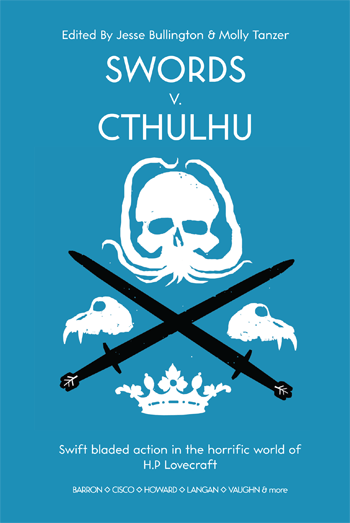
When Molly Tanzer, author of fun books likeVermilion and The Pleasure Merchant, asked me to review Swords v Cthulhu, the upcoming anthology she’s put together with Jesse Bullington, I was more than happy to do so… given that the book, released in July, has been on my to-buy list more or less since it was first announced.
Apart from being an avid fan of Tanzer’s fiction, I was also charmed by Bullington’s earlier anthology, Letters to Lovecraft — also released from Stone Skin Press, who with the ‘Swords’ anthology continue playing on a motif begun with their successful 2012 release, Shotguns v Cthulhu.
But because I know there’s lots of fun to be had when Tanzer and Bullington, shameless pastiche artists both, are given full reign over a project, I decided to go about my own review in the same spirit of referential collage.
So in the coming days, weeks, months — however long it takes for this project to unspool, anyway — I will be dedicating a post to each story. But apart from dedicating a couple of paragraphs to the analysis of each piece, I will also give full vent to the cultural free-association that they inspire: be it other prose, films, art or music. You may, if you wish, think of it as an exercise of ‘The Ecstasy of Influence‘.
We will begin with Michael Cisco’s chilly and precise ‘Non Omnis Moriar (Not All Of Me Will Die): A Sequel to H.P. Lovecraft’s The Very Old Folk‘. Stay tuned.
Schlock Magazine has finally emerged out of – only slightly self-imposed – hibernation with a special issue on the theme of ‘Utopia’, guest-edited by my good friend, the anthropologist Elise Billiard.
In a lot of ways, and particularly in the way that its entire thrust is based on a healthier attempt to look at the future, the issue lays the groundwork for how I’d like to see the magazine develop too.
It’s been through many permutations over the years, and I refuse to see this as anything but a good thing. More than anything else, our ability to change according to whim (though mainly circumstance) is the most honest way to leverage our ‘amateur’ status with all the possibilities offered by online publication methods for lo-fi operations such as us.
*
Speaking of imaginary structures given added life through creative impetus and irony, the Romanian film Hotel Dallas has proven to be my favourite from the selection at the second edition of the Valletta Film Festival so far.
A mockumentary built on a quirky historical factoid – Ceausescu allowed Dallas as the only American broadcast on Romanian TV for the express purpose of showing how decadent and corrupt American society was – its weaving together of musical, surrealist road trip and an overarching quest narrative never felt forced, pretentious or weird-for-weird’s-sake.
The reason for this is simple: the film’s inherent – sometimes cartoony – strangeness is implicit in the topsy-turvy political situation it seeks to dissect. But it’s the dissection of a trickster, not a surgeon.
‘Witch’ by Goblin, composed for Dario Argento’s giallo classic Suspiria (1977) appears to have a compelling series of tributes – deliberate, direct or otherwise – in more recent songs. But I am not a music critic is this is all based on intuition.
Valhalla Rising – Theme – Peter & Peter Kyed
The occult connection is something of a given in this, one of my favourite films of all time, but Peter & Peter Kyed’s main theme to Nicolas Winding Refn’s Valhalla Rising carries over the same ominous percussion as Goblin’s incantatory trip. Bonus link: Refn is a dedicated giallo fan who will be putting his money where his mouth is.
Burn the Witch – Queens of the Stone Age
Certainly a more upbeat experience than either of the above, but the breathy-screamy sample at the beginning marks a clear link to its goblinoid predecessor. Radiohead’s recent namesake track channels The Wicker Man instead – shoving us into northern climes far from Argento’s Italy but closer to Refn’s own sublime and brutal hills. Bonus link: Both Valhalla Rising and The Wicker Man were shot in Scotland.
“The flea market ethos, like many countercultural values, paid its respects to a modernist notion of prelapsarian authenticity. In an age of plastic, authentic material value could only be located in the “real” textures of the preindustrial past, along with traces of the “real” labor that once went into fashioning clothes and objects. By sporting a while range of peasant-identified, romantic proletarian, and exotic non-Western styles, students and other initiates of the counterculture were confronting the guardians (and the workaday prisoners) of commodity culture with the symbols of a spent historical mode of production, or else one that was“Asiatic” and thus “underdeveloped.” By doing so, they singled their complete disaffiliation from the semiotic codes of contemporary cultural power. In donning gypsy and denim, however, they were also taunting the current aspirations of those social groups for whom such clothes called up a long history of poverty, oppression and social exclusion. And in their maverick Orientalism, they romanticized other cultures by plundering their stereotypes.” – Andrew Ross
The fight of the century? Hardly. Loving Batfleck’s chunky digs though.
Batman v Superman: Dawn of Justice was, to my eyes, clumsy and misguidedly grandiloquent as its chunky title would suggest. And while there’s no love lost between me and Zack Snyder – much to his pained consternation, I’m sure – I didn’t go into the film as a hater, and wanted to enjoy it as, at least, the kind of omnishambles mess of the Jupiter Ascending ilk.
Alas, the film was a plethora of missed opportunities for fun and games because it was clearly all about setting up a future franchise to compete with Marvel’s already far-advanced “shared universe”, and while the film got a lot of flack for being joyless due to Snyder’s continued efforts to ape Christopher Nolan’s billions-raking reinvention of Batman, I think the real reason it felt bereft of the adrenaline jolt of pulpy fun was that it wasn’t in fact allowed to be pulp because it needed to do double-duty in setting up DC’s response to the Marvel behemoth, asap.
Gerður Kristný • Photo by Þórdís Ágústsdóttir
Gerður Kristný told me quite a few interesting things, but perhaps the most striking are the following:
“The original meaning of the word stupid (‘heimskur’) in Icelandic refers to the one that is always at home (‘heim’). People believed it would bring wisdom to leave your island and travel. We still believe so.”
“Coming from a country not many people know gives you opportunity to reinvent yourself, make up stories about yourself and your country.”
There was also some stuff about the Icelandic landscape and the island’s much vaunted literary culture – and what I loved is that no bubbles were burst in my conception of what looks to be a truly magical place, which I hope I’ll get to visit some day soon.
Colin Clive, Elsa Lanchester, Boris Karloff and Ernest Thesinger in Bride of Frankenstein (dir. James Whale)
“The only woman’s body I had studied, with ever-increasing apprehension, was the lame body of my mother, and I had felt pressed, threatened by that image, and still feared that it would suddenly impose itself on mine. That day, instead, I saw clearly the mothers of the old neighborhood. They were nervous, they were acquiescent. They were silent, with tight lips and stooping shoulders, or they yelled terrible insults at the children who harassed them. Extremely thin, with hollow eyes and cheeks, or with broad behinds, swollen ankles, heavy chests, they lugged shopping bags and small children who clung to their skirts and wanted to be picked up. And, good God, they were ten, at most twenty years older than me. Yet they appeared to have lost those feminine qualities that were so important to us girls and that we accentuated with clothes, with makeup. They had been consumed by the bodies of husbands, fathers, brothers, whom they ultimately came to resemble, because of their labors or the arrival of old age, of illness. When did that transformation begin? With housework? With pregnancies? With beatings? Would Lila be misshapen like Nunzia? Would Fernando leap from her delicate face, would her elegant walk become Rino’s, legs wide, arms pushed out by his chest? And would my body, too, one day be ruined by the emergence of not only my mother’s body, but my father’s? And would all that I was learning at school dissolve, would the neighborhood prevail again, the cadences, the manners, everything be confounded in a black mire, Anaximander and my father, Folgore and Don Achille, valences and the ponds, aorists, Hesiod, and the insolent vulgar language of the Solaras, as, over the millenniums, had happened to the chaotic, debased city itself?” – Elena Ferrante (trans. Ann Goldstein)
Having slogged three years to write a debut novel – that’s really a novella – I’m finding myself more and more drawn to collaboration as a default mode of planning for and engaging in future projects.
It’s partly to do with wanting a fresh start – Two was revelatory and educational to write, but also a fearful trudge with no apparent end in sight (personal matters which coloured the narrative itself, and others that didn’t, further cast a shadow on the experience).
But it’s also simply down to that alchemy of opportunity and the desire to experiment with different forms. As is the same with most of my generational colleagues – I suppose – experiencing fiction was always a multi-media experience for me: what with cartoons, comics, video games, cinema and literature usually existing side-by-side, and even more so now that ‘media convergence’ is such a blatant aspect of everyday life that even the term itself sounds redundant.
A comic book project of mine is currently on the rocks, but some TV/film based stuff might just take off. Either way, the process of creation for each of these things was markedly different to what I experienced with the novel.
Brewing largely in my head throughout its three-year conception period, Two was as obstinate and unwieldy a draft of novel that you can imagine – perhaps more true than ever in this case, with a parallel narrative structure defining its contours.
The new projects, on the other hand, are being put together in an atmosphere of constant dialogue – quite literally, plot points and character beats are drafted in conversation (with a whiteboard and marker never too far behind).
I’m finding it to be a great way of busting out of the warrens of endless possibility on the one hand, crippling self-doubt on the other, which tend to characterise the pitfalls of writing prose fiction from scratch. Collaboration both gets you out of your own head to enjoy some fresh air, and forces you to ‘make your case’ to another person at every turn.
Discovering the joys of structure mechanisms for storytelling is also something of a revolution for me. Again, like most people I know – or know of – I was initially sceptical of applying any form of overt structure to any piece of fiction I write a priori. For the usual reasons, of course: takes the fun out of it, ruins spontaneity, etc. Breaking out of that prejudice and exploring these options is proving to be far more liberating that I’d previously thought. But that’s something I’d like to talk about further in a future blog.
I first got to know about Elmore Leonard through Quentin Tarantino – on that note, Tarantino introduced me to a whole raft of pop culture curios – and I started digging into Norse mythology after Marvel Comics planted a seed in my brain thanks to their version of Thor.
Lovecraft swam into my purview during my teenage years – though I would delve into his stories much later, again – motivated by this initial, delayed spur – through the likes of Metallica and Cradle of Filth, and Lord Dunsany I read after finding out that actually, both Lovecraft and my former literary hero JRR Tolkien were influenced by him.
One of the joys of delving into the DNA of your favourite creative people is finding out, once you crack that shell, what lies beneath. Everyone is influenced by someone else, and this hall of mirrors is what arguably characterises our relentlessly postmodern age. (Should that be post-post-postmodern? I’m not an English undergrad anymore, which frankly means I’m past caring.)
In the case of the late David Bowie, it was Marilyn Manson who did it for me – specifically, the Marilyn Manson of the androgynous Mechanical Animals era.
Now of course, I had known who Bowie was long before my friend Herman loaned me a bootleg tape of the said Manson album (come to that, I of course knew who Manson was before that talismanic tape too). Family lore has it that my aunt and father went out to buy the latest Bowie LP to reach Serbia during a respite from the hospital as my mother was getting ready to give birth to me, even – and I’m sure that same record was spun in my presence after I eventually popped out into the world on that fateful May day in 1985.
But I think I first started to gain an understanding of what Bowie was “about” thanks to Manson’s very deliberate and openly acknowledged cribbing from Bowie during that comparatively brief chapter in “the God of Fuck’s” career.
I wouldn’t really be able to talk about the technical make-up of the songs in Mechanical Animals, so I doubt that I’d be able to construct much of a formal argument in favour of why these songs ‘worked’ on me the way they did.
But neither was it a case of being transfixed by the superficial aspects of Manson’s project, dazzling and sort-of* subversive as they may have been in the pop-culture mainstream at the time. And I say this at the risk of discounting just how mind-blowing it was to me to watch Manson’s performance of The Beautiful People – taken from Antichrist Superstar, the album previous to Mechanical Animals – at the MTV Video Music Awards back in 1997 (I was twelve). It still gives me a thrill of sadistic pleasure to remember the cut-aways to the likes of Sean Combs apparently scandalized by Manson’s bare-bottomed, fascist-attired attack on MTV glamour culture. The hypocrisy of someone like Combs taking apparent offense at Manson still strikes me as telling, in a “gotcha” kind of way.
But Mechanical Animals was certainly a ‘softer’ beast, and its immersive qualities are what seduced me. Beyond the obvious, catchy charms of The Dope Show and I Don’t Like the Drugs (But the Drugs Like Me), songs like The Last Day on Earth and my personal favourite, Coma White, transported me somewhere alien but strangely calming.
The electronic wash that characterises the album still gives me a sense of something cold but meditative, and it’s all helped along by the androgynous surrogate – ‘Omega’ – that Manson created for the purpose of the album. As I would later learn, creating an artistic persona, particularly an androgynous one of this kind, was cribbed from Bowie, who admittedly trumps Manson on this front – not only because he ‘got their first’ but also because he had a far clearer vision about when to adopt these personalities and when to drop them**.
But at the time, it introduced me to the concept of, well, the concept album. Not only that, but the concept album as propped up by an invented personality the performer deliberately took on. In short, the idea of music as storytelling, which has resonated with me ever since.
It’s this echo of Bowie that I’ve carried with me ever since. Of course I’ve listened to Bowie since that time too, though not, I must admit, with the kind of visceral fan-like fervour the teenage me bestowed upon Marilyn Manson.
That’s another thing about influences. You can be introduced to artists askance. Simply put, it wouldn’t have made much sense to me to force myself to listen to Bowie at the time. I was into hard rock and heavy metal, and Manson was a more palatable jumping point into the Bowie milieu for me at that point. This is, of course, the problem with recommending essential works to people with the kind of evangelical zeal we reserve for the very best. We tend to forget that everyone’s on their own journey, and telling them that you HAVE to read/watch/listen to this at that point in their life makes little sense.
If you’re meant to reach it, you’ll reach it. In the meantime you can follow the breadcrumbs you recognise.
*I think I opted for ‘sort-of’ partly because I know Bowie did all this before
**Manson’s dithering post-Holywood career is a testament to this… compare it to how Bowie, despite some flailing years of his own, remained so much in control that he even recorded a final album as a farewell
1. Your job is to try not to think of Dredd, but think of something more fragile and immersive.
2. We’re going deeper and wider, and the horror is closing in.
3. Running, jumping. But no fancy parkour. Stylised flames (you have no idea where they came from) just about lick an army of weaponised motorbikes. You notice the giant octopus from the edge of your vision.
4. This is what passes for romance in this world – or at least at this point in time. You recognise the threat and, hands trembling and sweat pouring in FFWD streaks, you try to formulate a plan.
5. Is it a plan of escape, or attack?
6. The moment of hesitation. Death or glory? Whatever the case, this is the point at which we – the sadistic, baying audience – get to revel in the beautiful, dark maw of what’s chasing you. The Gothic, blissful evil that’s more powerful than you could ever have imagined.
7. You have a power, a weapon – whatever. It could be an army of tanks or an armada or a hive of mind-controlled killer bats. Whatever – you’re channelling it, and you’re winning.
8. But for how long?
9. What happened? What’s the outcome? Somebody’s calling, which means somebody is alive. Will they live to fight another day?
Broken: Patrick Wilson, Kurt Russell, Richard Jenkins and Matthew Fox
Bone Tomahawk is an odd film. But its strangeness sneaks up on you rather than announcing itself straight to your face.
Ostensibly a Western with a fairly straightforward rescue narrative, the fact that it’s something of a genre mash-up (the other ingredient being a sparse but disturbing sprinkling of body horror) is actually not its most significant feature.
Rather, this is down to how the characters – each of them grizzled veterans of some variety – are shaped.
Particularly in the case of the frail, elderly and bumbling deputy sheriff Chicory (Richard Jenkins), this often comes in tangential bits of dialogue. On this front, writer-director S. Craig Zahler, also a novelist, is like a more sincere, less showy Tarantino. This isn’t a showcase for actors to hypnotise you with acerbic, incantatory language – it’s a showcase for actors to depict the pained, distracted nature of a group of people who are in way over their heads.
‘Troglodytes’: Things take a nasty turn when our heroes meet a pack of cannibals
In fact, another Western that also stars Kurt Russell – Bone Tomahawk’s hero figure – has been directed by Quentin Tarantino himself, and reached cinemas mere months after Bone Tomahawk appeared.
But I have a feeling that, for all its seemingly throwaway mini-monologues and its abrupt shifts in tone, Bone Tomahawk will be the one that sticks with me.