The Films That Never Were | Jodorowsky’s Dune, Lost Soul & The Death of Superman Lives

Poster for Alejandro Jodorowsky's aborted attempt at making Dune

The practically back-to-back release of three documentaries about films that never ended up being made makes for quite the wistful (and geeky) movie marathon, but it’s also a great exercise for the imagination and a jumping-off point for other artists to maybe get inspired to do something similar.

I’m talking, of course, about the trifecta made up of Jodorowksy’s Dune, Lost Soul and most recently The Death of Superman Lives. With ‘Dune’ being the most intriguing and richest of the bunch, it’s also garnered the most attention so far, in large part thanks to the charismatic, loquacious presence of its central protagonist, the cult Chilean director Alejandro Jodorowsky, as well as the totemic reputation of another key cook in the abortive Dune broth – pioneering French comic book artist Jean Giraud, aka Moebius.

Frank Pavich’s film sets the tone for this strand of documentary, balancing industry gossip with insights into the artistic process, and so feeding our curiosity from two different angles. We get to hear about ‘Jodo’ wrangling with studio execs, convincing the likes of Salvador Dali, Orson Welles and Pink Floyd to join what was already becoming a movable feast of a film.

Alejandro Jodorowsky, seen here with the totemic book of storyboards for Dune

Alejandro Jodorowsky, seen here with the totemic book of storyboards for Dune

But by dint of the fact that Moebius had completed the storyboards for the film long before the film went into (ultimately doomed) production, Pavich’s film also has the luxury of being the most visually arresting of the three films we’re discussing here, giving us a presumably accurate approximation of what Jodoroswky’s film may have looked like.

Jodorowsky’s Dune is also, perhaps, the most ‘culturally significant’ film of the three, because the fallout of the project then paved the way for likes of HR Giger and Dan O’Bannon to assert their influence on that other sci-fi behemoth – Ridley Scott’s Alien – to say nothing of how the would-be Dune’s reputation had a ripple effect that helped give rise to the likes of Star Wars.

Though all of the three projects were ultimately felled by a common enemy – film studios getting cold feet over what were essentially sprawling, avant-garde projects – this predicament is felt most keenly in Lost Soul, directed by David Gregory and charting the demise of director Richard Stanley’s attempt to make The Island of Dr Moreau.

Concept art for Richard Stanley's The Island of Dr Moreau

Concept art for Richard Stanley’s The Island of Dr Moreau

Eventually released in 1996 thanks to the efforts of a new director, John Frankenheimer, the Marlon Brando-starring stinker had a far more interesting – read: disastrous – behind-the-scenes story, owing in no small part to its exotic Australian location. Being the most ‘advanced’ project of three – for whatever it’s worth, the film was actually completed – its make-up is slightly different to that of Jodorowsky’s Dune or The Death of Superman Lives… but only to a point.

We’re here to lament the loss of Stanley’s proposed visionary take on HG Wells’s classic novel, the film suggests, and the fact that a bastardized version was sent to die to the theaters is irrelevant – if anything, it’s yet another twist of the knife.

Lost Soul is mostly talking heads and some piecemeal archive footage – there’s a disappointing scarcity of concept art on display – but its narrative does boast a universally appealing backbone: the tragic story of a misunderstood eccentric crushed by bean-counting and nervous executives (there’s a more tenuous connection too – Stanley can also be counted among the talking heads in Jodorowsky’s Dune).

Richard Stanley, holding the Dog Man mask he used to sneak his way onto the set of The Island of Dr Moreau after he was fired

Richard Stanley, holding the Dog Man mask he used to sneak his way onto the set of The Island of Dr Moreau after he was fired

Though Jodorowsky is hardly the pinnacle of well-adjusted normality, and though would-be director of Superman Lives Tim Burton has built a career out of marketing himself as an ‘outsider’, it’s only Stanley who comes across as the true eccentric of the bunch. Dressed all in black and sporting a hat at all times, a believer in the power of witchcraft (as bolstered and made somewhat more intellectually palatable by his background as an anthropologist), Stanley arrives to the project with plenty of interesting things to say, and a passion to lend a relevant, contemporary spin on Wells’s story while fully respecting its historical and intellectual history.

Things are, of course, not as black and white as all that, and what also emerges is how unsuited Stanley was for such a large scale project. Fresh off cult hits Hardware and Dust Devil, Stanley was a stranger to big studio films and hardly inspired confidence on set – refusing to have meetings and clearly not being comfortable with the demands of such a production.

To say nothing of dealing with the egos of the likes of Val Kilmer, whose fee ballooned the budget to ridiculous proportions, putting further pressure on an already strained shoot (to say nothing of the fact that he had reduced shooting days, and acted like a complete dick on set).

Still, the documentary suggests that Stanley had a healthy clutch of supporters, and that even the film’s producers were sympathetic to his overall aims and wanted what was best for the film.

Actress Fairuza Balk, who found a kindred bohemian spirit in Stanley, comes across as his most impassioned defender in Gregory’s film, and her immediate reaction to Stanley being eventually fired from the production makes for a hilarious anecdote.

By contrast to the two other films, The Death of Superman Lives is a conversation with high-powered industry individuals who, despite the project never getting off the ground (hur hur) remained comfortable in their careers and weathered this (very expensive) storm in the end.
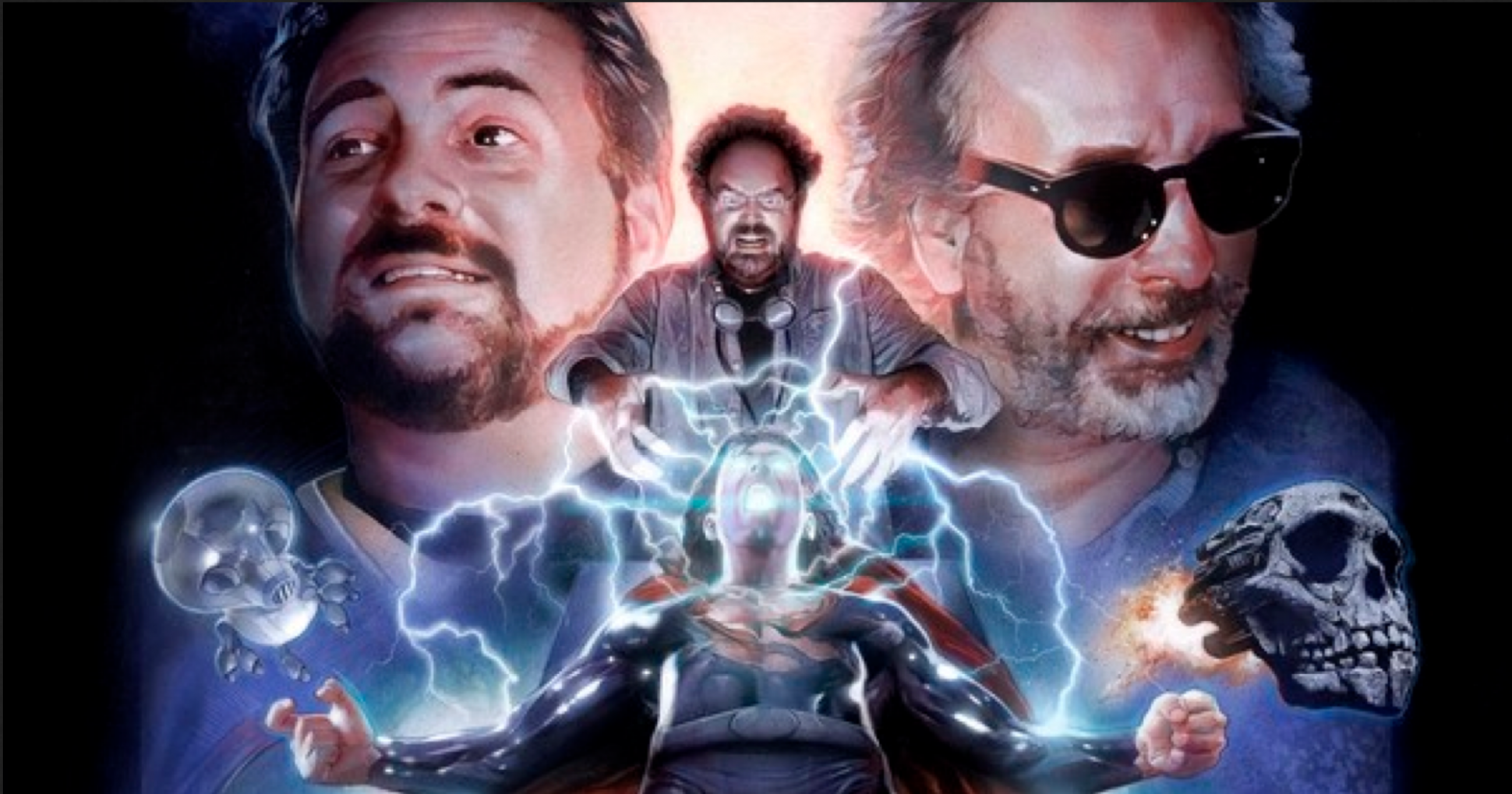
Poster for Death of Superman Lives

Whereas Stanley went into exile after being fired from ‘Moreau’ – first in Australia, then to the Montsegur commune in France – Tim Burton was allowed to continue his career in the rarefied atmosphere of Hollywood virtually unimpeded… although, as one-time screenwriter for the project Wesley Strick tellingly suggests, he hasn’t scaled the heights of its potential ever since.

Directed and narrated by Jon Schnepp – who is seen chatting to all of the interviewees – the partially Kickstarter-funded documentary has a rough-around-the-edges feel to it.

Sound quality fluctuates throughout and a disproportionate amount of the running time is dedicated to the costume Nic Cage would have worn for the film – perhaps betraying the ‘fanboy’ nature of Schnepp’s project (where dwelling on seemingly superficial accoutrements becomes a matter of cultish fetishisation).

But barring Nic Cage – whose presence is nonetheless felt through the use of now-totemic archive footage of costume fittings – Schnepp manages to assemble all of they key players involved in the cancelled production to have their say (on this point he gets one over ‘Lost Soul’, in which the absence of Kilmer and fellow actors David Thewlis and Ron Pearlman is keenly felt).
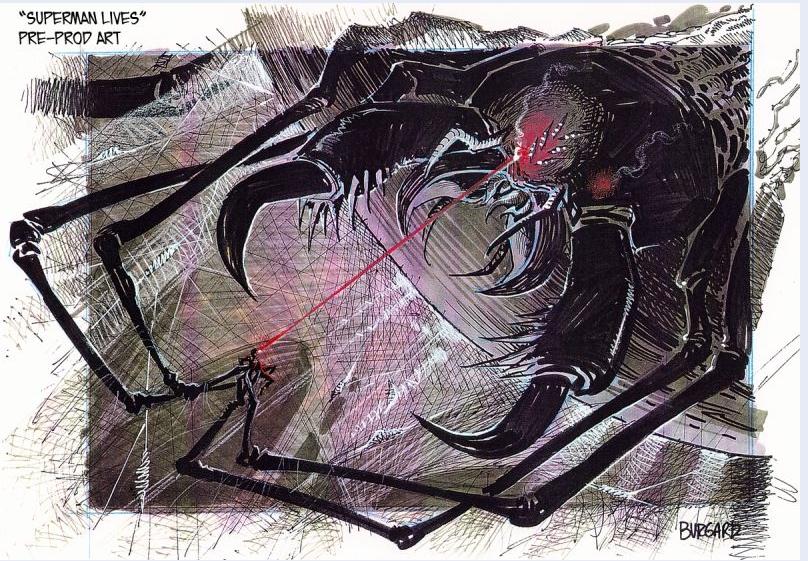
Giant spider! Pre-production concept art for Superman Lives

Giant spider! Pre-production concept art for Superman Lives

If nothing else, the film is a treasure trove of concept art. The jump to a high-budget production of this kind from Dune and ‘Moreau’ is made all the more evident by just how many varied talents were brought in to help bring Burton’s vision to life, and Schnepp succeeds in bringing the wild, colorful panoply into relief.

But for better or for worse – and despite a somewhat woozy presence from Burton himself – the key attraction remains producer Jon Peters. A former hairdresser with claims to bona fide street cred (at one point he tells Schnepp he was in “five hundred fights”), he comes across as a well-meaning nuisance at best, a bully at worst. He’s a fervent believer in the project but clearly also the product of the deluded Hollywood machine; 20 percent substance and 80 percent bullshit.

Tales of wondrous projects squashed by the machinery of ‘reality’, these films give breathing space to a pop culture landscape rapidly losing any heterogeneity in the name of financial security.

Perhaps they’re also a by-product of the internet age, in which nothing remains hidden for long, and where film fans become pseudo-historians and archivists by proxy. Whatever the case, I hope that they end up serving as cautionary tales above all, rather than just harmless curiosities.
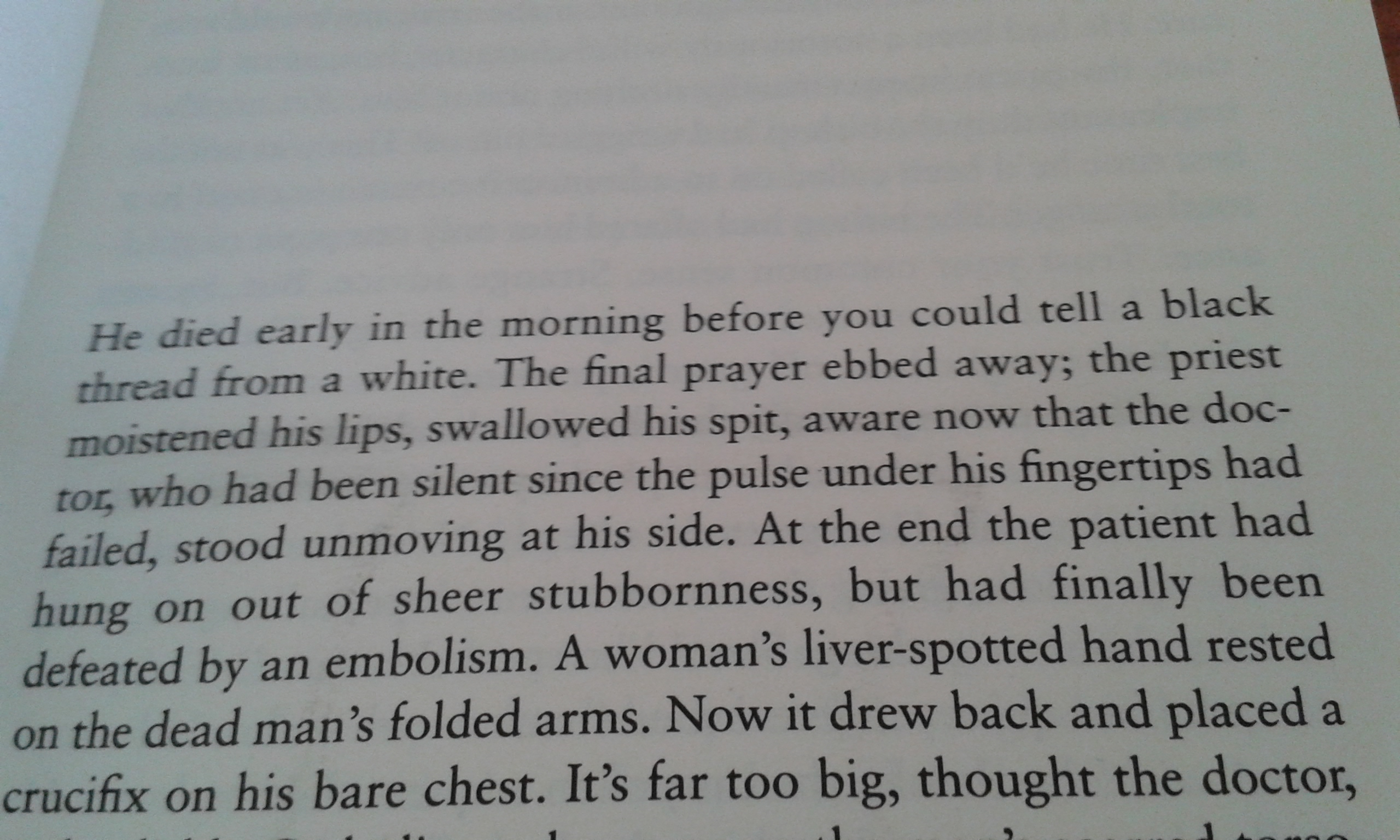
Black thread/White thread: Book sale serendipity

From The Collector of Worlds by Iliya Troyanov:

The Collector of Worlds by Iliya Toryanov

From The Snake Stone by Jason Goodwin:

The Snake Stone by Jason Goodwin


Insinuations of plagiarism aren’t exactly what I’m after, or even interested in, to be honest. The line in question recalls a particular passage from the Quran anyway, and we can extrapolate all sorts of symbolic readings in relation to this, and in both books.

What’s creepy is that I nabbed both books at a campus book sale, on the very same day.

As Borges as you like, but also a reminder of the kind of delightful randomness that sometimes comes out of buying books ‘old school’.


Turning Thirty to Rampant Development and Literary Nourishment

I turned 30 this May, to a welcoming committee of good friends at a terracotta-walled chillout bar – the same colour that adorns my old room at home and the same colour that will adorn my new room as I settle into the sleepy coastal town of Marsaskala with my girlfriend and Olivia, the fluffy ginger cat.

Or, at least, it will remain sleepy for the odd few months or so, until yet another ludicrous development takes over the ever-diminishing unspoilt land on the island, this time right under my (new) doorstep.

More on that later, for now here’s a few things that have kept me busy over the past month.

*

Photo by Jacob Sammut

Photo by Jacob Sammut

Schlock Magazine’s May issue – The overall brief was ‘Spring’, and I think we’ve succeeded in creating an eclectic and visually sumptuous edition, if I may say so myself. Check it out and give us your feedback, if you’re so inclined. It would be appreciated either way, as we’re planning some pretty big changes in the near future any constructive crit will go a long way. Click here to check it out.

Mark Pritchett in Malta. Photo by Ray Attard

Mark Pritchett in Malta. Photo by Ray Attard

Some cool interviews – Got to chat to the great Jeremy Robert Johnson about his blistering bizarro-noir debut novel Skullcrack City (once again, for Schlock) and the day job got a bit more interesting when I scored the chance to speak to David Bowie’s former guitarist turned newspaper mogul Mark Pritchett. It made for a curious afternoon, though as ever, the more memorable insights were kept off the record.

Vemilion by Molly Tanzer. Cover by Dalton Rose, design by Osiel Gomez

Vemilion by Molly Tanzer. Cover by Dalton Rose, design by Osiel Gomez

Fun reads – Apart from the aforementioned Skullcrack City, I thoroughly enjoyed Molly Tanzer’s Vermilion – a weird western with touches of Chinese mysticism and trans-continental vampire lore. We’ll be interviewing Tanzer for Schlock Talks too, and I’ll be reviewing the book for May’s edition of Schlock’s Pop Culture Destruction. Tanzer also featured in an anthology I’ve enjoyed and chatted to my Schlock interlocutor Marco about for Schlock’s podcast – Letters to Lovecraft, edited by Jesse Bullington. My dear friend Pyt also gifted me a sumptuous coffee table volume of Umberto Eco’s The Book of Legendary Lands, which now sits atop of The Steampunk User’s Manual (ed. Jeff VanderMeer & Desirina Boskovich) – another birthday gift, courtesy of my sister and her boyfriend. These are the books that are imagination fuel as I type or sketch away.

Reads I’m looking forward to in the near future: Station Eleven by Emily St John Mandel, Cyclonopedia by Reza Negarestani, The Gift of Stones by Jim Crace and – perhaps above all – Stone: An Ecology of the Inhuman by Jeffrey Jerome Cohen. The massed effect of this reading schedule seems to point to a keener environmental awareness, and a desire to get at something obstinately ancient and ‘quiet’, as a counter-reaction to the ADD generation. And what better way to do that than through rocks?

The Joker Is Wild: Celebrating 75 Years of the Clown Prince of Crime

The Joker by Brian Bolland

The Joker by Brian Bolland

We celebrated the 75th anniversary of the Joker with a small conference dedicated to the Clown Prince of Crime’s ‘life and works’ last Saturday, and it served as a good reminder of how refreshing academic inquiry could be when placed actually outside an academic context.

Organised by Euro Media Forum and chaired by my good friend Krista Bonello Rutter Giappone  – who also gave an lucid an insightful paper on the Joker and Batman as a comedy double-act  – the event may not have been terribly well attended, but it did inspire an convivial atmosphere of open discussion and debate which wasn’t about intellectual one-upmanship but genuine passion for the subject matter, and a desire to get at it – him – from as many angles as possible.

 Jack Nicholson at The Joker in Batman (1989)

Jack Nicholson at The Joker in Batman (1989)

Running the gamut from conversational ‘geeky’ presentations and more scholarly insights into the Joker as a key character of Batman lore across various media (comics, film, animation and video game), we heard presentations which delved into Joker’s design history, evil clowns in pop culture, and how the Jack Nicholson and Heath Ledger film-Jokers compare to each other; as well as the idea of the Joker as a demiurge, the Joker’s smile as a traumatic ‘wound’ (with all the symbolic weight that the image implies) and the socio-political imagery of both the Jack Nicholson and Heath Ledger Jokers (that would be me).

Heath Ledger as The Joker in The Dark Knight (2008)

Heath Ledger as The Joker in The Dark Knight (2008)

It was an unabashedly geeky way to spend a Saturday, of course, but a part of me felt very proud of the fact that we got together to pay tribute to the Joker – one of my favourite characters in fiction – in such a concerted and dedicated way. The main take-away insight from it all – if we could reduce it to just one – is that the Joker’s familiar-but-amorphous nature is what makes him such an enduring – and enduringly scary – villain. He is equal parts prankster, psychopath, terrorist and trickster – sometimes embodying just one of those characteristics at a given time, other times (more often than not, it seems) amalgamating all of those things in garish and dangerous brew.

Illustration by Greg Capullo

Illustration by Greg Capullo

In short, I think he’s secured himself the role of an archetype worth remembering, celebrating and returning to.

Worship My Wreck | The Pale Emperor by Marilyn Manson

Guess who's back: Nostalgia and slick production values rescue Manson from has-been histrionics

Guess who’s back: Nostalgia and slick production values rescue Manson from has-been histrionics

It was a combination of factors: slick marketing campaign that toned down the kitsch in favour of an appealing glacial menace, an evocative title that wouldn’t have been out of place in a Moorcockian post-swords and sorcery romp (and so was fun to think about) and a killer riff on its first single (‘Deep Six’). Whether it was one of these ingredients or a combination of all, I somehow found myself enjoying the latest Marilyn Manson album, The Pale Emperor, again and again.

The last time I dedicated as much time to a release from the former musical enfant terrible was when I was just pupating out of my own youth: Holywood, the final in an unofficial ‘trilogy’ of albums that still defines Manson’s contribution to pop culture: ‘Antichrist Superstar’ and ‘Mechanical Animals’ being the preceding albums… both of which I preferred to Holywood, though Holywood certainly made more of an impression than subsequent releases – the fact that it made an impression at all is already a step up, in fact.

There is something heartening about a former musical idol sort-of emerging from the has-been doldrums to release a decent album, and the fact that The Pale Emperor is not a tacky rehash of former glories while somehow also managing to ride on nostalgic appeal, is what allows it to pass muster, I think.

Despite the archly melodramatic title, Manson isn’t reaching for the same concept-album grandiosity of the ‘trilogy’ here. I’m not equipped to talk about the technicalities of the album’s sound and musical direction, but since Manson has always been conscious about ‘message’ to deliver either counter-cultural slogans or simply for shock value, I will say something about the lyrics.

The album kicks off with a Wildean refrain on ‘Killing Strangers’ – ‘We’re killing strangers so we don’t kill the ones that we love’ – which sets the poetic tone of the rest of it. It all tends towards the facile and it’s cringe-inducing at the best of times, but it’s so polished and earnest that I couldn’t help but find it charming.

Other notable nuggets:

– ‘It’s better to be blamed for robbing Peter than guilty for paying Paul’ (‘Devil Beneath My Feet’)
– ‘You want to know what Zeus said to Narcissus?’/’You better watch yourself’ (‘Deep Six’)
– ‘I feel stoned and alone like a heretic’/’I’m ready to meet my maker’ (‘The Mephistopheles of Los Angeles’)
– ‘Cannot say, I’m breaking the rules’/’If I can glue them back together’ (‘Worship My Wreck’).

What I will say about the sound is that it all comes across as less of a rock stadium courting experience, though one that still packs a punch. ‘Deep Six’, ‘The Devil Beneath My Feet’ and ‘Cupid Carries a Gun’ have a rock-and-roll sense of pure fun about them that’s infectious, and there’s also a rip-roaring appeal to ‘The Mephistopheles of Los Angeles’ and ‘Slave Only Dreams to be King’.

It’s the more vulnerable tracks that feel like innovations in Manson’s repertoire, however, with ‘Worship My Wreck’ and ‘Devil Beneath My Feet’ bolstering their confessional approach with equally ‘exposed’ vocal stylings.

I was introduced to Marilyn Manson during a blistering performance of the now-classic ‘The Beautiful People’ at the 1996 MTV Video Music Awards. An impressionable 10-year-old me was transfixed by this cross-dressing figure and his equally menacing band, ripping into the big middle finger of a song accompanied by confronting, fascist stage design as the likes of Sean ‘Puffy’ Combs looked on, aghast. He would then become something of a benchmark figure for me, and I’m sure everyone has ‘their own Manson’, whichever side of the generational divide they hail from.

For myself, Manson inculcated an appeal for gender-bending decadence which has stayed with me, and a love for gothic and subversive effects that threads through most things I love. (I never quite latched onto the anti-Christian element since I was raised in an atheist-cum-agnostic household, for better or worse).

Flawed as The Pale Emperor is, it feels good to learn that he can still punch his weight in a contemporary musical landscape. Though this time it feels less of a subversive slap on the face, and more of a welcome visit from an old friend.

Monster March | Kill List

Murder-bound: Neil Maskell and Michael Smiley in Kill List (2011)

Murder-bound: Neil Maskell and Michael Smiley in Kill List (2011)

While Schlock Magazine gets its ‘Monster March’ on the road, I troop away with my own, this time with a cold, hard aspiring cult classic.

Was it Harold Bloom who said that a ‘strong’ new literary entry has the power to alter even its predecessors in some way? Not name-dropping a theorist to up my cultural capital, and neither can I say I fully understand the above assertion, but it popped into my head as I finally watched Ben Wheatley’s Kill List (2011). The reason it popped into my head is because I couldn’t help but compare it to a later – and American – iteration of the same themes and character dynamics: the first season of HBO’s True Detective (2013). Seen this way it’s certainly a haunting matrix of fears and anxieties. As in True Detective, you’ve got fraught male bonding – scarred and identified by both traumatic history and a looming mid-life crisis. And spoiler alert here, but both properties also deal with filmed horrific acts distributed through underground networks, informed and capped off by a mass boogeyman in cult form.

American Gothic: Matthew McConaughey and Woody Harrelson in True Detective

American Gothic: Matthew McConaughey and Woody Harrelson in True Detective

The British variant of said cult is culled from the pagan imagery of homegrown classic The Wicker Man (1973), where True Detective clearly takes a cue from sadly enduring but eminently exploitable Ku Klux Clan imagery. If their similarities are thematic, their differences are narrative and stylistic. A common complaint with True Detective was that it got bloated and keeled over towards the end: the suspense and occult intrigue proved to be a game of hurried smoke and mirrors on the part of the – inexperienced – writer and showrunner Nic Pizzolato’s part. Of course, being a lean feature film, Kill List doesn’t have that to worry about, but it’s also a crueler beast. There is no sentimental arc for either of its protagonists to fall back on, and its grisly denouement leaves no window open for the mismatched happy ending afforded to True Detective.

Prelude to a Burning: Christopher Lee as Lord Summerisle in The Wicker Man (1973)

Prelude to a Burning: Christopher Lee as Lord Summerisle in The Wicker Man (1973)

“You’re cogs,” the protagonists of Kill List are informed at one point. The cults at the centre of both Kill List and True Detective are a grotesque reminder of how an attempt at heroism and exceptionalism can be undermined by this persistent aspect of the human psyche. Monsters are at their worst when they get organised.

READ PREVIOUS: Frankenstein’s Army

Monster March | Frankenstein’s Army

No agency: The patchwork creations of Frankenstein's Army are a perverted steampunk fever dream

No agency: The patchwork creations of Frankenstein’s Army are a perverted steampunk fever dream

While Schlock Magazine gets its ‘Monster March’ on the road, I troop away with my own, starting with a shit-and-mud caked gem.

That there is something both liberating and enslaving about the monster is a well-worn trope in both popular culture and popular discussion. ‘You take something away, you get something back’ is part of it: monstrosity can signify exclusion and enslavement, but by that same token it can also mean that the monster is freed from the rat race of day-to-day existence. By destiny or design, the monster is plunged into a skewed world, which can yield to plenty of advantages if they play their cards right… that is, given that the monsters in question have any cards to play at all, or if they do, whether they have the cerebral capability to process the rules of the game in question.

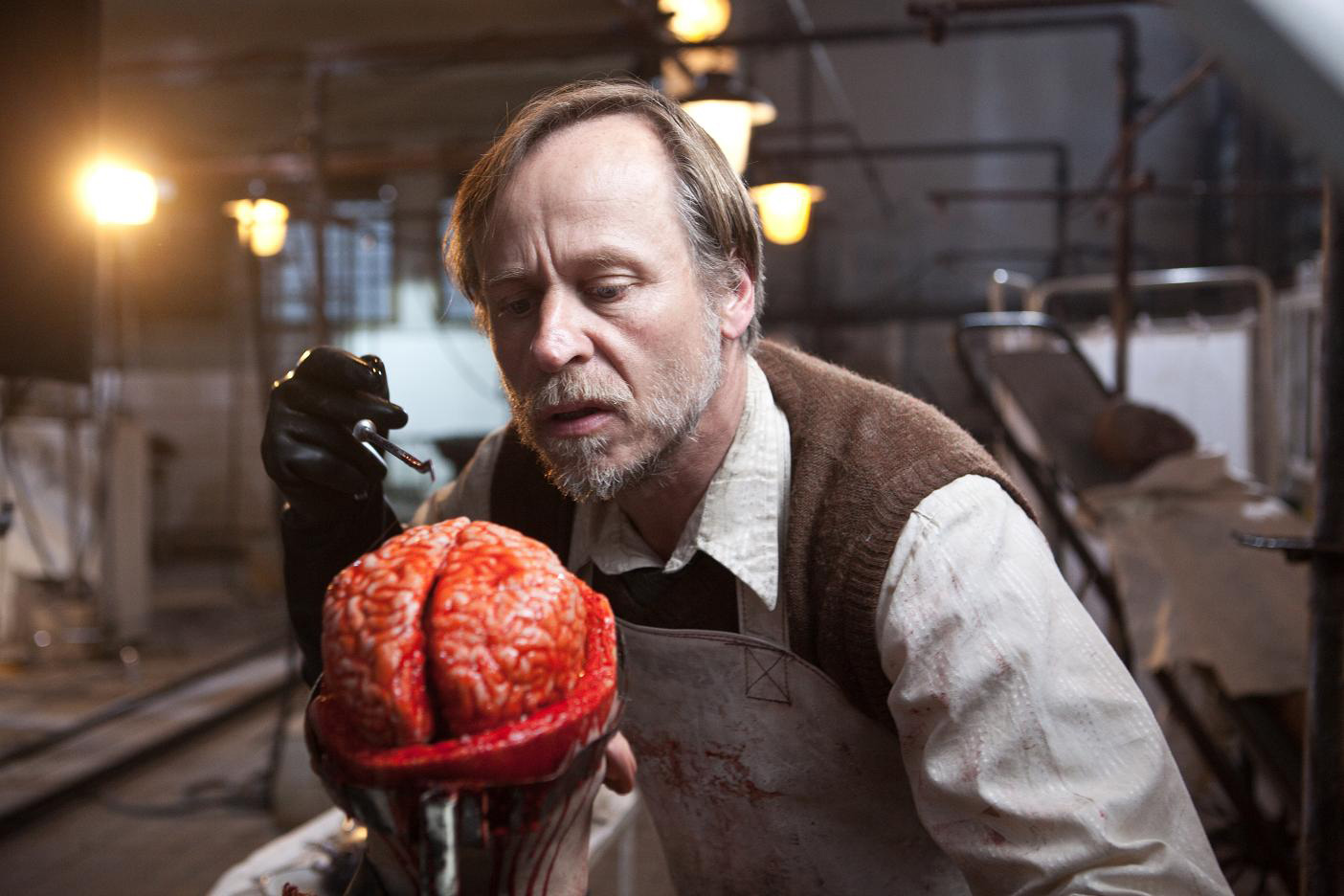
The monsters of Frankenstein’s Army (2013) certainly have zero agency. Nazi cyborg grunts for the titular Josef-Mengele like throwback to Mary Shelley’s famous doctor, they shuffle along, showing off their freshly grafted bodily modifications with automated – but still menacing – glee. What’s more interesting though is Dr Frankenstein’s (Karel Roden) justification for his experiments… at least, the justification we’re given at the end, which feels like a hurried, tacked-on thematic appendage suited both to his in-film creations and the meta-film’s messy raison d’etre.

Frankenstein, you're barmy: Karel Loder as the titular mad scientist

Frankenstein, you’re barmy: Karel Roden as the titular mad scientist

The fascists he – ostensibly – works for and under are “insane”, Frankenstein admits. But so are communists and capitalists. he declares. His creations, on the other hand, made entirely of the human contradictions that lead to war, can in fact be used to smooth the same contradictions out. The scene in which the doctor attempts to collage a fascist brain with a communist one is an explicit illustration of this, of course, but it’s also a reminder of how vulgar pulp can remind us of what monsters are ‘for’ in the first place.

READ RELATED: Monstering

Red Right Hand | Hellboy & Crimson Peak

Nick Cave and PJ Harvey

Nick Cave and PJ Harvey in the video for Henry Lee (1996)

Not quite a case of cover versions I prefer to the original, but the recent trailer for Guillermo Del Toro‘s upcoming Crimson Peak (yay!) showed us how Nick Cave’s haunting ditty Red Right Hand is etching itself into the Mexican director’s oeuvre as a musical placeholder, albeit as ventriloquised by different musicians.

A version by Pete Yorn was heard in the original Hellboy (2004), also directed by Del Toro. Something of a logical choice given the subject matter, even if the connection is a shallow one (i.e., limited to the song’s title). Yorn’s jauntier version certainly strips the song of its atmospheric sense of foreboding. Which is just as well in this case, because even though Hellboy – and Del Toro’s films in general – may have its creepy gothic touches, it remains a quirky superhero romp at the end of the day.

PJ Harvey’s version, originally commissioned for another audio visual project – this time the British gangster TV series Peaky Blinders – feels right for gothic melodrama Crimson Peak, at least insofar as the trailer suggests. Harvey’s pained vocals offer a nice contrast to Cave’s hard, stark imagery.

It’s a dynamic that matches my expectations of Crimson Peak itself. It appears to be a ghost story of the Victorian variety and as such, one that would by definition rely on subtle scares, rather than the outre, primary-coloured flourishes Del Toro is known for, and which he doesn’t appear to be shying away from here. I anxiously await to see how the twain will meet – if it does at all – come October.

Better the tropes you know | Gotham, The Musketeers and Black Sails

The premiere of Better Call Saul got me thinking about how the shows I enjoy now, post Breaking Bad folding, tend to fit more easily into the mold of romance rather than realism, and that this probably has a lot to do with how the ruse has now been rumbled on the supposedly ‘bold’ grittiness of the shows that have been lauded with both praise and generous ratings over the past few years.

"Have you grounded yourself?" Better Call Saul is off to a strong start

“Have you grounded yourself?” Better Call Saul is off to a strong start

You know, shows like The Wire and, indeed, Breaking Bad itself, with the latter admittedly conceding to a few Tarantinoesque stylistic flourishes every now and then.

This article illustrates the point better than I ever could, but the point remains this: there’s very little actual innovation or subversion happening in these shows, and this kind of storytelling is always better when its embraces its ‘genre’ roots. Because straining to do otherwise often results in nothing but kitsch. I enjoyed Breaking Bad and The Wire as much as anyone, but shows like Boardwalk Empire felt like brittle attempts at the same: spread thin by the half-assed attempt at historically accurate drama, it felt neither here nor there.

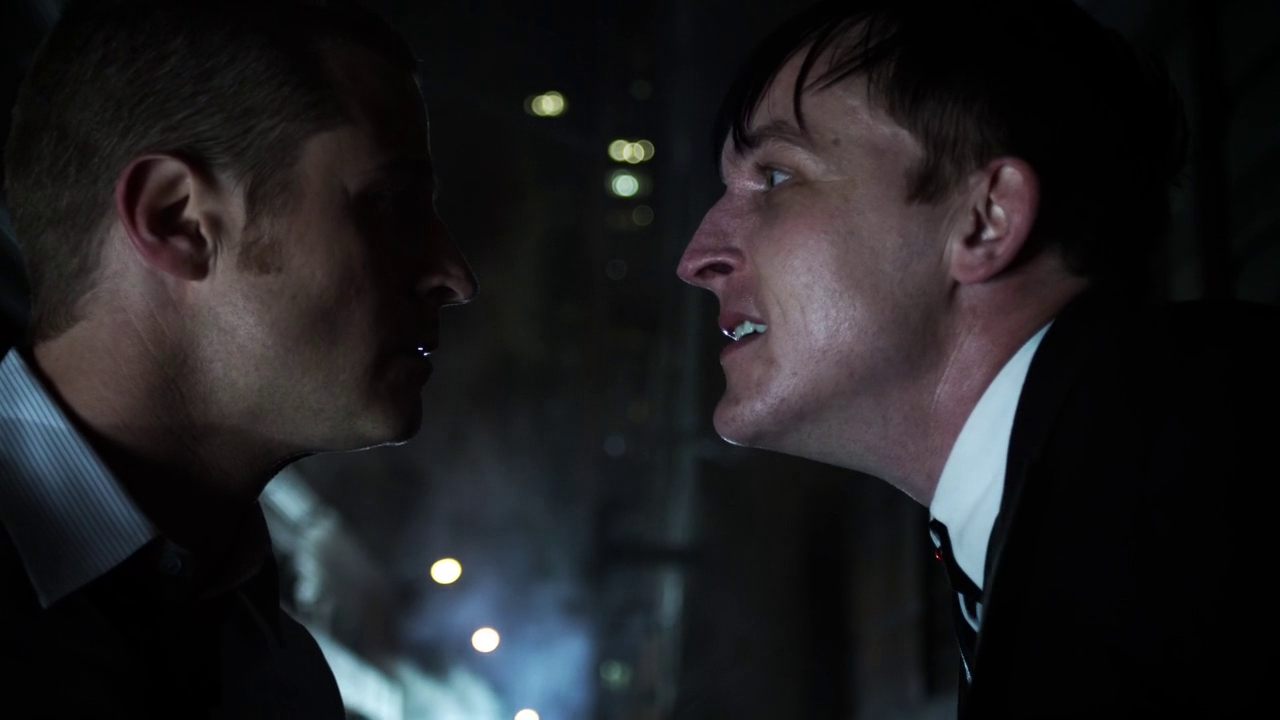
Ben McKenzie as James Gordon and Robin Lord Taylor as Oswald 'Penguin' Cobblepot in Gotham

Ben McKenzie as James Gordon and Robin Lord Taylor as Oswald ‘Penguin’ Cobblepot in Gotham

These days I’m quaffing shows like Black Sails, The Musketeers and Gotham – they don’t bother to hide their roots in firmly trodden narrative ground, and any ‘grit’ is by-the-by, acknowledged as just another stylistic detail rather than a willful attempt at – ultimately hollow – innovation. Hell, they simply can’t hide their derivative nature: all three shows are explicitly sourced from clear antecedents. Black Sails is a very loose prequel to Robert Louis Stevenson’s Treasure Island with a liberal sprinkling of ‘historical’ pirates thrown into the mix, The Musketeers is yet another adaptation of Alexandre Dumas’ enduring piece of swashbuckling proto-pulp fiction, and Gotham is a shamelessly opportunistic but also refreshingly goofy series about Gotham City 20-odd years before Batman arrived on the scene.

Santiago Cabrera as Aramis in The Musketeers

Santiago Cabrera as Aramis in The Musketeers

It’s particularly telling that the first two shows in are sourced from Stevenson and Dumas, writers historically associated with the aesthetic of ‘romance’. The BBC’s own Musketeers may not be the best iteration of that story – and it’s certainly the weakest show of this particular triad – but it’s telling that it reared its head just now, as if in direct opposition to the prevailing trend. Black Sails may have the same levels of sex and violence you’d expect from the likes of Game of Thrones*, but its main MO is adventure and intrigue, not some half-baked exploration of moral ambiguity. And while Gotham, being a prequel to an established comic book property, appears to play in the same sandbox as most of the reboot-and-remake happy mainstream, it resists the urge to ‘grimdark’, giving us a Gotham Cityscape that is less Nolan, more Burton.

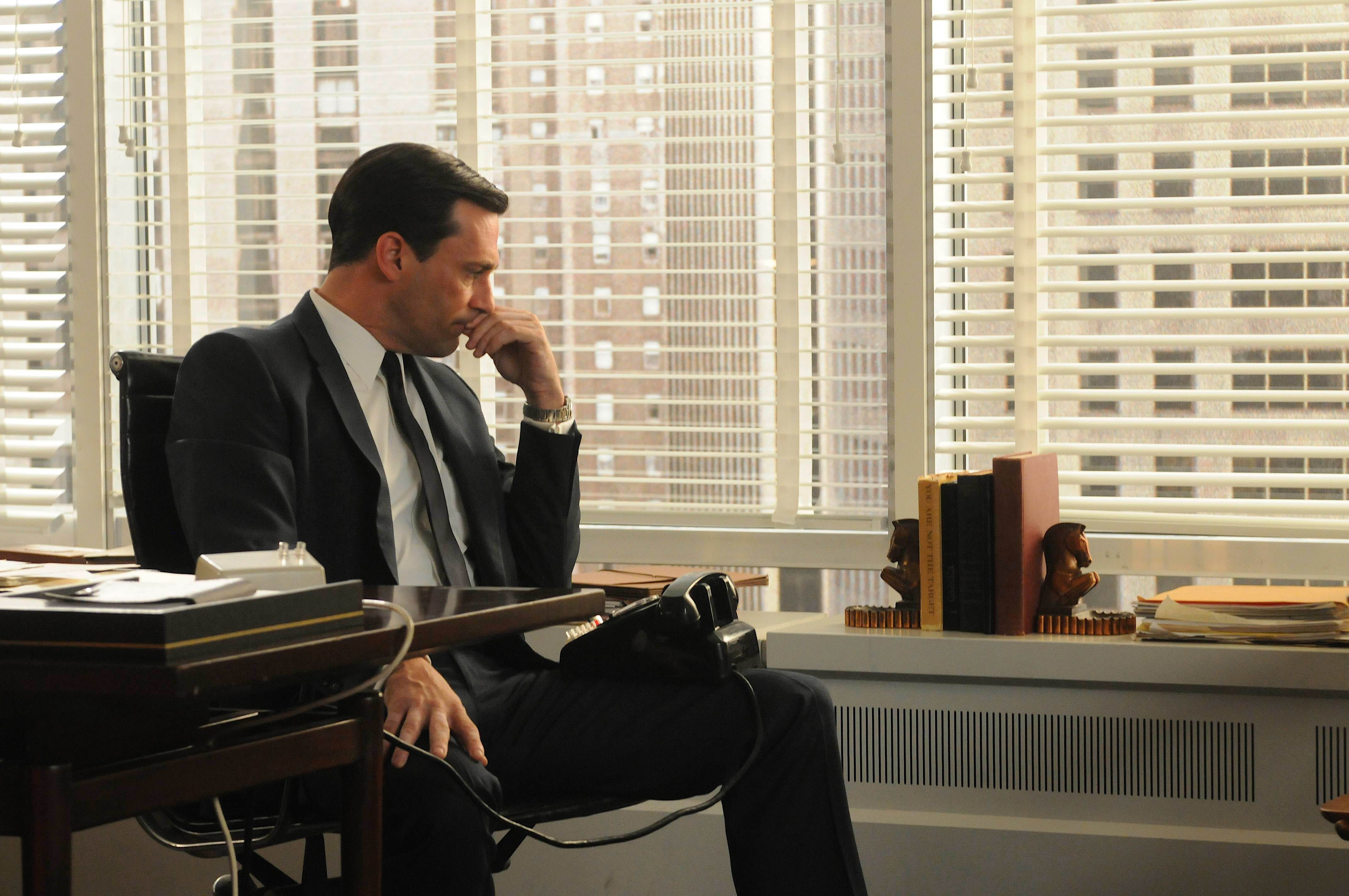
John Hamm as Don Draper in Mad Men

Jon Hamm as Don Draper in Mad Men

This is of course not to say that I won’t be tuning into Breaking Bad spinoff Better Call Saul – the pilot of which I found terrific – nor that television can’t be anything except pulp. But I’m finding more pleasure in taking in this kind of genre fare at the moment. Mostly because the likes of Breaking Bad, The Sopranos, Mad Men et al have proven themselves to ultimately be all about dissatisfied and/or stifled macho men eager to live out their machismo, and largely succeeding in doing so. There’s very little about that I find profound, and the fact that we’re treating it as something novel and worthy of our time all on its own is a bit disconcerting.

I would rather have my macho men as flat archetypes, to be taken with a pinch of salt. Better than than being lured into contemplating their aggressive contours as something to take in fully and even – the implication being – to be emulated.

*Game of Thrones is an interesting exception that proves the rule: by presenting us with a fantasy world that is directly informed by episodes from ‘real life’ medieval history, it blends both realism and romance.

READ RELATED: We Need to Talk About Genre

Greeking

Alexis Tsipras, leader of the Greek left-wing party Syriza, was elected Prime Minister of Greece on January 25 (Photo: AFP/Getty)

Alexis Tsipras, leader of the Greek left-wing party Syriza, was elected Prime Minister of Greece on January 25 (Photo: AFP/Getty)

“The light disdain of the Greeks, which I have never ceased to feel under their most ardent homage, did not offend me;  I found it natural. Whatever virtues may have distinguished me from them, I knew that I should always be less subtle than an Aegean sailor, less wise than an herb vendor of the Agora. I accepted without irritation the slightly haughty condescension of that proud race, according to an entire nation of privileges which I have always so readily conceded to those I loved. But to give the Greeks time to continue and perfect their work some centuries of peace were needed, with those calm leisures and discreet liberties which peace allows. Greece was depending upon us to be her protector, since after all we say that we are her master. I promised myself to stand watch over the defenceless god.” – Marguerite Yourcenar

*

Read previous: SAILING