Oh, you couldn’t dam that river

Some months have passed since my dad died and it’ll surprise no-one that I’m still processing everything that happened and that in many ways, the full realisation of the loss hasn’t hit me yet, and likely never will.

I’m also envious of those who could find it in them to mourn in seemingly more direct ways – bursting into tears as soon as they heard the news, or crying at any mention of him after the fact.

There’s a lot to be said about your brain working hard to “protect” you from being hit by the news that the person you’ve known since birth – someone who’s played a fundamental part of your life for 38 years – is now no more.
They are literally nowhere to be found in the living, material realm. You cannot hear them, smell them, touch them and certainly no longer hug them hello or goodbye. You cannot gossip with them, you cannot chastise them and you cannot show them affection nor expect any in return. You cannot visit them just to spend time with them – not even a wordless visit during which they click away at their computer and yawn between puffs of ultimately lethal cigarettes.

But this isn’t the worst of it, because this is all, still, the present – or at least, the very recent past. This is how I remember my father moving (sluggishly as it may be) and operating in the final years of his life. No, the torrential waters that the brain’s dam is desperate to keep at bay are the waters of layered history. Because my father was many things to many people, but to me he was dad, and that’s a multitude which contains many other multitudes within it.

A similar realisation hit me after my mum suffered a stroke which would plunge her into a coma that lasted a decade. A person is precious because they are a universe. A parent, in particular, exists as a storied shelf of memories and interconnected thoughts and behaviours; ones which continue to evolve and reverberate from each other while the person is still alive, but which are then frozen and ossified by proxy after they’re removed from the realm of the living.
This is where they can become mythologised if we’re so inclined. To some of us, or in some of our moods, this is also a site where it becomes easy to cast judgement with an illusion of rigid finality. You can draw definitive conclusions and cast a final verdict, now that the accused – or the lauded – is no longer around to contradict you.

In my father’s case, it is also about the extolling and fetishisation of an artist’s way of life. It’s so tempting to view the motor of this work as something which emerges from outside the common fold and which we can simply gawp at like it’s an alien diamond put on display just for us. As if the material conditions matter not a jot. As if he was given a gift and simply executed it with generous grace – bestowing his lessons onto others too, so that they may take some of the diamond for themselves.

It’s this abdication of the possible and the practical which allows many people to live in a similar phantasmagorical plane that my father occupied in the latter years of his life. 

In any contemporary society dictated by the norms of neoliberal capitalism, living “free” means living at the expense of others – or of your own wellbeing and stability. It’s kill or be killed, eat or be eaten, and when you’re not eating others, well… then you just have to eat yourself. My father chose to bite the bullet of precarity and to swerve out of the neoliberal order instead of meeting it halfway. He spent his time making beautiful work which my siblings and I will now endeavour to protect and preserve. A sizable effort which will also require us to undertake an additional – and equally onerous – side-quest: finding help which is truly trustworthy in an island beset by mercantile souls in search of their next host.

I am also dreading each passing day, because I suspect that the worms will come out of the woodwork good and proper once they decide the grace period has passed and they are within their rights to come knocking at our door demanding the pieces of my father he often gave all too freely when he was around.

Because the phantasmagorical state means that people are not only free to romanticise him, but in that romanticisation – a swerve away from reality and into the same cloudy realm in which he’d made his home – they can reassess and re-engineer their own relationship to him like a piece of Lego. If all is true, everything is permitted.

So we had a situation where people that I know for a fact meant to do my father both reputational and financial harm in the recent past, had no qualms about showing up to his memorial and even posting and boasting about it on social media – lest the FOMO get too much and they be excluded from the collective chant they’ve been called to participate in… a blitz in which genuine tributes collided directly with vainglorious, self-serving bandwagon-jumping.

Being an artist means that you’re public property to a certain extent, and my father’s accommodating nature meant that everyone had their own piece of his memory to take home with them. But it’s a piece free from the vicissitudes of the raging torrent that the dam is just about keeping steady for me.

Crucially, it’s a piece that may be small but it illuminates quite a bit, blessing the keeper with a selective blindness. So we would be forced to parse through DMs from apparently well-meaning Senders but whose content was so blisteringly insensitive it was difficult to even believe a human being took the time to type them out and hit ‘Send’. Like the Sender who, for example, implied that they should be the ones to archive my father’s work as they suspected that the family would be tempted to just leave it to rot somewhere.

In this instance, the family becomes secondary – lumpen byproducts of the artist’s creative process, clearly ill-equipped to handle his legacy because they weren’t seen to be going through the usual motions that fellow darkroom acolytes went through, and posted incessantly about on their socials.

In a lot of ways, this is a crucial consideration because it cuts to a deeper vein of my father’s life, work and his appeal to many.

It is down to that hopelessly fraught term: authenticity.

Many have extolled his sincerity, generosity and his apparent lack of ego, at least when it came to executing and promoting (or failing to promote) his work. The problem is that authenticity is entirely inimical to the status quo we’ve already mentioned. This is why my father’s version of authenticity was refreshing – it projected an alternative way of being which some sought to emulate, others to exploit.

Never mind that all the features which people were quick to romanticise about my father, came to the fore only a decade or so before his passing. He dove back into photography in earnest after my mother’s stroke. Always in search of low-hanging-fruit solutions to make some money while still catering to his creative instincts, he started giving workshops to an eager gaggle of hipsters (yes, the term still had currency back then), and it was from there that the whole Zvez vibe became a thing; that darkroom and oak table occupying an iconic space in the memory for many, hipsters and not.

But, faced with the imminent need to vacate his apartment, I was also faced with old family photos. They command more attention from me than his subsequent, lauded works. They are the propulsive energy of the waters beating against the dam. They tell of a life lived – of a struggling immigrant family, and of a man still plugged into the churn of day-to-day life. Put-upon and frustrated, sure, but certainly not relegated to a cave of his own making, gawped at by those with a hole to fill, the crowd that real friends with real love have to machete through for a glimpse of my father’s attention. 

They deserve space and time, and that’s why I’ll end it here from now because there are no neat endings in this process, only hard-won new beginnings. 

***

Photography by Virginia Monteforte
The Village by the Sea | Marsascala Under Attack (Again)

Having lived in Marsascala between 2015 and 2020 and seeing the sleepy-but-bustling former fishing village once again become a target for suffocating over-development, I’ve decided to look back on some of my impressions and memories of the town, partly motivated by simple nostalgia, partly by an urge to help myself understand just why the authorities and the business class so often make it a point to single out Marsascala in their ongoing drive towards uniform devastation. This is the third blog post in an erstwhile series.

So we had a sea view.

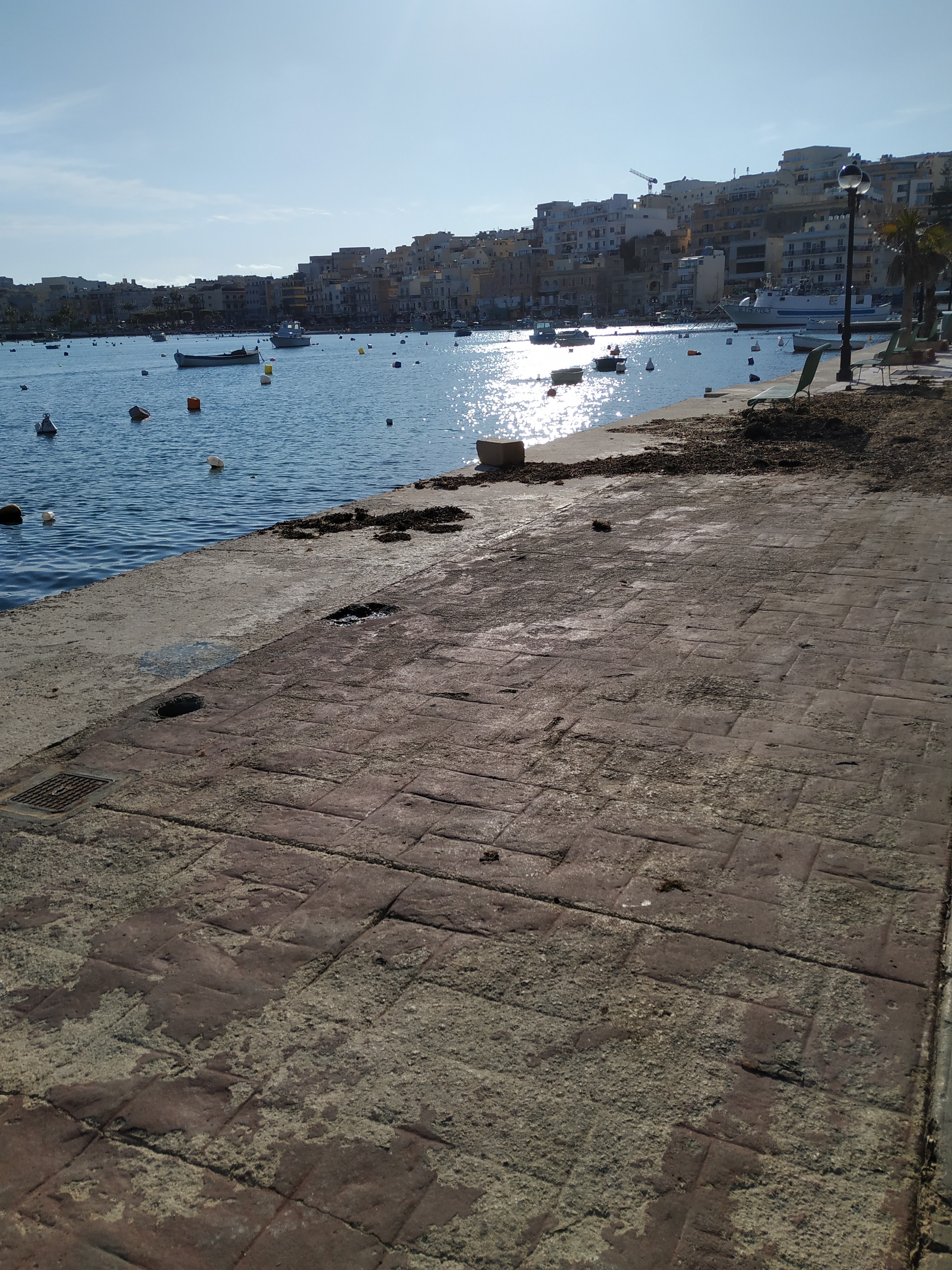
Sullied at the edges of your peripheral vision by clumsily placed solar panels, sure, but it was there. It greeted you each morning and provided a balm in the evening during summer – then, in all of the expected ways – and during winter it allowed for a showcase of nature’s fury as the waves crashed in violent foam over the promenade.

It remains the one undeniable perk we both miss very much now that we’ve relocated from Marsascala to Rabat a year ago. No longer being able to wake up and smell the sea, taking in its blue-on-blue hue, can’t be brushed off so easily. You can only be stoic about so much.

Thinking back on this, it’s the Marsascala dawn that really stands out in the memory. The sea view is the sea view, yes, but it really comes into its own in the morning, when it allows you to greet the day with a particular sense of accessible, graspable majesty. You visualise the opposite bay like a slowly-loading act of creation: the sight of the water hits you first, with the promenade and the dotted boats appearing gradually, replotting themselves into the scenery. A wide blue expanse, from eyeline to sublime horizon, would have its meditative perks too, of course.

But there’s something charming in the way the sea is stoppered by the twist of the promenade, at least viewed from our former spot in Zonqor. (One of my smallest – and so, most precious – delights was spotting buses work their way across the promenade road from our terrace. A miniature reminder of a system that somehow, with all its faults, still manages to work. To serve people.)

You realise it all the more when you actually go down and see for yourself – when you experience the promenade as a participant, not just a mere spectator. The slippy-slide of the moss-strewn walk down by what is a de facto boat yard… a brief shot of pure vernacular beauty, sadly interrupted too soon by the parked cars that insist on crowding you before you’re allowed to emerge to the main walk, facing the church.

But for a while, it’s like you’re transported into a scene redolent of the early 20th century: the promise of an effortlessly charming Mediterranean village fulfilled. Old houses fronted by streetlamp-flanked benches, for lovers to share pizza and beer purchased from very close by. Room for families to spread out a formica table and benches for a multi-generational gathering of card games and barbecues. And despite the independent flurry of boats that frame and flank it all, room enough for an old man with a bad leg to dull his pain with diligent exercise – a refreshing dip into the sea, after which he dries himself off seated upright by the wall, before working up the strength to head back home.

Regular sights for me, but morning and evening. But it all goes by in a few seconds: a pocket of fantasy, a near-literal blink of an eye. Because after that, you’re either back to the sea-view blocks by the road, where you’ll get to enjoy the more traditional pleasures of a rocky beach which will – eventually – be joined by the Zonqor fields we fought very hard to retain back in 2015. Or you’re more likely to head about your business in the opposite direction, marching your way to the promenade and its string of shops and restaurants, along with a nail technician and real estate agents’ office (or two. Pretty sure there were at least two).

This is where the true ‘life’ of Marsascala could be said to begin: the trigger of the daily churn of people and business. In the absence of a concentrated square, we get a stretched out one: the promenade serves as a gathering point for people and a stopping point for fruit & veg trucks, at least until it sheds the skin of a village square and becomes the ‘leisure’ promenade expected by convention.

The transition point for this is the small area by the traffic lights which lead to the bus terminus – or more accurately, to the recently-refurbished, multi-generational family restaurant Grabiel – where the barriers to the sea are briefly opened up; a place that serves as a small parking space and which in winter leaves plenty of leeway for flooding – you’re often forced so skip over and otherwise creatively manouevre through large puddles of pooled and brackish sea water.

From there forward, the communal spirit becomes more solitary and leisurely. You grab an ice cream and march forward towards St Thomas Bay and its environs; an area of true sublime beauty very much compatible with tourist postcards. But it also exists in the shadow of a fallen ruin: the old Jerma Palace Hotel, now a crumbling reminder of mismanagement and institutional dithering, but also a pro-active breeding ground for some of the island’s more interesting street art, and the location for many a low-budget music video.

Its neighbour, the St Thomas Tower, taps into a similar vein of neglect and decadence: it’s thankfully no longer a pizzeria, but any historical glory it may boast feels diminished by its flaking exterior, and its proximity to the far more imposing Jerma ruin. Still, both structures are also notable for their cat colonies, often seen crossing indistriminately from one side of the street to the other, making this cat lover’s heart skip a beat each time.

If our walk from Zonqor is undertaken during the evening, this is the point at which we often begin to turn back home. That, or we extend our walk past St Thomas Bay itself – to overlook the beach during magic hour and forgive this island and its people its many shortcomings.

Read previous: Distance Does Not Mean Protection

Distance Does Not Mean Protection | Marsascala Under Attack (Again)

Having lived in Marsascala between 2015 and 2020 and seeing the sleepy-but-bustling former fishing village once again become a target for suffocating over-development, I’ve decided to look back on some of my impressions and memories of the town, partly motivated by simple nostalgia, partly by an urge to help myself understand just why the authorities and the business class so often make it a point to single out Marsascala in their ongoing drive towards uniform devastation. This is the second blog post in this erstwhile series.

*

Marsascala always struck me as one of the few villages or towns in Malta whose borders are actively separated by clear distances.

Most of Malta’s localities exist on parallel and intersecting lines – like the twin cities of Besźel and Ul Qoma in China Mieville’s fantasy-noir novel The City and the City. Plant yourself at any border on the island and you’ll likely find yourself facing or tailing a couple more. Not so with Marsascala.

The road that extends from its closest Southern cousin of Zabbar feels like a proper ‘highway’ between one town, city, village and the next. Neither is it terribly feasible to walk to nearby villages through its other end – a one-hour trek to its more decorated fishing village cousin of Marsaxlokk is certainly beautiful in the right conditions, but impractical in others; opting to walk to the equidistant Zejtun is neither a pretty nor safe proposition.

And trudging through the ‘pedestrian’ highway to Zabbar (and nearby Birgu) would be pointless – it’s a strip of land designed exclusively for cars, and all the ramblers would get out of it would be inhaled fumes.

But this isolation equals neither boredom nor tranquility, much as I sometimes wished that to be the case. Marsascala is ‘bustling’ in various senses of that loaded word. A fishing village turned summer-house location for local families turned expat haven turned half-hearted tourist spot.

A few decent restaurants have popped up in recent years, but the provision of overall services remains on the sketchy side. No need to pine for the mercilessly ‘sleek’ counterparts of Sliema and St Julian’s – which would be uncomfortable for a host of related or vaguely-related reasons – but moving to the more centralised and quieter area of Rabat has quite literally brought home the benefits of the more traditional village structure.

Marsascala, on the other hand, is marked by long stretches and disproportionate distances, only to be stoppered by sprawl on its edges and contours. The long promenade cuts a swathe across Zonqor Point and St Thomas Bay on either end, and both of them are then burdened by apartment blocks – snails carrying a shell of cramped-together dwellings. In between are the shops, restaurants and yes, some villas with ‘unobstructed views’ for those who can afford them.

It’s a mish-mash rearing for change – or rather, for streamlining and ‘completion’ – a completion which in Malta signals only oblivion.

This is why a raggedly hybrid place like Marsascala is so vulnerable to attacks of ‘development’. Its liminal state – between warm summer dwelling and tourist hub, between fishing village and cool hangout – is an affront, an offence.

And its edges must be smoothened into the choking nothingness that Transport Malta, the Planning Authority and – crucially – the status-hungry populace want. Anything that just “sits there” is a waste of time and resources.

The poverty of the Maltese school system – a reheated version of utiliatrian British methods based on rote learning and mechanised exams – means there is no oxygen left to cultivate a sense of enrichment and belonging in leaving things just as they are, and enjoying them as such.

Which is why we are left to suffer under the yoke of public officials such as the Planning Authority’s executive chairperson Martin Saliba, who equate the zombie-brained expansion of ugly urban sprawl with an inevitable drive towards a vaguely-defined “modern era” for Malta.

Distance is what isolates Marsascala, and what makes it vulnerable. You reach it after a long stretch, and you find it to be all alone. You imagine it cupped in the palm of a distracted sea-goddess.

No UNESCO-protected fortifications defend it from attack, alas.

Read more: Resistance & Self-Compassion: The Case of (and for) Marsascala

Resistance & Self-Compassion: The Case of (and for) Marsascala

The seaside village of Marsascala which served as my home for roughly six years up until recently has once again become a beacon of environmental resistance in Malta, after a government-sponsored proposal to choke its bay with a vulgarly gigantic yacht marina has led to a near-unanimous uproar among both activists and locals.

If the root of the complaint were not so depressing, such a united front would have been inspiring to witness. After all, it’s a ripple that follows on from a similar wave or organised dissent back in 2015, when the ‘American University of Malta’ was proposed on the same village’s outskirts.

This was to be a beacon legacy project for disgraced former prime minister Joseph Muscat and his chosen coterie of movers and shakers in the political and business world – a Malta-Jordan collaboration built on virgin land with a pre-packaged, pre-purchased American university syllabus aiming to attract further ‘high net worth’ individuals to spend their money in Malta and Gozo.

That the project is now little more than a shadow of its proposed self stands as something of a feather in the cap of the same environmentally-conscious protestors who took to the streets to fight it tooth and nail.

We should remember this. We often denigrade ourselves for not doing enough, or for doing too little, too late. Or for not accepting that the status quo will carry on in its usual churn regardless, and give into apathy and a sense of futility as a consequence.

But the long view is that while short-term battles may be lost and while, on the environmental front at least, the political and business hegemony may continue to treat us with utter contempt (whose unholy alliance is still not taboo, even after it was a direct contributor to the murder of a journalist), taking a stand still matters.

There’s a lot to scoff at in the current generation’s earnest, somewhat pat ideas on how to make life marginally more tolerable – as was the case for generations past. But I would insist on encouraging everyone involved in this ‘resistance’ to exercise a degree of self-compassion.


Following the concerted uproar, the American University of Malta was set to be split into two campuses – one ostensibly to remain in a ‘reduced’ capacity on Marsascala’s Zonqor Point, the other to occupy an historic colonial building at the harbour town of Bormla. The extension back to Zonqor will only happen if the Bormla campus fills up. This remains an unlikely outcome, given how student count amounted to under 100 by late 2019.

Activists should allow themselves not just self-compassion here, but an enlivening jolt of sadism too. This is a call to laugh at the critically wounded near-corpse of a mortal enemy. To cackle in the face of at least one of these offenders – who cackle at our earnest attempts to counter them nearly 24/7, as more and more obscenities crop up at every corner.
It may not be the most noble emotion to indulge, but we deserve it. If anything, it will give us fuel for the next fight… which will always be around the corner.

*

I’ll be putting out some follow-up posts to this one, in which I’ll finally be dumping some memories and impressions of the town. Don’t expect amusing trivia and historical rigour. But feel free to expect pretty much anything else. I know I am.