The fight of the century? Hardly. Loving Batfleck’s chunky digs though.
Batman v Superman: Dawn of Justice was, to my eyes, clumsy and misguidedly grandiloquent as its chunky title would suggest. And while there’s no love lost between me and Zack Snyder – much to his pained consternation, I’m sure – I didn’t go into the film as a hater, and wanted to enjoy it as, at least, the kind of omnishambles mess of the Jupiter Ascending ilk.
Alas, the film was a plethora of missed opportunities for fun and games because it was clearly all about setting up a future franchise to compete with Marvel’s already far-advanced “shared universe”, and while the film got a lot of flack for being joyless due to Snyder’s continued efforts to ape Christopher Nolan’s billions-raking reinvention of Batman, I think the real reason it felt bereft of the adrenaline jolt of pulpy fun was that it wasn’t in fact allowed to be pulp because it needed to do double-duty in setting up DC’s response to the Marvel behemoth, asap.
Gerður Kristný • Photo by Þórdís Ágústsdóttir
Gerður Kristný told me quite a few interesting things, but perhaps the most striking are the following:
“The original meaning of the word stupid (‘heimskur’) in Icelandic refers to the one that is always at home (‘heim’). People believed it would bring wisdom to leave your island and travel. We still believe so.”
“Coming from a country not many people know gives you opportunity to reinvent yourself, make up stories about yourself and your country.”
There was also some stuff about the Icelandic landscape and the island’s much vaunted literary culture – and what I loved is that no bubbles were burst in my conception of what looks to be a truly magical place, which I hope I’ll get to visit some day soon.
Colin Clive, Elsa Lanchester, Boris Karloff and Ernest Thesinger in Bride of Frankenstein (dir. James Whale)
“The only woman’s body I had studied, with ever-increasing apprehension, was the lame body of my mother, and I had felt pressed, threatened by that image, and still feared that it would suddenly impose itself on mine. That day, instead, I saw clearly the mothers of the old neighborhood. They were nervous, they were acquiescent. They were silent, with tight lips and stooping shoulders, or they yelled terrible insults at the children who harassed them. Extremely thin, with hollow eyes and cheeks, or with broad behinds, swollen ankles, heavy chests, they lugged shopping bags and small children who clung to their skirts and wanted to be picked up. And, good God, they were ten, at most twenty years older than me. Yet they appeared to have lost those feminine qualities that were so important to us girls and that we accentuated with clothes, with makeup. They had been consumed by the bodies of husbands, fathers, brothers, whom they ultimately came to resemble, because of their labors or the arrival of old age, of illness. When did that transformation begin? With housework? With pregnancies? With beatings? Would Lila be misshapen like Nunzia? Would Fernando leap from her delicate face, would her elegant walk become Rino’s, legs wide, arms pushed out by his chest? And would my body, too, one day be ruined by the emergence of not only my mother’s body, but my father’s? And would all that I was learning at school dissolve, would the neighborhood prevail again, the cadences, the manners, everything be confounded in a black mire, Anaximander and my father, Folgore and Don Achille, valences and the ponds, aorists, Hesiod, and the insolent vulgar language of the Solaras, as, over the millenniums, had happened to the chaotic, debased city itself?” – Elena Ferrante (trans. Ann Goldstein)
Having slogged three years to write a debut novel – that’s really a novella – I’m finding myself more and more drawn to collaboration as a default mode of planning for and engaging in future projects.
It’s partly to do with wanting a fresh start – Two was revelatory and educational to write, but also a fearful trudge with no apparent end in sight (personal matters which coloured the narrative itself, and others that didn’t, further cast a shadow on the experience).
But it’s also simply down to that alchemy of opportunity and the desire to experiment with different forms. As is the same with most of my generational colleagues – I suppose – experiencing fiction was always a multi-media experience for me: what with cartoons, comics, video games, cinema and literature usually existing side-by-side, and even more so now that ‘media convergence’ is such a blatant aspect of everyday life that even the term itself sounds redundant.
A comic book project of mine is currently on the rocks, but some TV/film based stuff might just take off. Either way, the process of creation for each of these things was markedly different to what I experienced with the novel.
Brewing largely in my head throughout its three-year conception period, Two was as obstinate and unwieldy a draft of novel that you can imagine – perhaps more true than ever in this case, with a parallel narrative structure defining its contours.
The new projects, on the other hand, are being put together in an atmosphere of constant dialogue – quite literally, plot points and character beats are drafted in conversation (with a whiteboard and marker never too far behind).
I’m finding it to be a great way of busting out of the warrens of endless possibility on the one hand, crippling self-doubt on the other, which tend to characterise the pitfalls of writing prose fiction from scratch. Collaboration both gets you out of your own head to enjoy some fresh air, and forces you to ‘make your case’ to another person at every turn.
Discovering the joys of structure mechanisms for storytelling is also something of a revolution for me. Again, like most people I know – or know of – I was initially sceptical of applying any form of overt structure to any piece of fiction I write a priori. For the usual reasons, of course: takes the fun out of it, ruins spontaneity, etc. Breaking out of that prejudice and exploring these options is proving to be far more liberating that I’d previously thought. But that’s something I’d like to talk about further in a future blog.
1. Your job is to try not to think of Dredd, but think of something more fragile and immersive.
2. We’re going deeper and wider, and the horror is closing in.
3. Running, jumping. But no fancy parkour. Stylised flames (you have no idea where they came from) just about lick an army of weaponised motorbikes. You notice the giant octopus from the edge of your vision.
4. This is what passes for romance in this world – or at least at this point in time. You recognise the threat and, hands trembling and sweat pouring in FFWD streaks, you try to formulate a plan.
5. Is it a plan of escape, or attack?
6. The moment of hesitation. Death or glory? Whatever the case, this is the point at which we – the sadistic, baying audience – get to revel in the beautiful, dark maw of what’s chasing you. The Gothic, blissful evil that’s more powerful than you could ever have imagined.
7. You have a power, a weapon – whatever. It could be an army of tanks or an armada or a hive of mind-controlled killer bats. Whatever – you’re channelling it, and you’re winning.
8. But for how long?
9. What happened? What’s the outcome? Somebody’s calling, which means somebody is alive. Will they live to fight another day?
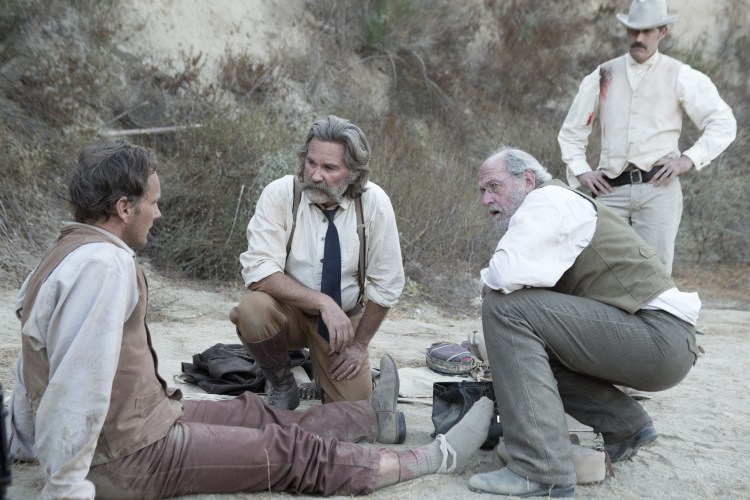
Broken: Patrick Wilson, Kurt Russell, Richard Jenkins and Matthew Fox
Bone Tomahawk is an odd film. But its strangeness sneaks up on you rather than announcing itself straight to your face.
Ostensibly a Western with a fairly straightforward rescue narrative, the fact that it’s something of a genre mash-up (the other ingredient being a sparse but disturbing sprinkling of body horror) is actually not its most significant feature.
Rather, this is down to how the characters – each of them grizzled veterans of some variety – are shaped.
Particularly in the case of the frail, elderly and bumbling deputy sheriff Chicory (Richard Jenkins), this often comes in tangential bits of dialogue. On this front, writer-director S. Craig Zahler, also a novelist, is like a more sincere, less showy Tarantino. This isn’t a showcase for actors to hypnotise you with acerbic, incantatory language – it’s a showcase for actors to depict the pained, distracted nature of a group of people who are in way over their heads.
‘Troglodytes’: Things take a nasty turn when our heroes meet a pack of cannibals
In fact, another Western that also stars Kurt Russell – Bone Tomahawk’s hero figure – has been directed by Quentin Tarantino himself, and reached cinemas mere months after Bone Tomahawk appeared.
But I have a feeling that, for all its seemingly throwaway mini-monologues and its abrupt shifts in tone, Bone Tomahawk will be the one that sticks with me.
The force awakened come Christmas time. Coincidence? I think not.
My happy places are: Valletta in various moods and times; Sliema at twilight and for lone, spontaneous walks; Attard-Balzan-Rabat for indelible memories and undeniable, cosy beauty and, perhaps topping it all, the childhood fairyland that thankfully remains much the same, Banja Vrujci.
Banja Vrujci
These places and others are what leave an impression – what reminds me of the raw matter that is true happiness and how it can continue to spread when “recollected in tranquility”.
And in many ways this is how the Christmas period functioned, for me. It’s not a family tradition and latterly it’s become little more than an annoyance for various reasons, but at least it gives me the perfect excuse to eschew all else – intellectual and otherwise – and my quiet little place amid everybody else’s celebratory din helps me to remember all the things that are important to me.
These often come in the form of memories, of course. What we cherry-pick from our past is a very important indicator of what remains important to us.
As I suspect is the case with most people, I’ve been placing quite a bit of stock on my ambitions of late. But such a relentless focus on them means fatigue sets in quick and fast.
So I’ve come to appreciate Christmas – most especially Christmas Day itself – as a kind of oasis.
Just as human beings have the misfortune of being animals saddled with the puzzling gift of self-consciousness – with all its problems – this also means that with enough self-awareness and emotional balance, we can fabricate things about ourselves, to ourselves, for our benefit.
*
Speaking of nostalgia, and variants of it… I really enjoyed the new Star Wars movie. Star Wars, too, is a lot like Christmas (or is it Christmas that’s a lot like Star Wars?).
Because just like Christmas, the franchise is a stark reminder of the pervasive power of capitalism – how it truly has the entire world in its grip, how it appropriates all stories and pieties into its gaping maw to further perpetuate a relentless desire for consumption.
The Christmas story is put aside in favour of “the gift economy” and our expectations for the holiday are calibrated to ‘spend and receive’ – in the same way as our beloved Star Wars characters are intrinsically wended to a film production and distribution model that views the movie and its merchandising as basically interchangeable.
But like Christmas, Star Wars still means a lot of things to a lot of people.
The saga – now in its seventh ‘episode’ – may be suspect in its method of delivery, but what it stimulates in people can’t be denied either.
It’s lovable alongside the cynical nature of its (internal or external?) dynamics, not despite of them.
Of course none of this is ‘natural’, and neither is it self-evident. Like the very act of writing an ‘essay’ – etymologically referring to the process of working things out – all of this is built out of opinions and perceptions chiseled out across time – and it’s entirely open to scrutiny.
But we can choose the fabrications that work the best for us – applying the usual caveat that this is a power we should try use for good and not ill.
But the decision to release The Force Awakens during Christmastime strikes me as a very shrewd fabrication indeed.
*
Party at Chez Reljic
New Year’s Eve, in fact, carries more weight for me and my family. This is partly down to national habits – it’s the big blowout celebration of the season in Serbia, gift-giving and all – and family habits too: my sister and I now carry the baton of organising a party each year.
The day after, dazed if not hungover while munching on leftovers, often tends to be an emotionally woozy time.
In more recent years, revisiting the apartment we grew up in to host the party has come with an edge of melancholy. Gentrification means that it’ll soon be beyond my father’s price range (he still rents there) and all of our memories of the place will remain just that.
It’s another reminder of just how important it is to keep mindful of the things that matter. Memories will never be solid, but you should work hard to make them as solid as possible.
French president François Hollande characterised the November 13 Paris attacks as an ‘act of war’
“The war is up there on the island, where we’re going to meet it, but there’s no war there, nor could there be. War is dreamlike, but war IS a dream… Where is the war? In the guns and helmets and uniforms? Is it in the rock from which the ore to make the gun was mined, the grass that fed the sheep whose wool went into the uniform, or the sun that lights the battlefield? Not impossible to escape but it tethers as unsubstantially, as lightly, as a dream, the odds binding me inside. I go on with it; I’m not bound like a prisoner, but like a sleeper. Two men meet, and one will give his life for the other, or they will each try to kill the other, while the day is still blandly unfolding around them. The violence I’ve already seen has been as random and abrupt as a dream, always ending in death that seems only to become more and more impossible. I always know that I’m no more than one sharp breath from waking. It’s a breath I can never manage.” – Michael Cisco
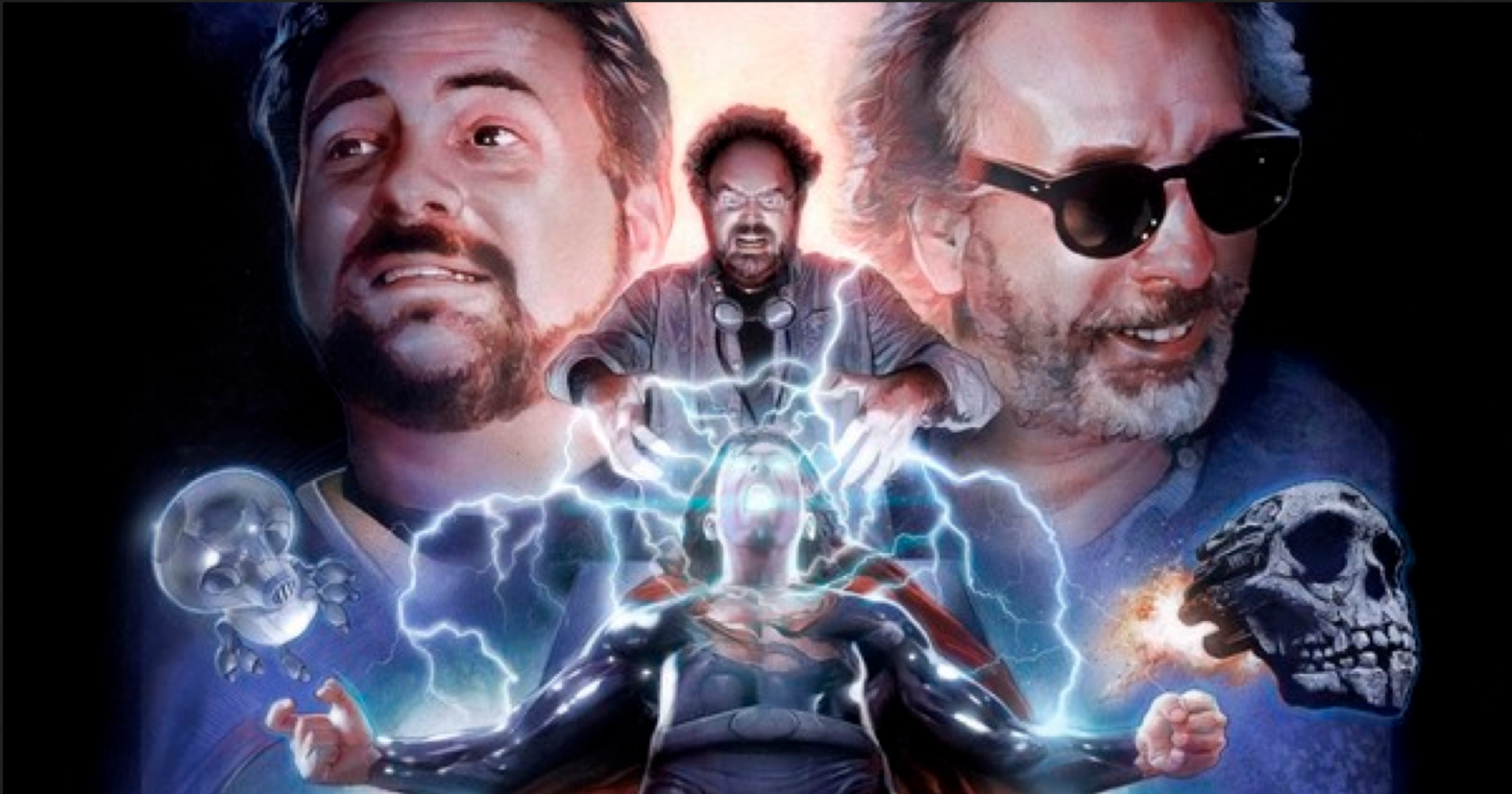
The practically back-to-back release of three documentaries about films that never ended up being made makes for quite the wistful (and geeky) movie marathon, but it’s also a great exercise for the imagination and a jumping-off point for other artists to maybe get inspired to do something similar.
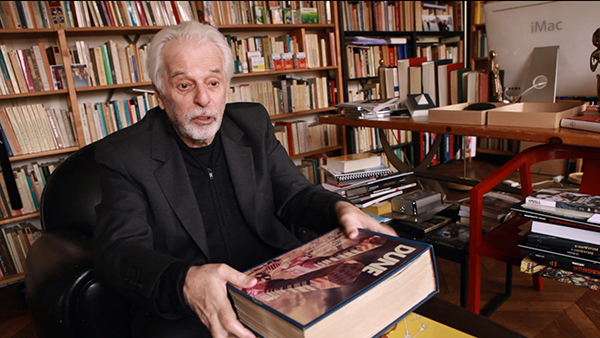
I’m talking, of course, about the trifecta made up of Jodorowksy’s Dune, Lost Soul and most recently The Death of Superman Lives. With ‘Dune’ being the most intriguing and richest of the bunch, it’s also garnered the most attention so far, in large part thanks to the charismatic, loquacious presence of its central protagonist, the cult Chilean director Alejandro Jodorowsky, as well as the totemic reputation of another key cook in the abortive Dune broth – pioneering French comic book artist Jean Giraud, aka Moebius.
Frank Pavich’s film sets the tone for this strand of documentary, balancing industry gossip with insights into the artistic process, and so feeding our curiosity from two different angles. We get to hear about ‘Jodo’ wrangling with studio execs, convincing the likes of Salvador Dali, Orson Welles and Pink Floyd to join what was already becoming a movable feast of a film.
Alejandro Jodorowsky, seen here with the totemic book of storyboards for Dune
But by dint of the fact that Moebius had completed the storyboards for the film long before the film went into (ultimately doomed) production, Pavich’s film also has the luxury of being the most visually arresting of the three films we’re discussing here, giving us a presumably accurate approximation of what Jodoroswky’s film may have looked like.
Jodorowsky’s Dune is also, perhaps, the most ‘culturally significant’ film of the three, because the fallout of the project then paved the way for likes of HR Giger and Dan O’Bannon to assert their influence on that other sci-fi behemoth – Ridley Scott’s Alien – to say nothing of how the would-be Dune’s reputation had a ripple effect that helped give rise to the likes of Star Wars.
Though all of the three projects were ultimately felled by a common enemy – film studios getting cold feet over what were essentially sprawling, avant-garde projects – this predicament is felt most keenly in Lost Soul, directed by David Gregory and charting the demise of director Richard Stanley’s attempt to make The Island of Dr Moreau.
Concept art for Richard Stanley’s The Island of Dr Moreau
Eventually released in 1996 thanks to the efforts of a new director, John Frankenheimer, the Marlon Brando-starring stinker had a far more interesting – read: disastrous – behind-the-scenes story, owing in no small part to its exotic Australian location. Being the most ‘advanced’ project of three – for whatever it’s worth, the film was actually completed – its make-up is slightly different to that of Jodorowsky’s Dune or The Death of Superman Lives… but only to a point.
We’re here to lament the loss of Stanley’s proposed visionary take on HG Wells’s classic novel, the film suggests, and the fact that a bastardized version was sent to die to the theaters is irrelevant – if anything, it’s yet another twist of the knife.
Lost Soul is mostly talking heads and some piecemeal archive footage – there’s a disappointing scarcity of concept art on display – but its narrative does boast a universally appealing backbone: the tragic story of a misunderstood eccentric crushed by bean-counting and nervous executives (there’s a more tenuous connection too – Stanley can also be counted among the talking heads in Jodorowsky’s Dune).
Richard Stanley, holding the Dog Man mask he used to sneak his way onto the set of The Island of Dr Moreau after he was fired
Though Jodorowsky is hardly the pinnacle of well-adjusted normality, and though would-be director of Superman Lives Tim Burton has built a career out of marketing himself as an ‘outsider’, it’s only Stanley who comes across as the true eccentric of the bunch. Dressed all in black and sporting a hat at all times, a believer in the power of witchcraft (as bolstered and made somewhat more intellectually palatable by his background as an anthropologist), Stanley arrives to the project with plenty of interesting things to say, and a passion to lend a relevant, contemporary spin on Wells’s story while fully respecting its historical and intellectual history.
Things are, of course, not as black and white as all that, and what also emerges is how unsuited Stanley was for such a large scale project. Fresh off cult hits Hardware and Dust Devil, Stanley was a stranger to big studio films and hardly inspired confidence on set – refusing to have meetings and clearly not being comfortable with the demands of such a production.
To say nothing of dealing with the egos of the likes of Val Kilmer, whose fee ballooned the budget to ridiculous proportions, putting further pressure on an already strained shoot (to say nothing of the fact that he had reduced shooting days, and acted like a complete dick on set).
Still, the documentary suggests that Stanley had a healthy clutch of supporters, and that even the film’s producers were sympathetic to his overall aims and wanted what was best for the film.
Actress Fairuza Balk, who found a kindred bohemian spirit in Stanley, comes across as his most impassioned defender in Gregory’s film, and her immediate reaction to Stanley being eventually fired from the production makes for a hilarious anecdote.
By contrast to the two other films, The Death of Superman Lives is a conversation with high-powered industry individuals who, despite the project never getting off the ground (hur hur) remained comfortable in their careers and weathered this (very expensive) storm in the end.
Whereas Stanley went into exile after being fired from ‘Moreau’ – first in Australia, then to the Montsegur commune in France – Tim Burton was allowed to continue his career in the rarefied atmosphere of Hollywood virtually unimpeded… although, as one-time screenwriter for the project Wesley Strick tellingly suggests, he hasn’t scaled the heights of its potential ever since.
Directed and narrated by Jon Schnepp – who is seen chatting to all of the interviewees – the partially Kickstarter-funded documentary has a rough-around-the-edges feel to it.
Sound quality fluctuates throughout and a disproportionate amount of the running time is dedicated to the costume Nic Cage would have worn for the film – perhaps betraying the ‘fanboy’ nature of Schnepp’s project (where dwelling on seemingly superficial accoutrements becomes a matter of cultish fetishisation).
But barring Nic Cage – whose presence is nonetheless felt through the use of now-totemic archive footage of costume fittings – Schnepp manages to assemble all of they key players involved in the cancelled production to have their say (on this point he gets one over ‘Lost Soul’, in which the absence of Kilmer and fellow actors David Thewlis and Ron Pearlman is keenly felt).
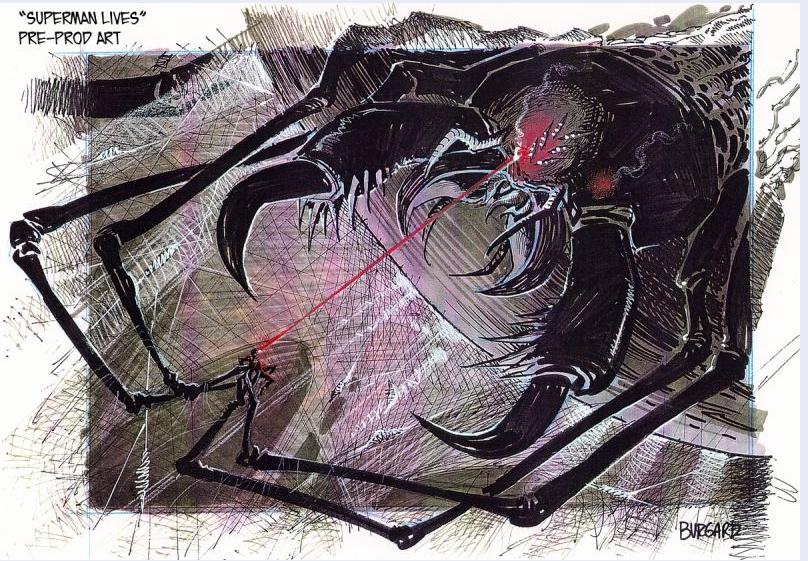
Giant spider! Pre-production concept art for Superman Lives
If nothing else, the film is a treasure trove of concept art. The jump to a high-budget production of this kind from Dune and ‘Moreau’ is made all the more evident by just how many varied talents were brought in to help bring Burton’s vision to life, and Schnepp succeeds in bringing the wild, colorful panoply into relief.
But for better or for worse – and despite a somewhat woozy presence from Burton himself – the key attraction remains producer Jon Peters. A former hairdresser with claims to bona fide street cred (at one point he tells Schnepp he was in “five hundred fights”), he comes across as a well-meaning nuisance at best, a bully at worst. He’s a fervent believer in the project but clearly also the product of the deluded Hollywood machine; 20 percent substance and 80 percent bullshit.
Tales of wondrous projects squashed by the machinery of ‘reality’, these films give breathing space to a pop culture landscape rapidly losing any heterogeneity in the name of financial security.
Perhaps they’re also a by-product of the internet age, in which nothing remains hidden for long, and where film fans become pseudo-historians and archivists by proxy. Whatever the case, I hope that they end up serving as cautionary tales above all, rather than just harmless curiosities.
We celebrated the 75th anniversary of the Joker with a small conference dedicated to the Clown Prince of Crime’s ‘life and works’ last Saturday, and it served as a good reminder of how refreshing academic inquiry could be when placed actually outside an academic context.
Organised by Euro Media Forum and chaired by my good friend Krista Bonello Rutter Giappone – who also gave an lucid an insightful paper on the Joker and Batman as a comedy double-act – the event may not have been terribly well attended, but it did inspire an convivial atmosphere of open discussion and debate which wasn’t about intellectual one-upmanship but genuine passion for the subject matter, and a desire to get at it – him – from as many angles as possible.
Jack Nicholson at The Joker in Batman (1989)
Running the gamut from conversational ‘geeky’ presentations and more scholarly insights into the Joker as a key character of Batman lore across various media (comics, film, animation and video game), we heard presentations which delved into Joker’s design history, evil clowns in pop culture, and how the Jack Nicholson and Heath Ledger film-Jokers compare to each other; as well as the idea of the Joker as a demiurge, the Joker’s smile as a traumatic ‘wound’ (with all the symbolic weight that the image implies) and the socio-political imagery of both the Jack Nicholson and Heath Ledger Jokers (that would be me).
Heath Ledger as The Joker in The Dark Knight (2008)
It was an unabashedly geeky way to spend a Saturday, of course, but a part of me felt very proud of the fact that we got together to pay tribute to the Joker – one of my favourite characters in fiction – in such a concerted and dedicated way. The main take-away insight from it all – if we could reduce it to just one – is that the Joker’s familiar-but-amorphous nature is what makes him such an enduring – and enduringly scary – villain. He is equal parts prankster, psychopath, terrorist and trickster – sometimes embodying just one of those characteristics at a given time, other times (more often than not, it seems) amalgamating all of those things in garish and dangerous brew.
Illustration by Greg Capullo
In short, I think he’s secured himself the role of an archetype worth remembering, celebrating and returning to.
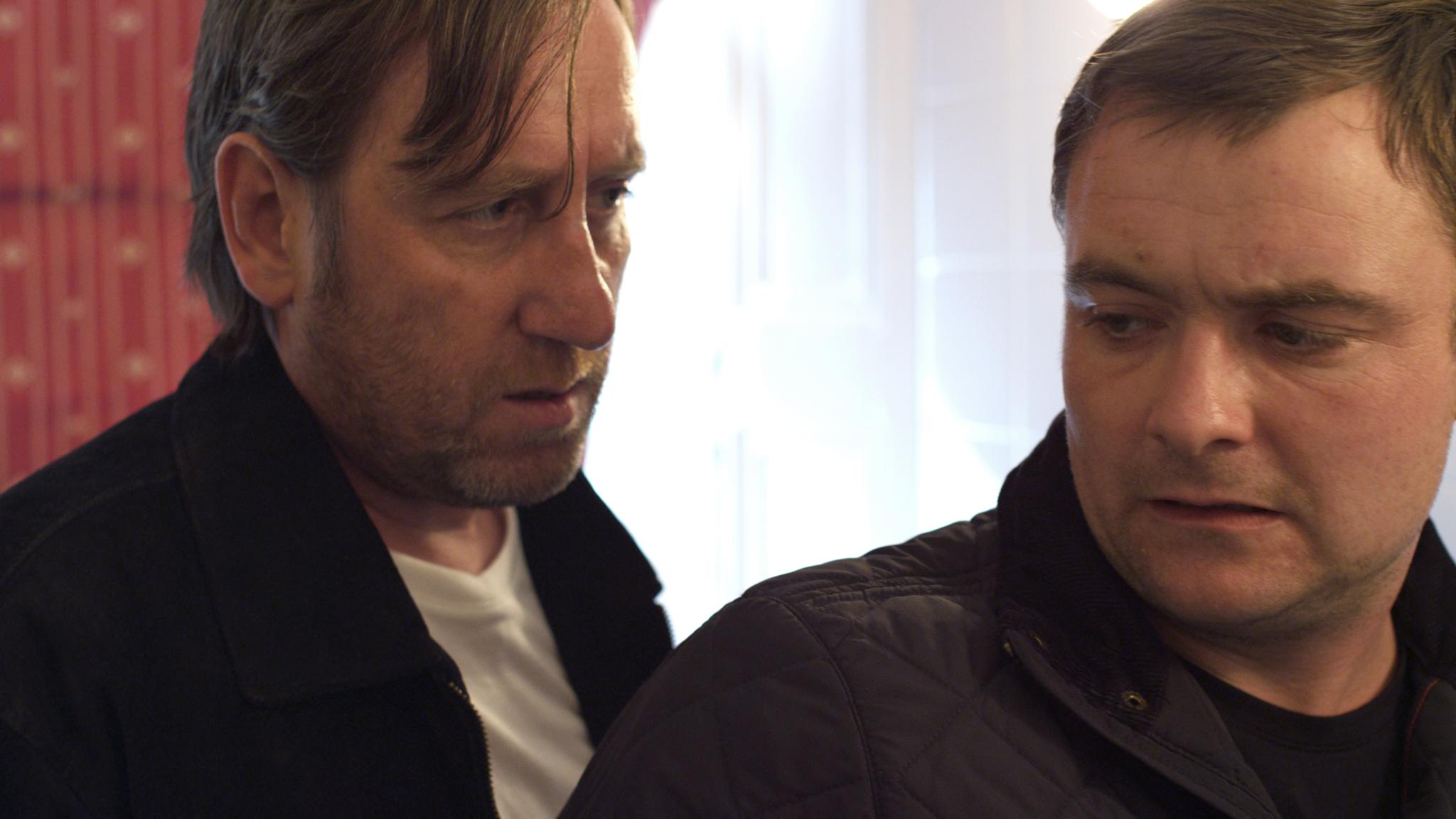
Murder-bound: Neil Maskell and Michael Smiley in Kill List (2011)
While Schlock Magazine gets its ‘Monster March’ on the road, I troop away with my own, this time with a cold, hard aspiring cult classic.
Was it Harold Bloom who said that a ‘strong’ new literary entry has the power to alter even its predecessors in some way? Not name-dropping a theorist to up my cultural capital, and neither can I say I fully understand the above assertion, but it popped into my head as I finally watched Ben Wheatley’s Kill List (2011). The reason it popped into my head is because I couldn’t help but compare it to a later – and American – iteration of the same themes and character dynamics: the first season of HBO’s True Detective (2013). Seen this way it’s certainly a haunting matrix of fears and anxieties. As in True Detective, you’ve got fraught male bonding – scarred and identified by both traumatic history and a looming mid-life crisis. And spoiler alert here, but both properties also deal with filmed horrific acts distributed through underground networks, informed and capped off by a mass boogeyman in cult form.
American Gothic: Matthew McConaughey and Woody Harrelson in True Detective
The British variant of said cult is culled from the pagan imagery of homegrown classic The Wicker Man (1973), where True Detective clearly takes a cue from sadly enduring but eminently exploitable Ku Klux Clan imagery. If their similarities are thematic, their differences are narrative and stylistic. A common complaint with True Detective was that it got bloated and keeled over towards the end: the suspense and occult intrigue proved to be a game of hurried smoke and mirrors on the part of the – inexperienced – writer and showrunner Nic Pizzolato’s part. Of course, being a lean feature film, Kill List doesn’t have that to worry about, but it’s also a crueler beast. There is no sentimental arc for either of its protagonists to fall back on, and its grisly denouement leaves no window open for the mismatched happy ending afforded to True Detective.
Prelude to a Burning: Christopher Lee as Lord Summerisle in The Wicker Man (1973)
“You’re cogs,” the protagonists of Kill List are informed at one point. The cults at the centre of both Kill List and True Detective are a grotesque reminder of how an attempt at heroism and exceptionalism can be undermined by this persistent aspect of the human psyche. Monsters are at their worst when they get organised.













 Soft Disturbances