What we talk about when we talk about home

I.


Is there a standard expectation of when our earliest memory is expected to be? The image I have in mind feels a bit late in the day – I was six or seven years old – but I can’t grasp for anything earlier with any conviction and anyway, the further down you go the risk of low-key hallucination – our own personal storehouse of fiction – increases exponentially.

We left Serbia for Malta when I was seven years old, and we spent some days in Bulgaria en route to the island, because wartime sanctions meant we couldn’t fly out directly and had to make a pitstop to Sofia, taking a train ride from Belgrade and sleeping over at the home of acquaintances I hadn’t heard about before or since.

I do remember parts of Sofia – a large, Communist-style statue of a male figure seeping through the urban sprawl, a vegetable market, the brutalist buildings that weren’t all that different from Belgrade – and I remember the train ride too: though the sequence and the images aren’t that clear, my maternal grandmother’s sorrow and confusion still lands like a fresh arrow.

But these weren’t the very first memories – hazy and ancient though they feel too, like watching a grainy film of somebody else’s life, lost in archival wreckage and only just about salvagable, albeit in fragmented form.

The first memory was a foreshortened view of my mother – stylishly dressed as she always was, but definitely dressed to go out, with a coat and a hat and everything, and a wide, warm smile that was to become an aching pull of charm to whoever would meet her.

“We’re going to go find dad.”

She was foreshortened because I was sleeping on the top bunk of our bed in Zemun, with my four-year-old brother on the lower one. The mood of her smile suddenly matched my own – it spread out to me like an infectious carrier of pure joy.

Finding dad was the one thing I wanted. The one thing I felt was missing. The wistfulness for him that had become my norm by then was finally going to find its culmination, was finally going to be allowed to die a natural death.

So that I could become me, in whatever was left.


Dad wasn’t around for a bit because before the Malta plan, there was the Libya plan. The creep of the Yugoslav Wars – that one blip in the otherwise end-of-history-ish vibe that permeated the West during the ’90s – had nudged our parents into considering other options.

And the one that made itself readily available was this one: my father would go to work for his uncle at the drydocks of Benghazi, and the first stage of that was an exploratory trip away from us for some months.

The surge of instant gladness I still remember feeling the moment my mother smiled up at me to say we’re going to find dad means that I had felt his absence like the undeniable cavity of a freshly pulled out tooth.

There’s something that invokes self-pity in the idea that a lack was a main characteristic of my psychic development at that time, but there’s also a positive flip-side to this early memory being tinged with relief and expectation. It’s also a confirmation of the kind of bond you develop with a parent so early on – they really are at the center of your world, so their absence feels, at the very least, like a key comfort denied.

Now my parents are both dead. What to do when that absence becomes not just deferred, but extended indefinitely?


The more time passes, the more I realise just how much of that initial childish separation from my father conditioned my emotional space.

It made me all the more keenly susceptible to nostalgia, to the point where people would make fun of me for wallowing in it at such a young age. (“You’re seventeen, what could you possibly be nostalgic about?”).

Because my parents were either incapable, or unwilling, to internalise the value of sitting still. Displaced from Serbia, we moved within Malta too, just about enough to fully rattle my young psyche into believing that I’ll never find a true sense of home. It’ll surprise precisely no-one that the upshot of this was a dovetailing into fantasy by default.

During break-time at at school, I was magnetically drawn towards the areas of the playground market ‘out of bounds’ – signs virtually unenforced by whatever passed for gatekeeping authorities – lax at the best of times – and which were certainly not going to clamp down on the gawky, floppy-haired nerd who did little except munch of a soggy sandwich and stare into space.


Nostalgia and fantasy walk hand in hand. This is why nostalgia is more than just dry record or a verifiable memory. This is why it comes with a charge of desire and wistfulness, and consequently also why it tends to be viewed with suspicion. Unhealthy, neurotic, escapist and regressive. Putting people inside hamster-cage loops of the past that are both ghostly and undeniable.

This is all well and good. It is the rational position to take. It is the sober and constructive approach that discourages needless and ultimately damaging wallowing. Being lost in the past means being placed in a state of arrested development. Nostalgia means being plunged back into the past, but time as we live it moves forward, and a lot of our psychic success hinges

on at least meeting it halfway.

But that implies that a ground of some kind exists. A home base – indeed, a home, period.

But what if your home never quite materialised? And what if this tenuous home is a rock in the middle of the sea that is constantly made to evolve according to the whims of its colonising forces – both imperial and capitalist?

II.

Both my parents are now dead, and of course I have plenty of regrets and unasked questions which will forever remain pending in a rotting pigeon-box; snuck in but unopened, and I’ll soon forget the actual articulation of these questions and everything will join the same ghostly realm of the nostalgic miasma that I’m straining to pin down and describe here.

As we’ve said – time moves forward, and this forward motion also implies the scalding away of the bodies of those who gave you life and who – inadvertently or otherwise – shaped your social and emotional expectations. But these expectations are never perfect, and often in fact emerge from a build-up of keen and unique damage: unprocessed and even barely addressed.

You know all this. We know all this. But the forward churn of time often leaves these scars lodged into our bodies while we’re forced to tend to other, fresh ones. To put out new fires while older ones are still raging, though some may be reduced to a slow, keen sputter that has morphed into a fireplace of sorts.

I’m overreaching with these metaphors, maybe. I’m just sculpting verbal play from immediate impressions, in the hopes that it would yield something useful. But in the end, isn’t that what all writing is? Isn’t that what the essay form is in particular – to assay, to try, to learn as you go along.

Besides, I like the old-flames-as-new-fireplace metaphor. I think it speaks to the tendency of ‘legacy-trauma’ becoming a default state. Something to return to. A toxic form of comfort. Stories we tell to root ourselves into a sense of coherence, if nothing else.


One of these fireside conversations could concern the details of my father’s time in Libya. He was there around 1991 and 1992 – it had to be around the first half of that time period because by July of 1992 we had already ‘settled’ into Malta with the same provisional air that would inform pretty much everything else we would do as a family.

He was meant to work at the drydocks there, but that plan obviously did not work out because we ended up starting a new life in Malta instead. (There would’ve been something divinely ironic though, wouldn’t there, in going from one country with an authoritarian wartime crisis that devolved into civil war, only to find ourselves in another further down the line).

The fireside story is that he was given a reprieve from whatever hands-on work he was expected to do and he was sent to ‘deliver documents’ to people in Malta. He never got too specific about either. And I never really felt the need to ask, for some strange reason. It’s not so much that I feared the answer would yield something suspicious or unsavory. It’s just that at the time, I took his word for it. I guess we all did. It’s just the kind of thing you allow dads, I suppose, because you want to submit to that imperative – to believe they are the ones providing you with that stable bedrock from which all other meaning emerges and grows.


The fireside story isn’t so much about what he did and didn’t do there, exactly. For that, I suppose there’s both the prosaic and the spurious – if not romantic – interpretations available to us to bandy about.

He could’ve just decided it wasn’t for him – any by extension, per the aforementioned patriarchal imperative, not for us – and that he made a judgement call and opted for the post-colonially wrecked but pretty Mediterranean island instead. Then we could of course run riot with the poundshop espionage narratives, the lurid conspiracy theories: ‘delivering documents’ from Libya to Malta at the peak of the Gaddafi regime? Juicy. Le Carre worthy. Even ‘sus’.

(Later, much later, as my brother and I would bond over his many faults and wounds after his death, he’d offer a plausible stitch to the story: our artsy father was ‘useless at actual construction work’ and so his uncle found some use for him as an messenger boy).

But funnily enough, the fireside story doesn’t amount to a culmination of any of the above. It concerns an even more finely-tuned and concise piece of storytelling. One that frames our tale of settling into Malta as both sanguine and inevitable.

“My dad went to work in Libya, he didn’t really like it, so he took a Captain Morgan boat to Malta to scope out the island and once there he said, this is good – we’ll settle here.”

An elevator pitch. Free of needless detail and complication. Emboldened with pure immigrant pluck, and animated by hope.


Just like we never questioned the details of my father’s time in Libya, so my family never picked all that much at the thorny matter of the Yugoslav Wars, at least not in any incantatory way that would cohere a united front – those micro-political stances some families do take on major issues like these. It’s not that the subject was taboo – my parents spoke about it among themselves in our presence, openly discussing it with fellow Yugo-expats while trying to condense it into bite-sized chunks for Maltese acquaintances – but there was a sense in which talking about it at length with the kids meant infecting the family with its oozing ugliness.

There were some tableside scraps of the narrative which were easy to internalise, though: such as the prevailing thought that the very premise of the war was absurd, that the internecine divisions which characterise it were arbitrary and that nationalistic impulses in whichever direction were enabled by a lumpen mass of the uneducated.

But on a day-to-day level, the war only registered in the undeniable fact of our displacement, and our ongoing distance from the home country as it all raged at its worst and sanctions still barred us from traveling.

So that we lived in that absurdist limbo state where Bryan Adams’s ‘Everything I Do (I Do it for You)’ – ubiquitous as the equally incorrigible camp-fest that was Robin Hood: Price of Thieves to which it was wended as the banner theme song – edged itself into our lives in a more significant way than the contemporaneous Battle of Vukovar never could. Similarly, when we finally got to return to Serbia in 1996, the main emotional undercurrent was that we got to introduce my sister – born a year prior – to our grandparents… us kids were oblivious to the fact that the Dayton Agreement is really what made the trip possible.

‘The war’ was just a perpetual hum in the background of our lives: an undeniable state whose particulars, however, were always remote for us in the immediate sense.

I suppose this is the privilege of those like us who made their way out. (Not to mention the position of Serbia in particular, when it came to its role in the conflict itself).

But there are so many remainders and loose ends. No real narratives, only impressions. And I suppose that, when it comes to war, this is all for the better: we know that concrete narratives in these scenarios often breed monstrous things.

But for a child, the space of silence is rarely a cocoon for meditation. More often than not, it becomes an incubator for loneliness.

III.

The space of loneliness is of course different from that of solitude – with the latter assuming the mantle of the heightened position, the zen-like placid calm and an easy self-communion – but when you’re a kid and experimenting with the things that make you feel good and ease the pain you don’t yet have the layers of experience, of trial-and-error to really make the distinction.

I’ve spoken a lot about the in-the-moment dynamics of displacement and migration here, and loneliness – crucially, not solitude – was a big part of it for me from the beginning since there was very little to latch onto or even land on.

This is what I’ve always found funny about Malta. That the rock is totally a rock. Its undeniable state as an island predominantly defined by rock and STONE – largely the flaky-soft limestone, but still. Famous for it Neolithic temples and famous for all the subsequent temples that followed – one church for each day of the year, St John’s Co-Cathedral and Ta’ Pinu Basilica and all the rest of it. The winding country roads defined by handmade cobbled walls – precarious as they are ubiquitous, a trademark to be protected and which will determine the island’s definition for what feels like forever.

And even down underground, from the paleo-christian catacombs that snake their way across the north, the old water cisterns now fit for dark-tourism-lite tours and boutique concerts, and of course the Hypogeum: now barely reachable by the masses keen to visit all year round because the tickets prices have shot up just like everyone else…

So many perfect enclaves. So many stone spaces to snuggle up against. For shelter, for reflection… to count each crack and each pock-mark, if you like. To be guided by flaming torchlight down subterranean a subterranean passageway and then, reach a clearing and drop it down to the humid floor, and what follows will either be a period of meditation or its longest culmination – death.

But it doesn’t happen that way, does it? Instead of the earthy, enveloping powder of the pure stones by day and its chiaroscuro promises as the sun goes down, the island actually fights against itself and becomes louder and louder – taking the advice to rage against the dying light just that little bit too literally to tip it all over and ruin any remaining chance of peace.


The rocky enclosures are just the kind of spaces I would dream about when I’d head down to lunch break at Ħamrun Liceo; a place where I eventually did find friends but whose long stretches were defined with simply wanting to be elsewhere and assuming this was normal.

Shaping yourself into someone who tolerates life means negotiating the space between the physical and the non-physical, and when you’re raised by parents too scattered and frayed on their own end to offer a ballast or groundwork beyond the most rudimentary, your grasp of the non-physical is equally all over the place.

This is also the same absurd space where Bryan Adams hit anthems co-exist with the news of the Battle of Vukovar, that hum which cannot shape itself into anything coherent, let alone stone.


So, home. Malta became home. We were ‘third-country nationals’ for the longest time and then, one day in 2012, we weren’t any more. A couple of years after my mother had a stroke that would land her in a coma for a decade, we were finally mailed that much-desired olive branch: citizenship.

My father, brother and I went to the office and read out a declaration and signed a paper. The burly policewoman behind the heaving-with-documents desk pointed to another small but significant feature: a crucifix. “Catholic?” she asked us, and when we nodded no she made no fuss about it and just made us read the secular take on all this – said declaration that we would loyal to the Maltese state and respect its institutions and blablabla – and that was that.

We went back home after that, what for both my parents remained a forever home owing to their premature deaths, and what in any case for us was the longest-running home we’d known by then.


3A, Panorama Flats in Sliema. It was something of a purgatorial wreck by that point, owing my mum’s long sojourn in hospital, and then a care home from 2010 to 2020. As us kids trickled out bit by bit, my father would eventually rebrand it into a workshop space-cum-artist commune.

But in that crucial moment in 2012, it was still something of a gutted mess: we were living like roommates – as my father would take pride in saying, sloughing off any leftover parental responsibility he may have still felt beholden to – hypnotised by the puzzling absurdity of our present situation.

My mother was a beautiful, creative young woman who was holding a bunch of stuff together, and her presence in the home – this apartment, the likes of which they don’t make anymore – was a huge part of that: from its inspired decor, down to her expert hand at entertaining a varied panoply of guests, mostly culled from what would pass for something resembling a bohemian strain to Malta’s doggedly provincial social scene.

After she was gone, there was a period when the house simply took on a life of its own – where our respective rooms became cocoons and we would barely cross each other’s paths because making excuses to not confront the core realities of it all was what we’ve been taught. Our parents always gave us the impression that life was simply TOO MUCH – that there was always too much to do, that we were always too broke, that they were always too tired and too stressed for us to be adding to any of that with our own problems.

So I began to view the parties they would organise in the same way that they would – a reprieve from the inevitable, native stress that resided in all our hearts – and which subsequently exploded their own – and we could join in because, after all, we were all just roommates, right?


The permutation of Panorama into a new space for more roommates speaks to my father’s inability to move on from the ingrained idea that this apartment would be the only forever home he would allow himself, despite the residue of all the ghosts it still contained – the same ghosts he never had the gumption to confront with any real sense of finality and articulation. Speaking to one of the roommates who would subsequently populate the space – this one in particular residing for a while in what used to be my room – revealed the extent of this: “Cleaning that place to the end was impossible. There was always some rot, some mould that just wouldn’t go away.”

Apply all of the psychological cliches you can think of here: a man loses his wife and cannot muster the strength or courage to get up off his ass and leave the home they built together, and after his kids fly the coop he populates it with new kids so as to be able to exist in a version of the same patterns he was used to and thus, keep the inevitable at bay.

This is why I feel drawn to a darkened catacomb as a culmination of everything. This is the emotional legacy I’m labouring under, if we are to passively accept that we all become our parents and simply follow in their footsteps.


The fact is, however, that home is not a static object. My mother reaching out to me in the bunk bed and telling me “we’re gonna go find dad” meant that we were leaving a home to find a more permanent one – one in which the cavity of my father’s absence was no longer felt.

This emotional space is slippery and prone to unfortunate dependencies. You rely on your parents, for example, to continue carving out that space of security for you, but my own were never really able to do that, so what was left for me was my own headspace – the generous reading: ‘Mind Palace’ – where I had a degree of control and I could craft things my way, but whose particulars also inevitably pulled from existing surroundings.

The danger lies in getting tired. If you’re tired you’re more prone to lie down, and to lie down you need a solid surface that will accommodate you. So this is why you craft the idea of home as a solid space to return to and just lie down in. But without a sense of cultivation, when all that’s left is rot, home becomes a prison.


Working through this, I suppose the grandiose take is that it’s all about forward motion and sudden death. Moving from one place to a better one and then being drained my life so that you’re felled in the same spot in which you’ve tried to make a home.

When you’re felled, you’re alone. And you either die there or you achieve genuine rest.


Soon after we got our citizenship, I took advantage of my newfound privilege as a European citizen to cross a fraction of the continent on my own steam – taking a three-week trip across London, Edinburgh, Prague and Berlin.

When I came back to Malta, it was September and despite the heat, I decided to go on a solo hike up north. I failed to adequately follow a walking tour guide offered by the Malta Tourism Authority – my map-dyslexia is maddeningly legendary – and ended up prolonging my journey to a ridiculous degree.

But trekking along Dingli Cliffs while listening to Popol Vuh’s soundtrack to Werner Herzog’s ‘Nosferatu’ was transformative. The heat was of course doing my head in, quite literally in many ways, but I didn’t care.

The strumming sitar sound, the yellow stones and the occasional abandoned shrine to the Madonna. Increasingly irrational, but it was a communion with the space that I hadn’t really felt before or since.

What we talk about when we talk about home – Part 3

Read Part 1 here. Read Part 2 here.

The space of loneliness is of course different from that of solitude – with the latter assuming the mantle of the heightened position, the zen-like placid calm and an easy self-communion – but when you’re a kid and experimenting with the things that make you feel good and ease the pain you don’t yet have the layers of experience, of trial-and-error to really make the distinction.

I’ve spoken a lot about the in-the-moment dynamics of displacement and migration here, and loneliness – crucially, not solitude – was a big part of it for me from the beginning since there was very little to latch onto or even land on.

This is what I’ve always found funny about Malta. That the rock is totally a rock. Its undeniable state as an island predominantly defined by rock and STONE – largely the flaky-soft limestone, but still. Famous for it Neolithic temples and famous for all the subsequent temples that followed – one church for each day of the year, St John’s Co-Cathedral and Ta’ Pinu Basilica and all the rest of it. The winding country roads defined by handmade cobbled walls – precarious as they are ubiquitous, a trademark to be protected and which will determine the island’s definition for what feels like forever.

And even down underground, from the paleo-christian catacombs that snake their way across the north, the old water cisterns now fit for dark-tourism-lite tours and boutique concerts, and of course the Hypogeum: now barely reachable by the masses keen to visit all year round because the tickets prices have shot up just like everyone else…

So many perfect enclaves. So many stone spaces to snuggle up against. For shelter, for reflection… to count each crack and each pock-mark, if you like. To be guided by flaming torchlight down subterranean a subterranean passageway and then, reach a clearing and drop it down to the humid floor, and what follows will either be a period of meditation or its longest culmination – death.

But it doesn’t happen that way, does it? Instead of the earthy, enveloping powder of the pure stones by day and its chiaroscuro promises as the sun goes down, the island actually fights against itself and becomes louder and louder – taking the advice to rage against the dying light just that little bit too literally to tip it all over and ruin any remaining chance of peace.


The rocky enclosures are just the kind of spaces I would dream about when I’d head down to lunch break at Ħamrun Liceo; a place where I eventually did find friends but whose long stretches were defined with simply wanting to be elsewhere and assuming this was normal.

Shaping yourself into someone who tolerates life means negotiating the space between the physical and the non-physical, and when you’re raised by parents too scattered and frayed on their own end to offer a ballast or groundwork beyond the most rudimentary, your grasp of the non-physical is equally all over the place.

This is also the same absurd space where Bryan Adams hit anthems co-exist with the news of the Battle of Vukovar, that hum which cannot shape itself into anything coherent, let alone stone.


So, home. Malta became home. We were ‘third-country nationals’ for the longest time and then, one day in 2012, we weren’t any more. A couple of years after my mother had a stroke that would land her in a coma for a decade, we were finally mailed that much-desired olive branch: citizenship.

My father, brother and I went to the office and read out a declaration and signed a paper. The burly policewoman behind the heaving-with-documents desk pointed to another small but significant feature: a crucifix. “Catholic?” she asked us, and when we nodded no she made no fuss about it and just made us read the secular take on all this – said declaration that we would loyal to the Maltese state and respect its institutions and blablabla – and that was that.

We went back home after that, what for both my parents remained a forever home owing to their premature deaths, and what in any case for us was the longest-running home we’d known by then.


3A, Panorama Flats in Sliema. It was something of a purgatorial wreck by that point, owing my mum’s long sojourn in hospital, and then a care home from 2010 to 2020. As us kids trickled out bit by bit, my father would eventually rebrand it into a workshop space-cum-artist commune.

But in that crucial moment in 2012, it was still something of a gutted mess: we were living like roommates – as my father would take pride in saying, sloughing off any leftover parental responsibility he may have still felt beholden to – hypnotised by the puzzling absurdity of our present situation.

My mother was a beautiful, creative young woman who was holding a bunch of stuff together, and her presence in the home – this apartment, the likes of which they don’t make anymore – was a huge part of that: from its inspired decor, down to her expert hand at entertaining a varied panoply of guests, mostly culled from what would pass for something resembling a bohemian strain to Malta’s doggedly provincial social scene.

After she was gone, there was a period when the house simply took on a life of its own – where our respective rooms became cocoons and we would barely cross each other’s paths because making excuses to not confront the core realities of it all was what we’ve been taught. Our parents always gave us the impression that life was simply TOO MUCH – that there was always too much to do, that we were always too broke, that they were always too tired and too stressed for us to be adding to any of that with our own problems.

So I began to view the parties they would organise in the same way that they would – a reprieve from the inevitable, native stress that resided in all our hearts – and which subsequently exploded their own – and we could join in because, after all, we were all just roommates, right?


The permutation of Panorama into a new space for more roommates speaks to my father’s inability to move on from the ingrained idea that this apartment would be the only forever home he would allow himself, despite the residue of all the ghosts it still contained – the same ghosts he never had the gumption to confront with any real sense of finality and articulation. Speaking to one of the roommates who would subsequently populate the space – this one in particular residing for a while in what used to be my room – revealed the extent of this: “Cleaning that place to the end was impossible. There was always some rot, some mould that just wouldn’t go away.”

Apply all of the psychological cliches you can think of here: a man loses his wife and cannot muster the strength or courage to get up off his ass and leave the home they built together, and after his kids fly the coop he populates it with new kids so as to be able to exist in a version of the same patterns he was used to and thus, keep the inevitable at bay.

This is why I feel drawn to a darkened catacomb as a culmination of everything. This is the emotional legacy I’m labouring under, if we are to passively accept that we all become our parents and simply follow in their footsteps.


The fact is, however, that home is not a static object. My mother reaching out to me in the bunk bed and telling me “we’re gonna go find dad” meant that we were leaving a home to find a more permanent one – one in which the cavity of my father’s absence was no longer felt.

This emotional space is slippery and prone to unfortunate dependencies. You rely on your parents, for example, to continue carving out that space of security for you, but my own were never really able to do that, so what was left for me was my own headspace – the generous reading: ‘Mind Palace’ – where I had a degree of control and I could craft things my way, but whose particulars also inevitably pulled from existing surroundings.

The danger lies in getting tired. If you’re tired you’re more prone to lie down, and to lie down you need a solid surface that will accommodate you. So this is why you craft the idea of home as a solid space to return to and just lie down in. But without a sense of cultivation, when all that’s left is rot, home becomes a prison.


Working through this, I suppose the grandiose take is that it’s all about forward motion and sudden death. Moving from one place to a better one and then being drained my life so that you’re felled in the same spot in which you’ve tried to make a home.

When you’re felled, you’re alone. And you either die there or you achieve genuine rest.


Soon after we got our citizenship, I took advantage of my newfound privilege as a European citizen to cross a fraction of the continent on my own steam – taking a three-week trip across London, Edinburgh, Prague and Berlin.

When I came back to Malta, it was September and despite the heat, I decided to go on a solo hike up north. I failed to adequately follow a walking tour guide offered by the Malta Tourism Authority – my map-dyslexia is maddeningly legendary – and ended up prolonging my journey to a ridiculous degree.

But trekking along Dingli Cliffs while listening to Popol Vuh’s soundtrack to Werner Herzog’s ‘Nosferatu’ was transformative. The heat was of course doing my head in, quite literally in many ways, but I didn’t care.

The strumming sitar sound, the yellow stones and the occasional abandoned shrine to the Madonna. Increasingly irrational, but it was a communion with the space that I hadn’t really felt before or since.
Ends.

What we talk about when we talk about home – Part 2

Read Part 1 here

Both my parents are now dead, and of course I have plenty of regrets and unasked questions which will forever remain pending in a rotting pigeon-box; snuck in but unopened, and I’ll soon forget the actual articulation of these questions and everything will join the same ghostly realm of the nostalgic miasma that I’m straining to pin down and describe here.

As we’ve said – time moves forward, and this forward motion also implies the scalding away of the bodies of those who gave you life and who – inadvertently or otherwise – shaped your social and emotional expectations. But these expectations are never perfect, and often in fact emerge from a build-up of keen and unique damage: unprocessed and even barely addressed.

You know all this. We know all this. But the forward churn of time often leaves these scars lodged into our bodies while we’re forced to tend to other, fresh ones. To put out new fires while older ones are still raging, though some may be reduced to a slow, keen sputter that has morphed into a fireplace of sorts.

I’m overreaching with these metaphors, maybe. I’m just sculpting verbal play from immediate impressions, in the hopes that it would yield something useful. But in the end, isn’t that what all writing is? Isn’t that what the essay form is in particular – to assay, to try, to learn as you go along.

Besides, I like the old-flames-as-new-fireplace metaphor. I think it speaks to the tendency of ‘legacy-trauma’ becoming a default state. Something to return to. A toxic form of comfort. Stories we tell to root ourselves into a sense of coherence, if nothing else.


One of these fireside conversations could concern the details of my father’s time in Libya. He was there around 1991 and 1992 – it had to be around the first half of that time period because by July of 1992 we had already ‘settled’ into Malta with the same provisional air that would inform pretty much everything else we would do as a family.

He was meant to work at the drydocks there, but that plan obviously did not work out because we ended up starting a new life in Malta instead. (There would’ve been something divinely ironic though, wouldn’t there, in going from one country with an authoritarian wartime crisis that devolved into civil war, only to find ourselves in another further down the line).

The fireside story is that he was given a reprieve from whatever hands-on work he was expected to do and he was sent to ‘deliver documents’ to people in Malta. He never got too specific about either. And I never really felt the need to ask, for some strange reason. It’s not so much that I feared the answer would yield something suspicious or unsavory. It’s just that at the time, I took his word for it. I guess we all did. It’s just the kind of thing you allow dads, I suppose, because you want to submit to that imperative – to believe they are the ones providing you with that stable bedrock from which all other meaning emerges and grows.


The fireside story isn’t so much about what he did and didn’t do there, exactly. For that, I suppose there’s both the prosaic and the spurious – if not romantic – interpretations available to us to bandy about.

He could’ve just decided it wasn’t for him – any by extension, per the aforementioned patriarchal imperative, not for us – and that he made a judgement call and opted for the post-colonially wrecked but pretty Mediterranean island instead. Then we could of course run riot with the poundshop espionage narratives, the lurid conspiracy theories: ‘delivering documents’ from Libya to Malta at the peak of the Gaddafi regime? Juicy. Le Carre worthy. Even ‘sus’.

(Later, much later, as my brother and I would bond over his many faults and wounds after his death, he’d offer a plausible stitch to the story: our artsy father was ‘useless at actual construction work’ and so his uncle found some use for him as an messenger boy).

But funnily enough, the fireside story doesn’t amount to a culmination of any of the above. It concerns an even more finely-tuned and concise piece of storytelling. One that frames our tale of settling into Malta as both sanguine and inevitable.

“My dad went to work in Libya, he didn’t really like it, so he took a Captain Morgan boat to Malta to scope out the island and once there he said, this is good – we’ll settle here.”

An elevator pitch. Free of needless detail and complication. Emboldened with pure immigrant pluck, and animated by hope.


Just like we never questioned the details of my father’s time in Libya, so my family never picked all that much at the thorny matter of the Yugoslav Wars, at least not in any incantatory way that would cohere a united front – those micro-political stances some families do take on major issues like these. It’s not that the subject was taboo – my parents spoke about it among themselves in our presence, openly discussing it with fellow Yugo-expats while trying to condense it into bite-sized chunks for Maltese acquaintances – but there was a sense in which talking about it at length with the kids meant infecting the family with its oozing ugliness.

There were some tableside scraps of the narrative which were easy to internalise, though: such as the prevailing thought that the very premise of the war was absurd, that the internecine divisions which characterise it were arbitrary and that nationalistic impulses in whichever direction were enabled by a lumpen mass of the uneducated.

But on a day-to-day level, the war only registered in the undeniable fact of our displacement, and our ongoing distance from the home country as it all raged at its worst and sanctions still barred us from traveling.

So that we lived in that absurdist limbo state where Bryan Adams’s ‘Everything I Do (I Do it for You)’ – ubiquitous as the equally incorrigible camp-fest that was Robin Hood: Price of Thieves to which it was wended as the banner theme song – edged itself into our lives in a more significant way than the contemporaneous Battle of Vukovar never could. Similarly, when we finally got to return to Serbia in 1996, the main emotional undercurrent was that we got to introduce my sister – born a year prior – to our grandparents… us kids were oblivious to the fact that the Dayton Agreement is really what made the trip possible.

‘The war’ was just a perpetual hum in the background of our lives: an undeniable state whose particulars, however, were always remote for us in the immediate sense.

I suppose this is the privilege of those like us who made their way out. (Not to mention the position of Serbia in particular, when it came to its role in the conflict itself).

But there are so many remainders and loose ends. No real narratives, only impressions. And I suppose that, when it comes to war, this is all for the better: we know that concrete narratives in these scenarios often breed monstrous things.

But for a child, the space of silence is rarely a cocoon for meditation. More often than not, it becomes an incubator for loneliness.

Continues…

Photo by Zvezdan Reljić

What we talk about when we talk about home – Part 1

Is there a standard expectation of when our earliest memory is expected to be? The image I have in mind feels a bit late in the day – I was six or seven years old – but I can’t grasp for anything earlier with any conviction and anyway, the further down you go the risk of low-key hallucination – our own personal storehouse of fiction – increases exponentially.

We left Serbia for Malta when I was seven years old, and we spent some days in Bulgaria en route to the island, because wartime sanctions meant we couldn’t fly out directly and had to make a pitstop to Sofia, taking a train ride from Belgrade and sleeping over at the home of acquaintances I hadn’t heard about before or since.

I do remember parts of Sofia – a large, Communist-style statue of a male figure seeping through the urban sprawl, a vegetable market, the brutalist buildings that weren’t all that different from Belgrade – and I remember the train ride too: though the sequence and the images aren’t that clear, my maternal grandmother’s sorrow and confusion still lands like a fresh arrow.

But these weren’t the very first memories – hazy and ancient though they feel too, like watching a grainy film of somebody else’s life, lost in archival wreckage and only just about salvagable, albeit in fragmented form.

The first memory was a foreshortened view of my mother – stylishly dressed as she always was, but definitely dressed to go out, with a coat and a hat and everything, and a wide, warm smile that was to become an aching pull of charm to whoever would meet her.

“We’re going to go find dad.”

She was foreshortened because I was sleeping on the top bunk of our bed in Zemun, with my four-year-old brother on the lower one. The mood of her smile suddenly matched my own – it spread out to me like an infectious carrier of pure joy.

Finding dad was the one thing I wanted. The one thing I felt was missing. The wistfulness for him that had become my norm by then was finally going to find its culmination, was finally going to be allowed to die a natural death.

So that I could become me, in whatever was left.


Dad wasn’t around for a bit because before the Malta plan, there was the Libya plan. The creep of the Yugoslav Wars – that one blip in the otherwise end-of-history-ish vibe that permeated the West during the ’90s – had nudged our parents into considering other options.

And the one that made itself readily available was this one: my father would go to work for his uncle at the drydocks of Benghazi, and the first stage of that was an exploratory trip away from us for some months.

The surge of instant gladness I still remember feeling the moment my mother smiled up at me to say we’re going to find dad means that I had felt his absence like the undeniable cavity of a freshly pulled out tooth.

There’s something that invokes self-pity in the idea that a lack was a main characteristic of my psychic development at that time, but there’s also a positive flip-side to this early memory being tinged with relief and expectation. It’s also a confirmation of the kind of bond you develop with a parent so early on – they really are at the center of your world, so their absence feels, at the very least, like a key comfort denied.

Now my parents are both dead. What to do when that absence becomes not just deferred, but extended indefinitely?


The more time passes, the more I realise just how much of that initial childish separation from my father conditioned my emotional space.

It made me all the more keenly susceptible to nostalgia, to the point where people would make fun of me for wallowing in it at such a young age. (“You’re seventeen, what could you possibly be nostalgic about?”).

Because my parents were either incapable, or unwilling, to internalise the value of sitting still. Displaced from Serbia, we moved within Malta too, just about enough to fully rattle my young psyche into believing that I’ll never find a true sense of home. It’ll surprise precisely no-one that the upshot of this was a dovetailing into fantasy by default.

During break-time at at school, I was magnetically drawn towards the areas of the playground market ‘out of bounds’ – signs virtually unenforced by whatever passed for gatekeeping authorities – lax at the best of times – and which were certainly not going to clamp down on the gawky, floppy-haired nerd who did little except munch of a soggy sandwich and stare into space.


Nostalgia and fantasy walk hand in hand. This is why nostalgia is more than just dry record or a verifiable memory. This is why it comes with a charge of desire and wistfulness, and consequently also why it tends to be viewed with suspicion. Unhealthy, neurotic, escapist and regressive. Putting people inside hamster-cage loops of the past that are both ghostly and undeniable.

This is all well and good. It is the rational position to take. It is the sober and constructive approach that discourages needless and ultimately damaging wallowing. Being lost in the past means being placed in a state of arrested development. Nostalgia means being plunged back into the past, but time as we live it moves forward, and a lot of our psychic success hinges on at least meeting it halfway.

But that implies that a ground of some kind exists. A home base – indeed, a home, period.

But what if your home never quite materialised? And what if this tenuous home is a rock in the middle of the sea that is constantly made to evolve according to the whims of its colonising forces – both imperial and capitalist?

Continues…

Photo by Virginia Monteforte

Keep your feasts and keep your famine

There’s something surreal about still being able to glut on a banquet of streaming material as the Hollywood strikes rage on in the background.

Add to that the ‘feast or famine’ vibe of my own personal summer vs autumn streaming experience: there was very little new stuff I wanted to watch over the summer, and then October came along and I’m once again spoilt for choice.

Not that this is a new mood for me. For all the economic chaos we’ve been labouring under in the Western world since 2007 or so, that doesn’t really seem to apply to cultural consumption. Audio-visual “content” is piped in at a regular pace through our obedient army* of trusted apps.

The “TBR” pile only grows and grows, and in my case, twists and morphs into Cronenbergian variants as I give up on one pile to forge another, confident in my prediction that this time, this will be the one that gets devoured.

Ready for them re-reads

This all stands in marked contrast to how I remember experiencing culture in the ’90s. As a geeky son of emigres who lived in Malta and spent summers back in native Serbia, but who was trained to desire the globalised products of the Anglophone sphere, I was often left blue-balled by my inability to grasp at all the stuff I wanted — nay needed — and required to consume. Consume, of course, on the basis of an imagined diet whose prescription was as vague as it was specific.

Getting comics in Malta was nigh impossible at the time, though there was a grassroots ‘comics club’ established by a pair of passionate — though often frustrated — friends who often treated its members as foundlings… which, in many ways, we were: orphaned in our need to latch onto story-products which would not otherwise have reached us were it not for their benediction.

The lack of a foundational cultural identity — or rather, a fragmented one that I wasn’t particularly keen to embrace or even poke at, given that Serbians were officially the aggressors in the nineties’ most significant conflict, rudely blotting the End of History with its own traumatic fallout — is perhaps what led me to latch onto various subcultures: comics were one, metal music was another.

Funnily enough, our trips to Serbia were particularly useful when it came to the latter. The mess of the post-Milosevic era meant that bootlegs could proliferate with impunity — public television channels even aired brand new cinema releases on their evening schedule — so we’d end up taking a bunch of CDs home and gain some degree of bragging rights with out metal head buddies.

Because for all that it was still struggling under the weight of a post-war depression, Belgrade in particular remained a European cities, and subcultures still functioned with an historic sense of purpose, and kindred spirits could be found if you knew where to look. Malta, for all its aspirations of being an up-and-coming place, still operated on a provincial logic.

This was also why the rapid rise and fall of Napster — whose fall was made largely redundant by the floodgates opening up to handily-available variants — was a balm to us in Malta. Suddenly, we could all be on the same page as our international counterparts. Metal Hammer and Kerrang were no longer dispatches from the future.

And yet, fast-forward to the present day, and what I look forward to most re-read season. This is how I’ve unofficially dubbed autumn, over and above its many reliefs and delights (ostensibly cooler weather at some point — climate change permitting — the excuse to binge on horror faves ‘cos Halloween, etc etc.).

It’s about acknowledging a split. On the one hand, there’s so much desirable stuff to consume. On the other, all of that noise is just so piercingly alienating. And caring for the self is all about remembering what makes you, you. The foundations built by all those things that left an impact, for some reason.

This runs counter to the prevailing cultural narrative, of course, which is probably why I always feel an internal pushback whenever I try to implement it. But the relief of re-reading a favourite book is immediate, and immense. It’s a relief akin to the best of drug-free hedonistic pursuits: sex, swimming and a volcanic eruption of laughter during a friends catch-up.

Consumption is what sold us the end of history. But we were nowhere near the end, of course. And regardless, there’s always been a ton of history to feast on in the meantime.

*though a master-slave dialectic may be the more appropriate metaphor here.

The Village by the Sea | Marsascala Under Attack (Again)

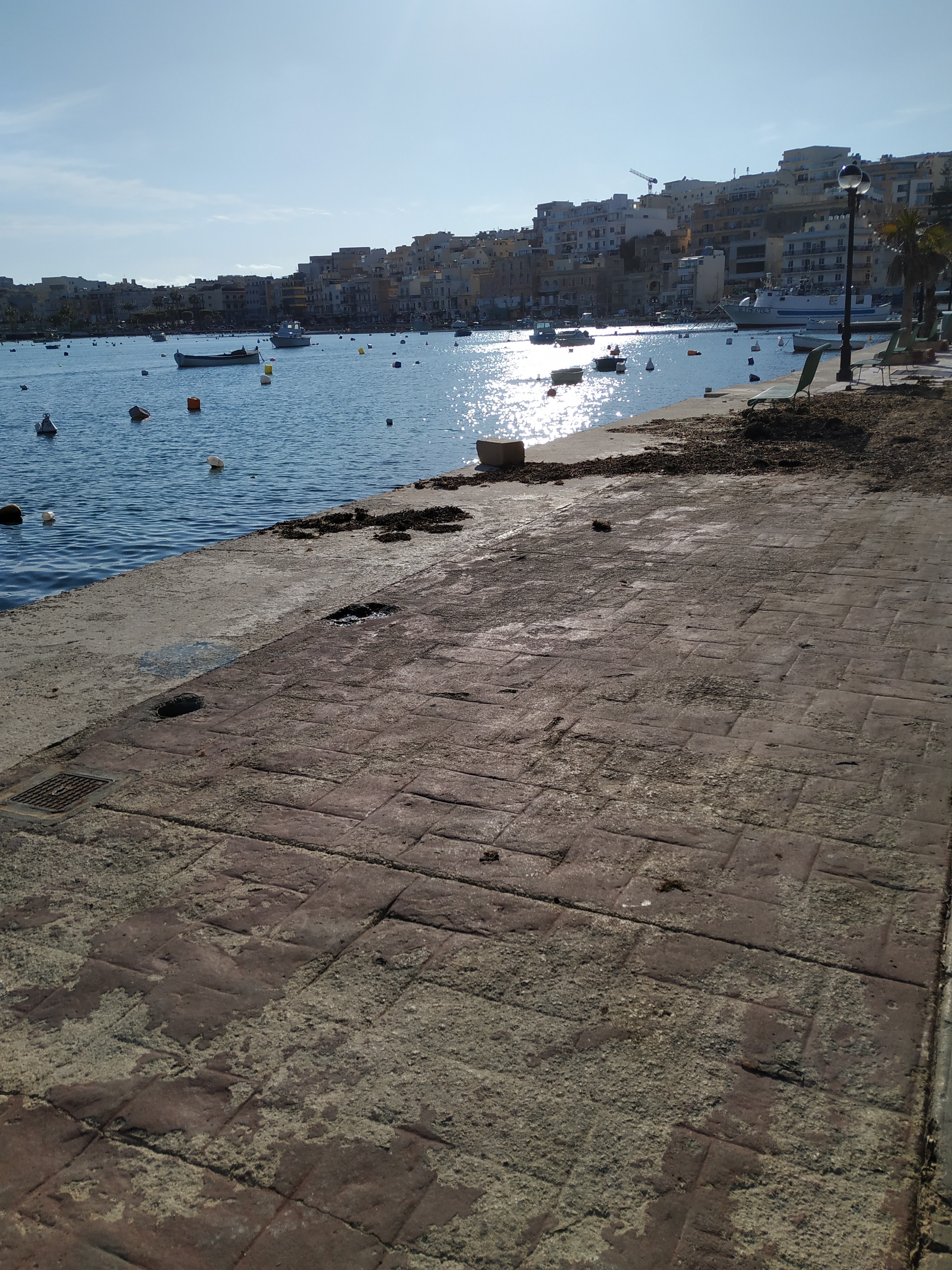
Having lived in Marsascala between 2015 and 2020 and seeing the sleepy-but-bustling former fishing village once again become a target for suffocating over-development, I’ve decided to look back on some of my impressions and memories of the town, partly motivated by simple nostalgia, partly by an urge to help myself understand just why the authorities and the business class so often make it a point to single out Marsascala in their ongoing drive towards uniform devastation. This is the third blog post in an erstwhile series.

So we had a sea view.

Sullied at the edges of your peripheral vision by clumsily placed solar panels, sure, but it was there. It greeted you each morning and provided a balm in the evening during summer – then, in all of the expected ways – and during winter it allowed for a showcase of nature’s fury as the waves crashed in violent foam over the promenade.

It remains the one undeniable perk we both miss very much now that we’ve relocated from Marsascala to Rabat a year ago. No longer being able to wake up and smell the sea, taking in its blue-on-blue hue, can’t be brushed off so easily. You can only be stoic about so much.

Thinking back on this, it’s the Marsascala dawn that really stands out in the memory. The sea view is the sea view, yes, but it really comes into its own in the morning, when it allows you to greet the day with a particular sense of accessible, graspable majesty. You visualise the opposite bay like a slowly-loading act of creation: the sight of the water hits you first, with the promenade and the dotted boats appearing gradually, replotting themselves into the scenery. A wide blue expanse, from eyeline to sublime horizon, would have its meditative perks too, of course.

But there’s something charming in the way the sea is stoppered by the twist of the promenade, at least viewed from our former spot in Zonqor. (One of my smallest – and so, most precious – delights was spotting buses work their way across the promenade road from our terrace. A miniature reminder of a system that somehow, with all its faults, still manages to work. To serve people.)

You realise it all the more when you actually go down and see for yourself – when you experience the promenade as a participant, not just a mere spectator. The slippy-slide of the moss-strewn walk down by what is a de facto boat yard… a brief shot of pure vernacular beauty, sadly interrupted too soon by the parked cars that insist on crowding you before you’re allowed to emerge to the main walk, facing the church.

But for a while, it’s like you’re transported into a scene redolent of the early 20th century: the promise of an effortlessly charming Mediterranean village fulfilled. Old houses fronted by streetlamp-flanked benches, for lovers to share pizza and beer purchased from very close by. Room for families to spread out a formica table and benches for a multi-generational gathering of card games and barbecues. And despite the independent flurry of boats that frame and flank it all, room enough for an old man with a bad leg to dull his pain with diligent exercise – a refreshing dip into the sea, after which he dries himself off seated upright by the wall, before working up the strength to head back home.

Regular sights for me, but morning and evening. But it all goes by in a few seconds: a pocket of fantasy, a near-literal blink of an eye. Because after that, you’re either back to the sea-view blocks by the road, where you’ll get to enjoy the more traditional pleasures of a rocky beach which will – eventually – be joined by the Zonqor fields we fought very hard to retain back in 2015. Or you’re more likely to head about your business in the opposite direction, marching your way to the promenade and its string of shops and restaurants, along with a nail technician and real estate agents’ office (or two. Pretty sure there were at least two).

This is where the true ‘life’ of Marsascala could be said to begin: the trigger of the daily churn of people and business. In the absence of a concentrated square, we get a stretched out one: the promenade serves as a gathering point for people and a stopping point for fruit & veg trucks, at least until it sheds the skin of a village square and becomes the ‘leisure’ promenade expected by convention.

The transition point for this is the small area by the traffic lights which lead to the bus terminus – or more accurately, to the recently-refurbished, multi-generational family restaurant Grabiel – where the barriers to the sea are briefly opened up; a place that serves as a small parking space and which in winter leaves plenty of leeway for flooding – you’re often forced so skip over and otherwise creatively manouevre through large puddles of pooled and brackish sea water.

From there forward, the communal spirit becomes more solitary and leisurely. You grab an ice cream and march forward towards St Thomas Bay and its environs; an area of true sublime beauty very much compatible with tourist postcards. But it also exists in the shadow of a fallen ruin: the old Jerma Palace Hotel, now a crumbling reminder of mismanagement and institutional dithering, but also a pro-active breeding ground for some of the island’s more interesting street art, and the location for many a low-budget music video.

Its neighbour, the St Thomas Tower, taps into a similar vein of neglect and decadence: it’s thankfully no longer a pizzeria, but any historical glory it may boast feels diminished by its flaking exterior, and its proximity to the far more imposing Jerma ruin. Still, both structures are also notable for their cat colonies, often seen crossing indistriminately from one side of the street to the other, making this cat lover’s heart skip a beat each time.

If our walk from Zonqor is undertaken during the evening, this is the point at which we often begin to turn back home. That, or we extend our walk past St Thomas Bay itself – to overlook the beach during magic hour and forgive this island and its people its many shortcomings.

Read previous: Distance Does Not Mean Protection

Distance Does Not Mean Protection | Marsascala Under Attack (Again)

Having lived in Marsascala between 2015 and 2020 and seeing the sleepy-but-bustling former fishing village once again become a target for suffocating over-development, I’ve decided to look back on some of my impressions and memories of the town, partly motivated by simple nostalgia, partly by an urge to help myself understand just why the authorities and the business class so often make it a point to single out Marsascala in their ongoing drive towards uniform devastation. This is the second blog post in this erstwhile series.

*

Marsascala always struck me as one of the few villages or towns in Malta whose borders are actively separated by clear distances.

Most of Malta’s localities exist on parallel and intersecting lines – like the twin cities of Besźel and Ul Qoma in China Mieville’s fantasy-noir novel The City and the City. Plant yourself at any border on the island and you’ll likely find yourself facing or tailing a couple more. Not so with Marsascala.

The road that extends from its closest Southern cousin of Zabbar feels like a proper ‘highway’ between one town, city, village and the next. Neither is it terribly feasible to walk to nearby villages through its other end – a one-hour trek to its more decorated fishing village cousin of Marsaxlokk is certainly beautiful in the right conditions, but impractical in others; opting to walk to the equidistant Zejtun is neither a pretty nor safe proposition.

And trudging through the ‘pedestrian’ highway to Zabbar (and nearby Birgu) would be pointless – it’s a strip of land designed exclusively for cars, and all the ramblers would get out of it would be inhaled fumes.

But this isolation equals neither boredom nor tranquility, much as I sometimes wished that to be the case. Marsascala is ‘bustling’ in various senses of that loaded word. A fishing village turned summer-house location for local families turned expat haven turned half-hearted tourist spot.

A few decent restaurants have popped up in recent years, but the provision of overall services remains on the sketchy side. No need to pine for the mercilessly ‘sleek’ counterparts of Sliema and St Julian’s – which would be uncomfortable for a host of related or vaguely-related reasons – but moving to the more centralised and quieter area of Rabat has quite literally brought home the benefits of the more traditional village structure.

Marsascala, on the other hand, is marked by long stretches and disproportionate distances, only to be stoppered by sprawl on its edges and contours. The long promenade cuts a swathe across Zonqor Point and St Thomas Bay on either end, and both of them are then burdened by apartment blocks – snails carrying a shell of cramped-together dwellings. In between are the shops, restaurants and yes, some villas with ‘unobstructed views’ for those who can afford them.

It’s a mish-mash rearing for change – or rather, for streamlining and ‘completion’ – a completion which in Malta signals only oblivion.

This is why a raggedly hybrid place like Marsascala is so vulnerable to attacks of ‘development’. Its liminal state – between warm summer dwelling and tourist hub, between fishing village and cool hangout – is an affront, an offence.

And its edges must be smoothened into the choking nothingness that Transport Malta, the Planning Authority and – crucially – the status-hungry populace want. Anything that just “sits there” is a waste of time and resources.

The poverty of the Maltese school system – a reheated version of utiliatrian British methods based on rote learning and mechanised exams – means there is no oxygen left to cultivate a sense of enrichment and belonging in leaving things just as they are, and enjoying them as such.

Which is why we are left to suffer under the yoke of public officials such as the Planning Authority’s executive chairperson Martin Saliba, who equate the zombie-brained expansion of ugly urban sprawl with an inevitable drive towards a vaguely-defined “modern era” for Malta.

Distance is what isolates Marsascala, and what makes it vulnerable. You reach it after a long stretch, and you find it to be all alone. You imagine it cupped in the palm of a distracted sea-goddess.

No UNESCO-protected fortifications defend it from attack, alas.

Read more: Resistance & Self-Compassion: The Case of (and for) Marsascala

Resistance & Self-Compassion: The Case of (and for) Marsascala

The seaside village of Marsascala which served as my home for roughly six years up until recently has once again become a beacon of environmental resistance in Malta, after a government-sponsored proposal to choke its bay with a vulgarly gigantic yacht marina has led to a near-unanimous uproar among both activists and locals.

If the root of the complaint were not so depressing, such a united front would have been inspiring to witness. After all, it’s a ripple that follows on from a similar wave or organised dissent back in 2015, when the ‘American University of Malta’ was proposed on the same village’s outskirts.

This was to be a beacon legacy project for disgraced former prime minister Joseph Muscat and his chosen coterie of movers and shakers in the political and business world – a Malta-Jordan collaboration built on virgin land with a pre-packaged, pre-purchased American university syllabus aiming to attract further ‘high net worth’ individuals to spend their money in Malta and Gozo.

That the project is now little more than a shadow of its proposed self stands as something of a feather in the cap of the same environmentally-conscious protestors who took to the streets to fight it tooth and nail.

We should remember this. We often denigrade ourselves for not doing enough, or for doing too little, too late. Or for not accepting that the status quo will carry on in its usual churn regardless, and give into apathy and a sense of futility as a consequence.

But the long view is that while short-term battles may be lost and while, on the environmental front at least, the political and business hegemony may continue to treat us with utter contempt (whose unholy alliance is still not taboo, even after it was a direct contributor to the murder of a journalist), taking a stand still matters.

There’s a lot to scoff at in the current generation’s earnest, somewhat pat ideas on how to make life marginally more tolerable – as was the case for generations past. But I would insist on encouraging everyone involved in this ‘resistance’ to exercise a degree of self-compassion.


Following the concerted uproar, the American University of Malta was set to be split into two campuses – one ostensibly to remain in a ‘reduced’ capacity on Marsascala’s Zonqor Point, the other to occupy an historic colonial building at the harbour town of Bormla. The extension back to Zonqor will only happen if the Bormla campus fills up. This remains an unlikely outcome, given how student count amounted to under 100 by late 2019.

Activists should allow themselves not just self-compassion here, but an enlivening jolt of sadism too. This is a call to laugh at the critically wounded near-corpse of a mortal enemy. To cackle in the face of at least one of these offenders – who cackle at our earnest attempts to counter them nearly 24/7, as more and more obscenities crop up at every corner.
It may not be the most noble emotion to indulge, but we deserve it. If anything, it will give us fuel for the next fight… which will always be around the corner.

*

I’ll be putting out some follow-up posts to this one, in which I’ll finally be dumping some memories and impressions of the town. Don’t expect amusing trivia and historical rigour. But feel free to expect pretty much anything else. I know I am.

Catching A Break… Or Not

We can’t manage to catch a break in Malta, can we? It’s been at least since last November that some kind of mental stability or continuity — the latter being a repeated slogan in the party leadership campaign that was to crown the November madness — was the norm in both public and private life.

I was actually on a break of sorts when that first crisis hit. High on the freshly released fumes of success generated by our being awarded the inaugural Malta Book Council feature film fund for our feature film adaptation of Alex Vella Gera’s Is-Sriep Regghu Saru Velenuzi, I decided to go for an early, modest version of a writerly fantasy and booked a ‘writing retreat’ at the sister island of Gozo in off-season.

It was a no-brainer, at least in theory. I chose to stay at the notoriously quiet village of Gharb, with a pipe-shaft view from my typing window and grossly over-pixelated landscape printouts hanging by the bed. So, no distractions there. The breakfasts were also nice and energising — full English, with a dollop of French sweets and Gozitan cheeselets on the side — and having paid in full for room and board meant that I was internally pressured to get cracking on the reams of research and story development that needed to be done.

Sriep Gozo Process

But the trip also coincided with the arrest of Yorgen Fenech, so I could forget all about isolation and silence, in the broadest sense of the word. How could I resist checking my phone when the political status quo of the island was being dismantled right before our eyes? Not least when the project itself hardly offered a neat cutoff point: my research dealt with political violence and corruption in 1980s Malta, and if anything was to be salvaged from the distraction it was that the resonances between then and now ensured that our film will be laced with an enduring, if unfortunate, relevance.

With the fallout came the protests, and an unprecedented political crisis culminating in the resignation of then prime minister Joseph Muscat and the election of Robert Abela in his stead, with a reshuffled cabinet following suit. As alluded to above, ‘continuity’ was the watchword, and Abela — to the cynical chuckles of many — quickly declared that ‘normality’ has been restored to the island.

The onset of the global covid-19 pandemic makes short work of precisely that kind of rhetoric. We have seen how it’s served to symbolically unseat the likes of Donald Trump, whose bluff and bluster collapses ‘like a flan in a cupboard’ when faced with a threat both invisible and undeniable. Though I would caution against declaring that ‘the Trump presidency is over‘ so categorically — the orange oaf has survived a record amount of scandals — watching him scramble for some political purchase while playing the same old xenophobic tunes is just farcical at this point.

But it’s not just limited to politicians. The sight of suddenly quarantined celebrity actors deciding to make use of their newly housebound condition to splice together a group singalong of John Lennon’s Imagine — “Imagine there’s no people” is hardly the thing you want to hear while a murderous pandemic continues to spread on a murderous rampage of the elderly and otherwise vulnerable — also points to the tone-deaf nature of another privileged class.

The cluelessness of the global rich is hardly news — Best Picture winner Parasite all but rendered it into an archetype, and these elites are actually nice — but a pandemic has away of making it all come out like a particularly eye-grabbing Lovecraftian bas relief.

So yes, we’re still very much not getting a break right now: not from the bone-headed stupidity of the global hegemony, not from the callousness and stupidity of those at the top. But we’re joined in this worldwide, and while the imposition to enforce ‘social distancing’ certainly lends fuel to the fire of certain xenophobic tendencies informed by the idea of the infectious and corrupting nature of otherness, we’re also getting to see limits of our status quo.

A status quo within which, as a self-employed freelance writer, I am likely doomed to remain on the fringes of, for better or worse.

(Here’s the bit where ask anyone who’s reading this to consider making use of my services as a journalist, content writer or scriptwriter during these trying times, as existing clients start to bail and any prospective ones suddenly be).

Perhaps some would call the largely worldwide self-quarantine a break of some sorts, though of course it’s not that, not by a long stretch. But it’s certainly a break in the aggressive sense, a rupture of the old routines we’re now scrambling to become accustomed to, with varying degrees of success, and each in their own way.

I’ll try to keep chasing the resonances. Even if they’re not all pleasant ones. Because in times like these, some kind of internal coherence is what we need more than anything else.


A Nostalgia Trigger From the Grotty Floating Hovel: Slipknot’s We Are Not Your Kind

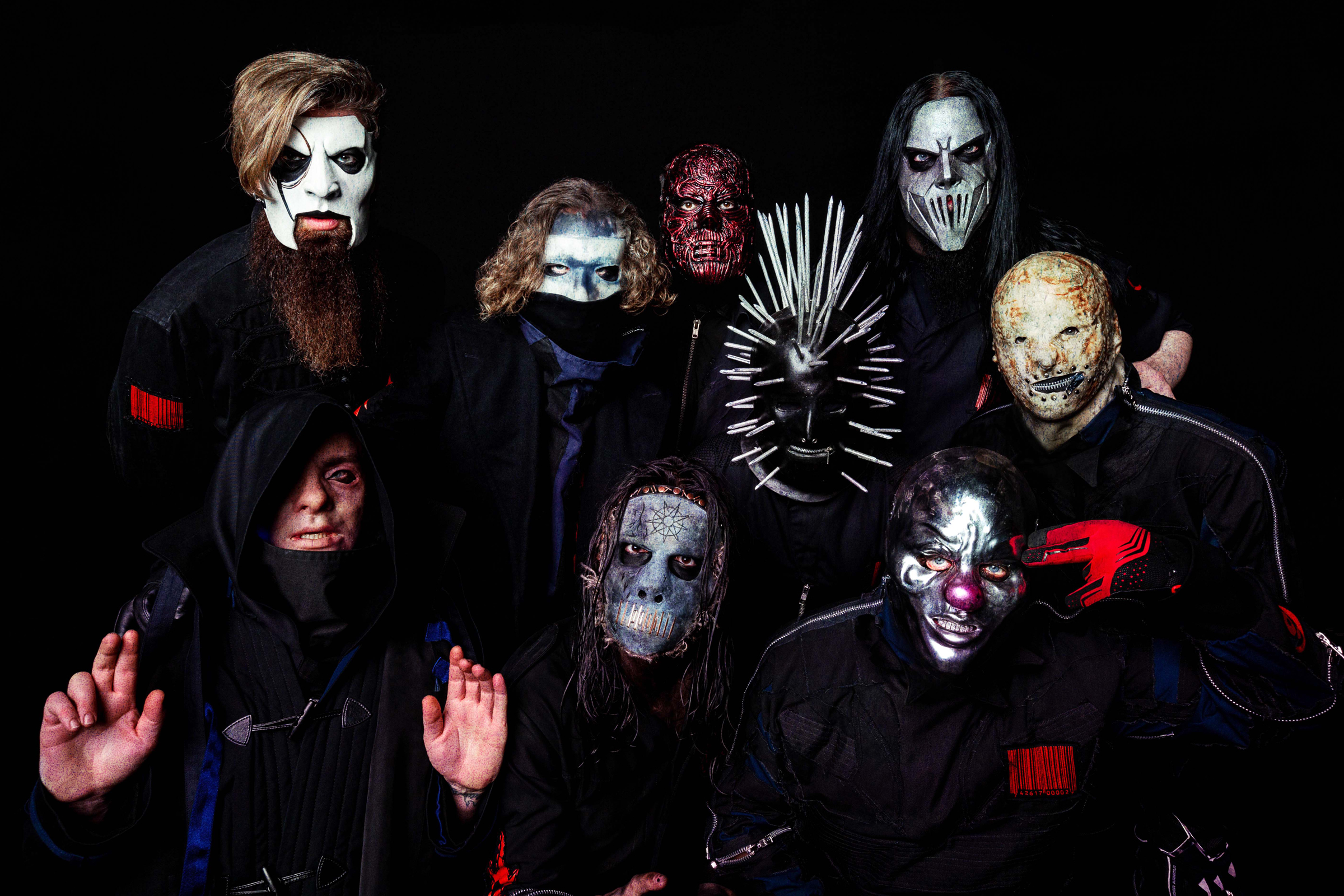
So Slipknot have released a new album and it’s a winner, beating even Ed Sheeran in the charts and delivering a slice of post-nu-metal that satisfies this nostalgic punter on so, so many levels.

But beyond the simple enjoyment of tucking into the fresh material of a band with whom you’ve intermittently come of age, is the refreshingly optimistic realisation that something previously thought irrelevant can be good again; that the adage of ‘has-been’ is something our culture has been getting wrong all these years.

slipknot

Neither is it an entirely alien feeling, either: I’ve personally been very glad to fall in love with The Pale Emperor, another latter-day release by a supposed has-been who was a musical guiding star for me even before Slipknot took over in the late nineties.

I still remember popping in a bootleg cassette of Marilyn Manson’s Mechanical Animals and thrilling to the wash of immersive-yet-subversive sounds; the photocopied wrap-around cover not being cut entirely right, so that the album read ‘Mechanical Anima’ in what felt like an apposite error: the pained screams of a mechanised soul, the ghost in the machine aching to express itself in mournful, trickster anger.

But we’ve seen this elsewhere too. The Cure, by all accounts, knocking it out of the park at Glastonbury (wish I’d been there for that one). Actors we thought washed up at the movies returning to shine on the smaller screen, reaping the benefits of the kind of long-form storytelling afforded by the TV Renaissance to character actors whose creases accommodate stories of nuance and depth.

stranger things

Weaponised nostalgia: Netflix’s Stranger Things

I’m convinced that this isn’t just the Stranger Things impulse: it’s not just about the indulgence in nostalgia for its own sake. For one, this surely the historical time-frames we’re dealing with here are too compressed, too recent to offer the kind of generational time-hop necessitated by the kind of the thing the Stranger Things does?

Granted, twenty years is a sizeable amount of time. It used to be a lifetime, not all that long ago. But just like we’re getting re-assessments of The Matrix and American Beauty (Brian Raftery’s Best. Movie. Year. Ever. offers an excellent analysis of the cinematic mainstream in that low-key magical year of 1999), this is more about taking stock than sinking in the warm bath of cultural nostalgia.

Maybe it has something to do with the way distribution models have changed. Both American Beauty’s Alan Ball and The Matrix’s Wachowski siblings, with varying degrees of success, have managed to find a foothold in the realm of TV. And with MTV no longer being the benchmark of what’s cool and popular, maybe musicians not being beholden to their cycles also serves as an opportunity.

Yes, social media is hardly ever a good thing. It’s too image-obsessed. It’s too fragmented and fickle. Far too easily beholden to manipulating and manipulateable algorithms to ease our minds into believing that our enjoyment of pop culture is not an expression of some folksy universality. Instead, it’s just us bending the knee to our corporate overlords yet again.

And yet, and yet. Being part of an ever-shifting stream means the ‘has-been’ is an obsolete term. When the hegemonic order is dispersed — again, when MTV is no longer the arbiter — age really does become just a number.

With MTV no longer being the benchmark of what’s cool and popular, maybe musicians not being beholden to their cycles also serves as an opportunity

A number, much like Slipknot’s own members styled themselves, at first. Now of course, their masks and costumes have evolved into something eminently Instagrammable, but that’s a rich discussion to be had on another day.

I’m no music critic and I actually can’t claim to have heard Slipknot all that much beyond their blistering sophomore effort Iowa (2001), but there’s certainly something to be said about how We Are Not Your Kind has burrowed its hooks in me pretty deep.

It comes down to that well-calculated blend of the familiar and the new. In this case, experience doesn’t communicate exhaustion, but depth and maturity. Like a friend you haven’t seen for a while returning from an exciting year of adventuring across countries, continents and galaxies, eager to recount their experience over refreshments in safe and comfortable surroundings.

slipknot iowa

The nine Iowans comprising Slipknot’s classic line-up wouldn’t be all that familiar with dingy arcades on Mediterranean beaches, but We Are Not Your Kind’s opener ‘Insert Coin’ certainly evokes that for me: these oil-caked, fry-up-stinking hovels are the kind of places we’d get some shade in while dipping in and out of the sea during those carefree summers.

One of these summers was that of 1999, where we’d scratch together pocket-money to get our hands on the band’s scene-changing, self-titled debut album. In a post-Napster, pre-Spotify world this would be a talisman of contemporary metal soon to be joined by the likes of Soulfly’s ‘Back to the Primitive’ and Fear Factory’s ‘Digimortal’, whose cuts we would still get to enjoy in grotty one-room nightclub venues, now closed, and whose single-row metallic pissoirs I remember with markedly diminished affection.

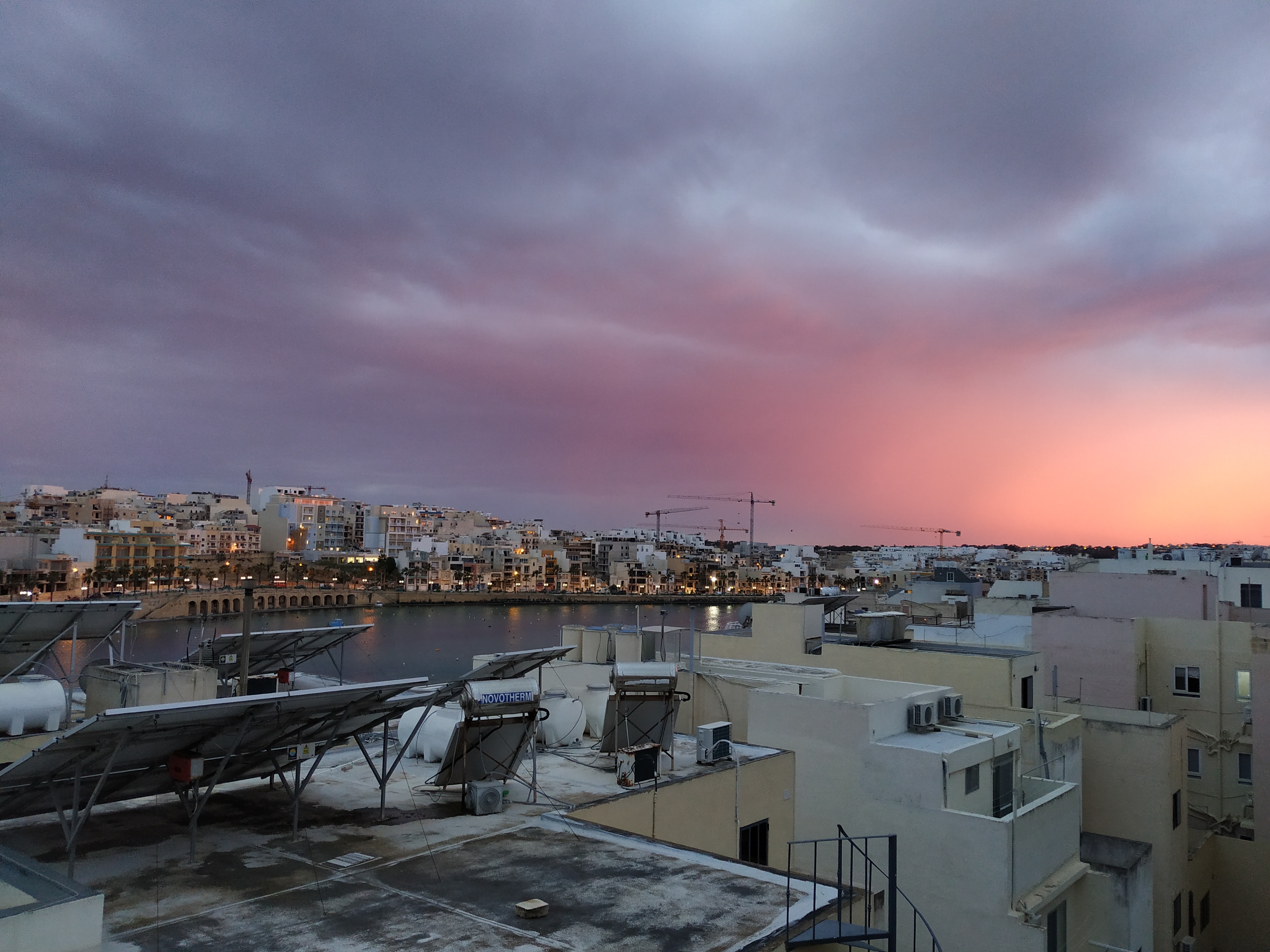
As an overbuilt, overcrowded and overpolluted floating hovel, Malta provides plenty of atmospheric angst of its own

Because while the angst inherent in Slipknot’s repertoire has something of the universal about it, neither should it be all that surprising that the sun-kissed Mediterranean isle I hail from is partial to a bit of metal.

Many of the bands that serve as mainstays of this scene rehearse in badly-lit, terribly under-oxygenated garages located in the depressed industrial town of Marsa and the mushrooming suburb of Birkirkara… as an overbuilt, overcrowded and overpolluted floating hovel, Malta provides plenty of atmospheric angst of its own.

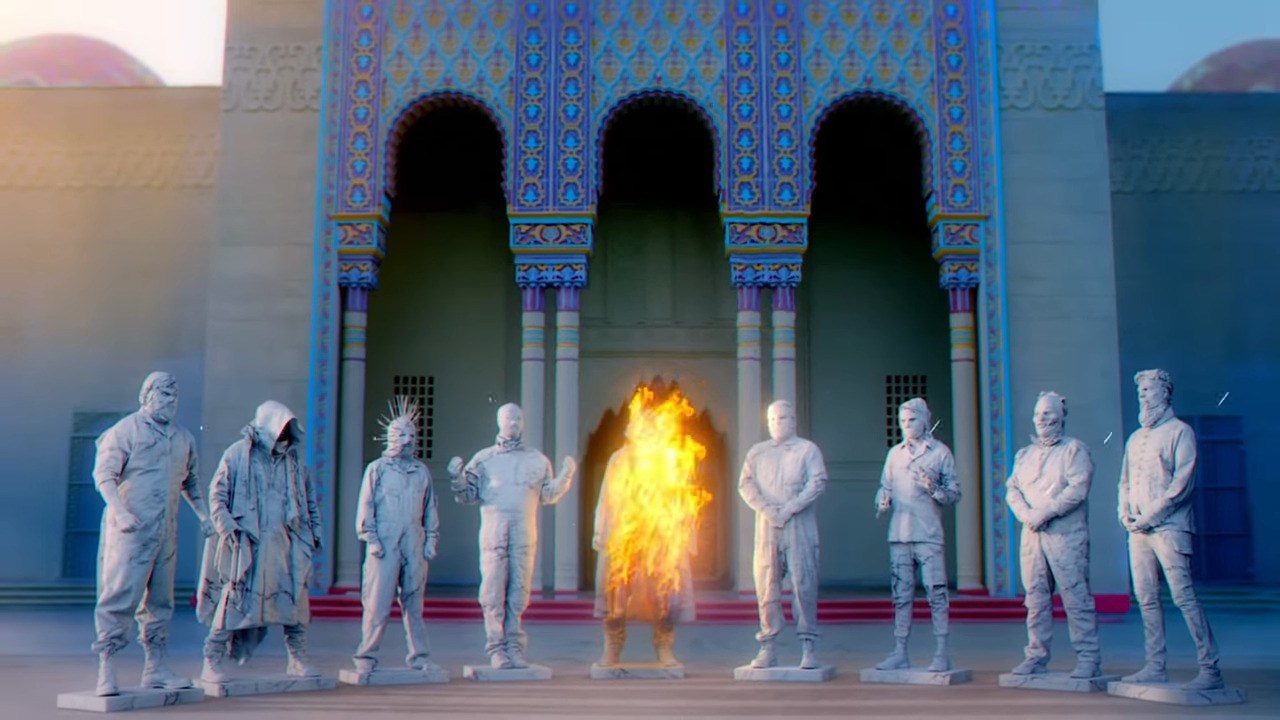
It’s an angst that certainly finds cathartic release in We Are Not Your Kind’s hit single ‘Unsainted’, whose blasphemous undertones speak to Malta’s only-recent de facto liberation from Catholic theocracy while admittedly also existing as tropey metal mainstays. The song is a distillation of just the kind of anthemic perfection that launched Slipknot into the mainstream; boasting a killer chorus limned by jagged but thumping surrounding verses, like an speed-injected Cadbury Creme Egg framed by a Marmite-marinated crown of thorns.

For me, it’s a reminder of the energetic core that’s the true appeal of metal music. The magnetic pull that can’t be denied; that others will find in other genres, but that nothing else really replaces for me even now, when my own tastes have evolved beyond what I’d used to listen to twenty years ago. Yes, I’ll tell myself that I only really listen to the likes of Opeth and Tool anymore, but when songs Korn’s ‘Blind’, or Fear Factory’s ‘Replica’, or Slipknot’s ‘Wait and Bleed’ and indeed ‘Unsainted’ pop back up on the horizon I can’t help but run towards them.

snapshot-1

But neither should we diminish the importance of evolution and maturity; the adding of something new to the mix. The washed-up actor whose career finds a new lease of life on Netflix or HBO should use their hard-won scars and creases to their advantage, not cover them up. Otherwise, that’s how we end up in Stranger Things territory (please accept by continued and non-flattering references to this show as mere shorthand, I actually enjoy it quite a bit).

Thankfully, We Are Not Your Kind does manage to achieve that elusive blend of the old and new. It distills Slipknot back into their essence, but like truly seasoned artists, they still manage to slide in a reminder that they’re aging gracefully.

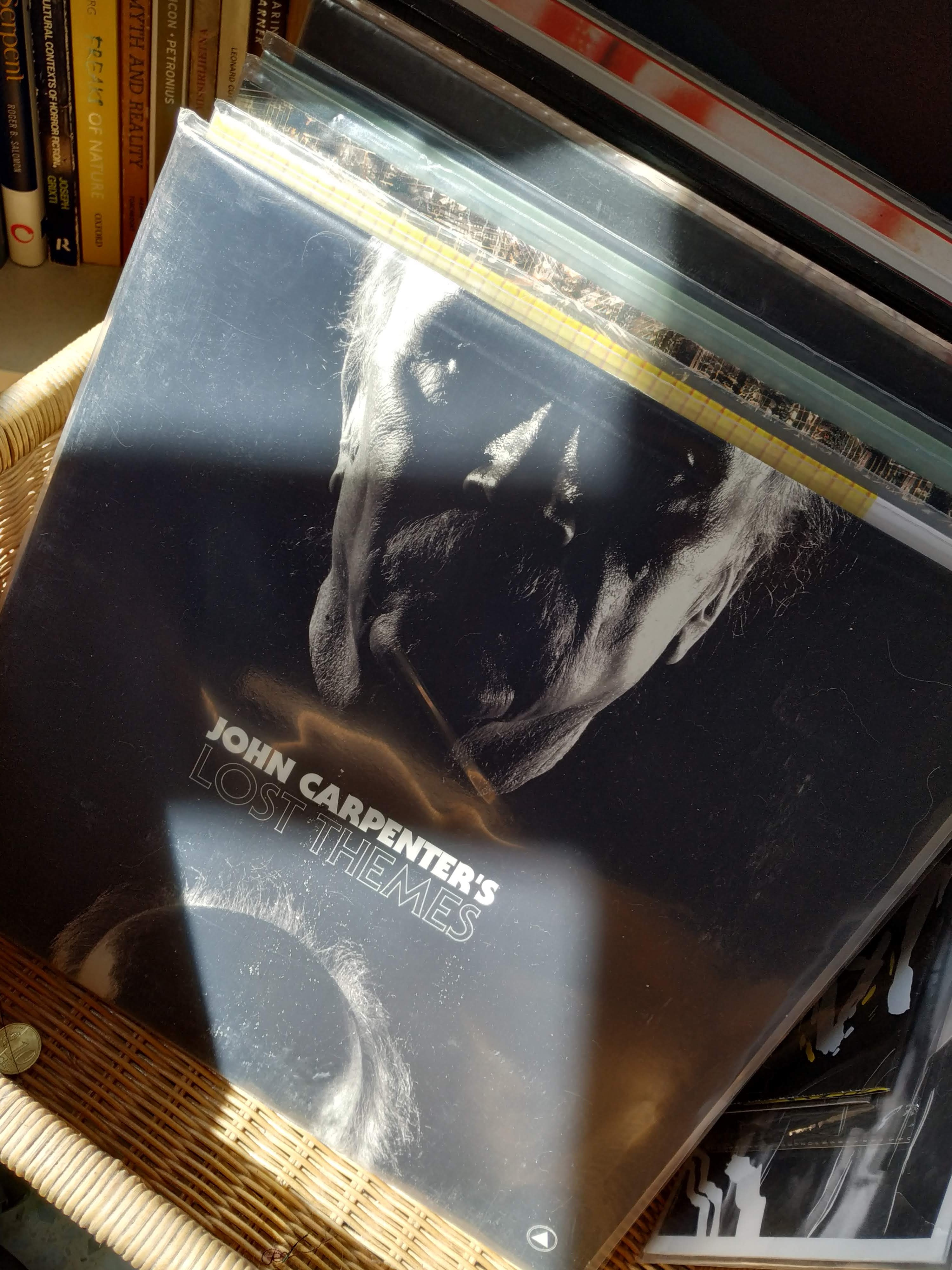
‘Spiders’ is a kooky Mike Patton-like number that still manages to be true to the ‘Knot’s Halloween-horror roots, while ‘My Pain’ cranks up both the atmospherics and melancholy. But this isn’t a mellowing out so much as a deepening of the musical landscape they’ve created. More than anything, Slipknot feel even more ‘cinematic’ now, wedded to their inspired imagery in more ways than one. More John Carpenter than Cannibal Corpse, and all the better for it.

IMG_20190412_112552

And perhaps this is why We Are Not Your Kind resonates with me so much right at this moment. While it’s hard to resist the nostalgia and romance that their debut evokes for me (see above), and I’m in a place where I’d rather fight for the hovel that is Malta to become a little bit less so; to salvage what is left of its green spaces, and for local bands to be able to practice in more than just grotty garages.

More than anything, though, the sonic architecture makes for a perfect writing accompanyment. It pummels at me to write and create works with uncompromising verve and energy, while offering that break of atmospheric concentration that’s also necessary to the process.

In short, it is a perfect soundscape of horror, which can take many forms, and whose protean variety I am continuing to find utterly thrilling.

Plus, “Horror will never die” says John Carpenter himself… another supposed has-been whose musical career offers a dignified middle-finger to that very notion.