Over the past couple of months, I’ve been reviewing the new Word Horde anthology Eternal Frankenstein, edited by Ross E. Lockhart. As was the case with my read-a-thon of Swords v Cthulhu, I tackled the anthology story by story, and my reviewing method was be peppered with the cultural associations that each of these stories inspire. These were presented with no excuse, apology or editorial justification. You can find the complete linkstorm to all of the reviews just below. Enjoy!
Over the past few weeks, I’ve been reviewing the new Word Horde anthology Eternal Frankenstein, edited by Ross E. Lockhart. As was the case with my read-a-thon of Swords v Cthulhu, I tackled the anthology story by story, and my reviewing method was be peppered with the cultural associations that each of these stories inspire. These were presented with no excuse, apology or editorial justification. Now, please enjoy the final review of the series.
Mary Shelley’s Body by David Templeton
And now, at the very end of Lockhart’s anthology, we get a focus on the body — the ultimate body as far as we’re concerned: that of Mary Shelley, the originator of all of the things we’ve been discussing so far, and one of the most fecund imaginations of the Romantic and/or Gothic high point of literature — an unexpected force to be reckoned with considering her young age when she composed her key work, and her compromised — some would say relentlessly tragic — private life.
David Templeton’s novella — it is in fact the longest piece in Eternal Frankenstein — makes for a fitting conclusion to this varied and comprehensive tribute to the legacy of Shelley’s most famous work, by forcing a fictionalised version of the beleaguered author to confront her many demons, seemingly as a final goodbye before parting the world for good.
In turn, the story also forces us, the readers, to come face-to-face with Frankenstein’s many themes and emotional implications; some of which weigh on the very real side of disturbing: not just in their Gothic power to enthrall and terrify by dint of grotesque detail and atmosphere, but also because of the tortured psychological place they come from, the biographical backbone of which Templeton makes it a point to unpeel, explore and embroider further to craft his novella.
Mary Shelley (1797-1851)
The setting is as baldly Gothic as they come, though, with Shelley’s disembodied form rising from her Bournemouth grave to settle a score initially mysterious to her. What follows is something of a rambling confessional whose shape, like the Creature Shelley constantly makes reference to in various ways, could have used some trimming and re-arrangement.
While the concept is a worthwhile one — and, again, a perfect note to end the anthology on — that does come with a real emotional pay-off in the end, Templeton’s decision to go over some of the key moments of Shelley’s life, as well as key passages of Frankenstein, will come across as a tad tiresome to those of us familiar with the scenes and passages in question.
What’s even more problematic is that Templeton doesn’t really do all that much to upend expectations, either: the obvious connection between the death of Mary’s mother while giving birth to her is made yet again, while Mary waxes lyrical about her Creature while condemning Victor Frankenstein as a coward at best, a clueless, callous bastard at worst.
But the digressive nature of it all is part of the point — this is a kind of mental Groundhog Day for our poor Mary, and if nothing else, Templeton demonstrates a key understanding of what makes Shelley’s work tick. And neither would it be fair to say that he succumbs entirely to boilerplate interpretations of the text; Victor Frankenstein’s failure is eventually revealed to be Mary’s own, in connection with the death of her first unborn child.
Ultimately, here we have a story about bodies — the bodies we encounter and the body that we inhabit, and all of the complexity that that implies once we’re forced to stop taking them for granted. This complexity falls down on Frankenstein’s Creature like a ton of bricks since he is first brought into the world, and so it serves to offset our own lives at any given moment. And, finding a suitably tortured test subject in Mary Shelley, Templeton uses the opportunity to zone in on these moments at various points in time: from bodies freshly born and vulnerable, to those sickly and decaying… and everything in between.
The body is all we have. And at some point, we were all Frankenstein’s Creature. At some point, we will BE Frankenstein’s Creature yet again. This, above all, is why Shelley’s legacy endures, and why it’s likely to help create more anthologies like Eternal Frankenstein in the years to come.
In the coming weeks, I will be reviewing the new Word Horde anthology Eternal Frankenstein, edited by Ross E. Lockhart. As was the case with my read-a-thon of Swords v Cthulhu, I will be tackling the anthology story by story, and my reviewing method will be peppered with the cultural associations that each of these stories inspire. These will be presented with no excuse, apology or editorial justification.
Postpartum by Betty Rocksteady
And so, Ross E. Lockhart impresses me with his sharp editorial skills once again. Just last review, I was speaking about how we in fact don’t speak about Frankenstein as a book about artistic creation all that often, spurred on by what seemed to be a subtle treatment of that very same strand in Michael Griffin’s novelette ‘The Human Alchemy’.
But turn the pages over to the next story on the TOC — Betty Rocksteady’s ‘Postpartum’ — and bang! there it is. Nothing subtle about it: Rocksteady decides to not only place that metaphor at the front and centre, but to make it the main motivating engine of her contribution to Lockhart’s anthology.
However, the title also suggests a more pained and universal fact of human life, and one that will also remind us of another key element in the fabric of Mary Shelley’s original text. Rocksteady’s protagonist is a reluctant teenage mother who has lost her sweetheart soon after their baby — the poor, unfairly derided Timmy — is born, and her first-person narration does very little to endear us to her plight beyond the fundamental misery, and recent tragedy, that underlies her existence.
Still from Hannibal, ‘Trou Normand’ (Season 1, Episode 9)
Rocksteady uses this to create suspense — the central artistic creation could easily be something out of NBC’s Hannibal — but the idea of a mother rejecting her child of course also recalls Victor Frankenstein’s heart-breaking (and instant) rejection of his own Creature.
But where Victor Frankenstein is all neurotic self-justification in his own version of events — really, it reaches Humbert Humbert like proportions at times — Rocksteady’s teenage narrator has no such qualms, coming across as bratty at best and downright spiteful at worst. This only increases the aforementioned suspense, because in that mental state, our otherwise powerless (psychically and economically) protagonist gains an unsettling degree of amoral freedom.
Rocksteady’s story is at its most affecting when the emotional satisfaction of creating art is being detailed: the only real relief that our narrator gets, and one that his sanctioned by her doting mother, who knows full well that art is her only real method of release. The trouble is that the raw matter used in the act of creation preclude the essential beauty of the idea, much like Victor Frankenstein’s ambitions to create life ex nihilo lose their luster when confronted with the groaning hodge-podge Creature springing into life and demanding to be recognised and loved.
A taboo-prodding tale with a shocking ending that’s fully earned.
In the coming weeks, I will be reviewing the new Word Horde anthology Eternal Frankenstein, edited by Ross E. Lockhart. As was the case with my read-a-thon of Swords v Cthulhu, I will be tackling the anthology story by story, and my reviewing method will be peppered with the cultural associations that each of these stories inspire. These will be presented with no excuse, apology or editorial justification.
Frankenstein Triptych by Edward Morris
One of the great things about intertexuality is that it is the literary-cultural equivalent of friends bonding over shared memories; only instead of real-world happenings you’re bonding over books, music, visual art or films.
Of course, an anthology like Eternal Frankenstein practically runs on this impulse: intertextuality is its engine, and in this case it’s a particularly well-oiled one because the authors comprising it have — as far as I can tell this deep into the read-a-thon — taken on the challenge posed by Lockhart’s anthology with a canny understanding that simple pastiche (perhaps one of the ‘lower’ forms of intertextuality in practice) will not be tolerated.
But there’s fun to be had in pastiche too, and this is not lost on Edward Morris, who deliberately presents three science fictional micro-tales as his contribution to the anthology. But the pastiches here are not direct piggybacks on Shelley’s original novel, and instead take an inspired swerve into varied, forking directions.
And in the case of the first segment of this mini-anthology, ‘Dolly’, we’re not really talking about pastiche at all so much a formally interesting take on the Artificial Intelligence sub-genre. In a thread that will continue throughout Morris’ entire piece, we’re thrown into a close-third-person focus giving us a window into an unconventional perspective; in fact, it’s not even that of a ‘person’ — a particularly sophisticated doll experiencing the pangs of an existential crisis in the first instance, a mecha-warrior of sorts (we think) in the second segment, GRUNT.
Unreal cities: Morris dedicates the final segment of his piece to HR Giger
The link to Frankenstein is tangential in one sense, but very much on-point in another. In his maddened collage — which I imagine to have been a blast to write, really — Morris taps into Shelley’s essential idea of imagining what a Creature not conceived through natural means would think about, and even feel, as it tries to make sense of the world it’s been thrust into.
GRUNT is particularly inspired on this front, and the random perceptions evidenced by this poor military cog — as he/she/it witnesses the eradication of its comrades — appear confusing but in fact accumulate to paint a vivid piece that resembles poetry more than prose. It brought to mind the powerful and unique pen of Joe Pulver and, lo and behold, as the segment concludes I see that Morris in fact dedicates it to Pulver, among others.
The final segment, ‘Wir Atomkinder’ slots into more conventional formal shape but, being the confessional of a Nazi Mad Scientist that’s dedicated to the memory of HR Giger, ‘more conventional’ in this case certainly does not translate into ‘more mundane’.
Stitching together his flash fiction narratives, Morris reminds us that there’s more to the legacy of Frankenstein than scientific hubris and the dour reminder of humanity’s indifference. It’s also a story of creation — for better or for worse — and the confused by animating force on which it runs.
In the coming weeks, I will be reviewing the new Word Horde anthology Eternal Frankenstein, edited by Ross E. Lockhart. As was the case with my read-a-thon of Swords v Cthulhu, I will be tackling the anthology story by story, and my reviewing method will be peppered with the cultural associations that each of these stories inspire. These will be presented with no excuse, apology or editorial justification.
Orchids by the Sea by Rios de la Luz
We can all pretty much agree that on one level — a significant one — Mary Shelley’s Frankenstein is a warning against scientific hubris: don’t meddle with nature, because God will punish you for encroaching on His territory. It’s to the novel’s credit that this inherently conservative thread did not sour the entire weave of the book. Instead, it’s just one animating neurosis amidst a whole army of them; as any novel penned by a preternaturally intelligent 19-year-old with a turbulent family background would be, I guess.
But in Rios de la Luz’s brief contribution to Eternal Frankenstein, the binary of Victor Frankenstein vs God is turned on its head, with Luz’s Frankenstein stand-in being presented as a Christian fanatic who believes that God himself is compelling him to breathe life into new people after stitching them into shape from the body parts of others.
The thing is, Luz’s Frankenstein — he’s never referred to by name — doesn’t believe he is “playing God” but that his victims-cum-subjects are: like the suicidal female whose brain he scoops out of the river and puts into a deliberately asexual body:
“His creation was not to have genitalia or anything resembling breasts. His creation needed no means of procreation. His creation would not be a born sinner.”
If nothing else, this shows up all of the possible dangers of any extreme position or behaviour: one extreme ends up resembling its cousin on the opposite spectrum pretty quick. So the original Frankenstein’s deep-seated concerns about the creature possibly procreating and creating more monsters of its ilk is here transferred into an urge to control sexual desire and its after-effects.
Both Shelley’s and Luz’s Frankenstein’s are men who create life only to turn away from what makes it vital in the first place: the imperfection of living beings (as made manifest by the Creature’s superficial ugliness and his shambling attempts at mimicking human life) and the effort you need to put in first before you can reap the psychological benefits of love — an effort and a degree of responsibility that Frankenstein is never willing to invest.
Thankfully — though no less tragically for it — the focus then shifts to the ‘creation’ herself, who adamantly remains a “she” despite her newfound master’s best efforts, and who escapes the creepy experimental enclosure — more bona fide Gothic than anything in Shelley’s landmark novel — to try and experience the world outside.
Her failure to find any solace is delivered with inevitability and pathos that’s far removed from the Strum und Drang of the pitchfork wielding hordes we see in more conventional representations of the Frankenstein story. The world is merciless, yes, but this is made even worse by the fact that this callousness isn’t a deliberate, calculating move made by a select few.
Instead, and like the bullying kids who thoughtlessly drive the creation to her ultimate fate in Luz’s story, it’s a casual fact embedded in us all.
We often forget how casual life is, and how lonely most of us are. We often forget to tread with caution, until it’s too late.
In the coming weeks, I will be reviewing the new Word Horde anthology Eternal Frankenstein, edited by Ross E. Lockhart. As was the case with my read-a-thon of Swords v Cthulhu, I will be tackling the anthology story by story, and my reviewing method will be peppered with the cultural associations that each of these stories inspire. These will be presented with no excuse, apology or editorial justification.
Sewn Into Her Fingers by Autumn Christian
We’ve commented on Victor Frankenstein’s neurotic bent before; how his lack of any emotional control and steadfast denial to confront his creation and its after-effects is what propels the drama of Mary Shelley’s original novel towards its tragic conclusion.
With her contribution to Eternal Frankenstein, Autumn Christian side-steps this crucial element of Frankenstein’s character to create a story that’s by turns chilling and deeply affecting.
Told from the perspective of her Victor Frankenstein stand-in, Christian’s story is a clinical tale of a deepening obsession whose (clinical) form matches its (clinical) subject.
The story’s opening lines have him frankly confess to breathing life into the creature — a female, this time — out of pure boredom: as an extension of his day-job skill set and to be able to work on something beyond office hours. This could have been played for (dark) laughs but is instead ‘played’ for nothing at all, as we soon realise that such a flippant approach towards life is what informs our protagonist’s MO.
Bros before bots: Ex Machina
Siobhan Carroll’s story gave us Victor Frankenstein as the Marquis De Sade; doing away with the original Frankenstein’s skewed moral panic and putting sheer sadism in its place. Here the re-imagining is more muted but no less powerful for it. Christian’s protagonist isn’t a sadist, but he’s certainly missing a couple of empathy cogs. At least at the beginning of the story, what we see is the logic of the abuser being laid out to us with no frills and in no uncertain terms.
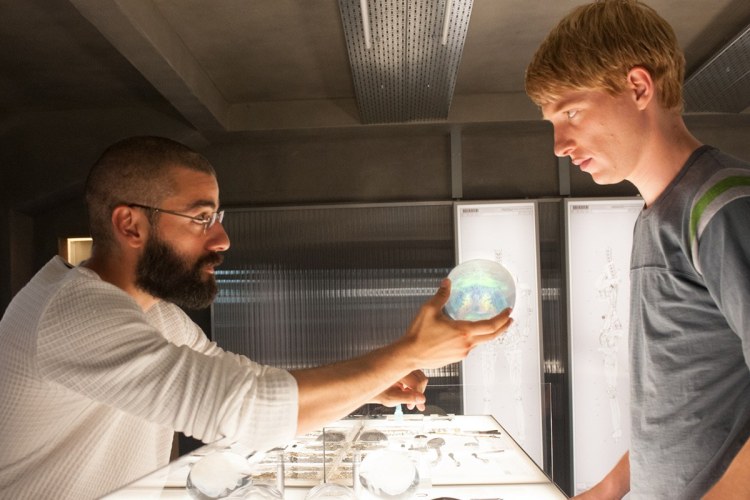
But then, something strange and wonderful happens. In another direct contrast to Shelley’s body-snatching, body-collaging man of science, our protagonist learns to embrace the creature. In a strange way — but again, also in a way that swerves away from the obvious trajectory of doomed and/or abusive scientists — the narrator’s thought process reminded me of the tiptoeing around the AI creation that we see in Ex Machina — one of my favourite movies of the past couple of years.
Unpeeling the truth: Alicia Vikander as Ava in Ex Machina (2015)
Like Nathan (Oscar Isaac) and Caleb (Domnhall Gleeson) in that very 21st century take on the nub of Shelley’s text, the protagonist of Christian’s story takes time to consider the various aspects and potential of what he’s just created. But whereas Ex Machina’s Ava (Alicia Vikander) reveals herself to be something of a femme fatale by the end, Christian’s creature demands to be treated as an equal.
The protagonist’s hedged acceptance of this demand is what pushes the story into truly original territory. And, helped along by the clear-eyed, clinical style — after all, a logical choice when a scientist is telling the tale — the story makes for a disturbing but satisfying arc.
An unsettling tale that’s also strangely uplifting.
T.E. Grau’s debut collection The Nameless Dark is a powder keg of imagination and potential. While the rag-tag gathering of stories sometimes slides too frequently into the unhallowed and by now well-trod annals of contemporary Lovecraftiana – a testament to it being made up of various magazine and anthology contributions over the years – the writer’s voice has a rich, fresh appeal.
Mining a vein opened by the likes of Clive Barker and more recently stretched further by the pained and earthy tales of Nathan Ballingrud – who introduces Grau’s collection, confirming that he’s a writer with a baton to pass – Grau regales readers with stories that have clear horror hooks but that don’t skimp on atmosphere or psychological exposition.
And as with the abovementioned precursors and influences, a keen handling of dread is another key wrinkle in the work, making for an unsettling but immersive experience.
One of my own favourite stories from the collection would have to be ‘Return of the Prodigy’, which I had originally encountered in the Cthulhu Ftaghn! anthology from Word Horde.
Detailing a late honeymoon in a Pacific island gone wrong, the story makes full use of its exotic setting to both seduce and unsettle the reader, while also letting in yet another trademark of the author’s work: a satirical streak; the targets in this case being the dull and bigoted American middle class. The undeniable pleasure of schadenfreude looms over the story – you know these unpleasant protagonists are in for an unpleasant time, which adds a giddy excitement to the terror.
Neither is our protagonist in ‘The Screamer’ all that sympathetic and relateable – a corporate cog with very little love for his fellow man and woman beyond what he can get from them, Boyd gains a strange kind of dignity in his doomed trajectory as he follows the titular ‘scream’ that appears to infect his workplace with a siren-like call.
The regression into a submerged world of horror bubbling right under the urban sprawl is a common theme for Grau and his fellow peddlers of modern horror, and an atavistic charge – an escape from the mundane into a world of destructive bliss – is taken to its logical conclusion here.
More traditional thrills are to be found in ‘Beer and Worms’ – a brief but hard-hitting chiller consisting of nothing more except for a conversation between two friends out fishing, which by the end takes a truly sinister turn without our characters having to lift a finger to influence this very sudden and very real shift in the mood.
It’s a testament to Grau’s ability to wring horror out of any situation, which is made all the more seductive and poignant by his command of the language.
In fact, Grau’s emphatically non-minimalist style holds him in good stead throughout, and on this point he’s very much in line with Ballingrud’s approach to the genre. It’s not so much about ‘sweetening the pill’ of the horror with beautiful language. If anything, it’s rather the opposite: the language immerses you into the tale, and Grau is also careful to add texture and nuance to his characters – making the hammer fall all the harder when it does.
T.E. Grau
But the writing is also, quite simply, a pleasure to savour, and notable passages can be picked more or less at random throughout the collection. Here’s one example from ‘White Feather’ – sins of the father horror on the high seas that takes its sweet time to establish a rich historical narrative before kicking into pulpy gear:
‘Chilton held the glass to his nose, working through the alcohol and molasses down to the subtle perfume of Newtown Pippins before they were picked, smashed, and ordered to rot. Back when they first emerged as springtime buds from a lifeless branch, so full of promise. This was the aroma of his home, of a particular wind and soil that knew him from birth and yet held no judgement. He wished he were a boy again, before his father lost his leg and his mother her will, before the responsibilities of adult life solidified a legacy that was as permanent as history written by the bloody victorious. Before his last raid on Nova Scotia’.
Sometimes it does dip dangerously into style-over-substance territory, as happens with the undeniably fun but largely cosmetic ‘The Truffle Pig’ – another story written for a Word Horde anthology, this time from Tales of Jack the Ripper – which envisages the world’s first serial killer as a member of a long-standing cadre of murderers who work in what they believe to be a noble tradition.
While the language and mood is certainly on point as ever, there’s not much to the story beyond this high-concept twist. A similar problem plagues ‘Love Songs from the Hydrogen Jukebox’, in which Grau very convincingly transports us back to the golden years of the Beat Generation milieu, only to end his psychedelic journey with a Lovecraftian add-on that fans of the weird fiction genre (and the looming behemoth that is Lovecraft) will have experienced all too frequently.
But that’s not to say that riffing on Lovecraft automatically means reverting to formula, nor that Grau isn’t capable of adding something fresh to the mix.
Clear evidence of this can be found in the strongest entry in the collection, ‘Tubby’s Big Swim’. A tour de force in every sense of the word, the story does appear to have a coveted octopus at its centre, though the resemblance to Cthulhu is kept to a minimum, and Grau waits until the end to deploy it to full effect.
Instead, the bulk of the narrative concentrates on the journey of a young boy burdened with a stereotypically shitty home life, who nonetheless remains hopeful that his pursuit of the octopus in question will bring happiness… if not transcendence. The glorious kicker of Grau’s tale is that it’s largely told with a corresponding sense of wide-eyed wonder shared by Alden, our protagonist.
It’s a modern picaresque story with a Dickensian dynamic at its core, and as the beleaguered but resilient young man winds his way through vibrant, filthy streets and suspect alleyways – climaxing in a visit to an abandoned zoo – Grau paints a vivid, memorable tapestry.
The Nameless Dark is a rich and varied collection that taps into the best strands of contemporary horror fiction.
It’s a wonderful bonus that Alistair Rennie‘s debut novel BleakWarrior has its own soundtrack, composed by the author himself, which you should definitely check out and listen to while you leaf through his gloriously crafted sledgehammer of a book. But for the purposes of this review, I propose the following piece of music to set the tone. I trust it will soon become clear why this selection was made.
New Weird or weird-weird?
There is an argument to be made for Alistair Rennie’s work slotting in rather neatly into the improvised sub-genre labelled ‘The New Weird’. After all his short story, ‘The Gutter Sees The Light That Never Shines’ was the only original entry in Ann and Jeff VanderMeer’s anthology The New Weird (2008), where it was presented as a sort of laboratory experiment of what’s to come — if anything is to come at all — for the genre under discussion, celebration and dissection.
Well, reams could perhaps be written about the ins-and-outs of the New Weird itself (for my part, I wrote something of a middling MA dissertation on the subject) but thankfully, Rennie went ahead and developed the germ of what lay in the original short story into a head-bangingly bizarre novel, BleakWarrior, released earlier this year from Blood Bound Books.
BleakWarrior by Alistair Rennie (Blood Bound Books, 2016). Cover illustration by Maxwell John Hudetz
BleakWarrior may resemble a superhero name — and he may have the abilities that vaguely match some superheroes — but the protagonist who wields it in Rennie’s novel has no alter ego. Neither do his erstwhile colleagues who populate the rather high-strung planet Rennie has concocted. In fact they boast names like Automanic, Gutter and The Light That Never Shines.
And their main mission in life is to obliterate each other with no rhyme or reason. Who needs alter egos, who needs a private life and relaxation time when endowed with such a single-minded mission? (That’s for the ‘Linear’ beings, not the ‘Meta-Warriors’ we’re concerned with right here.)
I’ll get to the main plot motor in a moment, but I’d like to dwell on this for second, because it’s important.
What Rennie captures so well is the hedonistic and atavistic thrill of having just such a brutal sense of purpose in life. The knife’s edge walk between creation and destruction — more to the point, between sex and violence — is what Rennie appears to be insatiably obsessed with. The inexorable churn of brutality that these characters engage in feels both inevitable and — operating within the hellish logic that Rennie sets up — strangely beautiful.
In lesser hands this would have felt like an adolescent indulgence: an exercise in attention-grabbing antics to an audience of lobotomised gore-hounds and their scandalised elders.
But then, the kicker.
You see, BleakWarrior suddenly grows tired of killing people without knowing the reason why. So begins his quest; which will of course be punctuated by blood and thunder — and blood and guts — while also being placed in direct parallel to that of The Sisters of No Mercy (their name a hint at yet another aesthetic fetish that Rennie very much gives vent to in the novel’s make-up): two expert warriors slashing and fucking their way through an organ-retrieving mission in the hopes of revitalising their dearly-departed ‘Middle Sister’.
This allows Rennie to have the cake and eat it too — an often-frustrated adolescent indulgence now given full vent. By placing a philosophical conundrum at the very centre of this monstrous clusterfuck, Rennie asks you to pay attention, all the while bending your mind with the very nature of this juxtaposition. Rennie has written eloquently on what makes the Sword & Sorcery genre so special, and BleakWarrior’s amoral world of violent supermen and women out for nothing but more violence certainly evokes that genre to some degree.
But the kicker kicks it all into crazy town. Since this is a book better experienced than explained, here’s a few extracts to give you an idea of what I’m talking about:
Whorefrost’s cock is long and thin with a remarkably bulbous head that makes it look like a bauble on the end of a stick. His testicles are disproportionately large and, like the rest of his body, hairless. More to the point, his egg-sac is teeming with semen that has an unusual potency: it is deadly cold and, to this extent, biologically devastating.
Humidity hung to the Fetid Mountains like a lubricant. The slopes were thick with an organic welter of sprawling variations of fecundity and decay. There was an aura of prototypical distinction between emergent species that took the principle of diversification to extremes that hardly seemed worth the bother.
…But what was most alluring in the appeal of the girl whose name they didn’t know was the potency of her vaginal juices that spilled over the lips of The Sisters of No Mercy with a sublime and syrupy thickness that seemed to fill their brains with infusions of erotic wonder. The taste had a weighty tang that produced an effect of mild invigoration mixed with a prolonged sense of internal melting, like being absorbed by the outer shades of a celestial aurora.
Notice how the perfectly sculpted — and it must be said, somewhat arch and archaic — prose serves as a jolting cymbal crash when combined with the XXX-rated stuff under consideration? Of course, it’s also funny, which feature Rennie exploits to full effect.
Yeah. This shit will fuck you up.
Hail, Dionysus
BleakWarrior is literature to the Nth degree. It’s a work by someone who is hopelessly infatuated with the ‘lower’ genres but whose love and enthusiasm for them is filtered through a mature intelligence and a respect for and knowledge of the art of fiction. The obvious clue of the ‘Meta’-Warriors gives that detached postmodern element to all the craziness.
In fact, this is a novel that gets its animating friction from the simple fact that it’s at constant war with itself. It’s a novel chock-a-block with one sensationalist set piece after another — a Jacobean display of torture porn Grand Guignol that will serve as a benchmark for prose brutality for years to come — but that’s delivered through a strong narratorial voice with no interest in simply remaining in the gutter (with the Gutter). Instead Rennie wrings the experience for all that it’s worth, making sure to play with ideas as well as bodies.
But gods damn it, what will remain etched in your brain is the images. The voice will only help you take them seriously as part of an interesting new project in genre writing. One that will hopefully spawn a plethora of imitators — to say nothing of more, more, more from Rennie himself, hopefully — which will grow over the literary terrain like rancid but glorious fungus.
For BleakWarrior is a a child of Dionysus filtered through the voice of Apollo… until you realise that it’s not Apollo at all, but a trickster god the likes of which we haven’t seen before.





 Soft Disturbances